
Is Mental Health Care Changing Fast Enough
PodcastDX3 Maalis

Is Mental Health Care Changing Fast Enough

This week we discuss the current status of Mental Health Care. Mental health care is changing, but most experts argue it is not changing fast enough relative to the need, especially on access, equity, and workforce.

Where change is too slow
  • Unmet need is huge. In the U.S., millions with a diagnosable condition still receive no treatment each year; a recent national report notes that many adults with mental illness remain uninsured or unable to access care.​

  • Global workforce shortages. Nearly 50% of the world's population lives in countries with fewer than 1 psychiatrist per 100,000 people, which severely limits access.​

  • Specialist shortages in high‑income countries. Projections for the U.S. estimate a shortage of roughly 14,000–31,000 psychiatrists, with over half of counties having none at all, and this gap may persist for decades without major policy changes.

  • System design still hospital‑centered. The WHO notes that two‑thirds of scarce mental health budgets still go to stand‑alone psychiatric hospitals rather than community‑based services, despite all countries having signed on to a reform plan.​

  • Persistent inequities. Underserved groups (rural communities, people of color, LGBTQ+ people, low‑income populations) face additional barriers like providers not taking Medicaid/Medicare, language gaps, and local provider deserts.​

What is changing quickly
  • Telehealth and virtual care. Teletherapy and virtual mental health visits expanded dramatically and now make it easier to reach people regardless of location, with greater scheduling flexibility and fewer logistical barriers.

  • Digital mental health tools. Apps and web programs delivering structured therapies (for example CBT modules) can reduce symptoms of depression and anxiety with moderate to high effect sizes, including in low‑resource settings.

  • New care pathways. Systems are experimenting with brief interventions, stepped‑care models, peer‑support programs, and task‑sharing where general health workers and community providers deliver basic mental health support.

  • Policy and parity efforts. Some U.S. states are strengthening mental health parity enforcement, improving network adequacy, and changing insurance rules to make psychiatric medications and services easier to access.​

  • Stigma is slowly decreasing. Recent commentary highlights that more people are willing to seek help, pushing demand higher and driving interest in more personalized, data‑driven psychiatric care.​

Big picture: mismatch between need and pace
  • Demand is outpacing innovation. Trauma, pandemic aftereffects, economic stress, and social unrest have increased mental health needs faster than systems can expand the workforce or redesign care, deepening inequities.

  • Technology helps but isn't a cure‑all. Digital tools and telehealth extend reach, but quality is uneven, many apps lack strong evidence, and people with the most severe conditions still need intensive, in‑person, multidisciplinary care.

  • Global agencies explicitly say pace is inadequate. The WHO's own assessment is that "change is not happening fast enough," framing the current situation as one of ongoing need and neglect despite clear evidence of what would work better.​

What would "fast enough" look like?
  • Large‑scale investment in community‑based services and integration of mental health into primary care, shifting funding away from institutional‑only models.​

  • Aggressive strategies to grow and sustain the mental health workforce (training, better reimbursement, support to prevent burnout, incentives for underserved areas).

  • Wider, evidence‑based use of digital interventions and telehealth, with standards for safety, privacy, and effectiveness so people can trust what they are using.

  • Stronger parity enforcement and policies that make it actually practical—not just theoretically covered—to find and afford care.

If you think about your own community or the people you work with, do you feel the main barrier is access (finding/affording care), quality (getting the right care), or something else like stigma or navigation?

Tämä jakso on lisätty Podme-palveluun avoimen RSS-syötteen kautta eikä se ole Podmen omaa tuotantoa. Siksi jakso saattaa sisältää mainontaa.

Jaksot(447)

L.A.T.E. A New Dementia (take two)

L.A.T.E. A New Dementia (take two)

This week on PodcastDX, we're talking about L.A.T.E., which stands for Limbic-predominant Age-related TDP-43 Encephalopathy. It's a type of dementia that many people have never heard of, but it's comm...

27 Loka 34min
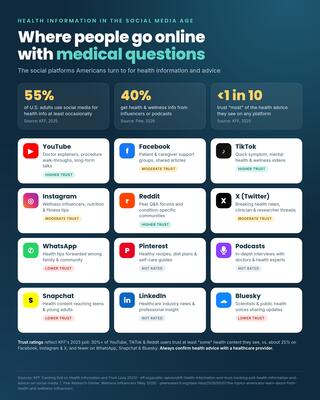
L.A.T.E.L.A.T.E., Limbic-predominant-Age-related-TDP-43-Encephalopathy

L.A.T.E.L.A.T.E., Limbic-predominant-Age-related-TDP-43-Encephalopathy

This week on PodcastDX, we're talking about L.A.T.E., which stands for Limbic-predominant Age-related TDP-43 Encephalopathy. It's a type of dementia that many people have never heard of, but it's comm...

27 Loka 34min

Social Media Health Advice- How Do You Vet It?

Social Media Health Advice- How Do You Vet It?

Welcome to PodcastDx, the show that helps you make sense of your health. I'm Jean Marie McNamara.  I'm joining you today with Lita Tomas, our Production Manager and of our co-hosts, Ron Rispoli (our t...

20 Loka 18min

Fatigue in Ehlers Danlos

Fatigue in Ehlers Danlos

Fatigue is more than feeling tired—for many people living with Ehlers-Danlos syndromes (EDS), it can mean overwhelming physical and mental exhaustion that affects even the simplest daily tasks. Chroni...

13 Loka 16min

Product Recalls (AGAIN!) and Your Health

Product Recalls (AGAIN!) and Your Health

This week we will discuss product recalls and your health.  According to WEBMD: A product safety recall happens when a consumer watch group or a manufacturer finds problems with a product. Lots of ite...

15 Syys 15min
Stage 4 Cancer as an ER Doc

Stage 4 Cancer as an ER Doc

Our guest today is a physician, author and activist.  The topic this week is "Stage 4 Cancer as an ER Doc".   Dr. James Maskalyk practices emergency medicine at St. Michael's, Toronto's inner-city tr...

8 Syys 1h 3min

Ai and Robotics in Medicine

Ai and Robotics in Medicine

This week on PodcastDX, Dr. Sanjeev Kumar joins Lita, Ron, and Jean Marie to discuss AI and robotics in medicine—from surgical robots and rehabilitation technology to hospital automation, patient safe...

1 Syys 47min

EECP The Most Underutilized Therapy in Medicine

EECP The Most Underutilized Therapy in Medicine

Retired U.S. Coast Guard Master Chief Petty Officer Jack Clifford joins PodcastDX to share how severe chronic angina once limited even everyday activities and left him facing the possibility of triple...

25 Elo 44min

Suosittua kategoriassa Terveys ja hyvinvointi

unicast
aamukahvilla
psykopodiaa-podcast
meditaatiot-suomeksi
tiedenaiset-podcast
vakeva-elama-viisaampi-mieli-vahvempi-keho
rss-pt-paahtio
katilon-kahvitunti
rss-hereilla
rss-uplevel-by-sonja-hannus
voi-hyvin-meditaatiot-2
rss-rampaseksia
rss-adama-mindful-hetki
rss-rentoudu-podcast-rentoutumiseen-hanna-viljanmaa
hippokrateen-vastaanotolla
rss-mighty-finland-podcast
rss-vapaudu-voimaasi
rss-kuumilla-aalloilla
rss-sanelunpurku-podcast
terapiassa