
Think Thursday: Subtraction-Why Less Might Be Better For Your Brain

Think Thursday: Subtraction-Why Less Might Be Better For Your Brain

When something in life is not working, most of us instinctively try to add something. A new habit. A new system. A new goal. Another tool.

But what if the smarter move is removing instead of adding?

In this episode of Think Thursday, we explore the neuroscience behind why the brain defaults to addition, why subtraction can feel uncomfortable or even threatening, and how learning to simplify may be one of the most powerful behavior change strategies available to us.

In This Episode

  • Why the brain equates improvement with accumulation
  • Research from Dr. Leidy Klotz showing our built-in bias toward adding instead of subtracting
  • How loss aversion makes removal feel like threat rather than refinement
  • The cultural conditioning that reinforces “more is better”
  • How cognitive load impacts the prefrontal cortex and decision-making
  • Why simplification increases flexibility and reduces overwhelm
  • The connection between subtraction and dopamine recalibration
  • How removing stimulation can restore reward sensitivity
  • The difference between identity loss and identity refinement

The Neuroscience Behind It

Your prefrontal cortex has limited capacity. Every added system, rule, or goal requires energy and attention. When cognitive load increases, the brain defaults to automatic patterns.

Subtraction reduces competing signals. Fewer cues mean less decision fatigue. Less noise allows greater clarity.

When stimulation is constantly high, your dopamine baseline shifts. Reducing input can initially feel uncomfortable, but over time it recalibrates your reward system, improves focus, and restores sensitivity to everyday experiences.

Simplification is not deprivation. It is neurological efficiency.

A Simple Experiment for This Week

Instead of asking, “What should I add to improve this?” try asking:

  • What is creating friction?
  • What is adding noise?
  • What feels heavy?
  • What is competing for my attention?

Then remove one thing.

Not dramatically. Not impulsively. Thoughtfully.

Subtraction compounds.

Key Takeaway

Progress does not always require more.

Sometimes the most intelligent move is editing.

Your brain may be wired to add, but you can choose to simplify.

Less input can create better output.
Less noise can create greater focus.
Less complexity can create stronger consistency.

Until next time, choose peace.

★ Support this podcast ★

Tämä jakso on lisätty Podme-palveluun avoimen RSS-syötteen kautta eikä se ole Podmen omaa tuotantoa. Siksi jakso saattaa sisältää mainontaa.

Jaksot(374)

Revisiting-Think Thursday: How Mindset Impact's the Body's Biology

Revisiting-Think Thursday: How Mindset Impact's the Body's Biology

In this Think Thursday episode, Molly revisits a timely conversation on mindset, neuroscience, and the biology of belief. Drawing on the work of Stanford health psychologist Dr. Alia Crum, she explore...

16 Huhti 18min

Alcohol Awareness Month: 8 Facts Everyone Should Know About Alcohol

Alcohol Awareness Month: 8 Facts Everyone Should Know About Alcohol

In this episode of the Alcohol Minimalist Podcast, Molly shares 8 evidence-based facts everyone should know about alcohol. From cancer risk and “safe” drinking limits to binge drinking, sleep, toleran...

13 Huhti 19min

Think Thursday: Paradox-The Power of "Both/And"

Think Thursday: Paradox-The Power of "Both/And"

In this Think Thursday episode, Molly explores Brené Brown’s ideas on paradox and why emotional resilience is less about certainty and more about our capacity to hold two truths at once. When we stop ...

9 Huhti 16min
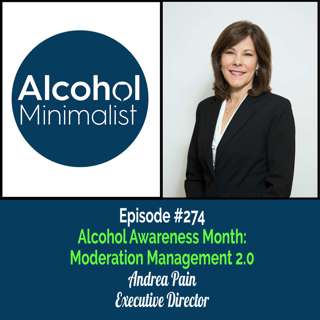
Alcohol Awareness Month:  Moderation Management 2.0 with Andrea Pain, Executive Director

Alcohol Awareness Month: Moderation Management 2.0 with Andrea Pain, Executive Director

In this episode of The Alcohol Minimalist Podcast, Molly talks with Andrea Pain, Executive Director of Moderation Management, about alcohol support options for people who want to drink less, explore m...

6 Huhti 41min
Revisiting: Think Thursday-The Neuroscience of New Habit Formation

Revisiting: Think Thursday-The Neuroscience of New Habit Formation

In this revisited Think Thursday episode, Molly explains why March may be a better time than January to build lasting habits. If your New Year’s goals have faded, this conversation offers a science-ba...

2 Huhti 18min

Why Your Partner Doesn't Have to Change for You to Change Your Drinking with Matt Wing

Why Your Partner Doesn't Have to Change for You to Change Your Drinking with Matt Wing

What happens when you want to drink less—but your partner doesn’t?In this episode, Molly talks with midlife sobriety coach Matt Wing about how to change your relationship with alcohol, even when your ...

30 Maalis 40min

Think Thursday: The Zeigarnik Effect: Why Your Brain Won’t Let Things Go

Think Thursday: The Zeigarnik Effect: Why Your Brain Won’t Let Things Go

Episode SummaryWhy does your brain keep bringing things back up—especially when you’re trying to relax?In this Think Thursday episode, Molly expands on the Zeigarnik Effect, a psychological principle ...

26 Maalis 9min

March Madness Series:  Play Until the Clock Says 0:00

March Madness Series: Play Until the Clock Says 0:00

In this final installment of the March Madness series, Molly brings the conversation full circle by focusing on the long game.After exploring your playbook, your scoreboard, and how to rebound when yo...

23 Maalis 14min

Suosittua kategoriassa Koulutus

rss-murhan-anatomia
psykopodiaa-podcast
voi-hyvin-meditaatiot-2
adhd-podi
rss-rahamania
rss-valo-minussa-2
rss-luonnollinen-synnytys-podcast
rss-narsisti
rahapuhetta
kesken
rss-liian-kuuma-peruna
rss-tietoinen-yhteys-podcast-2
rss-niinku-asia-on
filocast-filosofian-perusteet
ihminen-tavattavissa-tommy-hellsten-instituutti
rss-arkea-ja-aurinkoa-podcast-espanjasta
aamukahvilla
jari-sarasvuo-podcast
dear-ladies
rss-vapaudu-voimaasi

















