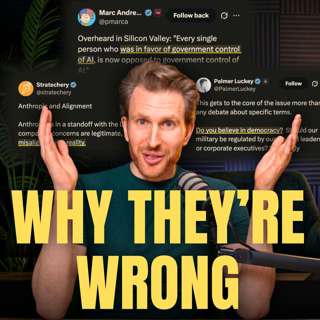
What everyone is missing about Anthropic vs the Pentagon. And: The Meta leaks are worse than you think.

What everyone is missing about Anthropic vs the Pentagon. And: The Meta leaks are worse than you think.

When the Pentagon tried to strong-arm Anthropic into dropping its ban on AI-only kill decisions and mass domestic surveillance, the company refused. Its critics went on the attack: Anthropic and its supporters are some combination of 'hypocritical', 'naive', and 'anti-democratic'. Rob Wiblin dissects each claim finding that all three are mediocre arguments dressed up as hard truths. (Though the 'naive' one is at least interesting.)

Watch on YouTube: What Everyone is Missing about Anthropic vs The Pentagon

Plus, from 13:43: Leaked documents from Meta revealed that 10% of the company's total revenue — around $16 billion a year — came from ads for scams and goods Meta had itself banned. These likely enabled the theft of around $50 billion dollars a year from Americans alone. But when an internal anti-fraud team developed a screening method that halved the rate of scams coming from China... well, it wasn't well received.

Watch on YouTube: The Meta Leaks Are Worse Than You Think

Chapters:

  • Introduction (00:00:00)
  • What Everyone is Missing about Anthropic vs The Pentagon (00:00:26)
  • Charge 1: Hypocrisy (00:01:21)
  • Charge 2: Naivety (00:04:55)
  • Charge 3: Undemocratic (00:09:38)
  • You don't have to debate on their terms (00:12:32)
  • The Meta Leaks Are Worse Than You Think (00:13:43)
  • Three fixes for social media's scam problem (00:16:48)
  • We should regulate AI companies as strictly as banks (00:18:46)

Video and audio editing: Dominic Armstrong and Simon Monsour
Transcripts and web: Elizabeth Cox and Katy Moore

Tämä jakso on lisätty Podme-palveluun avoimen RSS-syötteen kautta eikä se ole Podmen omaa tuotantoa. Siksi jakso saattaa sisältää mainontaa.

Jaksot(335)

#30 - Eva Vivalt on how little social science findings generalize from one study to another

#30 - Eva Vivalt on how little social science findings generalize from one study to another

If we have a study on the impact of a social program in a particular place and time, how confident can we be that we’ll get a similar result if we study the same program again somewhere else? Dr Eva V...

15 Touko 20182h 1min
#29 - Anders Sandberg on 3 new resolutions for the Fermi paradox & how to colonise the universe

#29 - Anders Sandberg on 3 new resolutions for the Fermi paradox & how to colonise the universe

Part 2 out now: #33 - Dr Anders Sandberg on what if we ended ageing, solar flares & the annual risk of nuclear war The universe is so vast, yet we don’t see any alien civilizations. If they exist, whe...

8 Touko 20181h 21min
#28 - Owen Cotton-Barratt on why scientists should need insurance, PhD strategy & fast AI progresses

#28 - Owen Cotton-Barratt on why scientists should need insurance, PhD strategy & fast AI progresses

A researcher is working on creating a new virus – one more dangerous than any that exist naturally. They believe they’re being as careful as possible. After all, if things go wrong, their own life and...

27 Huhti 20181h 3min
#27 - Dr Tom Inglesby on careers and policies that reduce global catastrophic biological risks

#27 - Dr Tom Inglesby on careers and policies that reduce global catastrophic biological risks

How about this for a movie idea: a main character has to prevent a new contagious strain of Ebola spreading around the world. She’s the best of the best. So good in fact, that her work on early detect...

18 Huhti 20182h 16min
#26 - Marie Gibbons on how exactly clean meat is made & what's needed to get it in every supermarket

#26 - Marie Gibbons on how exactly clean meat is made & what's needed to get it in every supermarket

First, decide on the type of animal. Next, pick the cell type. Then take a small, painless biopsy, and put the cells in a solution that makes them feel like they’re still in the body. Once the cells a...

10 Huhti 20181h 44min
#25 - Robin Hanson on why we have to lie to ourselves about why we do what we do

#25 - Robin Hanson on why we have to lie to ourselves about why we do what we do

On February 2, 1685, England’s King Charles II was struck by a sudden illness. Fortunately his physicians were the best of the best. To reassure the public they kept them abreast of the King’s treatme...

28 Maalis 20182h 39min
#24 - Stefan Schubert on why it’s a bad idea to break the rules, even if it’s for a good cause

#24 - Stefan Schubert on why it’s a bad idea to break the rules, even if it’s for a good cause

How honest should we be? How helpful? How friendly? If our society claims to value honesty, for instance, but in reality accepts an awful lot of lying – should we go along with those lax standards? Or...

20 Maalis 201855min
#23 - How to actually become an AI alignment researcher, according to Dr Jan Leike

#23 - How to actually become an AI alignment researcher, according to Dr Jan Leike

Want to help steer the 21st century’s most transformative technology? First complete an undergrad degree in computer science and mathematics. Prioritize harder courses over easier ones. Publish at lea...

16 Maalis 201845min

Suosittua kategoriassa Koulutus

rss-murhan-anatomia
psykopodiaa-podcast
voi-hyvin-meditaatiot-2
adhd-podi
rss-rahamania
rss-liian-kuuma-peruna
psykologia
rss-laadukasta-ensihoitoa
rss-narsisti
rss-vapaudu-voimaasi
kesken
rss-niinku-asia-on
rss-arkea-ja-aurinkoa-podcast-espanjasta
rss-hereilla
rahapuhetta
rss-keskeneraiset-aidit
ihminen-tavattavissa-tommy-hellsten-instituutti
rss-duodecim-lehti
rss-valo-minussa-2
rss-tfa-8020-podcast