Village gossip, pesticide bans, and gene drives: 17 experts on the future of global health

Village gossip, pesticide bans, and gene drives: 17 experts on the future of global health

What does it really take to lift millions out of poverty and prevent needless deaths?

In this special compilation episode, 17 past guests — including economists, nonprofit founders, and policy advisors — share their most powerful and actionable insights from the front lines of global health and development. You’ll hear about the critical need to boost agricultural productivity in sub-Saharan Africa, the staggering impact of lead poisoning on children in low-income countries, and the social forces that contribute to high neonatal mortality rates in India.

What’s so striking is how some of the most effective interventions sound almost too simple to work: banning certain pesticides, replacing thatch roofs, or identifying village “influencers” to spread health information.

Full transcript and links to learn more: https://80k.info/ghd

Chapters:

  • Cold open (00:00:00)
  • Luisa’s intro (00:00:58)
  • Development consultant Karen Levy on why pushing for “sustainable” programmes isn’t as good as it sounds (00:02:15)
  • Economist Dean Spears on the social forces and gender inequality that contribute to neonatal mortality in Uttar Pradesh (00:06:55)
  • Charity founder Sarah Eustis-Guthrie on what we can learn from the massive failure of PlayPumps (00:14:33)
  • Economist Rachel Glennerster on how randomised controlled trials are just one way to better understand tricky development problems (00:19:05)
  • Data scientist Hannah Ritchie on why improving agricultural productivity in sub-Saharan Africa is critical to solving global poverty (00:24:36)
  • Charity founder Lucia Coulter on the huge, neglected upsides of reducing lead exposure (00:47:48)
  • Malaria expert James Tibenderana on using gene drives to wipe out the species of mosquitoes that cause malaria (00:53:11)
  • Charity founder Varsha Venugopal on using village gossip to get kids their critical immunisations (01:04:14)
  • Rachel Glennerster on solving tough global problems by creating the right incentives for innovation (01:11:31)
  • Karen Levy on when governments should pay for programmes instead of NGOs (01:26:51)
  • Open Philanthropy lead Alexander Berger on declining returns in global health, and finding and funding the most cost-effective interventions (01:29:40)
  • GiveWell researcher James Snowden on making funding decisions with tricky moral weights (01:34:44)
  • Lucia Coulter on “hits-based giving” approaches to funding global health and development projects (01:43:01)
  • Rachel Glennerster on whether it’s better to fix problems in education with small-scale interventions versus systemic reforms (01:48:12)
  • GiveDirectly cofounder Paul Niehaus on why it’s so important to give aid recipients a choice in how they spend their money (01:51:09)
  • Sarah Eustis-Guthrie on whether more charities should scale back or shut down, and aligning incentives with beneficiaries (01:56:12)
  • James Tibenderana on why we need loads better data to harness the power of AI to eradicate malaria (02:11:22)
  • Lucia Coulter on rapidly scaling a light-touch intervention to more countries (02:20:14)
  • Karen Levy on why pre-policy plans are so great at aligning perspectives (02:32:47)
  • Rachel Glennerster on the value we get from doing the right RCTs well (02:40:04)
  • Economist Mushtaq Khan on really drilling down into why “context matters” for development work (02:50:13)
  • GiveWell cofounder Elie Hassenfeld on contrasting GiveWell’s approach with the subjective wellbeing approach of Happier Lives Institute (02:57:24)
  • James Tibenderana on whether people actually use antimalarial bed nets for fishing — and why that’s the wrong thing to focus on (03:05:30)
  • Karen Levy on working with governments to get big results (03:10:53)
  • Leah Utyasheva on how a simple intervention reduced suicide in Sri Lanka by 70% (03:17:38)
  • Karen Levy on working with academics to get the best results on the ground (03:29:03)
  • James Tibenderana on the value of working with local researchers (03:32:15)
  • Lucia Coulter on getting buy-in from both industry and government (03:35:05)
  • Alexander Berger on reasons neartermist work makes sense even by longtermist standards (03:39:26)
  • Economist Shruti Rajagopalan on the key skills to succeed in public policy careers, and seeing economics in everything (03:47:42)
  • J-PAL lead Claire Walsh on her career advice for young people who want to get involved in global health and development (03:55:20)

Audio engineering: Ben Cordell, Milo McGuire, Simon Monsour, and Dominic Armstrong
Content editing: Katy Moore and Milo McGuire
Music: CORBIT
Coordination, transcriptions, and web: Katy Moore

Jaksot(332)

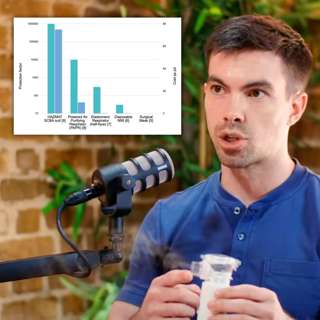
#224 – There's a cheap and low-tech way to save humanity from any engineered disease | Andrew Snyder-Beattie

#224 – There's a cheap and low-tech way to save humanity from any engineered disease | Andrew Snyder-Beattie

Conventional wisdom is that safeguarding humanity from the worst biological risks — microbes optimised to kill as many as possible — is difficult bordering on impossible, making bioweapons humanity’s ...

2 Loka 20252h 31min
Inside the Biden admin’s AI policy approach | Jake Sullivan, Biden’s NSA | via The Cognitive Revolution

Inside the Biden admin’s AI policy approach | Jake Sullivan, Biden’s NSA | via The Cognitive Revolution

Jake Sullivan was the US National Security Advisor from 2021-2025. He joined our friends on The Cognitive Revolution podcast in August to discuss AI as a critical national security issue. We thought i...

26 Syys 20251h 5min
#223 – Neel Nanda on leading a Google DeepMind team at 26 – and advice if you want to work at an AI company (part 2)

#223 – Neel Nanda on leading a Google DeepMind team at 26 – and advice if you want to work at an AI company (part 2)

At 26, Neel Nanda leads an AI safety team at Google DeepMind, has published dozens of influential papers, and mentored 50 junior researchers — seven of whom now work at major AI companies. His secret?...

15 Syys 20251h 46min
#222 – Can we tell if an AI is loyal by reading its mind? DeepMind's Neel Nanda (part 1)

#222 – Can we tell if an AI is loyal by reading its mind? DeepMind's Neel Nanda (part 1)

We don’t know how AIs think or why they do what they do. Or at least, we don’t know much. That fact is only becoming more troubling as AIs grow more capable and appear on track to wield enormous cultu...

8 Syys 20253h 1min
#221 – Kyle Fish on the most bizarre findings from 5 AI welfare experiments

#221 – Kyle Fish on the most bizarre findings from 5 AI welfare experiments

What happens when you lock two AI systems in a room together and tell them they can discuss anything they want?According to experiments run by Kyle Fish — Anthropic’s first AI welfare researcher — som...

28 Elo 20252h 28min

How not to lose your job to AI (article by Benjamin Todd)

How not to lose your job to AI (article by Benjamin Todd)

About half of people are worried they’ll lose their job to AI. They’re right to be concerned: AI can now complete real-world coding tasks on GitHub, generate photorealistic video, drive a taxi more sa...

31 Heinä 202551min

Rebuilding after apocalypse: What 13 experts say about bouncing back

Rebuilding after apocalypse: What 13 experts say about bouncing back

What happens when civilisation faces its greatest tests?This compilation brings together insights from researchers, defence experts, philosophers, and policymakers on humanity’s ability to survive and...

15 Heinä 20254h 26min
#220 – Ryan Greenblatt on the 4 most likely ways for AI to take over, and the case for and against AGI in <8 years

#220 – Ryan Greenblatt on the 4 most likely ways for AI to take over, and the case for and against AGI in <8 years

Ryan Greenblatt — lead author on the explosive paper “Alignment faking in large language models” and chief scientist at Redwood Research — thinks there’s a 25% chance that within four years, AI will b...

8 Heinä 20252h 50min

Suosittua kategoriassa Koulutus

rss-murhan-anatomia
psykopodiaa-podcast
voi-hyvin-meditaatiot-2
psykologia
adhd-podi
rss-rahamania
rss-liian-kuuma-peruna
rss-valo-minussa-2
rss-tietoinen-yhteys-podcast-2
kesken
rss-arkea-ja-aurinkoa-podcast-espanjasta
rahapuhetta
rss-niinku-asia-on
rss-narsisti
dear-ladies
rss-duodecim-lehti
rss-eron-alkemiaa
rss-vapaudu-voimaasi
koodikahvit
leikitaanko-laakaria