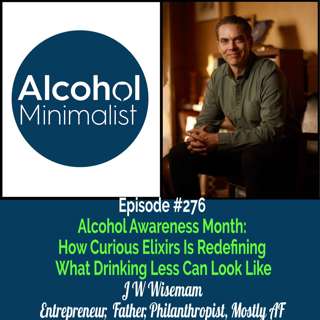
Alcohol Awareness Month: How Curious Elixirs Is Redefining What Drinking Less Can Look Like with J.W. Wiseman

Alcohol Awareness Month: How Curious Elixirs Is Redefining What Drinking Less Can Look Like with J.W. Wiseman

In this episode of the Alcohol Minimalist Podcast, Molly talks with J.W. Wiseman, founder of Curious Elixirs, about the rise of craft non-alcoholic cocktails and why they matter so much for people who want a more peaceful relationship with alcohol. J.W. shares how his own desire to drink less led him to create one of the earliest brands in the non-alcoholic beverage space, long before “sober curious” became a mainstream term.

Together, Molly and J.W. explore the idea that drinking less does not have to mean settling for something boring, basic, or deprived—it can still feel elevated, flavorful, social, and deeply satisfying.

From the origins of Curious Elixirs in 2015 to the role of functional herbs, adaptogens, and intentional drink design, this conversation offers a fresh look at how non-alcoholic beverages can support people across the sobriety spectrum. Molly also challenges the common belief that a drink needs alcohol to be worth enjoying, reminding listeners that taste, ritual, and experience matter too.

In This Episode, You’ll Hear:

  • Why J.W. started Curious Elixirs before the term “sober curious” even existed
  • How non-alcoholic beverages can support a more intentional relationship with alcohol
  • Why flavor, ritual, and connection matter more than alcohol itself
  • How Curious Elixirs helped pioneer the craft, functional non-alcoholic cocktail category
  • The role of herbs and adaptogens in creating drinks that feel sophisticated and supportive
  • Why “less alcohol” does not have to mean “less fun”
  • How J.W.’s own drinking habits pushed him to rethink what he wanted alcohol to do in his life

Key Takeaways

J.W. explains that people do not need alcohol to have fun—they need connection, intention, and something that genuinely feels good in their body. That idea aligns beautifully with the Alcohol Minimalist philosophy: creating a relationship with alcohol that is conscious, peaceful, and free from all-or-nothing thinking.

This episode also highlights an important mindset shift: non-alcoholic drinks are not “less than.” They can be crafted, complex, beautiful, and worthy of the same appreciation people often reserve for alcoholic beverages. Molly and J.W. discuss how that reframe opens up more options for people who want to drink less without feeling like they are missing out.

And finally, J.W.’s story is a reminder that change often starts with curiosity. What began as a personal effort to cut back and reset his tolerance eventually became a company built to help others find more freedom and flexibility in how they drink.

About the Guest

J.W. Wiseman is the founder of Curious Elixirs, one of the early leaders in the non-alcoholic cocktail movement. Before launching the company in 2015, he worked across media, marketing, and hospitality, including roles with NBC, Broadway, Thrillist, and Skillshare, before founding his own agency, Good Business.

Mentioned in This Episode

  • Curious Elixirs
  • The “sober curious” movement
  • Functional herbs and adaptogens
  • Curious Red
  • The Curious Elixirs flavor quiz
  • Molly’s idea of living “mostly alcohol-free”

Low risk drinking guidelines from the NIAAA:

Healthy men under 65:

No more than 4 drinks in one day and no more than 14 drinks per week.

Healthy women (all ages) and healthy men 65 and older:
No more than 3 drinks in one day and no more than 7 drinks per week.

One drink is defined as 12 ounces of beer, 5 ounces of wine, or 1.5 ounces of 80-proof liquor. So remember that a mixed drink or full glass of wine are probably more than one drink.

Abstinence from alcohol
Abstinence from alcohol is the best choice for people who take medication(s) that interact with alcohol, have health conditions that could be exacerbated by alcohol (e.g. liver disease), are pregnant or may become pregnant or have had a problem with alcohol or another substance in the past.

Benefits of “low-risk” drinking
Following these guidelines reduces the risk of health problems such as cancer, liver disease, reduced immunity, ulcers, sleep problems, complications of existing conditions, and more. It also reduces the risk of depression, social problems, and difficulties at school or work.

★ Support this podcast ★

Tämä jakso on lisätty Podme-palveluun avoimen RSS-syötteen kautta eikä se ole Podmen omaa tuotantoa. Siksi jakso saattaa sisältää mainontaa.

Jaksot(374)

Revisiting-Think Thursday: How Mindset Impact's the Body's Biology

Revisiting-Think Thursday: How Mindset Impact's the Body's Biology

In this Think Thursday episode, Molly revisits a timely conversation on mindset, neuroscience, and the biology of belief. Drawing on the work of Stanford health psychologist Dr. Alia Crum, she explore...

16 Huhti 18min
Alcohol Awareness Month: 8 Facts Everyone Should Know About Alcohol

Alcohol Awareness Month: 8 Facts Everyone Should Know About Alcohol

In this episode of the Alcohol Minimalist Podcast, Molly shares 8 evidence-based facts everyone should know about alcohol. From cancer risk and “safe” drinking limits to binge drinking, sleep, toleran...

13 Huhti 19min
Think Thursday: Paradox-The Power of "Both/And"

Think Thursday: Paradox-The Power of "Both/And"

In this Think Thursday episode, Molly explores Brené Brown’s ideas on paradox and why emotional resilience is less about certainty and more about our capacity to hold two truths at once. When we stop ...

9 Huhti 16min
Alcohol Awareness Month:  Moderation Management 2.0 with Andrea Pain, Executive Director

Alcohol Awareness Month: Moderation Management 2.0 with Andrea Pain, Executive Director

In this episode of The Alcohol Minimalist Podcast, Molly talks with Andrea Pain, Executive Director of Moderation Management, about alcohol support options for people who want to drink less, explore m...

6 Huhti 41min
Revisiting: Think Thursday-The Neuroscience of New Habit Formation

Revisiting: Think Thursday-The Neuroscience of New Habit Formation

In this revisited Think Thursday episode, Molly explains why March may be a better time than January to build lasting habits. If your New Year’s goals have faded, this conversation offers a science-ba...

2 Huhti 18min
Why Your Partner Doesn't Have to Change for You to Change Your Drinking with Matt Wing

Why Your Partner Doesn't Have to Change for You to Change Your Drinking with Matt Wing

What happens when you want to drink less—but your partner doesn’t?In this episode, Molly talks with midlife sobriety coach Matt Wing about how to change your relationship with alcohol, even when your ...

30 Maalis 40min
Think Thursday: The Zeigarnik Effect: Why Your Brain Won’t Let Things Go

Think Thursday: The Zeigarnik Effect: Why Your Brain Won’t Let Things Go

Episode SummaryWhy does your brain keep bringing things back up—especially when you’re trying to relax?In this Think Thursday episode, Molly expands on the Zeigarnik Effect, a psychological principle ...

26 Maalis 9min
March Madness Series:  Play Until the Clock Says 0:00

March Madness Series: Play Until the Clock Says 0:00

In this final installment of the March Madness series, Molly brings the conversation full circle by focusing on the long game.After exploring your playbook, your scoreboard, and how to rebound when yo...

23 Maalis 14min

Suosittua kategoriassa Koulutus

rss-murhan-anatomia
psykopodiaa-podcast
voi-hyvin-meditaatiot-2
adhd-podi
rss-rahamania
rss-valo-minussa-2
rss-luonnollinen-synnytys-podcast
rss-narsisti
rahapuhetta
kesken
rss-liian-kuuma-peruna
rss-tietoinen-yhteys-podcast-2
rss-niinku-asia-on
filocast-filosofian-perusteet
ihminen-tavattavissa-tommy-hellsten-instituutti
rss-arkea-ja-aurinkoa-podcast-espanjasta
aamukahvilla
jari-sarasvuo-podcast
dear-ladies
rss-vapaudu-voimaasi

















