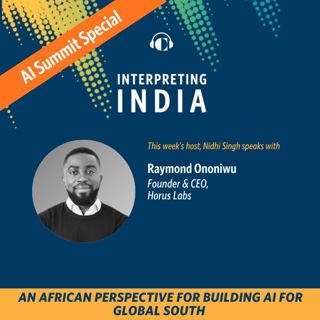
An African Perspective for Building AI for Global South | AI Summit Special

An African Perspective for Building AI for Global South | AI Summit Special

This episode is part of our special series on the India AI Impact Summit, examining the conversations, decisions, and debates that are shaping global AI governance.

Raymond draws a distinction early in the conversation that shapes everything that follows: training and inference are not the same thing, and conflating them is leading a lot of countries to make expensive mistakes. Training, he says, is like building the engine. Inference is running the transport system every single day. Most countries do not need to build the engine. What they need is airports, roads, and reliable infrastructure that gets the technology into the hands of people. The global assumption that frontier model training is the only legitimate AI pathway is, in his view, one of the more consequential misreads of the moment.

On the ground realities of building in Africa, Raymond is specific about where the bottlenecks actually are. It is not ambition. It is power reliability, cost of connectivity, access to capital, and the kind of financing frameworks that have not yet caught up with what AI infrastructure actually requires. He points to genuinely interesting anomalies, such as Ethiopia's extremely low cost of power sitting alongside very limited terrestrial fiber diversity, as a reminder that building in the Global South is not about replicating Silicon Valley at a discount. It is about finding combinations of constraints that can actually be made to work, and optimising for reliability, cost efficiency, and practical impact rather than scale and prestige.

His advice to governments is to start with problems, not hardware. Prestigious projects with no clear use case, over-regulation before a single GPU cluster exists, and attempts to rebuild sovereign versions of large compute clusters are all, in his view, things to ignore. What countries should actually invest in is reliable and clean power, public interest compute access, data governance frameworks, sector specific pilots in health, agriculture, and education, and talent development that works by getting the technology into the hands of people rather than running structured boot camps. For Raymond, the success metric for Africa in five years should not be the size of anyone's model. It should be whether AI has meaningfully improved economic productivity and public service delivery across the continent.

Episode Contributors

Nidhi Singh is an associate fellow at Carnegie India. Her current research interests include data governance, artificial intelligence and emerging technologies. Her work focuses on the implications of information technology law and policy from a Global Majority and Asian perspective.

Raymond Ononiwu is the founder of Horus Lab, a technology and infrastructure company building Africa’s next-generation digital backbone through modular, renewable-powered, AI-ready data centers. An engineer with more than 15 years of experience delivering products across Mixed Reality, Windows Analytics, and Teams Copilot, his work has powered platforms relied on by hundreds of millions globally.

Every two weeks, Interpreting India brings you diverse voices from India and around the world to explore the critical questions shaping the nation's future. We delve into how technology, the economy, and foreign policy intertwine to influence India's relationship with the global stage.

As a Carnegie India production, hosted by Carnegie scholars, Interpreting India, a Carnegie India production, provides insightful perspectives and cutting-edge by tackling the defining questions that chart India's course through the next decade.

Stay tuned for thought-provoking discussions, expert insights, and a deeper understanding of India's place in the world.

Don't forget to subscribe, share, and leave a review to join the conversation and be part of Interpreting India's journey.

Tämä jakso on lisätty Podme-palveluun avoimen RSS-syötteen kautta eikä se ole Podmen omaa tuotantoa. Siksi jakso saattaa sisältää mainontaa.

Jaksot(148)

AI Literacy and the Future of Work in India

AI Literacy and the Future of Work in India

Jaspreet's framing for the AI and work debate is worth staying with. He is not dismissive of disruption: he thinks AI will destroy certain jobs, create new ones, and the rupture will be real. But he p...

26 Touko 44min
Can AI Resources Be Democratized? AI Summit Special

Can AI Resources Be Democratized? AI Summit Special

This episode is part of our special series on the India AI Impact Summit, examining the conversations, decisions, and debates that are shaping global AI governance. The working group was designed from...

15 Touko 28min

Space Security in the Age of AI

Space Security in the Age of AI

Almudena opens with a distinction that anchors the entire conversation: space security, unlike space safety, is about intentional harm. It concerns deliberate attempts to disrupt, deny, or destroy spa...

7 Touko 1h 7min

The India-EU Trade Deal: What It Delivers and What It Doesn't

The India-EU Trade Deal: What It Delivers and What It Doesn't

For most of the last decade, a trade deal between India and the EU seemed unlikely. The nudge came as the world changed around both. Nicolas points to three converging forces: the pressure of US tarif...

23 Huhti 51min

From Bletchley Park to Delhi and What Comes Next | AI Summit Special

From Bletchley Park to Delhi and What Comes Next | AI Summit Special

This episode is part of our special series on the India AI Impact Summit 2026, examining the conversations, perspectives, and debates that are shaping global AI discourse. Tino has been in the room a...

16 Huhti 54min

Data, AI, and the Laws Trying to Keep Up

Data, AI, and the Laws Trying to Keep Up

The conversation begins with a close look at India’s data protection regime, particularly the DPDP Act and its emphasis on consent. Nikhil challenges the perception that the law is overly consent-driv...

31 Maalis 42min

Inside the Iran Conflict: Power, Strategy, and India’s Balancing Act

Inside the Iran Conflict: Power, Strategy, and India’s Balancing Act

The conversation begins with a look at where the conflict stands today and how Iran has managed to absorb significant military pressure while still responding in a measured way. Dharmendra explains ho...

25 Maalis 1h 8min

Suosittua kategoriassa Politiikka ja uutiset

uutiscast
aikalisa
politiikan-puskaradio
rss-ootsa-kuullut-tasta
ootsa-kuullut-tasta-2
rss-podme-livebox
tervo-halme
otetaan-yhdet
rss-vaalirankkurit-podcast
et-sa-noin-voi-sanoo-esittaa
viisupodi
rss-asiastudio
linda-maria
rss-girls-finish-f1rst
rss-pinnalla
the-ulkopolitist
helsingin-sanomat-dev
rss-kaikki-paskaksi-ystavat
rss-hyvaa-huomenta-bryssel
rss-ulkopoditiikkaa