
PFC Podcast 277: Multimodal Analgesia - Making Your Limited Narcotics Last Longer in Prolonged Field Care

PFC Podcast 277: Multimodal Analgesia - Making Your Limited Narcotics Last Longer in Prolonged Field Care

In this must-listen episode, Dennis sits down with Dr. Jon Andrews—former 5th and 20th Group Special Forces medic turned Duke-trained anesthesiologist (pediatric & cardiac fellowships)—to tackle one of the biggest headaches in austere medicine: you have a tiny box of opioids and ketamine, a long mission, and a patient who needs to stay alive AND comfortable.


They break down exactly how to stretch every milligram using real OR strategies adapted for prolonged field care: patient-specific planning, smart titration, multimodal synergy, regional blocks, ketamine myths, and when (and how) to layer non-narcotics without crashing your patient or your supply.

Why this episode matters: Acute pain becomes chronic pain. Chronic pain leads to opioid dependence, PTSD, and worse outcomes. In the field, your choices today shape your patient’s tomorrow—and whether you still have meds left when the next casualty shows up.


Key Takeaways

  • Start low, titrate smart. Cut your first dose in half on sick or unstable patients. You can always give more—never the other way around.
  • Multimodal is mission-critical. Hit pain from every angle (blocks + ketamine + acetaminophen + judicious NSAIDs) to dramatically reduce opioid requirements and prevent chronic pain pathways.
  • Ketamine IS an analgesic. It’s not just dissociation—it’s an NMDA antagonist that blunts central sensitization and has proven opioid-sparing effects.
  • Schedule your non-opioids. Acetaminophen (1 g IV/PO/PR q6h) and longer-acting adjuncts form your baseline; use fentanyl or morphine only for breakthrough.
  • Blocks beat everything—if you can do them. Pre-emptive regional anesthesia (when feasible) is the single highest-yield move before surgical stimulus hits.
  • Monitor like your life depends on it. Heart rate, blood pressure, and respiratory rate are your best pain score when the patient can’t talk.
  • Plan for worst-case evacuation. Bring more than you think you’ll need and dose for the opioid-naïve or opioid-tolerant reality in front of you.
  • Why treating hypertension in the OR (or field) almost always starts with fixing pain first
  • The “start low, see response, add more” mantra every austere provider needs
  • Why Tylenol often performs as well as morphine in blinded ED studies (and why your patients still doubt it)
  • Real talk on ultrasound-guided blocks in 2011 vs. today—and why proficiency still matters
  • The dangerous synergy of opioids + benzos + ketamine on respiratory drive
  • Why you must get comfortable decreasing doses, not just ramping them up


Chapters

  • 01:55 – The austere reality: limited narcotics and why your favorite med won’t last forever
  • 03:37 – OR planning vs. field reality: opioid-naïve vs. chronic users
  • 05:57 – Multimodal analgesia explained (blocks, ketamine, Tylenol, NSAIDs, dexmedetomidine)
  • 08:28 – Patient & mission factors that should drive your loadout
  • 12:23 – Golden rule: start low, titrate to effect, monitor vitals
  • 15:05 – Sick-patient hack: cut your mental dose in half
  • 16:01 – Is ketamine actually an analgesic? (NMDA, opioid-sparing, PTSD data)
  • 19:12 – Extending your supply: bolus vs. infusion, redosing strategy
  • 24:27 – First-line multimodal choices in the field
  • 27:43 – Juggling multiple agents: timing, scheduling, and longer-acting blocks
  • 30:15 – Regional anesthesia timing—pre-emptive is king (post-injury limitations)
  • 32:48 – Ultrasound & blocks in the current PFC world
  • 35:08 – Safety considerations for adjuncts (liver, kidneys, bleeding, alcohol)
  • 36:59 – Bang-for-buck data on Tylenol vs. morphine
  • 38:55 – Practical integration: layering Tylenol/ketamine with fentanyl titration
  • 41:54 – Getting comfortable titrating down (and why pain scores can lie)
  • 42:53 – Final wisdom: use everything you’re comfortable with.

For more content go to ⁠⁠⁠⁠⁠⁠⁠⁠⁠⁠www.prolongedfieldcare.org

⁠⁠⁠⁠⁠⁠⁠⁠⁠⁠Consider supporting us: ⁠⁠⁠⁠⁠⁠⁠⁠⁠⁠patreon.com/ProlongedFieldCareCollective⁠⁠⁠⁠⁠⁠ or ⁠⁠⁠⁠⁠⁠www.lobocoffeeco.com/product-page/prolonged-field-care

Tämä jakso on lisätty Podme-palveluun avoimen RSS-syötteen kautta eikä se ole Podmen omaa tuotantoa. Siksi jakso saattaa sisältää mainontaa.

Jaksot(624)

294 - Do Antibiotics Really Reduce Mortality in Trauma? Wound Care First in Prolonged Field Care

294 - Do Antibiotics Really Reduce Mortality in Trauma? Wound Care First in Prolonged Field Care

Antibiotics are not magic. In this episode of the PFC Podcast, Dennis sits down with Ryan to cut through the common myth that “I’ve given antibiotics, so the wound is protected.” They unpack why vigor...

31 Elo 36min
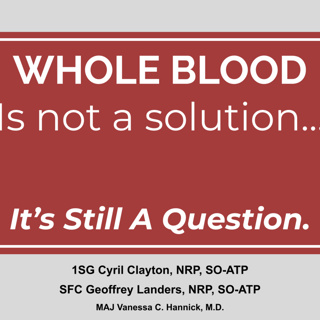
SOMA 26' - Fresh Whole Blood is Not The Answer: It's Still a Question

SOMA 26' - Fresh Whole Blood is Not The Answer: It's Still a Question

Whole Blood Is Not a Solution (Until Conventional Forces Can Deliver It)Recorded live at SOMA 26Dr. Vanessa Hanick (emergency physician, former active-duty Army, now National Guard) and 1SG Cy Clayton...

27 Elo 28min

293 - Dead Tissue Kills in Prolonged Field Care: 4 C’s, Early Debridement & Delayed Primary Closure Lessons from the Field

293 - Dead Tissue Kills in Prolonged Field Care: 4 C’s, Early Debridement & Delayed Primary Closure Lessons from the Field

In this episode of the PFC Podcast, Dennis sits down with missionary surgeon Jason to cut through the noise on real-world wound care in austere and unconventional warfare environments. From the bridge...

24 Elo 49min
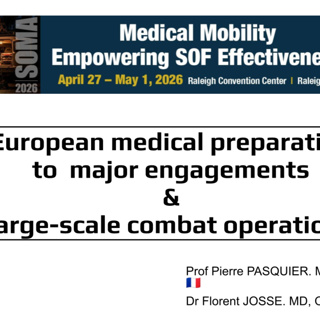
SOMA 26' - European Medical Preparations for Major Engagements and Large-Scale Combat Operations

SOMA 26' - European Medical Preparations for Major Engagements and Large-Scale Combat Operations

Recorded live at SOMA 26Pierre Pasquier (France) and his German counterpart deliver a clear-eyed assessment of how European military medical systems are preparing for large-scale combat operations and...

20 Elo 31min
292-Building Mobile Surgical Capability in Denied Environments

292-Building Mobile Surgical Capability in Denied Environments

In this episode of the Prolonged Field Care Podcast, Dennis sits down with Mitch (U.S. family practice/ER physician) and Augustine (frontline surgeon with five years of experience) to unpack what it a...

17 Elo 41min
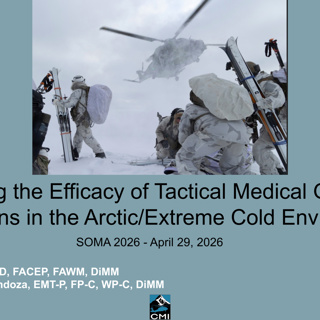
SOMA 26 - Optimizing the Efficacy of Commonly Used Tactical Medical Gear and Medications In The Arctic Extreme Cold Operational Environment

SOMA 26 - Optimizing the Efficacy of Commonly Used Tactical Medical Gear and Medications In The Arctic Extreme Cold Operational Environment

Recorded live at SOMA 26Dr. Emily Johnston (Cascadia Mountain Institute) and SFC Ezequiel Mendoza (Arctic Dustoff, Fairbanks) deliver a hard-hitting, field-validated look at how standard tactical medi...

13 Elo 29min
291 - Pediatric Burns In Prolonged Field Care Assessment, Resuscitation & Airway Management

291 - Pediatric Burns In Prolonged Field Care Assessment, Resuscitation & Airway Management

In this essential episode of the Prolonged Field Care Podcast, Dennis sits down with pediatric intensivist Dr. Sara Bibbens to tackle one of the most challenging and anxiety-inducing scenarios in aust...

10 Elo 30min
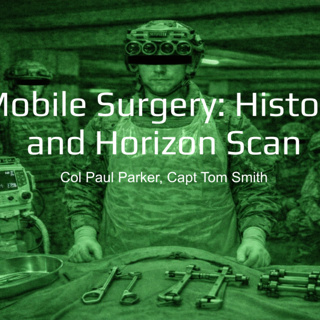
SOMA 26 - A History of Mobile Surgical Teams Role 1-3 and Horizon Scan

SOMA 26 - A History of Mobile Surgical Teams Role 1-3 and Horizon Scan

In this presentation, we take a deep dive into the 300-year history of mobile surgery supporting land campaigns — from Dominique Larrey’s ambulance volantes through the Letterman system, Arnhem, the F...

6 Elo 28min

Suosittua kategoriassa Koulutus

rss-murhan-anatomia
psykopodiaa-podcast
adhd-podi
voi-hyvin-meditaatiot-2
rss-vapaudu-voimaasi
ihminen-tavattavissa-tommy-hellsten-instituutti
rss-niinku-asia-on
rss-liian-kuuma-peruna
koulu-podcast-2
rss-uskonto-on-tylsaa
rss-arkea-ja-aurinkoa-podcast-espanjasta
rss-keskeneraiset-aidit
rahapuhetta
rss-koira-haudattuna
kesken
esa-saarinen-filosofia-ja-systeemiajattelu
rss-rahamania
rss-varapare
leveli
rss-arkijarki