Cosmic Accelerators: Unlocking the Secrets of Microquasar GRS 1915+105

Cosmic Accelerators: Unlocking the Secrets of Microquasar GRS 1915+105

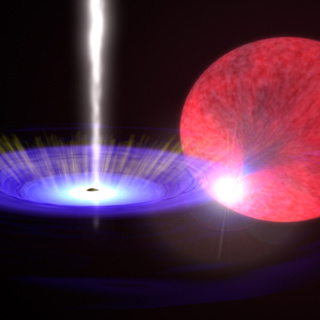
In this episode, we dive into the extreme and fascinating world of microquasars—binary systems where a compact object, like a black hole, feeds off a companion star and launches powerful, relativistic jets. Our spotlight is on GRS 1915+105, one of the most dynamic and powerful microquasars known in the Milky Way.


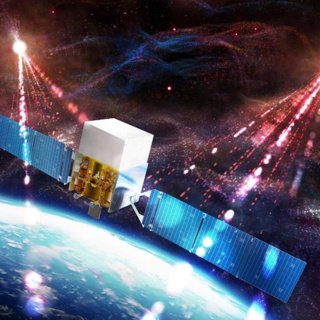
Recent groundbreaking observations from the LHAASO and Fermi-LAT observatories have mapped broadband gamma-ray emissions from this system, revealing that it operates as an extreme "PeVatron"—an accelerator capable of pushing particles to multi-PeV (peta-electron volt) energies. We break down the evidence pointing to a "hadronic scenario," which suggests that these mind-boggling energies are produced when highly accelerated protons from the jet smash into the dense ambient gas surrounding the system.


Join us as we discuss how this discovery proves that microquasars are exceptionally efficient particle accelerators and how they might be the missing link to understanding the origins of the most energetic cosmic rays in our galaxy.


Key Takeaways:

  • What is a Microquasar? A look at the anatomy of GRS 1915+105, a system featuring a black hole pulling material from a small K-type star and firing off jets at 80% the speed of light.
  • The Power of LHAASO & Fermi-LAT: How a joint analysis of 4 years of LHAASO data and 17 years of Fermi-LAT data finally detected persistent gamma-ray emissions from this source.
  • The Hadronic Accelerator: Why the shifted centroid of the gamma-ray emission suggests that protons (rather than electrons) are being accelerated by the jet's mechanical power and colliding with surrounding interstellar gas.
  • Solving a Galactic Mystery: How just a handful of microquasars like GRS 1915+105 could be responsible for supplying the entire Milky Way with PeV-level cosmic rays.


Reference:

Cao, Z., Aharonian, F., Bai, Y.X., et al. (The LHAASO Collaboration). "Extreme PeV accelerator associated with GRS 1915+105." (Preprint: 2606.25054v1).


Acknowledements: Podcast prepared with Google/NotebookLM. Illustration credits: NASA/CXC/A.Hobart

Tämä jakso on lisätty Podme-palveluun avoimen RSS-syötteen kautta eikä se ole Podmen omaa tuotantoa. Siksi jakso saattaa sisältää mainontaa.

Jaksot(112)

Peering Through the Ice: The Milky Way’s High-Energy Neutrino Signal

Peering Through the Ice: The Milky Way’s High-Energy Neutrino Signal

Peering Through the Ice: The Milky Way’s High-Energy Neutrino Signal Episode Summary: In this episode, we explore a major breakthrough in astrophysics: the IceCube Neutrino Observatory has established...

31 Heinä 20min

The Schmidt Observatory System unlocking the Transient Universe

The Schmidt Observatory System unlocking the Transient Universe

In this episode, we dive into the Eric and Wendy Schmidt Observatory System, a groundbreaking initiative designed to pioneer a new paradigm for astronomical research through rapid development, modular...

27 Heinä 21min

GUANO, NITRATES, and GLIMPSE: The Pipelines Powering Multi-Messenger Astronomy

GUANO, NITRATES, and GLIMPSE: The Pipelines Powering Multi-Messenger Astronomy

In this episode, we dive into the cutting-edge of time-domain and multi-messenger astrophysics with a deep look at BAT-GLIMPSE, a revolutionary new open-source pipeline developed for the Neil Gehrels ...

20 Heinä 20min

The Dynamic Radio Sky: Unveiling Transients with the SKAO

The Dynamic Radio Sky: Unveiling Transients with the SKAO

Welcome to a deep dive into the fast-paced, explosive universe of time-domain astronomy! In this episode, we explore how the upcoming Square Kilometre Array Observatory (SKAO) will revolutionize our u...

13 Heinä 19min

X-Raying the Earth: Neutrino Tomography at the South Pole

X-Raying the Earth: Neutrino Tomography at the South Pole

Welcome back to the podcast! Today, we are exploring a groundbreaking new way scientists are looking deep inside our planet. For a century, our understanding of the Earth's interior has relied almost ...

8 Heinä 23min

SVOM's First Year: From Gamma-Ray Bursts to Blazars

SVOM's First Year: From Gamma-Ray Bursts to Blazars

In this episode, we dive into the exciting early results from the SVOM (Space-based multi-band astronomical Variable Objects Monitor) mission, which launched in June 2024. Originally designed to hunt ...

6 Heinä 20min

SN 2024jlc: Bridging the Gap Between Supernova Classes

SN 2024jlc: Bridging the Gap Between Supernova Classes

In this episode, we dive into the fascinating discovery of SN 2024jlc, one of the closest and least luminous super-luminous supernovae (SLSNe) ever found. We explore how this extraordinary event is ch...

3 Heinä 20min

Suosittua kategoriassa Tiede

rss-poliisin-mieli
tiedekulma-podcast
rss-mita-tulisi-tietaa
rss-tiedetta-vai-tarinaa
docemilia
rss-duodecim-lehti
utelias-mieli
rss-kasvikutsut
rss-astetta-parempi-elama-podcast
radio-antro
rss-hereilla
rss-ammamafia
rss-tervetta-skeptisyytta
hippokrateen-vastaanotolla
rss-ranskaa-raakana
rss-radplus
filocast-filosofian-perusteet
mielipaivakirja
rss-bios-podcast
rss-ylistys-elaimille