
GUANO, NITRATES, and GLIMPSE: The Pipelines Powering Multi-Messenger Astronomy

GUANO, NITRATES, and GLIMPSE: The Pipelines Powering Multi-Messenger Astronomy

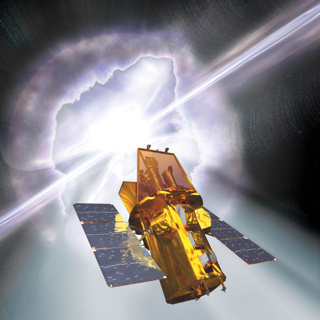
In this episode, we dive into the cutting-edge of time-domain and multi-messenger astrophysics with a deep look at BAT-GLIMPSE, a revolutionary new open-source pipeline developed for the Neil Gehrels Swift Observatory.


Historically, Swift's Burst Alert Telescope (BAT) suffered from a critical blind spot: its onboard triggering capability is intentionally disabled whenever the spacecraft is slewing (moving between targets) to prevent false alarms. With the observatory taking on more Target of Opportunity observations, the spacecraft spends more time slewing, reducing its chance to serendipitously catch Gamma-Ray Bursts (GRBs). Enter BAT-GLIMPSE (Gamma-ray Localization using Imaging and Mosaic techniques for Pointing and Slew Epochs).


We explore how this fully autonomous system uses advanced coded-mask imaging and mosaic techniques to recover arcminute positions of high-energy transients even while the telescope is in motion. We also break down how GLIMPSE works in perfect synergy with two other powerful ground-based systems:

  • GUANO (Gamma-Ray Urgent Archiver for Novel Opportunities): An automated infrastructure that commands on-demand downlinks of time-tagged event (TTE) data around external triggers.
  • NITRATES (Non-Imaging Transient Reconstruction and Temporal Search): A highly sensitive, likelihood-based pipeline that hunts for faint, sub-threshold GRBs. While extremely powerful, NITRATES is limited to periods when the spacecraft is in a stable, stationary pointing mode.


By seamlessly filling the gap left by slew intervals, BAT-GLIMPSE and NITRATES together are estimated to double the onboard arcminute-localization rate of Swift-BAT. We'll also discuss the real-world impact of GLIMPSE during the fourth LIGO-Virgo-KAGRA (LVK) observing run, where it operated in extreme low-latency to hunt for gamma-ray counterparts to gravitational waves—specifically in response to pre-merger alerts through the ULTRA-Swift project.


Reference Article:

Ronchini, S., Parsotan, T., DeLaunay, J., & Kennea, J. A. (2026). Swift gives a new BAT-GLIMPSE: Gamma-ray Localization using Imaging and Mosaic techniques for Pointing and Slew Epochs.


Acknowledements: Podcast prepared with Google/NotebookLM. Illustration credits: Spectrum Astro

Tämä jakso on lisätty Podme-palveluun avoimen RSS-syötteen kautta eikä se ole Podmen omaa tuotantoa. Siksi jakso saattaa sisältää mainontaa.

Jaksot(123)

Supernovae, TDEs, and Scintillation: How ASKAP and Rubin Are Mapping the Variable Universe

Supernovae, TDEs, and Scintillation: How ASKAP and Rubin Are Mapping the Variable Universe

In this episode, we dive into how astronomers are combining the power of the Australian Square Kilometre Array Pathfinder (ASKAP) and the Vera C. Rubin Observatory to capture the dynamic, ever-changin...

16 Loka 20min

JWST and MeerKAT Team Up: Uncovering the Most Distant Fast Radio Burst Yet

JWST and MeerKAT Team Up: Uncovering the Most Distant Fast Radio Burst Yet

Fast Radio Bursts (FRBs) are millisecond-duration radio signals originating from deep space. In this episode, we explore the groundbreaking discovery of FRB 20240304B, detected by the MeerKAT radio te...

12 Loka 20min

GRB 221009A: Measuring Relativistic Jets using Radio Interferometry

GRB 221009A: Measuring Relativistic Jets using Radio Interferometry

In this episode, we explore high-precision Very Long Baseline Interferometry (VLBI) radio observations of GRB 221009A, the brightest gamma-ray burst ever detected. Using the Global-VLBI network at 5 G...

8 Loka 21min

Unveiling GRB 240825A: Cosmic Dust, JWST, and a Supernova in Hiding

Unveiling GRB 240825A: Cosmic Dust, JWST, and a Supernova in Hiding

In this episode, we explore the cosmic mystery of GRB 240825A, a gamma-ray burst detected at redshift z = 0.659. Its short rest-frame duration and hard prompt emission initially pointed toward a compa...

5 Loka 14min

From GeV to EeV: A Data-Driven View of Cosmic Rays

From GeV to EeV: A Data-Driven View of Cosmic Rays

How do high-energy particles traveling across the universe reach Earth, and what are they made of? In this episode, we explore the Global Spline Fit (GSF), a comprehensive framework that unifies cosmi...

2 Loka 24min

From Blazars to Supernovae: Fermi’s Deepest High-Energy Sky Survey

From Blazars to Supernovae: Fermi’s Deepest High-Energy Sky Survey

In this episode, we dive into the release of the Fourth Catalog of Hard Fermi-LAT Sources (4FHL). Utilizing 16 years of continuous data from NASA's Fermi Gamma-ray Space Telescope, this catalog provid...

29 Syys 23min

GRB 220706A: The Longest-Lived Gamma-Ray Burst Engine Ever Seen

GRB 220706A: The Longest-Lived Gamma-Ray Burst Engine Ever Seen

In this episode, we explore the extraordinary discovery of GRB 220706A, a record-shattering cosmic explosion at redshift z = 0.8577. While most gamma-ray burst engines die down within minutes, X-ray f...

24 Syys 19min

Chasing Kilonovae: How LIGO-India Multiplies Multimessenger Discoveries

Chasing Kilonovae: How LIGO-India Multiplies Multimessenger Discoveries

In this episode, we explore the future of multimessenger astronomy as neutron star–black hole (NSBH) mergers take center stage. While binary neutron star collisions have delivered iconic multimessenge...

18 Syys 21min

Suosittua kategoriassa Tiede

tiedekulma-podcast
utelias-mieli
rss-mita-tulisi-tietaa
rss-duodecim-lehti
rss-hereilla
docemilia
rss-kasvikutsut
rss-vaasan-yliopiston-podcastit
rss-poliisin-mieli
rss-kasvatuspsykologiaa-kaikille







