How Movement Builds the Brain, the Body & Human Performance (Phase 3 Introduction)

How Movement Builds the Brain, the Body & Human Performance (Phase 3 Introduction)

Season 16, Episode 402 explores the Brain's Operating System for Human Performance, focusing on Phase 3: movement, adaptation, and performance. Andrea Samadi explains how movement triggers neurochemicals and blood flow, recovery enables adaptation, and measurable performance follows.

The episode shows how consistent, purposeful movement plus prioritized recovery creates lasting biological change—improved sleep, lower resting heart rate, higher VO2 max, and clearer thinking—and offers simple strategies to build the movement loop into daily life.

EP 402 — Introducing Phase 3

Movement, Adaptation & Performance

Watch Andrea teach this episode on YouTube https://youtu.be/Btaihnb5HPs

On EP 402, We'll Cover:

    Why movement is the missing link in human performance—and why the brain evolved to move before it learned. The Brain's Operating System for Human Performance—how the first three phases connect to create lasting change. The Movement Loop—my new framework explaining how movement leads to adaptation and ultimately performance. The science of adaptation—why the workout isn't what changes you, but the body's response during recovery is. My personal performance experiment—how tracking recovery, resting heart rate, heart rate variability, VO₂ Max, sleep, body composition, and biological age revealed measurable evidence of neuroscience in action. How the world's leading experts helped build this framework—and how their research fits together into one repeatable system. A preview of Phase 3—what you'll learn from Dr. Chuck Hillman, Dr. John Ratey, Kristen Holmes, Dr. John Medina, Jason Whitrock, and the bonus episodes throughout this season. Practical strategies you can begin using immediately to help your brain learn more effectively, your body adapt more efficiently, and your performance improve over time.

Opening

Welcome back to Season 16 of the Neuroscience Meets Social and Emotional Learning Podcast.

I'm Andrea Samadi, and this is where we bridge neuroscience, social and emotional learning, and human performance so we can create measurable improvements in our well-being, achievement, leadership, productivity, and results.

Seven years ago, when we launched this podcast, I started with one simple question:

If results matter—and they matter now more than ever—how exactly are we using our brain to create those results?

This question stemmed from the fact that very few of us were ever taught how the brain actually learns.

How motivation begins.

How emotions shape decisions.

How relationships influence performance.

Or how movement changes the brain.

That single question has taken us on an incredible journey through neuroscience, psychology, education, leadership, and human performance.

But something unexpected happened along the way.

I thought I was collecting interviews.

Instead...

I discovered that I was uncovering a system.

Looking back now, over the past 7 years, I realized every expert was describing the same mountain (or obstacle to overcome) but just from a different side (or with a different strategy).

One explained motivation.

Another explained attention.

Another explained learning.

Or repetition.

Another explained recovery.

Another explained movement.

None of them contradicted each other.

They completed each other.

That was the moment I realized...

I wasn't collecting interviews.

I was assembling a blueprint.

A Personal Discovery

But there was still one question I couldn't answer.

How would these ideas actually work together in everyday life?

Could they work for anyone? Not a pro athlete who has all day to train, but a regular person, like me, who was determined to improve their health, well-being and productivity and results.

That's when I stopped being just the interviewer...

and participated in the experiment.

Over the past year, I wasn't trying to become younger. I think our 50s, 60s and beyond, are an incredible time to practice and perfect our health beyond what we might have been able to do without as much effort in our 40s or younger.

Looking back, I can honestly say that I wasn't trying to lower my resting heart rate. It just started to show up in my data when I did certain things, in a certain way.

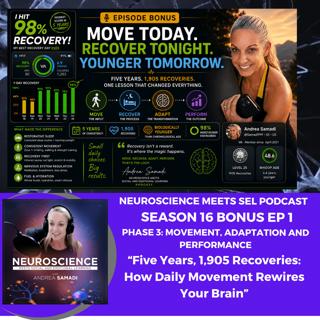
I wasn't trying to improve my WHOOP age (with my wearable device) or optimize my daily recovery score.

I was simply trying to answer another question.

If movement really changes the brain...

Could I actually measure this?

Can how much I move improve my data, and can I move too much (push too hard) and measure that as well?

So I began paying much closer attention to my own data, and looking at what it meant.

Not because I wanted better numbers. Well I did want better numbers, but I also wanted evidence. Something that could be replicated for others.

There’s lots of ways to measure our data with wearable devices. I used the Whoop wearable, something I have been wearing for the past 5 years.

I was focused on my daily recovery.

My resting heart rate.

Heart rate variability.

VO₂ Max.

Sleep (specifically how much stress I had while sleeping), REM sleep, and restorative sleep.

Body composition (how much fat and how much muscle)

Then I looked at my hiking performance (did I need to run fast with a weighted vest to get zone 4 and 5), or could I walk along the canal with my dogs, and get my heart rate up that high without having to drive to the mountain.

I looked at how high my heart rate went up with strength training.

Week after week...

Month after month...

A pattern began to emerge.

The improvements weren't random.

They were connected.

When I moved consistently...some easier workouts walking with one or two harder push hiking days, with some days at the gym on the stair climber, and others on the elliptical.

My recovery improved.

My resting heart rate dropped.

My biological age became younger.

My body became stronger.

My mind became clearer.

Long hikes felt easier.

The numbers weren't the story.

Adaptation was.

For the first time, I wasn't just reading neuroscience week after week.

I was watching it happen inside my own body.

And that's when something clicked.

Movement starts the change.

Recovery allows the change.

Adaptation becomes the change.

And performance is simply the evidence that the change occurred.

That realization became the foundation for everything you're about to hear this season.

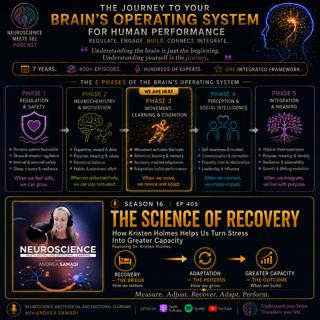
The Brain's Operating System

As I reviewed hundreds of conversations with world-leading researchers over the past seven years, I realized these ideas weren't isolated discoveries.

They fit together.

Like pieces of one much larger puzzle.

Today, I call that framework...

The Brain's Operating System for Human Performance.

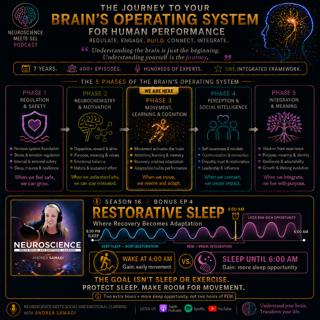
It's built on five interconnected phases.

Each one depends on the one before it.

Phase 1 — Regulation & Safety[i]

Before the brain can learn...

it must first feel safe.

Phase 2 — Neurochemistry & Motivation

Meaning creates motivation.

Motivation creates action.

Action begins change.

Phase 3 — Movement, Adaptation & Performance

Movement changes the brain.

Adaptation changes the body.

Together they create lasting performance.

Phase 4 — Perception & Social Intelligence

Understanding ourselves.

Understanding others.

Building trust.

Strengthening relationships.

Phase 5 — Integration & Meaning

Where knowledge becomes wisdom.

Experience becomes insight.

Performance becomes purpose.

Performance doesn't begin at the finish line.

It begins with the foundations.

And every phase strengthens the next.

Why Phase 3 Matters

For decades we've treated learning as though it happens inside classrooms...

inside books...

inside meetings...

inside our heads.

But evolution tells a very different story.

The brain didn't evolve to sit still.

It evolved to move.

Movement came first.

Learning followed.

Every step we take increases blood flow.

Releases powerful neurochemicals like BDNF.

Sharpens attention.

Improves executive function.

Creates the biological conditions for learning.

Movement isn't simply exercise.

It's the input that begins one of the most remarkable biological cycles in the human body.

The Power of Loops

I had to create another loop to show how this works.

Nature rarely works in straight lines.

Our hearts beat in rhythms.

Our lungs breathe in cycles.

Sleep follows repeating stages.

The seasons repeat.

Life itself is built on loops.

Human performance is no different.

The greatest mistake we've made is thinking performance is a destination. Or an end result that we will celebrate when we get there.

Neuroscience shows us it's actually a cycle.

One that repeats every single day.

I call it...

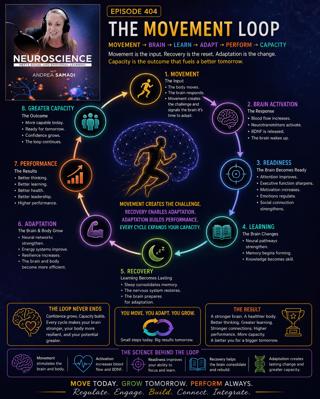
The Movement Loop.

One of the biggest shifts I've made while building this framework is changing the way I think about exercise.

Most of us think the workout is the goal. Or we think “I’ve got to go the gym” and I’m not sure about you, but my old way of thinking used to be something along the lines of “to burn fat, or calories, or so I can create a deficit with the workout.”

But Neuroscience—and exercise physiology—tell us something very different.

The workout is only the beginning.

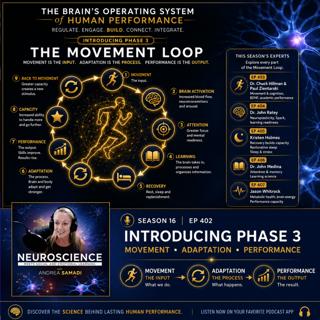
Think of it by looking at the movement loop.

Movement is the Input

Every system begins with an input.

For our bodies, that input is movement.

Whether it's a walk around the neighborhood, a strength-training session, a yoga class, or a hike in the mountains, movement sends a message to the brain and body.

It says:

"Something is being asked of you."

The brain responds immediately.

Blood flow increases.

Attention sharpens.

Neurochemicals like BDNF are released.

The nervous system begins preparing for change.

Movement isn't what changes us.

Movement is what tells the body that change is needed.

Adaptation is the Process

This is where the real transformation happens.

Not while we're exercising.

But afterward.

During recovery.

While we sleep.

While proteins rebuild muscle.

While neural pathways strengthen.

While the cardiovascular system becomes more efficient.

While the brain reorganizes itself through neuroplasticity.

Adaptation is the body's remarkable ability to respond to the demands we've placed upon it.

If we repeat the right inputs consistently, the body doesn't simply recover.

It becomes more capable.

This is why recovery isn't the opposite of growth.

Recovery is the process that makes growth possible.

Performance is the Output

Performance is simply the visible result of this successful adaptation.

It's thinking more clearly during an important meeting.

Remembering information more easily.

Feeling stronger day to day.

Recovering faster after stress.

Leading with greater confidence.

Sleeping more deeply.

Seeing your resting heart rate decline.

Watching your VO₂ Max improve.

Noticing your biological age become younger.

Performance isn't one great day. Or one workout.

It's the evidence that your brain and body have adapted over time to your repeated efforts.

Then the Cycle Begins Again

The beautiful part is that the process never ends.

Today's performance becomes tomorrow's starting point.

As you become more capable, your brain and body are ready for the next challenge.

So you move again.

You recover again.

You adapt again.

You perform at an even higher level.

This is why I call it The Movement Loop.

It's not a one-time event.

It's a lifelong cycle of growth.

Every walk.

Every workout.

Every good night's sleep.

Every recovery day.

Every healthy habit.

You're sending your brain and body another message:

"I’m becoming a little more capable than yesterday."

That's how sustainable human performance is built.

Not through one extraordinary effort.

But through thousands of ordinary repetitions that, over time, create extraordinary results.

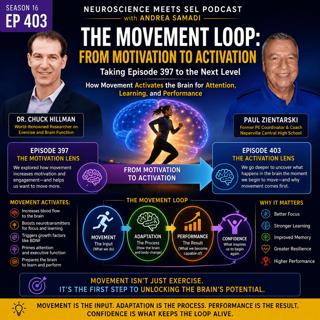
Movement

The body moves.

The brain responds.

Brain Activation

Blood flow increases.

BDNF and other neurochemicals are released.

The brain becomes ready to learn.

Attention

Executive function improves.

Focus sharpens.

Mental readiness increases.

Learning

New neural pathways strengthen through repetition and experience.

Knowledge becomes skill.

Recovery

Sleep, regulation, and restoration allow the brain and body to rebuild.

Recovery isn't the opposite of growth.

Recovery is what makes growth possible.

Adaptation

The nervous system becomes more efficient.

The cardiovascular system becomes stronger.

Metabolism improves.

The brain becomes more resilient.

The body becomes more capable.

Performance

Performance isn't a single event.

It's a capacity.

The ability to think clearly.

Learn faster.

Recover better.

Move more efficiently.

Lead with greater confidence.

Confidence

Success reinforces belief.

Belief increases motivation.

Confidence encourages us to move again.

And the cycle repeats.

The Movement Loop doesn't end with performance.

Performance creates confidence.

Confidence inspires more movement.

And every repetition builds a stronger brain and a stronger body.

Throughout this phase we'll explore every step of this loop with some of the world's leading experts.

Movement changes the brain.

Adaptation changes the body.

Performance changes your life.

The Experts

EP 403 — Dr. Chuck Hillman & Paul Zientarski

Movement is the Trigger

We'll discover why exercise is one of the most powerful ways to prepare the brain for learning through BDNF, executive function, cognition, and academic performance.

Key takeaway: Every adaptation begins with movement.

EP 404 — Dr. John Ratey

The Brain Adapts

We'll revisit the groundbreaking work from his book Spark to understand how exercise literally rewires the brain through neuroplasticity and prepares us for learning.

Key takeaway: Exercise changes the brain before it changes performance.

EP 405 — Kristen Holmes

Adaptation Happens During Recovery

We'll explore why sleep, recovery, nervous system regulation, and capacity building determine whether the body actually adapts.

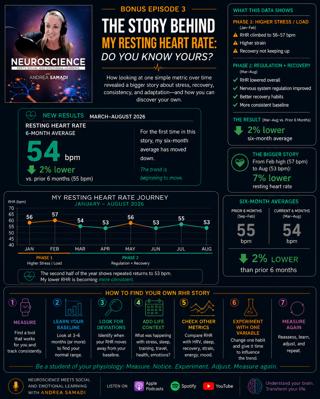
This is also where I'll share my own WHOOP data—including recovery trends, resting heart rate, and biological age—to show how adaptation becomes measurable.

Key takeaway: Recovery builds capacity. Consistency creates adaptation.

EP 406 — Dr. John Medina

Learning Creates Better Performance

Attention, memory, and learning science come together to explain how movement-supported learning becomes real-world performance.

Key takeaway: What we learn shapes how we perform.

EP 407 — Jason Whitrock

Adaptation Changes the Body

We'll explore metabolic health, brain energy, body composition, VO₂ Max, and performance capacity while connecting the neuroscience of movement with measurable physiological adaptation.

This is where I'll bring together my own data on muscle gain, fat loss, cardiovascular fitness, and healthy aging.

Key takeaway: Movement changes the brain. Adaptation changes the body. Together they transform performance.

Bonus Episodes

Throughout Phase 3 I'll also be sharing several bonus episodes using my own health data as a living case study.

We'll explore:

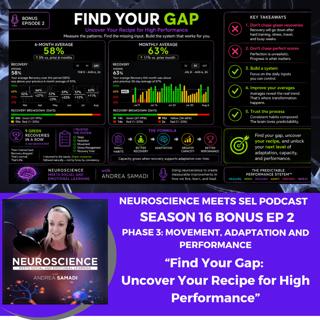
    Why recovery is built—not found (so we need to build it into our day strategically). The story behind my resting heart rate. How adaptation changed my body. How it works when you Move Today so you can become Younger Tomorrow. Restorative Sleep Sleep Stress

These episodes connect neuroscience to real-world data and show what happens when consistent habits become measurable biological change.

Because neuroscience isn't just something we study.

It's something we can measure.

It's something we can experience.

And ultimately...

it's something we can use to become healthier...

stronger...

more resilient...

and more capable throughout every stage of life.

Key Takeaways for Today

    Movement is the input. (what we do) Every meaningful change begins with movement. It prepares the brain for learning by increasing blood flow, oxygen, and neurochemicals like BDNF that support attention, learning, and neuroplasticity.

The actions we choose every day that provide the brain and body with a stimulus for change.

    Movement Exercise Walking Strength training Recovery habits Nutrition Sleep
    Adaptation is the process. The workout doesn't change you. Your body's response during recovery does. Every period of quality sleep, recovery, and restoration is an opportunity for your brain and body to become stronger and more efficient.

Adaptation — What Happens The brain and body respond to those inputs by becoming more efficient and more capable.

    Neuroplasticity Increased BDNF Stronger neural pathways Improved cardiovascular fitness Muscle repair and growth Better metabolic health Nervous system regulation
    Performance is the output. High performance isn't something we find—it's something we build. Every repetition of the Movement Loop increases your capacity to learn, lead, recover, and perform.

Output — The Result The measurable improvements we experience because of adaptation.

    Better focus Faster learning Higher energy Greater resilience Lower resting heart rate Improved VO₂ Max Better body composition Higher performance Greater healthspan
    What gets measured becomes visible. Tracking meaningful metrics—such as recovery, resting heart rate, VO₂ Max, sleep, or body composition—helps you see adaptations that would otherwise go unnoticed and reinforces the habits creating them. Your brain and body are one interconnected system. Better thinking, stronger physical health, emotional resilience, and sustained performance all emerge from the same biological process of movement, adaptation, and continuous growth.

Tips to Implement This Week

✓ Move with purpose every day. Aim for 30–60 minutes of purposeful movement—whether it's a brisk walk, strength training, cycling, yoga, or hiking. Remember, consistency matters more than intensity. Every movement is a signal to your brain and body to adapt. A walk after dinner, when kept consistent, can have an incredible impact on your overall health improvement. You don’t need to go all out for results to show up.

Start paying attention to your body’s signals.

You don’t need a WHOOP or smartwatch to begin.

Simply notice how you feel before and after movement.

Ask yourself:

    Do I think more clearly? Is my mood better? Do I have more energy? Am I sleeping better?

Your body is always giving you feedback.

Learn to listen.

✓ Protect your recovery. Treat tonight's sleep as part of today's workout. Prioritize restorative sleep, manage stress, and allow your brain and body the time they need to repair, rebuild, and become stronger. We are all at different stages here. This one is always a work in progress for me. I ran into someone I used to see every Saturday on the hiking trails this morning, and I asked him where he had been, or if he was hiking at a different time. I used to see him like clockwork and I noticed he wasn’t there as usual. He told me that he was protecting his sleep, and worked out indoors more when the weather was getting hot. In order to beat the heat in AZ, early mornings are the best time for this, but this guy knew to protect his recovery. I thought it was brilliant that he was able to practice what he knew to be important.

✓ Measure one meaningful metric.

Choose one health measure—such as your resting heart rate, sleep quality, daily steps, recovery score, or VO₂ Max—and observe how it changes over time. You're not looking for perfection; you're looking for patterns that reveal adaptation. I’ll share what I noticed over time on our bonus episodes by watching certain metrics.

This has been one of my biggest discoveries.

For years I assumed harder was always better.

But when I compared my data…you can see 2 of my data charts in the show notes.

I found something surprising.

A long hike and a morning walk created very different responses.

My hikes pushed my cardiovascular system into higher heart-rate zones.

My walks kept me primarily in Zone 1 while reducing stress and supporting recovery.

Both improved my health.

They simply trained different systems.

Instead of asking…

“Was today’s workout hard enough?”

Ask…

“What system am I training today?”

✓ Move before you think. Before beginning a challenging project, studying for an exam, or making an important decision, spend five to ten minutes moving your body. Then notice how your focus, mood, creativity, and mental clarity improve.

✓ Think in loops, not isolated workouts. Instead of asking, "Did I exercise today?" ask yourself:

"How did I support tomorrow's brain today?"

Every walk.

Every workout.

Every healthy meal.

Every recovery day.

Every night of restorative sleep.

Each one is another step around the Movement Loop—helping your brain learn, your body adapt, and your performance improve over time.

Review & Conclusion

Review and Conclude EP 402, Phase 3: Movement, Adaptation & Performance.

As we close today, I hope you're (like I did) beginning to see movement differently.

Not simply as exercise. Or to burn calories.

Not simply as another item on your to-do list.

But as the biological signal that tells your brain and body it's time to grow.

Throughout Phase 3, we'll discover that movement does far more than strengthen muscles.

It sharpens attention.

It accelerates learning.

It builds resilience.

It strengthens the nervous system.

It improves recovery.

And over time, it transforms both the brain and the body through the remarkable process of adaptation.

This season isn't about becoming an elite athlete.

It's about becoming someone who understands how lasting performance is built.

Together, we'll explore one simple but powerful truth:

Movement is the input (what we do)

Adaptation is the process (what happens when we do it)

Performance is the output (what we get from doing it)

Then the cycle begins again.

That's the Movement Loop.

Every walk.

Every workout.

Every night of restorative sleep.

Every healthy choice.

Every recovery day.

Each one is another opportunity to build a stronger brain, a healthier body, and a greater capacity to learn, lead, and perform.

Because when movement changes the brain...

the brain changes the body.

And when the brain and body begin working together...

performance is no longer something we chase.

It's something we build—

one movement,

one recovery,

one adaptation,

one day at a time.

Next week, we'll begin our journey around the Movement Loop with EP 403, revisiting Dr. Chuck Hillman and Paul Zientarski, where we'll discover why every lasting transformation begins with movement—and why a single step today can change the trajectory of our brain, our health, and our performance tomorrow.

Thank you for joining me, and I'll see you next week.

RESOURCES:

Phase 1 Anchor Episodes

    Episode 384 — Dr. Baland Jalal Curiosity, Sleep & Imagination → How curiosity, sleep, and imagination prepare the brain for learning and creativity. Episode 385 — Dr. Bruce Perry Trauma, Rhythm & Relational Safety → Why regulation and safety are the foundation for learning and performance. Episode 386 — Thoryn Stephens Biometrics & Performance → Turning HRV, sleep, and metabolic data into actionable performance strategies. Episode 387 — Dr. Sui Wong Lifestyle Medicine & Brain Health → How autonomic balance and healthy habits build long-term brain resilience. Episode 388 — Rohan Dixit HRV & Self-Regulation → Developing nervous system awareness through real-time biofeedback and HRV.

Phase 2 Anchor Episodes

    Episode 393 — Bob Proctor Belief → Why our beliefs determine the actions we take and the results we create. Episode 394 — Dr. Caroline Leaf Thought Patterns → How our thoughts shape neurochemistry, behavior, and long-term performance. Episode 395 — Dr. John Medina Attention & Reward → Why attention determines what the brain values, remembers, and learns. Episode 396 — Dr. Anna Lembke Neurochemistry & Reinforcement → How dopamine reinforces behavior and why sustainable motivation matters more than borrowed dopamine. Episode 397 — Dr. Chuck Hillman Movement & Brain Activation → How physical movement prepares the brain for learning, focus, and performance. Episode 398 — Dr. Friederike Fabritius Neuroleadership & Energy → How to manage brain energy and sustain high performance over time.

REFERENCES:

[i] Neuroscience Meets Social and Emotional Learning Podcast EPISODE 384 “How Learning Begins in the Brain: Sleep, Safety and Curiosity (Revisiting Dr. Baland Jalal) https://andreasamadi.podbean.com/e/hypnagogic-genius-capture-your-best-ideas-at-the-edge-of-sleep/

Tämä jakso on lisätty Podme-palveluun avoimen RSS-syötteen kautta eikä se ole Podmen omaa tuotantoa. Siksi jakso saattaa sisältää mainontaa.

Jaksot(406)

Trust as the Foundation with Greg Hill: How Great Leaders Create the Conditions for Learning, Growth and Performance

Trust as the Foundation with Greg Hill: How Great Leaders Create the Conditions for Learning, Growth and Performance

In episode 401 Andrea Samadi welcomes Greg Hill to explore why trust is the essential foundation for learning, growth, and high performance. They discuss how trust creates psychological safety, encour...

27 Kesä 37min

Episode 400: Sales Leadership Under Pressure with Majid Samadi: 7 Lessons Learned from 7 Years of Neuroscience

Episode 400: Sales Leadership Under Pressure with Majid Samadi: 7 Lessons Learned from 7 Years of Neuroscience

In this milestone episode (400), Andrea Samadi celebrates seven years of the Neuroscience Meets SEL Podcast with her husband Majid Samadi. They reflect on the journey of translating neuroscience into ...

20 Kesä 47min

Phase 2 Review: The Motivation Loop: How to Keep Effort Worthwhile

Phase 2 Review: The Motivation Loop: How to Keep Effort Worthwhile

Episode 399 reviews Phase 2 of Season 15 and introduces the Motivation Loop — the sequence of meaning, belief, attention, action, reward, and recovery that drives sustained effort. The episode explain...

14 Kesä 28min

Fun, Fear, Focus: Closing the Motivation Loop with Friederike Fabritius

Fun, Fear, Focus: Closing the Motivation Loop with Friederike Fabritius

Episode 398 revisits neuroscientist Friederike Fabritius (from November 2022) to explain how three ingredients — fun (dopamine), fear (productive challenge), and focus — create the neurochemical condi...

9 Kesä 23min

Move to Learn: How Movement Activates the Brain and Fuels Motivation (with Dr. Chuck Hillman and Paul Zientarski)

Move to Learn: How Movement Activates the Brain and Fuels Motivation (with Dr. Chuck Hillman and Paul Zientarski)

Season 15, Episode 397 revisits research and real-world practice showing movement is more than fitness: it activates the brain, boosts attention, enhances learning, and sustains motivation. Dr. Chuck ...

31 Touko 35min

Dopamine, Motivation and Why the Brain Repeats Behavior with Dr. Anna Lembke

Dopamine, Motivation and Why the Brain Repeats Behavior with Dr. Anna Lembke

Host Andrea Samadi welcomes Dr. Anna Lembke to explain how pleasure and pain share the same neural circuitry and how dopamine governs motivation. The episode explores why overconsumption of easy rewar...

24 Touko 23min

Theory of Mind: The Missing Link Between Attention, Reward, and Motivation with John Medina

Theory of Mind: The Missing Link Between Attention, Reward, and Motivation with John Medina

Episode 395 explores how theory of mind — our ability to understand others' intentions — drives attention, emotional relevance, and reward, shaping motivation and behavior. Dr. John Medina explains wh...

17 Touko 37min

Suosittua kategoriassa Koulutus

rss-murhan-anatomia
psykopodiaa-podcast
rss-arkea-ja-aurinkoa-podcast-espanjasta
rss-narsisti
rss-liian-kuuma-peruna
voi-hyvin-meditaatiot-2
rahapuhetta
adhd-podi
kesken
rss-vuosikymmenen-ilmastoteko
jari-sarasvuo-podcast
filocast-filosofian-perusteet
rss-vapaudu-voimaasi
aamukahvilla
salainen-paivakirja
ihminen-tavattavissa-tommy-hellsten-instituutti
rss-tripsteri
rss-valo-minussa-2
rss-laadukasta-ensihoitoa
rss-luonnollinen-synnytys-podcast