Fun, Fear, Focus: Closing the Motivation Loop with Friederike Fabritius

Fun, Fear, Focus: Closing the Motivation Loop with Friederike Fabritius

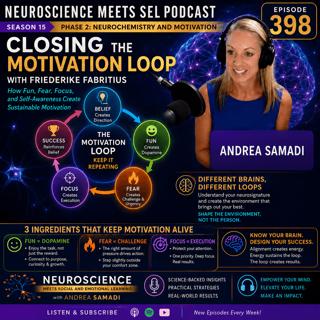
Episode 398 revisits neuroscientist Friederike Fabritius (from November 2022) to explain how three ingredients — fun (dopamine), fear (productive challenge), and focus — create the neurochemical conditions for sustained motivation and flow.

You'll also learn why individual neurosignatures matter and how designing environments that match your brain, rather than forcing yourself to change, makes effort easier and motivation durable.

Welcome back to Season 15 of the Neuroscience Meets Social and Emotional Learning Podcast.

I'm Andrea Samadi, and on this podcast, we bridge the science behind social and emotional learning, emotional intelligence, and practical neuroscience so we can create measurable improvements in well-being, achievement, productivity, and results.

In This Episode 398, Closing the Motivation Loop, with Friederike Fabritius, We Will Cover:

✔ How FUN, FEAR, and FOCUS create the neurochemical conditions for sustainable motivation

✔ Why dopamine is more than a pleasure chemical—and how it fuels motivation, anticipation, effort, and reinforcement

✔ How FUN creates dopamine and keeps us engaged in meaningful work

✔ Why the right amount of FEAR (challenge) drives growth without causing burnout

✔ How FOCUS converts energy, attention, and motivation into measurable results

✔ The connection between FUN, FEAR, FOCUS, and the Motivation Loop

✔ Why different brains require different motivation strategies

✔ Understanding your unique "Neurosignature" and how it influences performance

✔ How dopamine interacts with other neurochemicals like testosterone, estrogen, serotonin, and oxytocin

✔ Why sustainable motivation begins with self-awareness

✔ The Stress vs. Performance Curve and finding your optimal challenge zone

✔ How under-challenge leads to boredom and over-challenge leads to burnout

✔ Why peak performance occurs when challenge matches your brain's needs

✔ How to design environments that support attention, motivation, and performance

✔ Why the strongest motivation loops are powered by alignment—not willpower

✔ Practical strategies to create the conditions where your brain naturally wants to engage and perform

✔ How self-awareness, energy management, and neurochemistry work together to sustain long-term success

✔ What keeps the Motivation Loop repeating—and what causes it to break

✔ How to close Phase 2: Neurochemistry & Motivation and prepare for Phase 3: Movement, Learning & Cognition

🧠 Big Takeaway

✔ Sustainable motivation isn't something we force—it’s something we create by aligning our beliefs, thoughts, attention, neurochemistry, movement, and environment so that effort becomes meaningful, progress becomes rewarding, and the Motivation Loop continues to repeat.

The Big Idea for EP 398

This week, we continue our journey through Phase 2: Neurochemistry and Motivation, where we've been exploring one central question:

What drives sustained effort and forward movement?

How do we sustain this cycle over months, years, and even decades without burning out?

If EP 392-397 have taken us around the motivation loop, Friederike Fabritius today is the person who explains how to keep the loop repeating as we look at energy and sustainability.

Today we will revisit Friederike Fabritius to help us to close the motivation loop.

Looking at our roadmap graphic we began with:

Belief (Bob Proctor)[i] → Why you start something (The power of our beliefs and internal drive).

Thought Patterns (Dr. Caroline Leaf)[ii] → What we think and how what we think shapes our neurochemistry and results.

Attention & Reward (Dr. John Medina)[iii] → Showed us that attention determines what the brain decides matters.

Neurochemistry & Reinforcement (Dr. Anna Lembke)[iv] → Showed us why dopamine reinforces behavior and why motivation can break when we rely on borrowed dopamine.

Movement (Chuck Hillman)[v] → How movement activates the brain and fuels action for learning and performance.

Neuroleadership & Energy (Friederike Fabritius) → How to sustain all of it, over time

This is the missing piece.

For today’s episode, 398, we’ll review 2 clips from Friderike Fabritius through the lense of our motivation loop.

CLIP 1-FUN, FEAR & FOCUS = The Ingredients That Keep The Loop Alive

🎥 CLIP 1: The Neurochemical Formula for Sustainable Motivation

Let’s revisit Friederike Fabritius who explains that only 20% of people feel passionate about their jobs, and 40% never experience flow. Her solution? Three ingredients that create the optimal neurochemical environment for peak performance: FUN, FEAR, and FOCUS.

We’ve already covered this concept in EP 373[vi], but today we revisit this clip through the lens of the Motivation Loop.

Belief creates direction

Fun creates dopamine

Fear creates urgency

Focus creates execution

Success reinforces belief

Loop repeats

Looking back now, I see that Friederike’s Formula: Fun, Fear and Focus weren't just workplace performance tools.

They were actually the mechanism that keeps the motivation loop alive.

Let’s listen to CLIP 1.

💡 Key Takeaway #1

FUN Creates Dopamine and Fuels Motivation

Friederike explains that when we genuinely enjoy the task we're doing—not the reward afterward—our brain releases dopamine.

This is important because dopamine isn't just the "pleasure chemical."

As Dr. Anna Lembke taught us in EP 396, dopamine is the chemical of:

✔ Motivation

✔ Anticipation

✔ Pursuit

✔ Reinforcement

In the Motivation Loop, dopamine helps answer the question:

"Is this effort worth it?"

When the answer is YES, we keep moving forward.

Motivation Loop Connection:

Belief → Fun → Dopamine → And then we will put in the needed Effort

The more meaningful and enjoyable the work feels, the more likely we are to stay engaged and continue the cycle.

🔑 Tip to Implement

Ask yourself:

What part of my work do I genuinely enjoy?

Does the work you are doing REALLY excite you?

Look for ways to spend more time in tasks that naturally spark curiosity, creativity, learning, or growth.

If a task feels boring, connect it to a larger purpose or outcome that matters to you.

REFLECTION: I’m doing this RIGHT now, as I’m working on something in my work life that I’m really excited about. When the dots connect with what you are doing, you will put in the effort needed for the execution of what you are doing, as well as the energy to help you to overcome the obstacles that will come your way.

💡 Key Takeaway #2

FEAR Creates Productive Tension

Friederike isn't talking about chronic stress or anxiety (that we know tanks our sleep and overall performance).

She's talking about challenge.

The right amount of pressure pushes us into action.

Without challenge, motivation declines and we drift toward boredom and apathy.

Too much pressure creates overwhelm and burnout.

The sweet spot is what psychologists call the Flow Zone—where challenge meets skill.

Motivation Loop Connection:

Dopamine → Challenge → Effort → Progress

Challenge gives the brain a reason to stay engaged.

Without challenge, there is no growth.

🔑 Tip to Implement

Ask yourself:

Have I become too comfortable?

Create a healthy challenge this week:

✔ Learn a new skill

✔ Take on a project slightly beyond your comfort zone

✔ Set a meaningful deadline

✔ Ask others for feedback so you can be sure that your efforts will be successful.

Growth requires just enough discomfort to keep the brain engaged.

💡 Key Takeaway #3

FOCUS Converts Energy Into Results

John Medina taught us in EP 395 that attention determines what the brain decides matters.

Friederike's third ingredient—FOCUS—is where motivation becomes action.

Without focus:

    dopamine gets scattered attention gets divided effort becomes inconsistent

With focus:

    attention narrows performance improves progress becomes visible

Motivation Loop Connection:

Attention → Focus → Results → Reinforcement

The brain repeats what it sees working.

Focus allows us to generate the results that reinforce future motivation.

🔑 Tip to Implement

Protect one block of uninterrupted focus every day.

Even 30–60 minutes of distraction-free work can create momentum that carries into the rest of the day.

Ask yourself:

What is the ONE task today that deserves my best attention? Then complete the task.

I love creating LISTS and check off items that I accomplish from this list, which in itself gives me an extra boost of dopamine.

The Bigger Lesson Here

Looking back at everything we've covered in Phase 2, I think Friederike's FUN, FEAR, and FOCUS framework may be one of the simplest ways to understand how the Motivation Loop keeps repeating.

FUN provides the dopamine.

FEAR provides the challenge.

FOCUS provides the execution.

When these three elements are balanced, we enter a state of flow where effort feels rewarding, progress reinforces belief, and motivation becomes self-sustaining.

Reflection

Ask yourself:

✔ Do I have enough FUN in my work to create dopamine?

✔ Do I have enough FEAR or challenge to prevent boredom?

✔ Do I have enough FOCUS to turn effort into results?

Because when FUN, FEAR, and FOCUS work together, the Motivation Loop doesn't break—it repeats.

🎥 CLIP 2: Different Brains, Different Motivation Loops

In clip 2, Friederike reminds us that there is no one-size-fits-all formula for motivation.

People respond differently to challenge, stress, rewards, and work environments because of differences in their neurochemistry and what she calls their neurosignature. Revisit EP 258[vii] to review our interview on The Brain Friendly Workplace and EP 257.[viii]

As we've seen throughout Phase 2, dopamine plays a central role in motivation. But dopamine doesn't work alone. It interacts with other neurochemicals like testosterone, estrogen, serotonin, and oxytocin, creating unique patterns that influence how each of us performs under pressure.

This helps explain why the same environment can energize one person and exhaust another.

💡 Key Takeaway #1 Sustainable Motivation Requires Self-Awareness

One of the biggest lessons from Phase 2 is that motivation is personal.

What motivates one person may completely demotivate another.

Some people thrive under pressure and tight deadlines.

Others perform best with collaboration, connection, and psychological safety.

Friederike suggests that instead of trying to change people, we should first understand how their brains work.

Motivation Loop Connection

Belief → Effort → Feedback → Repeat

The loop works best when the environment matches the person.

When there is a mismatch between our neurochemistry and our environment, effort becomes draining instead of energizing.

Over time, the loop breaks.

🔑 Tip to Implement Clip 2 to Sustain our Motivation

Ask yourself:

When am I performing at my best?

    Under pressure or with preparation? Working independently or collaboratively? With structure or flexibility?

Look for patterns rather than trying to force yourself into someone else's formula for success.

I know that I work best with just enough pressure to push me to perform, but not too much that my brain shuts down. I like to work independently, with the ability to collaborate with others to fill in the gaps, so that together, we are stronger.

For example, Friederike says that “people high in dopamine are curious, energetic, and future-oriented. Inventors and entrepreneurs tend to have this neurosignature. They get bored easily and are always looking for the next new exciting project.”

How do you perform at your best? Understanding your own neurosignature will help you here.

💡 Key Takeaway #2 Peak Performance Happens When Challenge Matches Your Brain

Back in EP 373, Friederike introduced us to the Stress vs. Performance Curve.

Too little challenge leads to boredom and apathy.

Too much challenge leads to anxiety and burnout.

Peak performance exists in the middle.

What this clip adds is that everyone's optimal stress point is different.

Motivation Loop Connection

This is where many motivation loops break.

If challenge is too low:

➡ Dopamine drops

➡ Attention drifts

➡ Effort decreases

If challenge is too high:

➡ Stress overwhelms focus

➡ Recovery suffers

➡ Burnout follows

The goal is not maximum stress.

The goal is optimal stress.

🔑 Tip to Implement

Think about the past year.

Ask yourself:

When did I feel most energized and productive?

Then ask:

Was I under-challenged, over-challenged, or appropriately challenged?

Adjust your workload accordingly.

💡 Key Takeaway #3 Stop Trying to Fix Yourself and Start Designing Your Environment

This may be Friederike's most important insight.

She says we spend too much time trying to mold people to fit jobs.

Instead, we should shape environments that allow different brains to thrive.

This aligns perfectly with what we've learned from:

    Dr. John Medina on attention Dr. Anna Lembke on dopamine Dr. Chuck Hillman on movement Dr. Caroline Leaf on thought patterns

The brain performs best when the environment supports success.

Motivation Loop Connection

The strongest motivation loops are not powered by willpower.

They're powered by alignment.

When your environment supports your strengths:

✔ Attention improves

✔ Effort feels easier

✔ Results improve

✔ Dopamine reinforces behavior

✔ The loop repeats

🔑 Tip to Implement

Rather than asking:

"What's wrong with me?" when something isn’t working as you would like.

Ask:

"What conditions help me perform at my best?"

Then intentionally create more of those conditions to support you to perform at your best.

Self-awareness is critical here, because what we once felt aligned to, can definitely change over time.

🧠 The Bigger Lesson

As we close the Motivation Loop with Friederike's work, one theme keeps emerging:

Sustainable motivation isn't about forcing ourselves to work harder.

It's about understanding our unique neurochemistry and creating the conditions where our brain naturally wants to engage, focus, and perform.

The people who sustain motivation over the long term aren't necessarily the most disciplined.

They're often the people who understand themselves best.

And when we align our environment with our neurosignature, the Motivation Loop becomes easier to repeat—and much harder to break.

REVIEW AND CONCLUSION

To wrap up this week's Episode 398, where we revisited Friederike Fabritius and explored how to keep the Motivation Loop repeating, we covered two powerful insights about sustainable performance and long-term success.

💡 CLIP 1: The Neurochemical Formula for Sustainable Motivation

We learned that sustainable motivation is not about pushing harder or relying on willpower alone.

Friederike's framework of FUN, FEAR, and FOCUS gives us a practical blueprint for creating the neurochemical conditions that allow motivation to thrive.

✔ FUN creates dopamine and helps us enjoy the pursuit of meaningful work.

✔ FEAR creates productive tension and challenge, pushing us to grow beyond our comfort zone.

✔ FOCUS converts energy into action, helping us turn effort into measurable results.

When these three elements are balanced, we enter a state of flow where effort feels rewarding, progress becomes visible, and motivation naturally reinforces itself.

💡 CLIP 2: Different Brains, Different Motivation Loops

We also learned that there is no universal formula for peak performance.

Each of us has a unique neurosignature that influences how we respond to challenge, stress, rewards, and work environments.

Rather than trying to force ourselves into someone else's model for success, Friederike encourages us to better understand our own brain and create environments that support our own individual strengths.

When our environment aligns with our neurochemistry:

✔ Attention improves

✔ Effort feels more natural

✔ Energy is sustained

✔ Results improve

✔ The Motivation Loop continues

The most successful people are not necessarily those with the strongest willpower. Today, we have uncovered that the most successful people are those who understand themselves best and intentionally create the conditions that allow them to thrive.

As we close out Phase 2: Neurochemistry and Motivation, one lesson stands above all others.

Sustainable motivation isn't something we force.

It's something we create.

Throughout this phase we've learned that motivation begins with belief, is shaped by our thoughts, strengthened through attention and movement, reinforced by dopamine, and sustained through energy management and self-awareness.

When these systems work together, effort becomes meaningful, progress becomes rewarding, and the Motivation Loop continues to repeat.

And when the loop repeats long enough, something remarkable happens.

The behaviors that once required effort become part of who we are.

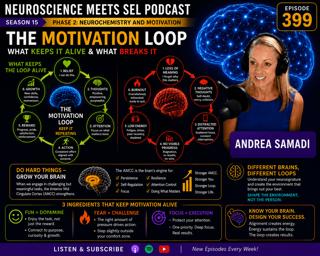
Next week, in Episode 399, we'll step back and review the entire Motivation Loop, exploring what helps us repeat the loop and what causes it to break through burnout, distraction, overwhelm, and unhealthy reward-seeking.

We'll connect everything we've learned from Bob Proctor, Dr. Caroline Leaf, Dr. John Medina, Dr. Anna Lembke, Dr. Chuck Hillman, and Friederike Fabritius into one practical framework that we can ALL apply to our own lives.

And then we'll prepare for our milestone Episode 400 as we transition into our next phase on Movement, Learning, and Cognition.

Until next time, keep moving forward, keep learning, and keep creating the conditions that allow your brain to perform at its best.

See you next week

RESOURCES:

Watch Full Interview 1 with Friederike Fabritius https://www.youtube.com/watch?v=iHK3UG8-Or0

Clip 1 Fun, Fear, Focus PART 1 https://www.youtube.com/shorts/DZkTBIb-JNk

Clip 1B Fun, Fear, Focus, PART 2 https://www.youtube.com/shorts/rEnJXHJIgbg

Clip 2 Men vs Women https://www.youtube.com/shorts/S4Wxat_I2vU

Watch Full Interview 2 with Friederike Fabritius

https://www.youtube.com/watch?v=Mmv9PmuioFs

THE BRAIN FRIENDLY WORKPLACE https://friederikefabritius.com/books/the-brain-friendly-workplace/

[i] Neuroscience Meets Social and Emotional Learning Podcast EPISODE 393 https://andreasamadi.podbean.com/e/belief-first-the-neuroscience-of-motivation/

[ii] Neuroscience Meets Social and Emotional Learning Podcast EPISODE 394 https://andreasamadi.podbean.com/e/thoughts-as-biology-how-your-mind-shapes-neurochemistry/

[iii] Neuroscience Meets Social and Emotional Learning Podcast EPISODE 395 https://andreasamadi.podbean.com/e/theory-of-mind-the-missing-link-between-attention-reward-and-motivation/

[iv] Neuroscience Meets Social and Emotional Learning Podcast EPISODE 396 https://andreasamadi.podbean.com/e/dopamine-nation-the-pleasure%e2%80%93pain-balance-that-drives-motivation/

[v]Neuroscience Meets Social and Emotional Learning Podcast EPISODE 397 https://andreasamadi.podbean.com/e/move-to-learn-how-movement-activates-the-brain-and-fuels-motivation/

[vi]Neuroscience Meets Social and Emotional Learning Podcast EPISODE 373 https://andreasamadi.podbean.com/e/fun-fear-focus-neuroscience-hacks-for-peak-performance/

[vii] Neuroscience Meets Social and Emotional Learning Podcast EPISODE 258 with Neuroscientist Friederike Fabritius on “The Brain Friendly Workplace” https://andreasamadi.podbean.com/e/neuroscientistwallstreet-journalbestselling-authorfriederike-fabritius-onhernew-bookthe-brainfriendly-workplacewhy-talented-peoplequitand-how-tomake/

[viii]Neuroscience Meets Social and Emotional Learning Podcast EPISODE 257 https://andreasamadi.podbean.com/e/brainfactfriday-adeepdiveintothebrainfriendlyworkplaceby-friederike-fabritiusunderstanding-our-neurosignature-for-improvedhappinessandproductivity/

Tämä jakso on lisätty Podme-palveluun avoimen RSS-syötteen kautta eikä se ole Podmen omaa tuotantoa. Siksi jakso saattaa sisältää mainontaa.

Jaksot(402)

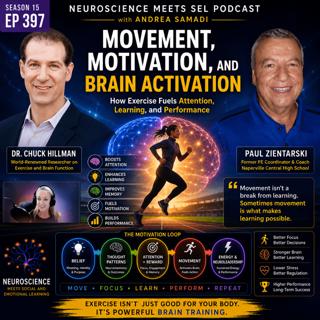
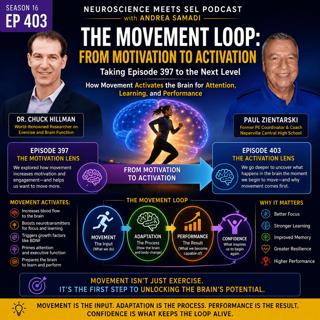
Move to Learn: How Movement Activates the Brain and Fuels Motivation (with Dr. Chuck Hillman and Paul Zientarski)

Move to Learn: How Movement Activates the Brain and Fuels Motivation (with Dr. Chuck Hillman and Paul Zientarski)

Season 15, Episode 397 revisits research and real-world practice showing movement is more than fitness: it activates the brain, boosts attention, enhances learning, and sustains motivation. Dr. Chuck ...

31 Touko 35min
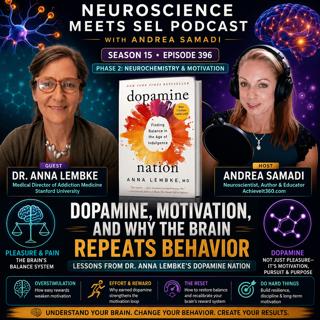
Dopamine, Motivation and Why the Brain Repeats Behavior with Dr. Anna Lembke

Dopamine, Motivation and Why the Brain Repeats Behavior with Dr. Anna Lembke

Host Andrea Samadi welcomes Dr. Anna Lembke to explain how pleasure and pain share the same neural circuitry and how dopamine governs motivation. The episode explores why overconsumption of easy rewar...

24 Touko 23min

Theory of Mind: The Missing Link Between Attention, Reward, and Motivation with John Medina

Theory of Mind: The Missing Link Between Attention, Reward, and Motivation with John Medina

Episode 395 explores how theory of mind — our ability to understand others' intentions — drives attention, emotional relevance, and reward, shaping motivation and behavior. Dr. John Medina explains wh...

17 Touko 37min

Thought Patterns & Neurochemistry — The Hidden Drivers of Your Life (Revisiting Dr. Caroline Leaf)

Thought Patterns & Neurochemistry — The Hidden Drivers of Your Life (Revisiting Dr. Caroline Leaf)

In this episode Andrea Samadi revisits her October 2022 interview with Dr. Caroline Leaf about how our thought patterns act as biological instructions that shape brain chemistry, behavior, and results...

26 Huhti 25min

The Neuroscience of Belief: How Meaning, Identity and Frequency, Drive Motivation (Featuring Bob Proctor)

The Neuroscience of Belief: How Meaning, Identity and Frequency, Drive Motivation (Featuring Bob Proctor)

Andrea Samadi explores Phase Two of the brain roadmap, showing how belief—shaped by meaning, identity, and daily practice—starts the motivation loop and drives action. Featuring insights from Bob Proc...

19 Huhti 28min

The Motivation Loop: How Your Brain Decides What’s Worth Doing

The Motivation Loop: How Your Brain Decides What’s Worth Doing

Season 15, Episode 392 introduces phase two of the roadmap: neurochemistry and motivation. Andrea Samadi breaks down the motivation loop—expectation, thought patterns, attention and action, feedback, ...

12 Huhti 19min

When Brains Dream: How Sleep Integrates Emotion, Insight, and Creativity (Revisiting Antonio Zadra)

When Brains Dream: How Sleep Integrates Emotion, Insight, and Creativity (Revisiting Antonio Zadra)

Andrea Samadi revisits a conversation with sleep researcher Antonio Zadra on why the brain dreams, how REM sleep integrates emotions and memories, and the NextUp model (Network Exploration to Understa...

5 Huhti 21min

Suosittua kategoriassa Koulutus

rss-murhan-anatomia
psykopodiaa-podcast
voi-hyvin-meditaatiot-2
rss-hereilla
rss-valo-minussa-2
rss-narsisti
kesken
rss-liian-kuuma-peruna
rss-koira-haudattuna
rss-niinku-asia-on
dear-ladies
rss-opiskelemaan
rss-arkea-ja-aurinkoa-podcast-espanjasta
aamupore
rahapuhetta
adhd-podi
rss-rahamania
rss-tietoinen-yhteys-podcast-2
rss-suomen-aa-podcast
rss-retoriikan-kesakoulu