The Movement Loop: How Movement Activates the Brain for Learning, Adaptation & Performance

The Movement Loop: How Movement Activates the Brain for Learning, Adaptation & Performance

Welcome back to Season 16 of the Neuroscience Meets Social and Emotional Learning Podcast.

I'm Andrea Samadi, and this is where we bridge neuroscience, social and emotional learning, and human performance so we can create measurable improvements in our well-being, achievement, leadership, productivity, and results.

In this episode 403 The Movement Loop: How Movement Activates the Brain for Learning, Adaptation & Performance we will cover:

✔ Why movement is the biological input that prepares the brain for learning, adaptation, and performance.

✔ How Dr. Chuck Hillman's groundbreaking neuroscience research explains what happens inside the brain during and immediately after exercise.

✔ Why even one bout of physical activity can improve attention, executive function, and learning readiness.

✔ How Paul Zientarski translated neuroscience into practice through Naperville Central High School's internationally recognized Zero Hour PE Program.

✔ The science behind brain activation, neuroplasticity, positive stress, and cognitive reserve.

✔ Why movement isn't a break from learning—it's preparation for learning.

✔ How teachers, coaches, parents, and workplace leaders can use movement to improve focus, decision-making, creativity, and performance.

✔ How to apply the Movement Loop in everyday life using practical strategies you can begin today.

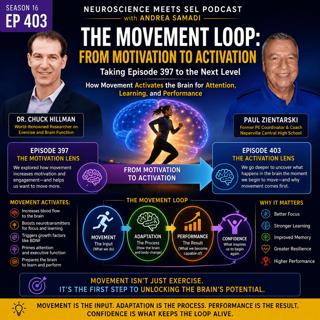
✔ Why movement is the input, adaptation is the process, and performance is the result.

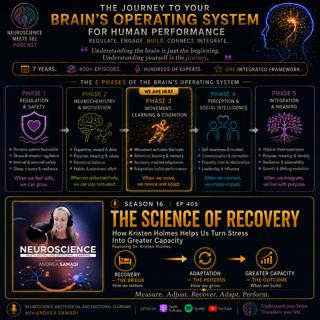
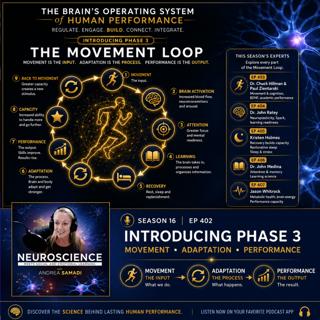
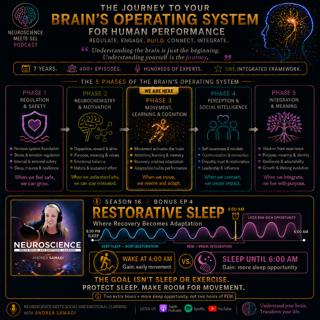
If you're just joining us, Season 16 explores Phase 3 of the Brain's Operating System for Human Performance—the Movement Loop. This season asks one central question: How does movement change the brain, adaptation change the body, and together create measurable improvements in performance? If you'd like the full overview of the five-phase framework, I encourage you to start with Episode 402.

In Episode 402[i], we introduced Phase 3 of the Brain's Operating System for Human Performance—where we introduced The Movement Loop.

We discovered one powerful idea.

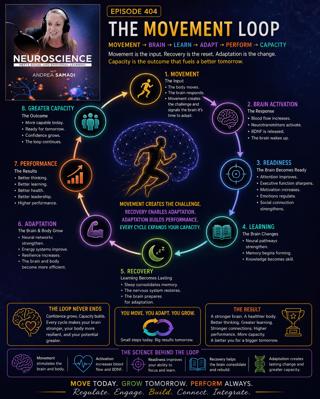
Movement is the input.

When you move, your body sends a powerful biological signal to the brain that says:

"Prepare. Activate. Adapt."

Adaptation is the process.

With movement, repetition, and recovery, the brain and body strengthen, rewire, and become more efficient.

Performance is the output.

The changes become visible in everyday life—clearer thinking, better decisions, stronger health, and improved performance.

Then the loop begins again.

Today we're asking the next question.

Why does movement come first?

Not simply because exercise is good for our bodies.

But because movement is one of the most powerful biological signals we can send to the brain.

Before we can focus...

Before we can learn...

Before we can adapt...

The brain must first be activated.

That's why movement isn't the outcome.

It's the beginning.

When we first interviewed Dr. Chuck Hillman on Episode 123[ii], (back in April 2021) I wanted to understand how his neuroscience research inspired Paul Zientarski's revolutionary Zero Hour PE Program at Naperville Central High School.

It was Naperville's extraordinary performance on the Trends in International Mathematics and Science Study (TIMSS) that caught the eye of Dr. John Ratey. Naperville District 203 entered the international comparison as if it were its own "country" and ranked #1 in the world in science and #6 in the world in math. Those results made Dr. Ratey ask, "What are they doing differently?" That question ultimately led him to Naperville, (IL) where he discovered Zientarksi’s Zero Hour PE initiative and made it the opening case study in his book Spark. We will cover this story on our next episode

Then years later, we revisited that conversation in Episode 397[iii] through the lens of motivation—exploring how movement increases engagement and helps us want to move more.

But looking back through the lens of Phase 3, I realized I had been asking the wrong question.

The bigger question isn't whether movement motivates us.

The bigger question is:

What happens inside the brain the moment we begin to move?

That's the question we're answering today.

And it's the reason movement sits at the beginning of the Brain's Operating System for Human Performance.

Let's begin where every performance story begins...

with movement.

As we begin Phase 3, Dr. Chuck Hillman's research helps us understand why movement is the first step in the Movement Loop.

In our interview, he mentioned that his lab has consistently demonstrated that even a single bout of physical activity can improve attention, cognition, and academic performance.

But what fascinated me most wasn't simply that exercise works.

It was why it works.

Listen carefully as Dr. Hillman explains how movement acts as a positive biological stressor that prepares the brain for learning.

EP 403 — Clip 1 Summary

Movement is the First Signal

As we begin Phase 3 of the Brain's Operating System, the first question is simple:

Why does movement come first?

Dr. Chuck Hillman has spent his career studying how physical activity changes the brain—from childhood through older adulthood. His research doesn't just focus on exercise, but on understanding how different life experiences shape brain health across the lifespan.

One insight from our conversation completely changed how I think about movement.

Dr. Hillman explained that even a single session of exercise can improve attention, cognition, and academic performance in children. His team is now studying why that happens, exploring how exercise acts as a positive stressor that activates biological pathways supporting brain function.

But what struck me even more was why he chose to study children in the first place.

Rather than waiting until someone reaches their 60s and begins experiencing cognitive decline, his goal is to help children build a stronger brain from the very beginning—to create what he calls a cognitive reserve that may protect brain health throughout life.

That idea captures exactly what Phase 3 is all about.

Movement isn't simply something we do to stay fit.

It's one of the earliest investments we can make in the future health and performance of our brain.

______

This is the first piece of the Movement Loop.

Movement isn't valuable because we eventually become fitter.

This is what many of us used to think? I can’t be alone in this…I used to move for fitness alone.

Until I studied the brain…and learned that:

It's valuable because it immediately changes the state of the brain.

Before learning improves...

Before memory improves...

Before performance improves...

The brain has to be activated.

That's exactly what movement does.

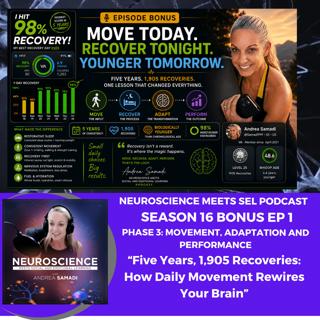
Key Takeaways from Dr. Hillman

There are three ideas I'd like all of us to remember from this first clip.

    Movement is Information

The Neuroscience

Every movement you make sends information throughout your nervous system.

As your muscles contract, they don't just move your body—they communicate with your brain. Your heart pumps faster, blood flow increases, oxygen and glucose are delivered more efficiently, and neurons begin communicating more actively.

Movement also changes your brain's neurochemistry. Exercise increases the release of neurotransmitters like dopamine, norepinephrine, and serotonin, which help regulate attention, motivation, mood, and learning. At the same time, it stimulates the production of growth factors such as brain-derived neurotrophic factor (BDNF), which supports neuroplasticity—the brain's ability to form and strengthen new neural connections.

That's why I like to think of movement as sending a message to the brain:

"Wake up. Pay attention. Get ready to learn."

Movement isn't simply burning calories.

It's providing your brain with the biological conditions it needs to perform at its best.

    Stress Isn't Always Harmful

The Neuroscience

When we hear the word stress, we usually think of chronic stress—too much cortisol, too little recovery, and the negative effects that follow.

But the brain actually needs short, manageable challenges to become stronger.

Exercise is an example of what's often called eustress, or positive stress.

When you exercise, your body briefly increases stress hormones like cortisol and activates your sympathetic nervous system. At the same time, it stimulates beneficial signaling molecules and growth factors that help the brain adapt.

Dr. Hillman's research explores how these temporary changes—including biomarkers like cortisol and salivary alpha-amylase—may help explain why even a single bout of exercise improves attention and cognition.

The important point is that the stress is temporary.

When it's followed by recovery, your brain and body adapt.

Without recovery, stress becomes harmful.

With recovery, stress becomes the signal that drives growth.

That's why adaptation sits in the middle of the Movement Loop.

The challenge isn't the goal.

The adaptation is.

    Activation Comes Before Performance

The Neuroscience

One of the biggest misconceptions about learning is that we can simply decide to pay attention.

The brain doesn't work that way.

Before the prefrontal cortex—the part of the brain responsible for focus, planning, decision-making, and executive function—can perform well, it must first be activated.

Movement helps create that activation.

Exercise increases cerebral blood flow, raises arousal to an optimal level, and improves communication across large-scale brain networks involved in attention and cognitive control.

Think of it like warming up an orchestra before a concert.

Before the musicians can perform together, they first need to tune their instruments.

Movement helps the brain tune itself.

That's why research consistently shows improvements in attention and executive function immediately after moderate physical activity.

Performance doesn't begin when you sit down to work.

Performance begins the moment you prepare your brain.

That's why movement sits at the beginning of the Movement Loop.

One final thought

Movement isn't magic.

It changes the brain because it changes the brain's biology.

It increases blood flow.

It changes neurochemistry.

It activates neural networks.

It stimulates neuroplasticity.

And when those changes are repeated over time—and supported by recovery—they become adaptation.

That's why movement is the input.

Adaptation is the process.

Performance is the result.

TIPS to IMPLEMENT

So what can we do with this research?

Here are three simple ways to put the Movement Loop into practice this week.

✅ 1. Move with purpose.

Before asking your brain to perform...

Prepare it.

Take a 10–20 minute walk.

Ride your bike.

Do a short workout.

Climb the stairs instead of taking the elevator.

Don't think of movement as taking time away from your work.

Think of it as the first step toward doing your best work.

I always park my car at the back of the parking lot, not afraid add bits of movement into the day.

✅ 2. Prepare the brain before expecting learning.

Whether you're a parent...

A teacher...

A coach...

Or a leader...

Create opportunities to move before asking people to think.

Movement isn't a reward after learning.

It's preparation before learning.

I discovered this one early on with this podcast. I can’t focus on this topic, without moving first.

✅ 3. Start measuring brain performance—not just physical performance.

The next time you move, don't just ask:

"How many calories did I burn?"

Ask:

    Did I think more clearly today? Did I focus more easily? Did I feel more energized? Did I recover better tonight? Am I becoming more resilient?

Those are the real returns on your investment.

Movement for me, is at the root of each of these questions. If I lacked movement (and sometimes I can’t fit it in) I’ll notice it show up in one of these questions, and know how important it is to get it back on track.

Final Reflection

Remember...

Movement is the input.

It's what we do.

Every step you take sends a message to your brain:

"Prepare. Activate. Adapt."

The more consistently you send that signal, the more opportunities your brain and body have to change.

Over time, those changes become visible.

You think more clearly.

You learn more effectively.

You recover more efficiently.

You perform at a higher level.

But here's the part I find most fascinating.

When I look at the Movement Loop...

I don't stop at Performance.

I look at the final circle.

Confidence.

Because confidence is what keeps the loop alive.

I’ll be the first to say I can’t always do this. Something gets in the way.

It's not always easy to move.

Some days we're busy.

Some days we're tired.

Some days we simply don't feel like it.

But every time you complete the loop, you collect another piece of evidence.

"I showed up."

"I felt better afterward."

"I handled that challenge differently."

"I'm becoming stronger than I was yesterday."

Those moments become evidence.

Evidence builds confidence.

And confidence makes it easier to begin again tomorrow.

That's how lasting change happens.

Not through one workout.

Not through one perfect week.

But by repeating the loop.

Again.

And again.

And again.

Because every movement today is an investment in the person you're becoming tomorrow.

Movement is the input.

Adaptation is the process.

Performance is the result.

And confidence is what inspires us to begin again.

Clip 2 Summary

Brain Activation Creates Readiness to Learn

Paul Zientarski explains how Naperville Central High School achieved remarkable academic results through its Zero Hour PE Program and the use of heart rate monitoring. His work around getting students to move was inspired by Dr. Hillman’s research.

In this clip, Paul Zientarski describes how Dr. Chuck Hillman's research transformed physical education from something schools did for physical health into something they could use to improve learning itself.

The research that ignited him showed that after just 20 minutes of walking, students demonstrated measurable increases in brain activation and performed better on cognitive tasks.

For Paul, this wasn't simply evidence that exercise works.

It explained why movement belongs at the beginning of the school day.

Movement wasn't taking time away from learning.

It was preparing the brain to learn.

Looking at this through the lens of the Movement Loop, we can now see what was happening biologically.

Movement activated the brain.

An activated brain was better able to pay attention.

Better attention improved learning.

Repeated learning created adaptation.

And over time, those adaptations translated into stronger academic and life performance.

That's why movement is the first step in Phase 3.

Key Takeaways

✔ 1. Brain activation is the bridge between movement and performance.

Movement doesn't improve learning—or performance—directly.

It first changes the brain into a state that's ready to focus, solve problems, make decisions, and learn.

Whether you're in a classroom, on the athletic field, or leading a team at work, performance begins with brain activation.

✔ 2. Readiness comes before instruction/teaching/learning.

One of Paul Zientarski's greatest insights was that not every student needed more movement. Sometimes they needed more recovery.

By monitoring students' heart rates, he learned to recognize when a student was physiologically ready to learn and when the brain and body needed time to recover.

That's a lesson for all of us.

Teachers can observe energy before beginning a lesson.

Coaches can balance challenge with recovery.

Leaders can recognize when their teams need a reset before asking for peak performance.

The question isn't simply,

"What am I teaching?"

It's, "Are people ready to learn?"

✔ 3. Small actions create lasting adaptation.

One walk.

One movement break.

One active lesson.

One walking meeting.

None of these seem significant on their own.

But repeated consistently, they become the biological signals that drive adaptation.

Small actions, repeated often, create lasting change.

✔ 4. Performance begins long before the moment that matters.

A student's success doesn't begin when they open the exam.

An athlete's success doesn't begin when the whistle blows.

A leader's success doesn't begin when the meeting starts.

Performance begins much earlier—

when we prepare the brain to perform.

✔ 5. Movement isn't a break from work.

It's preparation for better work.

Whether you're teaching a lesson...

Coaching a team...

Leading a meeting...

Or solving a complex problem...

Movement should be viewed as part of the performance process—not time taken away from it.

Tips to Implement

    Prepare the brain before expecting performance.

Before teaching...

Before coaching...

Before presenting...

Before solving difficult problems...

Ask one question:

"Is the brain ready to perform?"

Sometimes the best way to improve performance is to begin with five to ten minutes of purposeful movement.

    Build movement into the rhythm of the day.

Instead of viewing movement as a separate activity, make it part of how you work and learn.

Teachers can begin lessons with movement.

Coaches can use dynamic warm-ups with a cognitive focus.

Leaders can replace one seated meeting each week with a walking meeting.

Movement becomes the signal that says,

"It's time to focus."

    Balance challenge with recovery.

Paul didn't simply encourage students to move more.

He also recognized when they needed recovery.

High performance isn't created by constant effort.

It's created by alternating challenge with recovery.

That's true in classrooms.

It's true in sports.

And it's true in the workplace.

    Think beyond fitness.

Don't ask,

"How do I fit exercise into my day?"

Instead ask,

"How can movement improve everything I do afterward?"

That one shift changes movement from another task on your calendar...

into the first step toward better thinking, better learning, better leadership, and better performance.

Closing Reflection

Every time we move...

We send a message to the brain.

"Prepare. Activate. Adapt."

That's why movement isn't just something we do for our bodies.

It's one of the most practical performance tools available to teachers, coaches, leaders, parents, and anyone who wants to think more clearly, learn more effectively, and perform at a higher level.

Because in the end...

Movement is the input. (What we do.)

Adaptation is the process. (How the brain and body change.)

Performance is the result. (What we're capable of becoming.)

Paul Zientarski didn't change physical education at Naperville HS. He changed the purpose of physical education. Instead of asking, "How do we build fitter students?" he helped us ask, "How do we build brains that are ready to learn?"

EP 403 Review and Conclusion

As we review and close out this episode, I'd like to leave you with one final thought.

When we first interviewed Dr. Chuck Hillman, I was fascinated by what exercise did for the brain.

When we interviewed Paul Zientarski, I was inspired by how he translated that research into a school that changed lives.

But looking back through the lens of Phase 3, I realize they were teaching us something even bigger.

They were teaching us where human performance begins.

Not with talent.

Not with intelligence.

Not with motivation.

It begins with a biological signal.

Movement.

Every step you take...

Every walk...

Every workout...

Every hike...

Every time you choose to move...

You're telling your brain:

"Prepare. Activate. Adapt."

That's the first instruction your brain receives.

From there, everything else becomes possible.

Movement activates the brain.

An activated brain pays attention.

Attention makes learning possible.

Learning creates adaptation.

Adaptation improves performance.

And performance builds confidence.

Confidence is what inspires us to move again tomorrow.

That's the Movement Loop.

A Personal Journey

This season has become personal for me.

For years, I interviewed experts and shared their research.

Over the past year, I began testing these ideas (their research) in my own life.

Not to become a better athlete.

Not to chase perfect numbers on my wearable device (as much as I would like to have them).

But to see whether the neuroscience actually showed up in everyday life.

It did.

The more consistently I moved...

The more consistently I recovered...

The more my brain and body adapted.

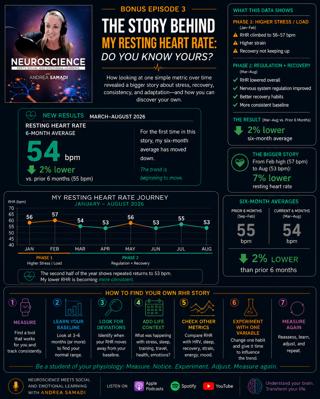
My recovery improved.

My resting heart rate dropped.

My hikes became easier.

My thinking became clearer.

Those weren't isolated improvements.

They were evidence that the Movement Loop was working.

And with every small improvement...

my confidence grew.

Not because someone told me I was improving.

Because I could see it.

I could measure it.

I could feel it.

That confidence became more than the result of movement.

It became something I began carrying into other areas of my life.

Into my work.

Into my relationships.

Into the challenges I was willing to take on.

And that's when I realized something...

Confidence doesn't end the Movement Loop.

It becomes the beginning of another part of the Brain's Operating System.

But...

that's a conversation for another episode.

Your challenge for the week

So before our next episode, I'd like to leave you with a simple challenge.

Don't focus on changing your life overnight.

Just begin the loop.

Tomorrow morning...

Before work...

Before studying...

Before an important conversation...

Move.

Even if it's just for ten or twenty minutes.

Then ask yourself one question:

How did that movement prepare my brain today?

Start paying attention.

Notice your focus.

Notice your energy.

Notice how you think.

Because once you begin looking for the changes...

You'll start seeing them everywhere.

Write down what you notice…because if you don’t write things down, you won’t remember that the change occurred.

Looking ahead

In our next episode, we'll continue exploring Phase 3 with one of the pioneers in this field, Dr. John Ratey, author of Spark.

If Dr. Hillman showed us that movement activates the brain...

Dr. Ratey helps us understand why exercise has been called "Miracle-Gro for the brain" and how movement literally changes the brain's ability to learn, adapt, and grow.

We'll continue building the Movement Loop...

one step at a time.

Until next time...

Remember...

Movement is the input. It's what we do.

Adaptation is the process. It's how the brain and body change.

Performance is the result. It's the measurable improvement we experience in our thinking, learning, health, leadership, and daily lives.

And perhaps most importantly...

Confidence is what keeps the loop alive.

Because every step you take today is building the brain you'll depend on tomorrow.

By the end of this season, my hope is that we don't just understand the neuroscience of human performance—we put it into practice.

That we begin moving with purpose. That we notice how our brain and body respond. That we embrace adaptation as part of the process. And that we experience measurable improvements in our thinking, learning, health, leadership, and everyday performance.

I'm Andrea Samadi, and this has been the Neuroscience Meets Social and Emotional Learning Podcast. I'll see you next time.

EP 403: How did movement prepare my brain today?

EP 404: How did today's movement help my brain learn?

EP 405: How did recovery help my brain adapt?

EP 406: How did attention improve my performance?

EP 407: How will I keep the loop going?

RESOURCES:

Full interview Dr. Chuck Hillman https://www.youtube.com/watch?v=6ip5s2iDFLE&list=PLb5Z3cA_mnKhiYc5glhacO9k9WTrSgjzW&index=88

Full interview Paul Zientarski

https://www.youtube.com/watch?v=UHYNEhxkxfE

Paul Zientarski’s clip https://www.youtube.com/shorts/DmtkP_licdA

REFERENCES:

[i] Neuroscience Meets Social and Emotional Learning Podcast EPISODE 402 “Phase 3 Intro: How Movement Builds the Brain https://andreasamadi.podbean.com/e/movement-loop-how-everyday-action-rewires-your-brain-and-boosts-performance/

[ii] Neuroscience Meets Social and Emotional Learning Podcast EPISODE 123 https://andreasamadi.podbean.com/e/northeastern-university-professor-chuck-hillman-phd-on-the-impact-of-exercise-on-the-brain-and-learning/

[iii] Neuroscience Meets Social and Emotional Learning Podcast EPISODE 397

https://andreasamadi.podbean.com/e/move-to-learn-how-movement-activates-the-brain-and-fuels-motivation/

Tämä jakso on lisätty Podme-palveluun avoimen RSS-syötteen kautta eikä se ole Podmen omaa tuotantoa. Siksi jakso saattaa sisältää mainontaa.

Jaksot(407)

How Movement Builds the Brain, the Body & Human Performance (Phase 3 Introduction)

How Movement Builds the Brain, the Body & Human Performance (Phase 3 Introduction)

Season 16, Episode 402 explores the Brain's Operating System for Human Performance, focusing on Phase 3: movement, adaptation, and performance. Andrea Samadi explains how movement triggers neurochemic...

12 Heinä 25min

Trust as the Foundation with Greg Hill: How Great Leaders Create the Conditions for Learning, Growth and Performance

Trust as the Foundation with Greg Hill: How Great Leaders Create the Conditions for Learning, Growth and Performance

In episode 401 Andrea Samadi welcomes Greg Hill to explore why trust is the essential foundation for learning, growth, and high performance. They discuss how trust creates psychological safety, encour...

27 Kesä 37min

Episode 400: Sales Leadership Under Pressure with Majid Samadi: 7 Lessons Learned from 7 Years of Neuroscience

Episode 400: Sales Leadership Under Pressure with Majid Samadi: 7 Lessons Learned from 7 Years of Neuroscience

In this milestone episode (400), Andrea Samadi celebrates seven years of the Neuroscience Meets SEL Podcast with her husband Majid Samadi. They reflect on the journey of translating neuroscience into ...

20 Kesä 47min

Phase 2 Review: The Motivation Loop: How to Keep Effort Worthwhile

Phase 2 Review: The Motivation Loop: How to Keep Effort Worthwhile

Episode 399 reviews Phase 2 of Season 15 and introduces the Motivation Loop — the sequence of meaning, belief, attention, action, reward, and recovery that drives sustained effort. The episode explain...

14 Kesä 28min

Fun, Fear, Focus: Closing the Motivation Loop with Friederike Fabritius

Fun, Fear, Focus: Closing the Motivation Loop with Friederike Fabritius

Episode 398 revisits neuroscientist Friederike Fabritius (from November 2022) to explain how three ingredients — fun (dopamine), fear (productive challenge), and focus — create the neurochemical condi...

9 Kesä 23min

Move to Learn: How Movement Activates the Brain and Fuels Motivation (with Dr. Chuck Hillman and Paul Zientarski)

Move to Learn: How Movement Activates the Brain and Fuels Motivation (with Dr. Chuck Hillman and Paul Zientarski)

Season 15, Episode 397 revisits research and real-world practice showing movement is more than fitness: it activates the brain, boosts attention, enhances learning, and sustains motivation. Dr. Chuck ...

31 Touko 35min

Dopamine, Motivation and Why the Brain Repeats Behavior with Dr. Anna Lembke

Dopamine, Motivation and Why the Brain Repeats Behavior with Dr. Anna Lembke

Host Andrea Samadi welcomes Dr. Anna Lembke to explain how pleasure and pain share the same neural circuitry and how dopamine governs motivation. The episode explores why overconsumption of easy rewar...

24 Touko 23min

Suosittua kategoriassa Koulutus

rss-murhan-anatomia
psykopodiaa-podcast
voi-hyvin-meditaatiot-2
rss-niinku-asia-on
adhd-podi
kesken
ihminen-tavattavissa-tommy-hellsten-instituutti
rss-liian-kuuma-peruna
rss-arkea-ja-aurinkoa-podcast-espanjasta
rahapuhetta
rss-perho-rajoilla
rss-koira-haudattuna
rss-narsisti
rss-rahataito-podcast
rss-ai-mita-siskopodcast
rss-tietoinen-yhteys-podcast-2
rss-hereilla
salainen-paivakirja
rss-valo-minussa-2
rss-ihana-elamani