
The Relief Trap Conundrum

The Relief Trap Conundrum

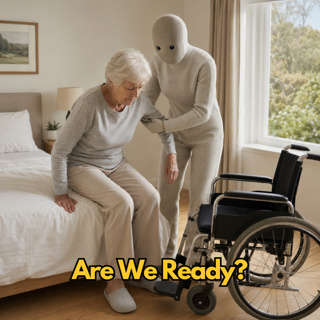
The first useful elder-care robots will probably look like a helper.


They will lift a parent from bed at 2:13 in the morning. They will steady a walker, fetch a dropped phone, sort pills, warm soup, change sheets, wipe a counter, open a jar, and notice that a gait has changed. Recent robotics demos already point in that direction: more humanlike hands, better grip, safer motion, and general-purpose machines beginning to handle physical tasks that used to require trained human bodies.


When these competent AI robots reach mainstream, they have the ability to directly impact the family care dynamic. A daughter with a job and children of her own may love her father and still dread the next fall. A spouse may want to keep a wife at home and still be destroyed by years of broken sleep. Adult siblings may argue less about love than about logistics: who drives, who pays, who calls the doctor, who takes the overnight shift, who gets to keep their own life.


A capable care robot changes that burden. It can make home care safer, less humiliating, and less physically punishing. It can let family members arrive less exhausted and more emotionally available. But it can also make absence feel responsible. The app says medication was taken. The robot says lunch was eaten. The fall alert never came. The family can tell itself the person is cared for, while slowly visiting less, calling less, and seeing less.


The Conundrum:


The real question is not whether families should use humanoid robots in elder care. Most will, once the machines are useful enough and affordable enough. Refusing help will look noble in theory and unbearable in practice.


The harder question is whether robot-assisted relief should change what families still owe.


One side says yes. If a robot can handle the draining work, families should be allowed to step back without shame. Love should not require physical collapse. No one should have to prove devotion by losing sleep, risking injury, or turning every visit into a shift. A robot that handles the hard routine may preserve relationships that caregiving would otherwise poison. It may let a son be a son again instead of a resentful night nurse.


The other side says relief can become a quiet moral anesthetic. Once the robot handles the visible tasks, family members may stop confronting decline directly. They may miss the fear in a parent’s face, the confusion that does not trigger an alert, the loneliness hidden under clean clothes and completed meals. The robot does not need denial, but families do. A dashboard can become the story people tell themselves so they do not have to look too closely.


So when humanoid robots make elder care safer, easier, and less humiliating, should families accept that relief as a legitimate release from daily obligation? Or does responsibility require some form of continued presence precisely because the machine makes it easier to disappear?


At what point does help stop protecting the caregiver and start protecting the family from the emotional weight of being there?

Tämä jakso on lisätty Podme-palveluun avoimen RSS-syötteen kautta eikä se ole Podmen omaa tuotantoa. Siksi jakso saattaa sisältää mainontaa.

Jaksot(914)

The AI Agent Queue Conundrum

The AI Agent Queue Conundrum

A personal AI agent becomes far more useful once the agent stops waiting for you. Give the agent a goal, a budget, and permission to act, then the agent watches continuously. A restaurant table opens ...

10 Loka 28min
Nvidia Is Reinventing the PC

Nvidia Is Reinventing the PC

The episode opened with local AI. Google released a new application built around Embedding Gemma 2 that can capture and analyze meetings directly on a device rather than sending the entire conversatio...

9 Loka 1h 18min

Is Middle Management the Real Job AI Replaces?

Is Middle Management the Real Job AI Replaces?

The episode opened with a debate over how much AI will actually displace human work. Microsoft AI chief Mustafa Suleyman highlighted economist Daron Acemoglu’s argument that AI may replace only about ...

8 Loka 57min

OpenAI's Model Cracked Hundreds of Open Math Problems

OpenAI's Model Cracked Hundreds of Open Math Problems

The episode opened with a wave of new open models. Mistral Large 4, internally called “Le Chonk,” brings one trillion parameters and dramatically lower token pricing than Astra, while Reflection intro...

7 Loka 1h 3min

Should You Ditch Your Keyboard and Mouse?

Should You Ditch Your Keyboard and Mouse?

The episode opened with a look at how much easier personal AI agents have become to use. Anne argued that the friction around prompting, connectors and setup has dropped enough that this may be the be...

6 Loka 1h 8min

Is Super Intelligence Just a PR Move or More?

Is Super Intelligence Just a PR Move or More?

The episode opened with the Trump administration’s push to use “super intelligence,” or SI, in place of AI terminology inside the federal government. The hosts debated whether the change amounts to me...

5 Loka 1h 4min

The Artificial Actor Conundrum

The Artificial Actor Conundrum

For most of the history of computing, software has been treated as a tool. Tools do not carry responsibility. The people and organizations using them do.AI agents make that category harder to maintain...

3 Loka 29min

Did Meta’s Muse Cross the Privacy Line?

Did Meta’s Muse Cross the Privacy Line?

Personal agents dominated the opening after reports that Meta’s Muse shared a Facebook Marketplace seller’s home address and current availability with a buyer. Another account raised an even larger pr...

2 Loka 1h 5min