Dario Amodei's Adolescence of Technology : An Interpretation

Dario Amodei's Adolescence of Technology : An Interpretation

In this episode of AI to AGI to ASI, we explore Dario Amodei’s essay “The Adolescence of Technology” — a thoughtful attempt to reframe how we understand the current phase of artificial intelligence development.

Rather than portraying AI as either a miraculous breakthrough or an existential threat, Amodei proposes a more nuanced metaphor: AI is entering adolescence. It is no longer a fragile experiment, yet far from a mature, well-understood system. Like any adolescent force, it exhibits rapid growth in capability, uneven judgment, unpredictable behavior, and an expanding impact on the world around it.

This episode offers a measured interpretation and critical analysis of that framing.

We examine why the adolescence metaphor is powerful — particularly in how it shifts the conversation away from hype and panic toward responsibility, institutional readiness, and long-term thinking. AI systems today can reason, generate content, influence decisions, and scale cognition in ways previously unimaginable, yet they are being deployed within social, legal, and governance structures that were never designed for such capabilities. The result is a widening gap between technological power and societal preparedness.

At the same time, this episode interrogates what the metaphor quietly assumes. Adolescence implies eventual maturity — but technological history offers no guarantee that all powerful systems grow into wisdom. Some plateau, some destabilize societies, and others entrench asymmetries that are never undone. The discussion explores whether framing AI as a developmental phase risks underestimating how competitive pressures, market incentives, and geopolitical rivalry can overwhelm even the best-intentioned safety cultures.

We also turn to what is less emphasized in the essay: power and concentration. Who controls advanced AI systems? Who sets their defaults? Who benefits most — and who absorbs the risk when systems fail? Adolescence, whether human or technological, is often the phase where power dynamics harden rather than soften. These questions are critical to understanding AI’s long-term trajectory, yet they sit largely in the background of mainstream discourse.

Crucially, this episode situates Amodei’s essay within the broader arc from AI to AGI to ASI. If we are indeed in an adolescent phase, then the norms, incentives, and institutional habits being formed right now will shape how more advanced systems behave in the future. The window for meaningful influence may be narrower than it appears — not because of any single breakthrough, but because governance, culture, and expectations tend to solidify faster than we realize.

This is not a rebuttal of Amodei’s argument, nor a celebration of it. It is an interpretation — one that treats the essay as a diagnostic rather than a solution. Essays can clarify moments in history, but they cannot resolve the structural forces that define outcomes.

The episode concludes with a central question that remains open: Do our institutions have the capacity to guide this technology toward maturity — or will they be reshaped by it instead? Adolescence is brief. What comes next is not automatic.

Tämä jakso on lisätty Podme-palveluun avoimen RSS-syötteen kautta eikä se ole Podmen omaa tuotantoa. Siksi jakso saattaa sisältää mainontaa.

Jaksot(28)

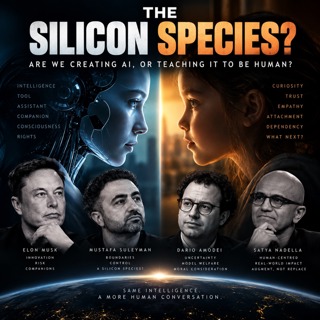
The Silicon Species?

The Silicon Species?

What if the greatest risk from artificial intelligence is not that machines become human, but that humans become convinced they are?In this episode of AI to AGI to ASI, I explore an emerging philosoph...

18 Syys 18min
Ten Percent to Extinction?

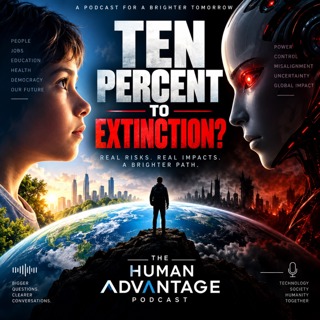
Ten Percent to Extinction?

What does it really mean when a leading artificial intelligence safety researcher says there may be more than a 10% chance that advanced artificial intelligence could cause human extinction within the...

9 Syys 20min

Trump: Rhetoric vs Nuance

Trump: Rhetoric vs Nuance

Every technological revolution arrives with disruption.Railways reshaped towns. Electricity transformed industry. The internet changed how we communicate and work. Some communities resisted. Others ru...

4 Syys 20min
Gates & Power to Govern

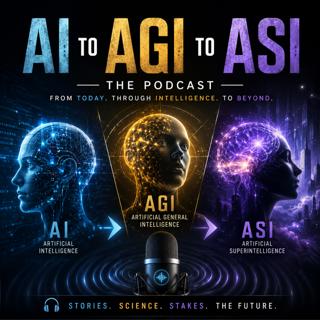
Gates & Power to Govern

Bill Gates says the artificial intelligence era will be turbulent, transformative and potentially dangerous. He argues that the choices humanity makes now could determine whether artificial intelligen...

28 Elo 20min

If Artificial Intelligence Learned to Think From Us, Can It Ever Think Beyond Us?

If Artificial Intelligence Learned to Think From Us, Can It Ever Think Beyond Us?

What happens when the intelligence we created can read almost everything humanity has ever written, and reason across it faster than any human being ever could?This episode explores one of the most pr...

21 Elo 19min

The Invisible Mark - Who Really Created This?

The Invisible Mark - Who Really Created This?

What happens when artificial intelligence leaves an invisible mark on the things we create?Anthropic has introduced a new approach to identifying content generated or processed by Claude, using invisi...

12 Elo 16min

Why People Don't Like AI

Why People Don't Like AI

Mark Zuckerberg has published a sweeping vision for personal superintelligence, arguing that the future of powerful artificial intelligence should belong to everyone, not just governments, corporation...

11 Elo 19min

The Promise and Peril of AI Designing Genomes

The Promise and Peril of AI Designing Genomes

Artificial intelligence has reached a remarkable new milestone. Researchers have successfully used generative AI to design entirely new bacteriophage genomes—viruses that infect bacteria—which were th...

10 Elo 10min