
The Gypsies, The Bohemians and The Habsburgs - A Connection Hidden in Plain Sight

The Gypsies, The Bohemians and The Habsburgs - A Connection Hidden in Plain Sight

"Before Bohemian meant artists hippies and boho it was a name attached to people traveling Europe under the protection of kings."

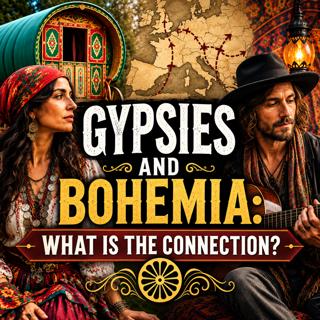
The history of Jews, Gypsies, Roma, Bohemia and European royal families contains connections rarely discussed together. Roma groups traveling through Europe in the early 1400s sometimes carried safe-conduct documents issued by kings and rulers, allowing them passage through territories controlled by local authorities. The historical use of "Bohemians" for Gypsies also developed from their association with Bohemia and royal protection rather than from Roma origins in Bohemia.

Jewish communities likewise had complicated relationships with European kings, princes and aristocratic families. Jews could be expelled from one territory while receiving protection, settlement rights and commercial privileges from another ruler. Both Jews and Roma therefore became known as outsiders while simultaneously maintaining documented relationships with the political and aristocratic authorities controlling the territories where they lived.

The powerful Esterházy family, closely connected with the Habsburg world, provides an important example. On Esterházy territory at Galánta, Jewish and Roma communities existed under the authority of the same aristocratic family. Historical records show Roma families receiving protection and occupational privileges, while Jewish families received settlement, religious and commercial privileges under Esterházy patronage.

The similarities between historical stereotypes surrounding Jews and Gypsies are also preserved in language. The derogatory expressions "gypped" and "Jewed down" both became associated with financial transactions, bargaining or cheating. These expressions reflect longstanding European stereotypes involving money, trading, outsiders and distrust rather than establishing the actual behavior of either population.

The history of Roma safe-conduct, Jewish protection agreements, the Esterházy family, the Habsburg monarchy and Galánta reveals that Jews, Gypsies and European aristocrats were not living in completely isolated worlds. They participated in the same political, economic and social systems. Following those relationships provides a different way of examining the history of Gypsies in Europe, Jewish history, Bohemia, European royalty, Roma history and the Habsburg world.

Music: Donovan - Season of the Witch (Official Audio) - YouTube

How hormones work to flip sexes: Hormones

Do you have a psychopath in your life? The best way to find out is read my book. BOOK *FREE* Download – Psychopath In Your Life4

Support is Appreciated: Support the Show – Psychopath In Your Life

Download Pods here - one click and pods load to any device fully titled and ready to listen to or archive: TOP PODS – Psychopath In Your Life

My old discussion forum with last 10 years of victim stories, is back online. Psychopath Victim Support Community | Forums powered by UBB.threads™

Google Maps My HOME Address: 309 E. Klug Avenue, Norfolk, NE 68701 SMART Meters & Timelines – Psychopath In Your Life

Jews and Roma: Two Peoples Burdened With Remarkably Similar European Stereotypes

When the history of Jews and Roma—historically called "Gypsies" in English—is examined side by side, something striking appears. Both populations accumulated unusually broad collections of negative stereotypes in European society. These were not simply occasional insults. They became recurring ideas about money, honesty, work, movement, religion, family, criminality and whether either population truly belonged within the societies where they lived.

The comparison becomes especially interesting because Jews and Roma were very different peoples with different origins, religions and histories. Yet European societies repeatedly described them using surprisingly similar language.

Their Names Became Words for Dishonest Transactions

Perhaps the clearest surviving evidence is embedded in the English language.

"Jew" became a derogatory verb during the nineteenth century. "To Jew" somebody, and later "to Jew somebody down," meant to bargain aggressively, obtain an unfairly low price, or cheat someone financially. The Oxford English Dictionary records this derogatory verbal usage in the early nineteenth century.

Something remarkably similar happened with "Gypsy."

"Gyp" or "gypped" came to mean cheating, swindling or shortchanging someone. Merriam-Webster records the verb gyp from 1879 and identifies its probable relationship to Gypsy.

So the names of two minority populations became English verbs involving getting the better of somebody financially.

The meanings aren't identical. "Jew down" became particularly associated with bargaining a price downward, whereas "gyp" meant cheating or swindling more generally. But the linguistic parallel is difficult to miss.

Money, Trading and Bargaining

Behind those words were older stereotypes.

Jews had been associated with moneylending, commerce and finance for centuries. Part of that history resulted from the occupational environment imposed upon Jewish communities. In various European jurisdictions, Jews faced restrictions on land ownership, guild membership, government employment and other occupations. Moneylending and commerce became important economic niches in some places.

The stereotype eventually detached itself from that complicated history. Instead of asking why Jews were concentrated in particular occupations, popular culture transformed the association into a supposed Jewish characteristic: Jews were greedy, obsessed with money or unusually skilled at extracting money from others.

Roma encountered a related process.

Roma communities participated in numerous occupations, including metalworking, animal trading, entertainment, seasonal labor, crafts and horse dealing. Mobility itself was economically useful for some of those occupations. But European folklore increasingly converted particular occupations and lifestyles into supposed racial characteristics.

The traveling trader became the dishonest trader.

The horse dealer became the horse cheat.

The outsider became someone who could not be trusted.

Eventually the word Gypsy itself helped produce gyp.

The "Permanent Outsider"

Another major similarity was the idea that neither population really belonged.

Jewish communities could exist in a European territory for generations and still be described as foreigners.

Roma could similarly live within a country for centuries while continuing to be treated as outsiders.

This produced a peculiar historical situation. A family could have ancestors living within the same kingdom for hundreds of years and nevertheless remain classified socially or legally as something separate from the surrounding population.

That distinction mattered because governments repeatedly created laws specifically regulating these populations.

Governments Controlled Where They Could Live

Both Jews and Roma encountered restrictions involving residence and movement, although the laws differed enormously according to country and period.

Jews were confined to particular towns, districts or ghettos in various European jurisdictions. Governments also imposed special permissions, taxes and numerical restrictions upon Jewish settlement.

Roma faced restrictions aimed particularly at mobility. Some governments expelled them outright. Others attempted to prevent traveling and force Roma families into permanent settlements.

Under the Habsburgs, this becomes particularly important.

Maria Theresa attempted to transform Roma into settled subjects during the eighteenth century. Her government restricted Roma mobility and increasingly attempted to suppress distinguishing aspects of Romani life.

At approximately the same historical period, the Habsburg monarchy was also deciding where Jews could live, how many Jewish families could reside in particular territories, what economic activities they could undertake and under what conditions they would be tolerated.

Gypsies, Jews and the Royals: What the Records Show

The history of Gypsies in Europe becomes much more interesting when you go back to their early appearances.

The familiar story is that Gypsies were wandering outsiders who arrived in Europe and were eventually driven from one place to another.

But some of the early records contain another part of the story.

When groups identified as Gypsies traveled across Europe during the early 1400s, some carried safe-conduct documents issued by rulers. These documents told local authorities to allow them to travel and, in some cases, to protect them.

That royal connection also helps explain one of the strange names attached to Gypsies in Western Europe.

Bohemians.

Gypsies did not originate in Bohemia. But groups traveling west became associated with Bohemia and with documents connected to rulers in that part of Europe. In France, Bohémien consequently became a word for Gypsy.

So the image of the completely unattached wanderer misses something important.

Some Gypsy groups moved through Europe with official protection from the people who ruled it.

The relationship did not end with medieval safe-conduct papers.

As Gypsy communities became established throughout Central Europe, particular families developed relationships with aristocratic landowners. Those relationships could involve permission to remain on estates, work, travel, practice trades or perform music.

Now put the Jews beside them.

Jewish communities had their own long history of relationships with European rulers.

Jews could be expelled by one ruler and welcomed by another. Kings and aristocrats sometimes granted Jewish communities protection and permission to settle and conduct business. In return, Jewish communities could pay special taxes, rents, protection money and other charges.

So underneath the public image of two unwanted outsider populations was a more complicated reality.

Both populations could have direct relationships with the ruling families.

This becomes particularly clear when we look at the Esterházys, one of the great aristocratic families of the Habsburg world.

The Esterházys controlled enormous estates in the Kingdom of Hungary. One of their important centers was Galánta, today in Slovakia.

And at Galánta we find Jews and Gypsies living under the authority of the same castle family.

The Esterházys had established relationships with particular Gypsy families by the seventeenth century. Surviving documents show Roma leaders receiving protection connected with the Esterházy family. Their relatives and descendants appear in the records, demonstrating that these relationships could continue across generations.

The Roma weren't simply anonymous people passing through.

They had families, leaders, occupations and established relationships with the people controlling the land.

By the eighteenth century, Galánta had also become particularly associated with Roma musicians. The Esterházys granted privileges to musicians from the community, and music became an occupation passed from parents to children.

At the same time, an established Jewish community was living at Galánta under Esterházy patronage.

By 1728, records show approximately fifteen Jewish families there. The following year the Jewish community received formal privileges from the Esterházy estate.

Jewish residents were permitted to worship and conduct economic activities. They paid the estate for various privileges, leases and protections.

The community grew substantially. By 1787, more than 300 Jews lived in Galánta, comprising roughly one-fifth of its population.

This gives us a very different picture from the simple story of unwanted outsiders.

The people in the castle weren't merely tolerating two mysterious populations they knew nothing about.

They were dealing directly with both of them.

  • They knew who their leaders were.
  • They knew what occupations they practiced.
  • They issued privileges.
  • They provided protection.
  • They collected money.

And some of these relationships lasted for generations.

That becomes especially interesting when we consider how similar the stereotypes surrounding Jews and Gypsies eventually became.

  • Both populations were portrayed as outsiders.
  • Both were associated with trading and bargaining.
  • Both were accused of cheating.
  • Both were accused of maintaining strong internal family loyalties.

And both ethnic names eventually became derogatory English expressions involving financial behavior: "gypped" for being cheated and "Jewed down" for bargaining someone down.

Both populations could exist in protected relationships with the same ruling families.

Meanwhile, the ruling families themselves were anything but separate.

European royalty and aristocracy built power through marriage.

Families married into other families, inherited their property, changed names and titles and produced new branches. The royal houses that appear separate when listed by surname were frequently related by blood.

The Esterházys themselves were part of this interconnected aristocratic world.

So when we place everybody back into the same historical landscape, the picture looks considerably different from the neat categories we inherited.

At the top were interconnected royal and aristocratic families controlling land and government.

Underneath them were populations including Jews and Gypsies who could simultaneously be described as outsiders while maintaining direct relationships with those rulers.

At Galánta, those relationships existed side by side.

And this is the important result of following the story backward.

The castle was never separate from the story of the outsiders.

The Gypsies who became famous as wandering people had, in some of their earliest European appearances, traveled under royal safe-conduct.

Centuries later, particular Roma families were still living and working under aristocratic protection.

Jewish families were likewise living under arrangements negotiated with those same kinds of aristocratic rulers.

So whatever else happened between these populations over the centuries, the historical record shows something that the stereotypes obscure:

Jews, Gypsies and the people in the castles were not three isolated worlds. They were participants in the same political, economic and social system.

A few especially important examples:

  • Oxford coffeehouses, 1650s — Among England's earliest. Oxford's coffeehouses became gathering places for scholars interested in experimental science and natural philosophy. This overlaps with the intellectual environment from which the Royal Society, founded in 1660, emerged.
  • Jonathan's Coffee House, London, late 1600s — Stockbrokers and merchants congregated here. Jonathan's became one of the important predecessors of what developed into the London Stock Exchange.
  • Edward Lloyd's Coffee House, London, c. 1686 — This one is extraordinary. Shipowners, merchants, captains and people willing to insure voyages gathered there. From that coffeehouse ultimately developed Lloyd's of London.
  • Button's Coffee House, London, early 1700s — Associated with Joseph Addison, Richard Steele, Alexander Pope and London's literary world. Coffeehouses were sometimes called "penny universities" because the price of coffee effectively bought admission to conversation and information.
  • Café Procope, Paris, 1686 — One of the big ones for your line of inquiry. Voltaire, Rousseau and Diderot are associated with it, and it later became connected with political figures of the French Revolution, including Danton and Marat. Benjamin Franklin also frequented it while in Paris.
  • Café de Foy, Paris — Particularly interesting historically because on July 12, 1789, Camille Desmoulins famously addressed a crowd there, helping ignite the revolutionary mobilization immediately preceding the storming of the Bastille.
  • Vienna's coffeehouses, 1800s–early 1900s — This becomes almost an intellectual ecosystem. Writers, journalists, psychologists, mathematicians, political thinkers and artists worked and argued in cafés. Café Central became associated with figures including Peter Altenberg, Stefan Zweig and Leon Trotsky.
  • Budapest coffeehouses, late 1800s–early 1900s — This connects directly with what we were just discussing. Budapest developed an enormous café culture in which writers, journalists, mathematicians and intellectuals could essentially use cafés as offices.
  • Caffè Greco, Rome, founded 1760 — Associated over time with Goethe, Byron, Keats, Shelley, Wagner and other writers and artists. It is a particularly clean example of the café becoming part of European bohemian artistic culture.
  • Café de Flore and Les Deux Magots, Paris, 1900s — Associated with Sartre, Simone de Beauvoir and the existentialists, along with writers and artists. These are much closer chronologically to the eventual Beat generation.
  • San Francisco's North Beach coffeehouses, 1950s — Now you arrive directly at the Beats. Places such as Caffè Trieste became associated with writers, poets and the North Beach bohemian environment in which the Beats flourished.

And there is a striking progression here that fits the question you've been developing:

1600s: merchants, scientists and political discussion
1700s: Enlightenment and revolution
1800s: writers, artists and political radicals
early 1900s: European intellectuals and avant-garde movements
1950s: Beatniks
1960s: hippies/counterculture

The institution keeps changing names and clientele, but the underlying function is surprisingly durable: a semi-public meeting place outside the established institutions where information, ideas, networks and unconventional movements can develop.

That makes the Beatnik coffeehouse much less trivial historically than the stereotypical image of somebody in a black turtleneck reading poetry. It belongs to a European coffeehouse tradition several centuries old.

historically consequential coffeehouse/café intellectual circles—rather than simply famous cafés—the pattern becomes clearer.

Period Place / circle Why it matters 1650s Oxford coffeehouse circles Scholars and natural philosophers congregated in the new coffeehouses during the period when England's experimental-science networks were developing. The Royal Society followed in 1660. 1660s–1700s London coffeehouses After the Great Fire of 1666, coffeehouses became important information exchanges for merchants, scientists, politicians, writers and financiers during London's reconstruction and commercial expansion. 1680s–1700s Jonathan's Coffee House, London Brokers and traders congregated here. It became an important institutional ancestor of the London Stock Exchange. c. 1686 onward Lloyd's Coffee House, London Merchants, shipowners and underwriters exchanged shipping intelligence and arranged insurance. This eventually developed into Lloyd's of London. 1686–1700s Café Procope, Paris Enlightenment intellectual culture: Voltaire, Rousseau, Diderot and others. Later associated with revolutionary political circles. 1789 Paris revolutionary cafés Cafés became political organizing and information centers. Camille Desmoulins' famous July 12 speech at Café de Foy immediately preceded the Bastille uprising. 1800s Parisian literary/bohemian cafés Artists, writers and political outsiders increasingly made cafés their social headquarters. This is especially relevant to the development of the modern meaning of "bohemian." 1800s–early 1900s Vienna coffeehouse culture An extraordinary concentration of writers, journalists, artists, scientists, psychoanalytic thinkers and political figures circulated through Vienna's cafés. late 1800s–1930s Budapest café culture Budapest's cafés became working environments for journalists, writers, mathematicians and intellectuals. This is the environment immediately relevant to Hungary's remarkable intellectual generation. 1890s–1930s Hungarian "Martians" generation John von Neumann, Leo Szilard, Eugene Wigner, Edward Teller, Theodore von Kármán and other Hungarian émigré intellectuals emerged from Budapest's exceptional educational/intellectual environment. "Martians" was the later joke that their abilities were so extraordinary they couldn't really be human. 1920s–40s Paris Left Bank cafés Writers, artists, expatriates and political thinkers—Hemingway, Picasso and others—made café life inseparable from the image of modern bohemian Paris. 1940s–50s Existentialist Paris cafés Sartre, Simone de Beauvoir and their circle famously worked and met in cafés such as Café de Flore and Les Deux Magots. 1950s–early 60s Beat coffeehouses — New York/San Francisco Kerouac, Ginsberg and the Beat milieu carried forward the café/bohemian model: poetry, jazz, unconventional lifestyles and rejection of mainstream middle-class culture. 1960s Beat → hippie counterculture The coffeehouse culture doesn't disappear, but the cultural center increasingly moves toward music venues, communes, parks, clubs and large gatherings. "Hippie" replaces "Beatnik" as the dominant label. The particularly interesting chain

If you're following the social institution, rather than claiming that these people belonged to one continuous organization, you can trace something like:

Oxford scientific circles → London coffeehouses → Enlightenment cafés → French revolutionary cafés → Parisian bohemians → Vienna/Budapest intellectual cafés → Hungarian "Martians" → Paris existentialists → Beats → hippies.

And there are several genuine historical transformations in that chain that are stronger than coincidence. A coffeehouse could function as an unofficial institution. Lloyd's is probably the cleanest demonstration: conversation and information exchange in a coffeehouse eventually became an enormous formal financial institution.

The Martians are especially interesting because they weren't merely poets or political talkers. Von Neumann helped establish modern computing and game theory; Szilard conceived the nuclear chain reaction; Wigner won the Nobel Prize in Physics; Teller became central to thermonuclear-weapons development; von Kármán transformed aeronautics. That is an unusually consequential intellectual cluster to emerge from one relatively small Central European country and generation.

One caution worth keeping in the timeline: Budapest café culture contributed to their broader intellectual environment, but it would be too strong to say "the Martians were a coffeehouse group." Their remarkable common denominators also include Budapest's elite schools, mathematics competitions, universities, Jewish-Hungarian intellectual culture, and later migration into German, British and American scientific institutions.

That distinction actually makes the historical argument stronger: coffeehouses repeatedly appear as networking infrastructure around intellectual movements without necessarily causing those movements.

Yemen looks peripheral on a modern map of global power, but historically it is anything but peripheral.

Coffee is a perfect example. Yemen didn't necessarily originate the coffee plant—Coffea arabica is generally traced botanically to the Ethiopian highlands—but Yemen was crucial in turning coffee into a cultivated crop, prepared beverage, commercial commodity, and eventually a global phenomenon.

By the 15th century, Yemeni Sufis were drinking coffee, and Yemen became the center of early commercial coffee cultivation. The port of Mocha (al-Makha) became so closely identified with the coffee trade that we still say "mocha" today.

And Yemen's importance goes much deeper. Its position at the southern entrance to the Red Sea put it astride ancient trade routes connecting East Africa, Egypt, Arabia, India and the Mediterranean world. The ancient kingdoms of southern Arabia—including Saba, commonly associated with the biblical kingdom of Sheba—grew wealthy partly through the incense and spice trades.

That's what makes the coffeehouse trail unexpectedly useful. Following something as ordinary as Beatniks sitting around drinking coffee eventually takes you backward through San Francisco and New York, Paris, Budapest and Vienna, London, Constantinople and Cairo—and ultimately into Yemen and the Red Sea trading world.

And suddenly that Beatnik coffeehouse doesn't look quite so modern. It's the latest incarnation of a social institution with roughly five centuries of documented history behind it.

the pattern doesn't begin in London or Europe at all.

The rough historical sequence is:

1400s — Yemen: Coffee drinking becomes established among Sufi communities. Coffee was useful for remaining awake during nighttime religious observances.

Early 1500s — Mecca and Cairo: Public coffeehouses appear in major Islamic cities. Importantly, these were already more than beverage shops. Men gathered to exchange news, debate, play games and discuss politics and religion. Authorities occasionally became suspicious of them precisely because people were gathering and talking outside official institutions.

1550s — Constantinople/Istanbul: This is the major milestone. The first famous Ottoman coffeehouses in Constantinople are traditionally dated to about 1554–1555. They became centers for conversation, storytelling, news, poetry and political discussion.

1600s — Venice: Coffee and the coffeehouse model move increasingly into European commercial centers through Mediterranean/Ottoman trade.

1650 — Oxford: England's first commonly cited coffeehouse opens.

1652 — London: Pasqua Rosée establishes one of London's earliest coffeehouses. Within a few decades London has an extraordinary coffeehouse culture.

1666 onward — London after the Great Fire: This is where your observation becomes particularly interesting. Coffeehouses are already present when London is devastated, and they flourish during the period of rebuilding and enormous financial/commercial development.

Then come Lloyd's, Jonathan's, scientific circles, publishers, political factions and financial markets.

So if you're asking:

Who started the historical coffeehouse tradition that eventually reaches London, Paris, Vienna, Budapest and the Beatniks?

The trail leads most strongly to the Islamic world—Yemen, then the great urban coffeehouse cultures of Mecca, Cairo and especially Ottoman Constantinople.

And there is an intriguing chronological connection to your other research: the European coffeehouse tradition begins developing during the same broad centuries in which "Bohemian," Roma/Gypsy, Ottoman and Eastern cultural influences were moving through Europe.

That doesn't establish that these phenomena were connected. But chronologically, the coffeehouse wasn't an ancient European institution that the Beats rediscovered.

Europe imported the basic institution from the Islamic/Ottoman world and then adapted it to European intellectual, commercial and political life.

The word "Bohemian" has traveled an extraordinary distance. Today it can describe an interior-design style, clothing, artists, musicians, hippies, or an unconventional way of life. But the word did not begin as an artistic concept. It began with an actual place in Central Europe: Bohemia.

Understanding that history helps separate several things that eventually became tangled together: Bohemia, the Roma, the Habsburgs, artists and performers, the Beat generation, and finally the 1960s counterculture represented by musicians such as Donovan.

Ancient Origins: Bohemia Was a Place Before It Was a Lifestyle

The name Bohemia ultimately derives from the Boii, a Celtic people who inhabited parts of Central Europe. The ancient name Boiohaemum essentially meant the home of the Boii.

Bohemia developed into one of the major political territories of Central Europe, with Prague eventually becoming its principal city. For centuries it was associated with the Kingdom of Bohemia and the Holy Roman Empire.

Long before anyone called an artist a "Bohemian," therefore, Bohemia meant a geographical and political territory.

Early 1400s: Roma Appear in Central Europe

Roma groups are documented moving through Central and Western Europe by the early fifteenth century.

Some Roma made their living through mobile occupations including music, dance, entertainment, metalworking, animal trading and other specialized trades. Music in particular became strongly associated with Roma communities in several parts of Central and Eastern Europe.

Their migration would eventually play an unexpected role in changing the meaning of the word Bohemian.

1400s: France Begins Calling Roma "Bohemians"

When Roma groups appeared in France during the fifteenth century, the French used the word bohémien, derived directly from Bohême — Bohemia.

The explanation traditionally given is that Europeans believed these travelers had originated in, or had arrived through, Bohemia.

That belief about their ultimate origin was incorrect. Roma ancestry traces much farther east, ultimately to the Indian subcontinent.

But the name stuck.

This creates the first major transformation:

Bohemia was originally a place. "Bohemian" then became a European name applied to wandering Roma populations believed to have come through that place.

1526: Bohemia Comes Under Habsburg Rule

A major political change occurred in 1526.

After King Louis II of Hungary and Bohemia died at the Battle of Mohács, Ferdinand I of Habsburg acquired the crowns of Bohemia and Hungary.

Bohemia therefore became part of the expanding Habsburg dynastic world.

This also meant that Roma populations were living and traveling through territories that were increasingly under Habsburg rule, including portions of Bohemia, Hungary, Croatia and other Central European lands.

The three subjects therefore genuinely intersect historically:

Bohemia. The Habsburgs. The Roma.

That intersection does not by itself establish a connection to Bern, but it places all three within the Central European landscape of the sixteenth century.

1543: The Kindlifresserbrunnen Appears in Bern

Only seventeen years after the Habsburg acquisition of Bohemia and Hungary, the famous Kindlifresserbrunnen was erected in Bern.

The fountain dates to approximately 1543, with the present figure generally attributed to Hans Gieng.

Bern was not under Habsburg control at this point. Its conflicts with the Habsburgs belonged to an earlier chapter of Swiss history.

Nevertheless, the dates provide useful historical context. The fountain was created during the same sixteenth-century Central European world in which the Habsburg dynasty was expanding dramatically and Bohemia had just entered Habsburg rule.

There is currently no evidence demonstrating that Roma or Bohemia supplied the meaning of the Kindlifresserbrunnen. That would require another historical link.

But chronologically, these events belong to the same period.

1600s–1700s: "Bohemian" Begins Escaping Its Geographic Meaning

Over time, the European meaning of Bohemian began changing.

Because the term had become associated with people perceived as wandering outside conventional settled society, it gradually acquired broader associations with an unconventional or itinerant existence.

The word was moving farther away from its original geographical meaning.

A person increasingly could be described as Bohemian without actually coming from Bohemia.

1800s: Artists Become the New "Bohemians"

The next transformation occurred particularly strongly in nineteenth-century France.

Poor writers, painters, musicians, actors and other creative people living outside respectable bourgeois society increasingly became known as Bohemians.

The association made cultural sense at the time. Artists living irregular lives in cheap quarters, gathering in cafés and rejecting conventional careers were compared with the romanticized European image of wandering "Bohemians."

By this point the word had undergone a remarkable transformation:

A geographical identity had become a social identity.

Henri Murger helped permanently establish this meaning with his nineteenth-century work Scènes de la vie de bohème, depicting impoverished young artists living in Paris.

The story later provided the basis for Giacomo Puccini's famous opera La Bohème.

"Bohemia" was now firmly associated with the world of artists, writers, musicians and performers.

Early 1900s: Bohemian Becomes an Artistic Identity

During the early twentieth century, Bohemian culture continued to represent people living outside conventional middle-class expectations.

The word became associated with artists' colonies, writers, cafés, unconventional dress, experimental art, political radicals and alternative lifestyles.

Its connection to the actual territory of Bohemia became increasingly distant.

But the name remained.

1940s–1950s: The Beats Inherit the Bohemian Tradition

The American Beat generation became a modern continuation of this much older idea.

Writers and artists including Jack Kerouac, Allen Ginsberg and others cultivated lifestyles deliberately separated from conventional postwar American expectations.

Once again the familiar elements appeared: poetry, music, cafés, unconventional relationships, travel, experimentation and rejection of mainstream respectability.

The old Bohemian identity had found another generation.

1958: "Boho" Appears

The shortened word "boho" is recorded by Merriam-Webster from 1958.

That is significant because it occurs immediately before the explosion of the 1960s counterculture.

Bohemia had now traveled from an ancient Central European territory to a convenient modern word describing unconventional artistic culture.

1960s: Beatniks Become the Counterculture

The Beats helped provide part of the cultural foundation for the 1960s counterculture.

Music became enormously important to that transition.

Artists who previously would have existed on the cultural margins suddenly became internationally famous. The unconventional appearance, music and lifestyles associated with the underground were increasingly absorbed into popular culture itself.

That is the world in which Donovan wrote "Season of the Witch" in 1966.

One of its most revealing lines is:

"Beatniks are out to make it rich."

The outsider was entering the marketplace.

1966: Donovan's "Bohemia"

Donovan later described what was happening during this period as "bohemia infiltrating the popular culture."

His other comments indicate that he was primarily using Bohemia in its cultural sense — the artistic and Beat world moving into mainstream society.

But the word he inherited had an extraordinarily long history behind it.

When Donovan said Bohemia, he was using a cultural concept that had traveled through centuries:

Bohemia the Central European territory became associated with Roma travelers; "Bohemian" became associated with unconventional wandering; that image became attached to artists and performers; nineteenth-century artistic Bohemianism developed from it; the Beats inherited that tradition; and the 1960s counterculture inherited it from the Beats.

1970s to Today: Bohemian Becomes a Design Style

The transformation continued.

Bohemian clothing and décor increasingly incorporated an eclectic mixture of textiles, patterns, handcrafted objects, unconventional combinations and influences borrowed from numerous cultures.

Eventually the design industry shortened the concept to "boho" and "boho chic."

Periodically fashion and interior-design magazines announce that Bohemian style is back.

But underneath that modern marketing term sits a word with hundreds of years of accumulated history.

The Historical Thread

The modern word Bohemian did not appear from nowhere.

It begins with Bohemia — an actual Central European kingdom.

Roma populations appeared in Central Europe during the fifteenth century and became associated in France with the name of Bohemia.

In 1526, Bohemia passed to the Habsburgs.

In 1543, the Kindlifresserbrunnen appeared in Bern.

Centuries later, the geographical word became a cultural term for artists and outsiders.

The Beats inherited that identity.

And in 1966, Donovan could sing about beatniks and later describe what he was witnessing as "Bohemia infiltrating the popular culture."

That does not establish a hidden Bohemian meaning behind the Bern statue. But it does establish something useful for the investigation:

Bohemia, Roma history, and the Habsburg world really do intersect. The modern artistic meaning of "Bohemian" is the distant descendant of that much older Central European history.

Then there is the Bohemian Club in San Francisco, founded in 1872. The name made sense because it originally presented itself as a gathering of journalists, writers, artists, actors and musicians—precisely the people nineteenth-century society had come to call "Bohemians." It later evolved into the extremely wealthy and powerful membership associated with Bohemian Grove, which makes the transformation of the word itself rather striking: a term associated with outsiders and impoverished artists eventually became the name of an exclusive establishment club.

Yes—the striking part is its persistence. "Bohemian" has survived while countless other labels for artistic movements disappeared.

The actual Bohemia is ancient; then the name gets attached to Roma in Western Europe; then to unconventional artists and performers; then nineteenth-century Paris makes la bohème famous; the Bohemian Club adopts the name in 1872; Puccini gives the world La Bohème in 1896; the Beats inherit the Bohemian identity; hippies revive its look and lifestyle; and now boho clothing, boho weddings, boho interiors, and boho chic remain ordinary commercial terms.

I wouldn't necessarily conclude that there is a single someone deliberately keeping Bohemia alive. There's a simpler and quite interesting mechanism: each generation inherited the word from the previous one and reinvented what "Bohemian" meant.

What barely changed was the central idea: outside convention, artistic, exotic, free-spirited, slightly mysterious. That is an extraordinarily marketable identity, which probably helps explain why fashion and design keep resurrecting it.

And there's a wonderful irony in the Bohemian Club example. A word that came to signify people living outside respectable establishment society eventually became the name of one of America's most famous exclusive establishment clubs.

So for your story, you don't need to prove somebody has deliberately preserved it. The documented history is interesting enough:

Bohemia never really left the Western vocabulary. It repeatedly changed costumes.

Bohemia: How an Ancient Kingdom Became Gypsies, Artists, Hippies and Boho

Most people have heard the word Bohemian without giving much thought to where it came from.

Bohemian clothing comes back into fashion every few years. Interior designers advertise Bohemian or "boho" rooms. The hippies of the 1960s were frequently described as Bohemian. Before them came the Beat generation. There is the famous Bohemian Club in San Francisco. Puccini wrote La Bohème. And Donovan later described the world surrounding his 1966 song "Season of the Witch" as "bohemia infiltrating the popular culture."

The word seems to be everywhere.

But Bohemia wasn't originally a lifestyle, a fashion or an artistic movement.

Bohemia was a real place.

And following the word backward leads into a surprisingly complicated story involving Roma or Gypsy populations, medieval rulers, Egypt, royal protection documents and the Kingdom of Bohemia.

Bohemia Begins as a Place

Bohemia is the historic region that today forms much of the western Czech Republic, including Prague.

Its name goes back much further. The ancient name Boihaemum referred to the land of the Boii, a Celtic people who once inhabited the region. The French linguistic authority CNRTL traces Bohême directly back through medieval Latin to the land of the Boii.

So long before there were Bohemian artists, Bohemian clothing or Bohemian clubs, Bohemia meant an actual Central European territory.

Early 1400s: A New Population Appears in European Records

During the early fifteenth century, European chronicles begin recording larger groups of people today identified as Roma moving through Central and Western Europe.

Their deeper origins were not actually Egyptian. Modern linguistic and genetic research has placed the distant origins of Roma populations in the Indian subcontinent.

But that is not necessarily what Europeans in the 1400s were hearing.

The travelers were repeatedly described as Egyptians, and some represented themselves as coming from Egypt or "Little Egypt."

This is the origin of the English word Gypsy: it developed from Egyptian.

But France would eventually give these same people another name:

Bohémiens — Bohemians.

And that is where the story becomes considerably more interesting.

1416: "Lord Emaus of Egypt"

The Council of Europe's history of Roma in Central Europe identifies 1416 as the first unchallenged documentary evidence of Roma in Hungary.

At Brașov in Transylvania, authorities provided food and money to a man identified as "Lord Emaus of Egypt" and his 120 companions.

Already several elements of the later pattern are visible.

There is an Egyptian identity.

There is a named leader.

There is a sizable traveling company.

And there is direct interaction with European authorities.

1417: Sigismund Enters the Story

The following year brings in one of the most important people in this history: Sigismund of Luxembourg.

Sigismund was King of Hungary and eventually Holy Roman Emperor. Crucially for this story, he was also King of Bohemia.

According to the Council of Europe, Sigismund granted Roma groups travel permits in 1417 and again in 1423.

The Council's historical account says the first group apparently possessed useful information about the Ottoman Turks after spending time in Ottoman territory. They were granted freedom to travel and then moved through Bohemia toward Western Europe.

That gives us an important reason not to picture these early groups simply as anonymous wanderers.

Some were dealing directly with political authorities.

1417–1421: The Travelers Move West

The documentary trail becomes much clearer as groups move through German-speaking Europe.

In 1417, chroniclers recorded a large unfamiliar traveling population passing through cities including Lüneburg, Hamburg, Lübeck, Wismar, Rostock and Stralsund.

By 1418, Frankfurt records people described as coming from "Little Egypt."

The Council of Europe identifies this as the earliest recorded reference to Little Egypt as the Roma homeland in this migration.

Then named leaders begin appearing.

In 1419, "Duke André of Little Egypt" appeared in France.

In 1420, Duke Andreas and approximately 100 companions appeared in Brussels and then Deventer.

By 1421, Duke Andreas appeared at Mons and produced a letter of safe conduct issued by Emperor Sigismund.

Another group arrived shortly afterward under a leader named Michael, who reportedly claimed to be Andreas's brother.

The pattern is becoming difficult to miss.

These groups use an Egyptian or Little Egyptian identity.

Their leaders use titles such as duke, count and voivode.

And some possess documents connected with powerful European rulers.

The Royal Papers Matter

Safe-conduct letters were enormously valuable in medieval Europe.

They functioned somewhat like portable credentials, identifying a leader and instructing authorities to permit that person and his company to travel safely.

The Council of Europe cautions that the documentary situation was complicated. Genuine safe-conducts existed, but documents could also be copied, passed between groups or fabricated.

That distinction is important.

It would be a mistake to assume every document was genuine.

It would be equally mistaken to assume the entire system was fabricated.

Royal protection itself was real.

1423: Ladislaus and Sigismund

The most striking document comes in 1423.

Sigismund issued a decree at Spiš to László or Ladislaus, identified as a Voivode of the Gypsies, and his people.

The House of European History states that the original decree is held by the National Archives of Hungary and that the document was based upon previous letters of privilege, probably originating in Hungary.

That last detail is important because it suggests the arrangement did not necessarily begin with Ladislaus.

Something apparently preceded it.

According to the translated charter, Ladislaus and members of his company appeared personally before Sigismund and petitioned him.

Sigismund then ordered nobles, soldiers, castle wardens, customs officials, cities and magistrates throughout his territory to assist and protect Ladislaus and the people under him.

The document went even further.

If a dispute occurred among Ladislaus's people, Sigismund ordered local authorities not to adjudicate it. Ladislaus himself was given jurisdiction.

Officials were also ordered to return the charter after reading it so that its bearer could continue carrying and presenting it.

That makes the document a genuine portable credential.

Whatever questions remain about these people's claimed origins, their interaction with royal authority cannot simply be dismissed as later folklore.

Why Would Sigismund Protect Them?

That remains one of the unanswered questions.

The Council of Europe notes that Roma in this Central European environment became known as musicians and metalworkers, and that some served in Hungarian armies. It also suggests that the earlier 1417 group may have possessed valuable military information concerning the Ottoman Turks.

Those facts provide plausible practical reasons rulers might find mobile Roma groups useful.

But there is presently no document demonstrating that Ladislaus personally received his 1423 privilege because he was a weapons maker, messenger, spy or military informant.

That would be going beyond the evidence.

The stronger observation is simpler:

Ladislaus had access to Sigismund, petitioned him personally and received substantial royal protection.

How that relationship developed remains an important question.

Egypt and Bohemia Meet

Now we reach the origin of a linguistic puzzle.

Why would people presenting themselves as Egyptians become known in France as Bohemians?

There are two closely related historical explanations.

The standard French etymological explanation is that bohémien became a name for Roma because they were believed to have originated in Bohemia. France's CNRTL records the Roma meaning by the fifteenth century and derives it from Bohême.

The French Academy gives essentially the same explanation: these communities were called bohémiens because they were believed to have come from Bohemia.

But historians of Roma migration provide a more specific mechanism.

A history published by Central European University Press explains that the newcomers presented letters of protection from Sigismund of Luxembourg, King of Bohemia, and consequently came to be regarded as people arriving from that country.

Those explanations need not actually contradict one another.

People traveling through Bohemia and carrying credentials associated with its king could quite naturally become identified by outsiders with Bohemia.

That gives us two names developing from two different perceived connections:

Egyptian → Gypsy.

Bohemia → Bohémien → Bohemian.

Neither name necessarily tells us the population's deeper geographical origin.

The Meaning Begins to Change

Then something remarkable happens.

The word Bohemian gradually escapes from both geography and ethnicity.

CNRTL records bohème being used by 1659 for a person living an irregular or unconventional life.

Eventually the word becomes associated with people living outside ordinary respectable society.

That creates the bridge into the artistic world.

The 1800s: Artists Become Bohemians

By the nineteenth century, particularly in Paris, Bohemian increasingly described writers, painters, musicians, actors and other artists living unconventional lives outside respectable bourgeois society.

They did not have to come from Bohemia.

They did not have to be Roma.

Bohemian had become a cultural identity.

Henri Murger's Scènes de la vie de bohème helped permanently establish this romantic image of impoverished young artists living unconventional lives in Paris.

Murger's world eventually inspired Puccini's 1896 opera La Bohème.

By then the transformation was nearly complete.

The name of an ancient Central European territory had become shorthand for the artistic outsider.

The Bohemian Club

The word then crossed into another world.

The Bohemian Club was founded in San Francisco in 1872, originally drawing heavily from journalists, writers, actors, musicians and artists.

The name made perfect sense in nineteenth-century language.

They were the creative people society had come to call Bohemians.

The historical irony is difficult to miss: a word associated with wandering outsiders and struggling artists eventually became attached to one of America's most famous exclusive clubs.

Beats and Beatniks

The twentieth-century Beat generation inherited much of the older Bohemian identity.

Again the familiar characteristics appear: writers, poets, musicians, cafés, unconventional clothing, travel, experimentation and rejection of conventional middle-class expectations.

The Bohemian had changed clothes again.

Now he could be called a Beat or beatnik.

Donovan and "Season of the Witch"

That brings the story into the 1960s.

Donovan's "Season of the Witch", released in 1966, contains the peculiar line:

"Beatniks are out to make it rich."

Donovan later described the cultural transformation surrounding the song as Bohemia entering or infiltrating popular culture.

That makes considerable sense when viewed against this much longer history.

The Beat or Bohemian outsider was moving into mainstream entertainment.

The underground was becoming popular culture.

Hippies Become the New Bohemians

The hippies then inherited much of the same identity.

Long hair, loose clothing, beads, embroidered garments, peasant blouses, flowing skirts, handmade jewelry, sandals and textiles borrowed from cultures around the world became part of the visual vocabulary of the late 1960s and 1970s.

Much of what was simply called hippie clothing at the time would later be marketed as Bohemian or boho fashion.

Once again, Bohemia had changed costumes.

And Finally: Boho

Today the word survives almost everywhere.

There is boho fashion.

There are boho weddings.

There is boho chic.

Interior designers continually rediscover Bohemian design.

A word whose history reaches back to an ancient Central European territory is now used to sell flowing dresses, patterned rugs, plants, pillows and living-room furniture.

Most people using the word probably have no idea how far backward it goes.

The Trail

The history can be reduced to one extraordinary progression:

Bohemia was a real Central European territory.

Roma groups appeared in Central European records during the early fifteenth century, frequently using Egyptian or Little Egyptian identities.

Some of their leaders obtained or carried royal safe-conducts, including documents associated with Sigismund of Luxembourg, King of Bohemia.

As these populations moved west, France came to call them Bohémiens.

Bohemian gradually became associated with wandering and unconventional living.

Artists inherited the name.

The Beats inherited the artistic Bohemian identity.

The hippies inherited much of the Beat and Bohemian culture.

Donovan could therefore describe the cultural revolution of the 1960s as Bohemia entering popular culture.

And modern fashion and design inherited "boho."

Bohemia never really disappeared.

It simply kept changing what it meant.

And buried underneath a word now casually used to describe clothing and interior decorating is a much older story involving Egypt, Roma migration, medieval Europe, royal safe-conducts and the King of Bohemia himself.

That is why the word is still with us.

References

Council of Europe. A New Method: Assimilation—The Four Decrees of Maria Theresia. Factsheets on Romani History. Strasbourg: Council of Europe, 2008. Council of Europe document

Douglas, George. "The Origin of the Gypsies." The Atlantic Monthly 17, no. 100 (February 1866). The Origin of the Gypsies

Etymonline. "Bohemian." Online Etymology Dictionary. Accessed September 5, 2026. Bohemian—etymology and history

Etymonline. "Bohemia." Online Etymology Dictionary. Accessed September 5, 2026. Bohemia—etymology and history

Metropolitan Opera. "Czech It Out." La Bohème Educator Guide. Accessed September 5, 2026. Metropolitan Opera—Bohemia and the Romani connection

Silber, Michael K. "Josephinian Reforms." YIVO Encyclopedia of Jews in Eastern Europe. February 12, 2010. Accessed September 5, 2026. YIVO Encyclopedia—Josephinian Reforms

Vojak, Danijel, and Neven Kovačev. "Theresian and Josephine Reform Efforts in the Regulation of the Socioeconomic Position of Roma in Croatia and Slavonia." Povijesni prilozi (Historical Contributions) 37, no. 55 (2018). Historical Contributions article

Winkler, Anita. "The Idea of Tolerance." The World of the Habsburgs. Accessed September 5, 2026. The World of the Habsburgs—The Idea of Tolerance

The World of the Habsburgs. "Maria Theresa and Her Reforms." Accessed September 5, 2026. Maria Theresa and Her Reforms

Encyclopædia Britannica. "Bohemia." 11th ed. Cambridge: Cambridge University Press, 1911. Encyclopædia Britannica—Bohemia

U.S. Commission on Security and Cooperation in Europe. Romani Human Rights in Europe. Washington, DC: Commission on Security and Cooperation in Europe, 2000. Romani Human Rights in Europe

These support the particularly important chain in the show: Roma were being called bohémiens in France by the fifteenth century; Sigismund of Luxembourg, King of Bohemia, issued protection to a Romani group in 1423; Bohemia subsequently came permanently under the Habsburg dynasty in 1526; and Maria Theresa and Joseph II later imposed extensive assimilation policies on Roma within the Habsburg lands.

The 1423 Sigismund document/protection passage is especially important because it gives the show something considerably stronger than merely saying that the French somehow confused Roma with people from Bohemia. The Metropolitan Opera's historical guide specifically identifies Sigismund of Luxembourg—King of Bohemia and later Holy Roman Emperor—and the 1423 protection granted to followers of Laszlo Voivoda as one explanation for the later association of Roma with Bohemia.

Tämä jakso on lisätty Podme-palveluun avoimen RSS-syötteen kautta eikä se ole Podmen omaa tuotantoa. Siksi jakso saattaa sisältää mainontaa.

Jaksot(579)

NEPAL Flooding: Same Land. Same People. Since 2015, Disaster After Disaster - LAND THEFT on STEROIDS

NEPAL Flooding: Same Land. Same People. Since 2015, Disaster After Disaster - LAND THEFT on STEROIDS

When the people can no longer live on the land, the question becomes: who gets it? Nepal has endured a remarkable sequence of disasters involving earthquakes, floods, landslides, dams, hydropower proj...

31 Elo 50min

Who Designed the Human Body? A CREATOR -or an APE? Darwin Said Your Organs Were Useless. He Was Wrong.

Who Designed the Human Body? A CREATOR -or an APE? Darwin Said Your Organs Were Useless. He Was Wrong.

"Man is descended from a hairy, tailed quadruped, probably arboreal in its habits." — Charles Darwin, The Descent of Man   Darwin, Evolution, and the Human Body Did a Creator design the human body, or...

29 Elo 2h 3min

EBOLA in Congo: The Same Global-Health Network That Ran the Ivermectin Campaign Is Now Fighting Ebola. WTH

EBOLA in Congo: The Same Global-Health Network That Ran the Ivermectin Campaign Is Now Fighting Ebola. WTH

"Trust must be earned, it cannot be assumed. We have not always done things correctly." — WHO Director-General Tedros Adhanom Ghebreyesus, message to the people of the Democratic Republic of the Congo...

25 Elo 1h 28min

Eugenics and Silicon Valley: The Gates Family, Stanford University and William Shockley, Father of Silicon Valley, PROMOTED Eugenics.

Eugenics and Silicon Valley: The Gates Family, Stanford University and William Shockley, Father of Silicon Valley, PROMOTED Eugenics.

"Before you trust someone with the future, look at what they did with the power they already had." - Dianne Emerson   Eugenics and Silicon Valley: The Gates Family, Stanford University and William Sho...

22 Elo 1h 41min

Walter Rodney Exposed How America and Europe Looted Africa. Then He Was Murdered by a Car Bomb.

Walter Rodney Exposed How America and Europe Looted Africa. Then He Was Murdered by a Car Bomb.

"The question as to who and what is responsible for African underdevelopment can be answered at two levels. First, the operation of the imperialist system bears major responsibility for African econom...

13 Elo 35min

Is Ivermectin a BioWeapon from Unit 731? Hundreds of Millions of People. 38 Years in Africa. Over 5 billion Treatments. Merck USA's Largest Drug Donation Program.

Is Ivermectin a BioWeapon from Unit 731? Hundreds of Millions of People. 38 Years in Africa. Over 5 billion Treatments. Merck USA's Largest Drug Donation Program.

"Are we allowing the entire world to become a kill box—where governments can identify, track, and strike people anywhere with little public oversight?"  Ivermectin: 38 Years in Africa. Over 5 Billion ...

7 Elo 4h 2min

Human Feces Spread on Crops Worldwide. But not in Switzerland or Netherlands. Biosolids Means Human Feces in Fertilizer. Was Cyclospora CREATED in a lab?

Human Feces Spread on Crops Worldwide. But not in Switzerland or Netherlands. Biosolids Means Human Feces in Fertilizer. Was Cyclospora CREATED in a lab?

Why Is Everyone Getting Explosive Diarrhea?  The Answer Isn't What Most People Think. The Story Begins Decades Before Cyclospora—with The United States, Nazi Germany, Sanitation, And the Long History...

2 Elo 4h 52min

Suosittua kategoriassa Koulutus

rss-murhan-anatomia
aamukahvilla
psykopodiaa-podcast
adhd-podi
voi-hyvin-meditaatiot-2
rss-koira-haudattuna
rss-rahamania
rss-niinku-asia-on
rss-vapaudu-voimaasi
rss-liian-kuuma-peruna
jari-sarasvuo-podcast
rss-keskeneraiset-aidit
koulu-podcast-2
rss-8-oppituntia-rohkeudesta
rss-luonnollinen-synnytys-podcast
kesken
ilona-rauhala
salainen-paivakirja
aloita-meditaatio
rss-duodecim-lehti