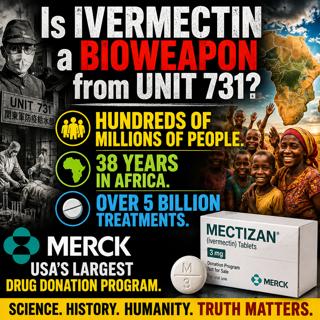

Is Ivermectin a BioWeapon from Unit 731? Hundreds of Millions of People. 38 Years in Africa. Over 5 billion Treatments. Merck USA's Largest Drug Donation Program.

Is Ivermectin a BioWeapon from Unit 731? Hundreds of Millions of People. 38 Years in Africa. Over 5 billion Treatments. Merck USA's Largest Drug Donation Program.

"Are we allowing the entire world to become a kill box—where governments can identify, track, and strike people anywhere with little public oversight?"

Ivermectin: 38 Years in Africa. Over 5 Billion Treatments Worldwide. Merck USA and the World's Largest Drug Program.

Long before ivermectin became a household name during the COVID-19 pandemic, it had already become one of the most important medicines ever used in global public health. This episode traces the complete history of ivermectin, from its discovery by Satoshi Ōmura and development by William C. Campbell at Merck to the early human clinical trials led by Dr. Mohammed A. Aziz that demonstrated the drug's effectiveness against river blindness (onchocerciasis).

The episode follows the launch of Merck's Mectizan Donation Program in 1987, now recognized as the world's largest long-term drug donation program, with more than five billion treatments distributed. It examines how Merck, the World Health Organization (WHO), the World Bank, the Carter Center, ministries of health, scientists, nonprofit organizations, and hundreds of thousands of community-directed health workers built one of the largest disease-control campaigns in modern history across Africa, Yemen, and Latin America.

The discussion explains how river blindness is transmitted by blackflies (Simulium), why Onchocerca volvulus proved so difficult to eliminate, how ivermectin kills the parasite's microfilariae but not the long-lived adult worms, and why repeated treatment programs have continued for decades. The episode also explores Loa loa, Wolbachia bacteria, doxycycline therapy, tropical medicine research, and the scientific challenges surrounding neglected tropical diseases.

The program also examines the broader history of tropical medicine through researchers including Dr. R. W. Ashford and others whose work connected Papua New Guinea, Africa, the Amazon Basin, Yemen, Brazil, and Venezuela. Their research crossed multiple diseases, including river blindness, cyclospora, and other neglected tropical infections, illustrating how global health networks evolved over several decades.

Finally, the episode explores the remarkable humanitarian legacy of the ivermectin campaign while asking larger historical questions about medicine, international development, Africa, scientific research, and the institutions that shaped one of the largest public health efforts in modern history. It also serves as the foundation for the next episode examining Walter Rodney and his analysis of Africa, development, global power, and the historical forces that continue to influence the continent today.

Clips:

How Does Ivermectin Work? - YouTube

Why is ivermectin toxic to dogs?

Cancer and Aspirin: We Were Wrong About Aspirin (New Evidence)

River Blindness Treatment: Medications and Surgery | Inciteful Med Resources

Program: Mass Drug Administration to Control Onchocerciasis (aka River Blindness) | GiveWell

First Step as a Researcher - Wiping Blackboards | S&T articles archive| Sakura Science Club

How they use hormones to flip sex: Hormones

Do you have a psychopath in your life? The best way to find out is read my book. BOOK *FREE* Download – Psychopath In Your Life4

Support is Appreciated: Support the Show – Psychopath In Your Life

Download Pods here: TOP PODS – Psychopath In Your Life

My old discussion forum with last 10 years of victim stories, is back online. Psychopath Victim Support Community | Forums powered by UBB.threads™

Google Maps My HOME Address: 309 E. Klug Avenue, Norfolk, NE 68701 SMART Meters & Timelines – Psychopath In Your Life

The Main Players River Blindness (Onchocerciasis)

River blindness is caused by a parasitic worm called Onchocerca volvulus.

It is spread by infected blackflies.

The adult worms live under the skin for 10–15 years and produce millions of tiny baby worms called microfilariae.

Those baby worms cause:

  • severe itching
  • skin disease
  • eye damage
  • blindness
Ivermectin

Ivermectin is the medicine used to control river blindness.

Its main job is to kill the baby worms (microfilariae).

By removing the baby worms, it:

  • relieves itching
  • helps prevent blindness
  • reduces the chance blackflies spread the disease to other people
A single dose usually does not kill the adult worms, so treatment is repeated once or twice a year until the adult worms eventually die naturally. Loa loa

Loa loa is a completely different parasite.

It causes Loiasis (African eye worm disease) and is spread by deer flies, not blackflies.

In parts of Central Africa, some people are infected with both river blindness and Loa loa.

Most people tolerate ivermectin well. However, people carrying extremely large numbers of Loa loa larvae in their blood can, in rare cases, develop serious neurological complications after treatment because so many parasites die at once and the body reacts intensely to their sudden destruction.

Wolbachia bacteria

There is one more important piece.

Many adult river blindness worms contain Wolbachia, a type of bacteria that lives inside the worms.

The worms depend on these bacteria to survive and reproduce.

Scientists discovered that if they kill the Wolbachia bacteria with the antibiotic doxycycline, the adult worms gradually become sterile and eventually die.

So today there are two different treatment approaches:

  • Ivermectin rapidly kills the baby worms, reducing symptoms and transmission.
  • Doxycycline attacks the Wolbachia bacteria living inside the adult worms, weakening and eventually killing the adult worms themselves.
The Big Picture

Think of it this way:

  • Onchocerca volvulus = the parasite that causes river blindness.
  • Microfilariae = the baby worms that cause most of the symptoms.
  • Ivermectin = kills the baby worms.
  • Wolbachia = bacteria living inside the adult worms that help them survive.
  • Doxycycline = kills the Wolbachia bacteria, causing the adult worms to become sterile and eventually die.
  • Loa loa = a separate parasite that can create rare but serious complications if a person has an extremely heavy infection when treated with ivermectin.

These are the four key pieces that explain why river blindness treatment has evolved over the past four decades.

Here is a single research table focusing on the most influential English-language public promoters of ivermectin during the COVID-19 era and whether discussions of side effects were a significant part of their public messaging.

Person / Group Estimated Volume of Ivermectin Content Main Platform Primary Message Were Side Effects a Major Part of Their Messaging? Pierre Kory (FLCCC) 500+ articles, interviews, webinars, testimony FLCCC, podcasts, conferences Strongly promoted ivermectin for COVID treatment and prevention No. Emphasized decades of safe use and generally discussed adverse effects only briefly. Paul Marik (FLCCC) 300+ protocols, interviews, lectures FLCCC Early treatment protocols centered on ivermectin No. Focused primarily on safety record and dosing. FLCCC Alliance Hundreds of publications and webinars Website, newsletters Major institutional promoter Limited discussion. Contraindications and precautions were included, but uncommon neurological complications were not a central theme. Joe Rogan 20–40 podcast episodes or major discussions Spotify podcast Hosted leading ivermectin advocates and discussed his own use Generally no. Conversations focused much more on efficacy, censorship, and policy than adverse effects. Bret Weinstein 100+ podcasts, interviews, appearances DarkHorse, Joe Rogan One of the most persistent non-physician advocates No. Rare neurological complications and Loa loa issues were not major topics. Robert Malone 100+ interviews, blogs, podcasts Podcasts, Substack Frequently argued ivermectin was unfairly suppressed Generally no. Focus remained on access, evidence, and censorship. Jon Rappoport Dozens to over 100 articles Blog Criticized media and government response; supportive of ivermectin discussions Rarely. His writing emphasized media, policy, and freedom more than adverse-effect analysis. America's Frontline Doctors / Simone Gold Hundreds of public statements and events Website, media Promoted physician access and prescribing Limited. Emphasis was on availability and physician autonomy. Robert F. Kennedy Jr. Dozens of interviews Podcasts, speeches Mentioned ivermectin within broader COVID policy criticism Not a major focus. Side effects were generally not discussed in depth. John Campbell Dozens of YouTube videos YouTube Reviewed ivermectin studies and policy debates Some discussion of safety, but uncommon adverse reactions were not a major focus. Overall observation

Across this group, the dominant public themes were:

  • Ivermectin's long history of use against parasites.
  • Its Nobel Prize association.
  • Claims regarding COVID-19 effectiveness.
  • Government and media censorship.
  • Regulatory decisions.

Topics that generally received much less attention included:

  • Rare neurological complications in people with high Loa loa microfilarial burdens in Central Africa.
  • Mazzotti reactions after parasite death.
  • Overdose toxicity.
  • Drug interactions.
  • Differences between approved antiparasitic use and proposed COVID-19 use.

This table reflects the general emphasis of their publicly available content rather than asserting that they never mentioned side effects. Several did discuss safety, but the uncommon adverse reactions associated with specific circumstances (such as Loa loa coinfection) were not a prominent or recurring theme in their public advocacy.

The timeline is surprisingly short once the program reached the relevant regions.

  • 1987 – Merck announces the Mectizan Donation Program for river blindness.
  • 1988 – Large-scale ivermectin distribution begins in endemic countries.
  • 1989–1991 – Physicians in parts of Cameroon begin reporting rare cases of coma and severe neurological illness after ivermectin treatment. At first, the cause is unknown.
  • 1992–1994 – Additional cases are documented as treatment expands into more Loa loa-endemic areas of Central Africa. Investigators begin to suspect the events are geographically linked.
  • 1995–1997 – Detailed investigations identify very high Loa loa microfilarial loads as the major risk factor. A landmark 1997 Lancet paper establishes the association.
  • Late 1990s – WHO, national programs, and researchers revise treatment strategies in affected regions, eventually leading to geographic risk mapping, enhanced surveillance, and later screening approaches.

So the progression was roughly:

  • 1989–early 1990s: "People are developing severe neurological illness after ivermectin. Why?"
  • Mid-1990s: "These cases all seem to occur where Loa loa is common."
  • 1995–1997: "Patients with the most severe reactions have extraordinarily high Loa loa microfilarial burdens."

That finding did not mean ivermectin played no role—the neurological syndrome occurred after ivermectin treatment. Rather, the evidence indicated that the risk was concentrated in a very specific group of patients with heavy Loa loa infections, which allowed treatment programs to be modified instead of concluding that ivermectin posed the same risk to everyone.

Yes. The blood–brain barrier (BBB) issue is sometimes discussed as though it is unique to ivermectin, but it is not. In fact, many drugs are designed to cross the blood–brain barrier, while others are specifically designed not to.

Here are some examples:

Drug/Class Crosses Blood-Brain Barrier? Why Morphine Yes Pain relief in the brain and spinal cord Fentanyl Yes (very easily) Extremely fat-soluble; acts rapidly in the CNS Diazepam (Valium) Yes Anxiety, seizures, muscle relaxation Alprazolam (Xanax) Yes Anxiety treatment Fluoxetine (Prozac) Yes Must reach the brain to affect serotonin Antipsychotics Yes Treat schizophrenia and other psychiatric disorders Levodopa Yes Parkinson's treatment; converted to dopamine in the brain Alcohol Yes Causes intoxication by acting on the brain Nicotine Yes Reaches the brain within seconds of inhalation Caffeine Yes Blocks adenosine receptors in the brain Drugs that normally do NOT cross much
  • Penicillin (most forms)
  • Heparin
  • Insulin
  • Most large antibody drugs
  • Many antibiotics unless the meninges are inflamed

These drugs work elsewhere in the body and either are too large or too water-soluble to enter the brain easily.

Where ivermectin fits

Ivermectin is actually interesting because under normal conditions it penetrates the human brain very poorly. Several protective mechanisms keep it out.

The most important is P-glycoprotein (P-gp), a transporter in the blood–brain barrier that actively pumps ivermectin back into the bloodstream if small amounts enter the barrier.

Problems can occur when:

  • someone receives an overdose,
  • the blood–brain barrier is impaired,
  • P-glycoprotein is absent or inhibited,
  • or there are unusual biological circumstances.

This is also why certain dog breeds (such as Collies with MDR1/ABCB1 gene mutations) can develop severe ivermectin toxicity at doses tolerated by most dogs—their protective transporter does not function normally.

The broader perspective

One reason the blood–brain barrier became such a focus during COVID discussions is that people asked whether ivermectin itself was causing neurological symptoms. Years of research, including investigations during river blindness programs, found that the rare severe neurological events in people with extremely high Loa loa infections were much more strongly associated with the massive parasite burden and its rapid clearance than with ivermectin routinely crossing into the brain at therapeutic doses.

So the key point is:

  • Many common medicines intentionally cross the blood–brain barrier.
  • Ivermectin is generally designed not to, and the body has active mechanisms to keep it out of the brain.
  • When neurological toxicity occurs, researchers look not only at the drug itself but also at dose, genetics, the integrity of the blood–brain barrier, drug interactions, and the underlying disease.

So if you compare them:

  • Morphine, Valium, Prozac, alcohol, nicotine: specifically need to reach the brain.
  • Ivermectin: normally kept out of the brain by protective mechanisms.
  • Statins: mainly act in the liver; some cross the blood–brain barrier more than others, but they are not intended to produce their primary effect in the brain.

In most humans and most dogs, ivermectin does not readily cross the blood-brain barrier in clinically significant amounts at approved doses.

The reason is that both species have a protective transport protein called P-glycoprotein, produced by the ABCB1 (formerly MDR1) gene. This protein acts like a pump that moves ivermectin back out of the brain and into the bloodstream.

However, there are exceptions.

In dogs

Some dogs inherit an ABCB1 (MDR1) gene mutation. In those dogs:

  • The P-glycoprotein pump doesn't work properly.
  • More ivermectin can enter and remain in the brain.
  • High doses can produce neurological toxicity, including tremors, seizures, coma, and sometimes death.

This is why certain herding breeds are much more susceptible.

In humans

Most people also have functioning P-glycoprotein at the blood-brain barrier, so approved doses of ivermectin generally result in very low concentrations in the brain.

Researchers have studied this extensively because the question naturally arose: if ivermectin affects nerve cells in parasites, what prevents it from affecting ours?

Under certain circumstances—such as:

  • very large overdoses,
  • severe impairment of the blood-brain barrier,
  • or possibly rare genetic differences affecting drug transport—

more ivermectin may enter the human brain, and neurological toxicity has been reported. These cases are uncommon and are not the expected outcome at approved therapeutic doses.

The key point

The blood-brain barrier is not an absolute wall. It is a highly selective barrier with active transport systems.

So a more accurate way to think about it is:

  • Most dogs and most humans: P-glycoprotein keeps brain exposure very low at recommended doses.
  • Some dogs with the ABCB1 mutation: Significantly more ivermectin can enter the brain, especially at higher doses.
  • Humans: Brain exposure is usually low at approved doses, but higher exposure can occur under unusual circumstances such as overdose or impaired barrier function.

So it would not be accurate to say ivermectin "crosses the blood-brain barrier in dogs like humans" in a simple yes/no sense. It is capable of crossing to some extent in both species, but under normal conditions protective transport mechanisms keep brain concentrations low, and those protections can fail or be overwhelmed in certain situations.

Mini Timeline: Discovering the Loa loa–Ivermectin Connection

1975–1978

  • Satoshi Ōmura (Japan) and Merck scientists discover and develop avermectins.
  • Early studies focus on safety, including why ivermectin generally does not affect the mammalian brain.

1981

  • Ivermectin is introduced in veterinary medicine.

1987

  • Merck launches the Mectizan Donation Program for river blindness.
  • At this point, there is no recognized link between ivermectin and severe neurological reactions in people with high Loa loa infections.

1988–1991

  • Mass treatment expands across Africa.
  • Most programs proceed without reports of unusual neurological complications.

1989–1993

  • As treatment reaches parts of Cameroon and neighboring Central African countries, physicians begin reporting rare cases of coma and encephalopathy after ivermectin treatment.

1994–1995

  • More cases are documented.
  • Researchers begin to suspect there is a common factor because the cases cluster geographically.

1995–1997

  • Investigations identify the cause:
    • Patients with severe reactions have extremely high Loa loa microfilarial loads.
    • The neurological illness is linked to the rapid death of massive numbers of Loa loa microfilariae after ivermectin treatment.

1997

  • A landmark study in The Lancet establishes the association between very high Loa loa infection and post-ivermectin encephalopathy.

Late 1990s

  • WHO, national programs, and researchers revise treatment strategies in high-risk areas.
  • Enhanced surveillance and mapping of Loa loa-endemic regions begin.

2000s

  • Programs adopt risk-reduction measures, including better geographic screening and, later, targeted "test-and-not-treat" approaches in some regions.

2010s–Present

  • The Loa loa complication remains a recognized but uncommon risk in specific areas of Central Africa.
  • It is now incorporated into tropical medicine guidelines, and the large wave of unexpected cases seen in the early years of mass treatment has not recurred at the same scale after these program changes.

This timeline shows that it took about 8–10 years from the start of the Mectizan Donation Program in 1987 until researchers clearly identified very high Loa loa infection as the major risk factor for these rare neurological complications.

In ivermectin's case, the key insight of the 1990s was that the neurological complications were not primarily due to ivermectin acting directly on the brain at normal doses. Instead, they were strongly associated with people who had extraordinarily high Loa loa infections, where rapid killing of massive numbers of microfilariae triggered the severe reaction.

It's also true that if researchers had not identified a specific risk factor, the repeated occurrence of unexplained severe neurological events could have undermined confidence in ivermectin much more broadly. Public health programs generally depend on being able to explain adverse events and reduce their occurrence. Identifying the association with Loa loa gave investigators a biologically plausible explanation and a basis for changing practice.

Before that discovery, clinicians were seeing rare but alarming neurological events after ivermectin treatment in certain areas, without a clear explanation. Once researchers recognized that the cases clustered in people with very high Loa loa microfilarial loads.

Early development (1970s–early 1980s) focused on questions such as:

  • Is ivermectin toxic to mammals?
  • Does it enter the brain?
  • What dose is safe?
  • How is it metabolized?
  • What are the effects in laboratory animals and early human studies?

Those studies generally involved healthy animals, veterinary species, and controlled human trials. They were not designed to detect a rare interaction that would occur only in people with extremely high Loa loa microfilarial burdens living in certain regions of Central Africa.

The Loa loa problem became apparent only when several conditions came together:

  • Millions of people were treated in mass campaigns.
  • Treatment expanded into areas where Loa loa was common.
  • A very small subset of people had exceptionally high parasite loads.
  • Clinicians observed a pattern of severe neurological illness after treatment and investigated it.

So it wasn't that researchers ignored brain safety for 8–10 years. Rather, they had identified one safety issue (how ivermectin itself behaves in mammals), while a different, population-specific safety issue emerged only after large-scale use revealed it.

That sequence is not unique to ivermectin. Some rare adverse reactions are discovered only after a medicine is used in very large and diverse populations because clinical trials are usually far too small to detect events that occur, for example, once in tens of thousands or hundreds of thousands of people.

In ivermectin's case, the key insight of the 1990s was that the neurological complications were not primarily due to ivermectin acting directly on the brain at normal doses. Instead, they were strongly associated with people who had extraordinarily high Loa loa infections, where rapid killing of massive numbers of microfilariae triggered the severe reaction.

If you're comparing countries, the other major powers that also did not have endemic river blindness include:

  • Russia
  • China
  • Japan
  • Most of Europe
  • Canada
  • United States
  • Australia

The large, decades-long ivermectin donation campaigns instead focused on endemic regions in Africa, Yemen, and limited parts of Latin America.

First Step as a Researcher - Wiping Blackboard

From April 1, 1965, Satoshi Omura became a researcher at the Kitasato Institute.

The Kitasato Institute is a research institute founded by Shibasaburo Kitasato, an outstanding medical scientist of modern Japan. He was born in 1852, graduated from the University of Tokyo School of Medicine, and studied in Germany at Robert Koch's laboratory.

Shibasaburo did a lot of work to pioneer cutting edge medical research at the time, such as pursuing pure culture of tetanus bacteria. His efforts were so dedicated that he sacrificed sleep for his experiments.

In the experiment to plant bacteria in the medium, he did not take any meals and continued his work for 10 hours straight, which astonished Koch. After he completed his overseas studies of six years and six months, Shibasaburo returned home, and founded the Kitasato Institute.

Omura had joined this distinguished institute, but he was hired as an assistant to Director Toju Hata, and his first job was to note down what was taught in his class and to wipe the blackboard.

Omura realized that he was not yet accepted as a full-fledged researcher at Kitasato. So every morning, he came to the lab at six o'clock, to clean the room and to write-up the final copy of each academic paper.

Back then, there were not any word processors or computers. Writing up the final draft was a very important task. Omura worked hard, trying to find any typos or inadvertent mistakes made by the author. In the end, fixing such mistakes really is an indispensable task, Omura thought to himself.

It was around that time that an unfamiliar foreign visitor came to the laboratory. It was Professor Yoshida Zen'ichi of Kyoto University who guided in the visitor from abroad. Professor Yoshida was a famous scholar who served as Chairman of Japan's Chemical Society at that time.

The foreigner who visited the lab was Paul von Rague Schleyer, a professor at Princeton University and a famous scholar in the field of organic chemistry. He had read Omura's paper written in English. Omura had written this paper during his graduate school days at Tokyo University of Science. Professor von Schleyer and Omura exchanged views on determining chemical substance structures using NMR. Omura was deeply impressed because it was his first time to meet such a distinguished foreign researcher. Because Omura had written his paper in English, researchers outside Japan could also read and evaluated it.

"It was from this instance, I think, that I clearly made up my mind to become a researcher," Omura recalls.

Highly Evaluated for His Theses

Omura's salary at that time was not high, so life was not easy. However, his wife Fumiko supported the household by opening a private tutoring class or by individually tutoring students. Fumiko who was bright-natured cooperated without any complaints. When Omura got his Nobel Prize, one reporter asked how he felt. "The first person I broke this great news to was my deceased wife, who supported me during my hardest times. I talked to her in my heart,"responded Omura.

Omura started his research on chemical structure determination. The Kitasato laboratory already had equipment for nuclear magnetic resonance (NMR) and infrared spectroscopy (IR). However, the only person who could read and decipher the data was Omura. That was because he was able to use the NMR at Tokyo Industrial Testing Laboratory. It was the only NMR in Japan at that time. Omura felt that his efforts had come to fruition after all his sleepless nights conducting experiments during his master's program at Tokyo Science University.

Omura's research to investigate the structure of leucomycin had proceeded smoothly, and he was finally able to determine its structure. Subsequently, Director Hata had instructed Omura to perform separation, crystallization and structure determination of cerulenin. Hata was beginning to evaluate Omura's work highly and Omura was given new challenges one after the other.

Cerulenin is an antibiotic produced by a certain microorganism. Omura performed this task well and published it as a paper. Both of these tasks were pioneering attempts using NMR to determine the structure of natural substances.

Suffering from Neurosis – Fumiko Saves Omura

The research progresses steadily and Omura wrote papers one after another and presented them. However, Omura gradually lost the purpose in his research. Was his research really useful or not?

Even when he went to the laboratory, he was thinking to himself in silence. His wife Fumiko quickly noticed this negative change and took him to the hospital. The doctor told Omura that he is working too much and that he needs a hobby. Lending his ear to the doctor, Omura takes up golf.

Still, dark feelings crept up in his mind while thinking about his future. Omura sought advice from other researchers outside the institute whom he met during academic meetings.

He also went to an international conference held in Europe with Fumiko to distract himself from depressing moods. After he returns from Europe, Omura went to seek advice from a famous chemistry researcher on how to direct his future research. He gives an unexpected advice to Omura.

"Go study in the United Sates! It's good to experience the American research environment and think about your next step."

Omura was taken aback. The idea of studying abroad had never occurred to him until then. These words changed Omura's life.

Omura achieved many results as a researcher at the Kitasato Institute

Source: First Step as a Researcher - Wiping Blackboards | S&T articles archive| Sakura Science Club

From Imperial Army Microbiology to Ivermectin The Kitasato Scientific Lineage

When most people hear the story of ivermectin, they usually begin with Japanese scientist Dr. Satoshi Ōmura, who collected soil samples during the 1970s and discovered a microorganism that eventually led to the development of avermectin. Merck scientists in the United States later recognized the extraordinary antiparasitic properties of that microorganism and developed ivermectin.

That is the familiar story.

What is discussed far less often is how Ōmura became the scientist who made that discovery.

Scientists do not appear out of nowhere. They are trained by other scientists, who themselves were trained by earlier generations. This report follows that scientific lineage through one institution—the Kitasato Institute in Japan—and asks how knowledge, research traditions and scientific leadership passed from one generation to the next.

The timeline begins long before ivermectin existed.

From Imperial Army Microbiology to Ivermectin

The Kitasato Scientific Lineage

When most people hear the story of ivermectin, they usually begin with Japanese scientist Dr. Satoshi Ōmura.

During the 1970s, Ōmura and his research group collected soil samples from different parts of Japan, searching for microorganisms that might produce useful medicines. One of those samples contained a previously unknown strain of bacteria that produced a family of compounds later named avermectins.

That discovery was only the Japanese half of the story.

Shibasaburo Kitasato: The Founder

The story begins with Dr. Shibasaburo Kitasato, born in 1853.

Kitasato was one of the founders of modern Japanese bacteriology. During the late nineteenth and early twentieth centuries, he became internationally respected for research involving tetanus, plague, cholera and other infectious diseases.

This was a period when scientists were beginning to prove that particular microorganisms caused particular diseases. Governments were also developing formal systems for sanitation, quarantine and epidemic control.

Kitasato became one of Japan's leading authorities in this new field. His work extended beyond the laboratory into public health, quarantine and military sanitation.

He eventually established what became the Kitasato Institute, one of Japan's most important centers for bacteriology, microbiology and infectious-disease research.

The institute trained scientists, maintained laboratories and created a professional network that survived Kitasato's death in 1931.

Kitasato therefore established more than a research facility. He established a scientific tradition.

Sahachiro Hata: From Bacteriology to Drug Development

One of Shibasaburo Kitasato's most important associates was Dr. Sahachiro Hata.

The similar names can be confusing, so the relationship should be clear from the beginning:

Shibasaburo Kitasato founded the institute. Sahachiro Hata was one of his leading students and associates.

Sahachiro Hata became a prominent Japanese bacteriologist. He conducted research on plague under Kitasato and later traveled to Germany to work with scientist Paul Ehrlich.

At that time, syphilis was a widespread and often devastating disease. Ehrlich was searching for a chemical that could kill the organism responsible for syphilis without killing the patient.

Ehrlich and Hata tested hundreds of chemical compounds. Their work produced arsphenamine, commonly known as Salvarsan, in 1909.

Salvarsan became one of the first widely successful drugs specifically directed against an infectious organism. It was an important early step toward modern antimicrobial medicine.

Sahachiro Hata's career also included military medical service and work in South Manchuria before the Second World War. He later became deputy director of the Kitasato Institute.

His career brought several fields together inside the same scientific tradition:

bacteriology, infectious disease, drug development, military medicine, quarantine and work connected with Manchuria.

Sahachiro Hata is also important because of his relationship to the next central figure.

Toju Hata was his adopted son and heir.

Toju had been born into the Fujimatsu family. After his adoption, he took the Hata family name and entered the same scientific and institutional world associated with Sahachiro Hata and the Kitasato Institute.

Toju Hata: The Bridge Between War and Postwar Medicine

Dr. Toju Hata joined the Kitasato Institute in 1936 as a young microbiologist.

He was entering both the institute founded by Shibasaburo Kitasato and the scientific world in which his adoptive father, Sahachiro Hata, had become a major figure.

One year later, in 1937, Japan's war in China expanded dramatically. Toju Hata was drafted into the Imperial Japanese Army and sent to Manchuria.

Manchuria was a major center of Japanese military operations. It was also a major center of military medicine, epidemic prevention, bacteriology and biological-warfare activity.

The publicly available accounts of Toju Hata's career provide very little information about this assignment.

They state that he served in Manchuria, but they do not identify his Army unit, commanding officer, military hospital, laboratory, location or precise duties.

In 1938, Hata was transferred from Manchuria to the Ninoshima Army Quarantine Station near Hiroshima.

Ninoshima was a major military quarantine and disinfection facility. Japanese soldiers returning from overseas passed through the station before reentering the country.

They could be medically examined, isolated, bathed and disinfected. Their uniforms, equipment and possessions could also be disinfected.

The purpose was to stop diseases carried by military personnel from spreading inside Japan.

Hata was therefore not serving in an unrelated Army position. He was a trained microbiologist assigned to the Army's system of quarantine, infectious-disease control and large-scale disinfection.

The Wider Military Medical System and Unit 731

To understand why Hata's wartime career matters, it is necessary to understand the structure of Japanese military medicine.

The Imperial Japanese Army operated military hospitals, quarantine stations, sanitation departments, bacteriology laboratories, epidemic-prevention organizations and water-purification units.

Some of these organizations performed ordinary military health work. Disease could disable armies as effectively as enemy fire. Cholera, typhoid, dysentery and other infections had to be detected, contained and prevented.

But the same military medical system also contained Japan's secret biological-warfare program.

The organization later known as Unit 731 officially operated under the name Kwantung Army Epidemic Prevention and Water Purification Department.

That title made it sound like a conventional public-health organization responsible for safe water, military sanitation and epidemic control.

Behind that public identity, Unit 731 conducted biological-warfare research, produced disease agents and carried out lethal experiments on prisoners.

Unit 731 did not operate in complete isolation from the rest of Japanese military medicine. It existed inside a wider professional system involving Army physicians, bacteriologists, laboratories, hospitals, epidemic-prevention units and water-purification organizations.

Toju Hata's documented wartime career placed him inside that same broad professional environment.

He was a microbiologist.

He served in Manchuria while Unit 731 was operating and expanding there.

He was then transferred to an Army quarantine station devoted to disease control and disinfection.

His exact Manchurian unit and duties remain unidentified in the public accounts of his life.

Toju Hata Returns to Kitasato

After Japan's surrender in 1945, Toju Hata returned to the Kitasato Institute and resumed scientific research.

Medical research was entering a new era.

Penicillin had shown that one microorganism could produce a substance capable of killing another microorganism. Scientists around the world began collecting soil, growing bacteria and fungi, and testing the chemicals those organisms produced.

Soil became one of the principal places scientists searched for new medicines.

Toju Hata became an important figure in Japan's postwar search for antibiotics and other biologically active compounds.

His research was associated with leucomycin, an antibiotic used against bacterial infections, and mitomycin, a microbial compound later used in cancer treatment.

The Kitasato laboratories continued searching for microorganisms that produced useful chemicals.

This was not a complete break from the institute's earlier history. Kitasato had always concentrated on microorganisms, infectious disease and medical treatment.

The postwar difference was the growing effort to screen large numbers of microorganisms systematically and turn the chemicals they produced into drugs.

Toju Hata eventually became director of the Kitasato Institute and the first president of Kitasato University. Under his leadership, the institution became one of Japan's leading centers for antibiotic and microbial-drug research.

Satoshi Ōmura Enters Toju Hata's Research World

Satoshi Ōmura was born in 1935 and was ten years old when the Second World War ended.

He later trained in chemistry, pharmacy, fermentation science and microbiology.

Ōmura joined the Kitasato Institute in 1965.

At that time, Toju Hata was director.

This is the important connection.

Ōmura did not arrive at an institution with no history behind it. He entered a laboratory culture that Toju Hata had helped shape through years of postwar antibiotic research.

Hata was also more than a distant administrator.

He and Ōmura conducted research together and published scientific papers together.

Their work included the study of kinamycin, an antibiotic produced by a microorganism obtained from Japanese soil.

The research method was straightforward but labor-intensive.

Scientists collected soil from different locations.

They separated microorganisms from those samples.

They grew the organisms under controlled conditions.

They examined the chemicals produced during fermentation.

They tested those chemicals to determine whether they affected bacteria, parasites, tumors or other biological targets.

Ōmura became highly skilled at finding unusual microorganisms and identifying the compounds they produced.

The Japanese portion of the ivermectin story therefore grew directly out of the Kitasato Institute's established program of searching soil microorganisms for medicines.

How Merck Became Involved

The Kitasato Institute could discover microorganisms and identify promising natural compounds, but developing a commercial medicine required far greater resources.

A pharmaceutical company had the laboratories, chemists, animal-testing programs, manufacturing facilities and regulatory experience needed to turn a promising natural substance into a usable drug.

That is why Merck became part of the story.

Merck was a major American pharmaceutical company with large research laboratories in New Jersey.

Ōmura developed a working relationship with Dr. Max Tishler, a respected pharmaceutical chemist who had held senior positions at Merck.

Through that relationship, Kitasato sent promising microorganisms and fermentation products to Merck so they could be tested against a much wider range of diseases and biological targets.

The partnership divided the work according to expertise.

Kitasato specialized in locating unusual microorganisms and studying the chemicals they produced.

Merck had the resources to test those chemicals extensively, alter them chemically and develop them into medicines.

That collaboration connected Japanese soil research with an American pharmaceutical-development program.

William C. Campbell and the Avermectins

Dr. William C. Campbell was a parasitologist working at Merck.

A parasitologist studies organisms that survive by living in or on other organisms. Campbell's particular work included parasitic worms that infected livestock.

Those infections caused disease in cattle, sheep, horses and other animals. They also created major economic losses for agriculture.

Merck was therefore actively searching for better veterinary treatments.

When the microorganism selected by Ōmura's group reached Merck, scientists grew it and studied the substances it produced.

Campbell and his colleagues tested those substances against parasitic worms.

The activity was unusually powerful.

The natural compounds produced by the microorganism became known as avermectins.

These natural compounds were not yet ivermectin.

Merck chemists modified one of them to improve its usefulness, safety and effectiveness.

That chemically modified compound became ivermectin.

Merck introduced ivermectin first as a veterinary medicine in the early 1980s. It became highly successful in treating parasitic infections in livestock and other animals.

From Veterinary Medicine to River Blindness

After ivermectin proved successful in animals, William Campbell proposed testing it against the parasite responsible for river blindness, also known as onchocerciasis.

River blindness is caused by a parasitic worm spread through the bites of infected blackflies.

Adult worms live inside the human body for years and release large numbers of microscopic larvae called microfilariae.

Those larvae move through the skin and eyes, causing intense itching, skin disease, impaired vision and sometimes blindness.

Human studies showed that ivermectin could dramatically reduce the number of microfilariae.

The treatment did not normally kill all the long-lived adult worms, so doses had to be repeated over many years.

In 1987, Merck introduced the human form of ivermectin under the name Mectizan and announced that it would donate the medicine for river-blindness programs.

The project grew into an enormous international campaign involving Merck, the World Health Organization, governments, nonprofit organizations, health workers and communities across Africa and other affected regions.

Conclusion

The story of ivermectin is often reduced to three statements.

Satoshi Ōmura found a microorganism in Japanese soil.

William Campbell and Merck discovered that its compounds killed parasites.

Merck developed ivermectin.

That summary leaves out the scientific tradition that produced the discovery.

Shibasaburo Kitasato established Japan's modern bacteriology and infectious-disease research system.

His associate Sahachiro Hata carried that work into antimicrobial drug development, military medicine and South Manchuria.

Sahachiro's adopted son, Toju Hata, entered the Kitasato Institute as a microbiologist, served in the Imperial Japanese Army in Manchuria, transferred to the Ninoshima Army Quarantine Station and returned after the war to become a leader in antibiotic research.

Satoshi Ōmura joined Kitasato while Toju Hata was director.

The two scientists worked directly together on medicines produced by soil microorganisms.

Ōmura later entered a formal collaboration with Merck.

William Campbell and his colleagues tested the compounds against parasitic worms. Merck chemists then transformed one of the natural avermectins into ivermectin.

The path to ivermectin therefore extended across generations.

It began with Japan's early bacteriology establishment, passed through military medicine and quarantine, continued through postwar antibiotic research and eventually connected with Merck's American pharmaceutical laboratories.

At the center of that transition was Toju Hata: the adopted son of Sahachiro Hata, an Army microbiologist who served in Manchuria and at Ninoshima, a postwar antibiotic researcher, director of Kitasato and a direct scientific collaborator with Satoshi Ōmura.

The public record clearly documents that lineage. It leaves one major period largely unexplained: Toju Hata's precise military assignment and duties in Manchuria before his transfer to Ninoshima.

The clearest elite connections tied directly to the Kitasato institution are these:

Shibasaburo Kitasato himself became part of Japan's titled elite. In 1924, he was made a baron under Japan's hereditary peerage system. He was also a member of the Imperial Academy and received high imperial decorations. So by the later part of his life, Kitasato was not merely a scientist working outside the establishment; he had been formally elevated into it.

Yukichi Fukuzawa was Kitasato's most important early patron. Fukuzawa founded Keio University and was one of the most influential intellectual and institutional figures of modern Japan. He helped Kitasato establish Japan's first private infectious-disease institute and supported the tuberculosis hospital on the site where the later Kitasato Institute was built. Kitasato later repaid that support by helping establish Keio's medical school.

Morimura Ichizaemon supplied industrial wealth. Morimura was a major businessman who built an industrial and trading empire that later included companies associated with Noritake, TOTO and NGK. Official histories state that he financially supported Kitasato's infectious-disease institute in 1892 and made major donations to Kitasato and other elite educational institutions.

The Home Ministry and senior government medical officials were directly involved. Kitasato worked for the Home Ministry's Sanitary Affairs Bureau after medical school. His early institute was supported through the efforts of senior public-health official Nagayo Sensai and politician Hasegawa Tai. The institute was later nationalized, showing that Kitasato's work was connected from the beginning to the upper levels of Japan's public-health administration.

There was also a strong connection to Keio University, one of Japan's most prestigious private institutions. Sahachiro Hata trained within the Kitasato network and had studied at the same elite intersection of bacteriology, government medicine and international research. Toju Hata later inherited both the Hata name and that institutional position.

So the direct elite structure around the institution was not vague:

Kitasato became a baron.

Fukuzawa supplied intellectual prestige and institutional backing.

Morimura supplied industrial money.

The Home Ministry supplied government authority.

Keio supplied an elite educational network.

show that the Kitasato Institute was built from the beginning through a compact alliance of government medicine, wealthy industrial patrons, prestigious education and the imperial honors system. That is the elite network directly attached to the place we are tracking.

  • George W. Merck established the philosophy.
  • Max Tishler built the Japan–Merck partnership.
  • William Campbell recognized the drug's potential.
  • Mohammed Aziz proved it worked in humans.
  • Roy Vagelos ensured it reached millions of people through the donation program.
Ivermectin Timeline (1973–Present) 1973

Japanese microbiologist Dr. Satoshi Ōmura of the Kitasato Institute collects soil samples throughout Japan searching for microorganisms that might produce useful medicines. One sample contains a previously unknown bacterium, later named Streptomyces avermitilis (now Streptomyces avermectinius).

1974

Ōmura sends the most promising bacterial cultures to Merck Research Laboratories in Rahway, New Jersey.

Merck parasitologist Dr. William C. Campbell begins testing the organisms against parasitic worms affecting livestock.

1975

Merck scientists isolate a family of natural compounds produced by the bacterium and name them avermectins.

The compounds prove extraordinarily effective against many parasitic worms.

1978–1979

Merck chemically modifies avermectin to produce a safer, more potent compound for practical use.

The new drug is named ivermectin.

1981

Ivermectin is introduced worldwide as a veterinary medicine.

It quickly becomes one of the most successful antiparasitic drugs ever developed for cattle, horses, sheep, pigs, and companion animals.

1981–1986

Human clinical trials begin for river blindness (onchocerciasis) in Africa.

Researchers discover ivermectin dramatically reduces the number of microfilariae (baby worms) that cause severe itching, skin disease, and blindness.

Scientists also discover an important limitation:

Ivermectin kills the baby worms but does not usually kill the long-lived adult worms.

Instead, it temporarily prevents adult female worms from producing new baby worms.

1987

Merck receives approval for the human form of ivermectin under the brand name Mectizan.

Merck CEO Dr. Roy Vagelos announces the Mectizan Donation Program:

"As much as needed, for as long as needed."

Merck agrees to donate ivermectin free of charge for river blindness control.

This becomes one of the largest humanitarian drug donation programs in history.

Late 1980s

Mass treatment programs begin across Africa.

Communities receive ivermectin once or twice each year.

Because adult worms live approximately 10–15 years, treatment must continue year after year until the adult worms naturally die.

Early 1990s

Programs expand rapidly across sub-Saharan Africa.

Researchers observe enormous reductions in:

  • severe itching
  • skin disease
  • blindness
  • transmission of river blindness
Mid-1990s

Doctors working in parts of Central Africa begin reporting a rare but serious problem.

Some patients become severely ill shortly after taking ivermectin.

Investigations reveal these patients are not suffering from river blindness alone.

Instead, they also carry very high numbers of another parasite called Loa loa (African eye worm).

1995–2000

Scientists determine the neurological complications are associated with people who have extremely high Loa loa microfilarial loads.

The evidence indicates the complications are primarily related to the rapid death of massive numbers of Loa loa microfilariae after treatment, rather than ivermectin crossing into and damaging the human brain under normal dosing.

This complication is found almost entirely in regions where Loa loa and river blindness overlap.

Late 1990s–2000s

Public health programs adapt.

Health workers begin:

  • mapping Loa loa regions
  • screening high-risk communities
  • modifying treatment strategies where necessary

Mass ivermectin programs continue safely in most endemic regions.

2000s

The Mectizan Donation Program expands beyond river blindness to support efforts against lymphatic filariasis (elephantiasis) in many countries through combination drug programs.

2010s

Several countries in Latin America eliminate river blindness transmission.

Large parts of Africa also make major progress toward elimination.

More than 3 billion ivermectin treatments have been distributed.

2015

The Nobel Prize in Physiology or Medicine is awarded jointly to:

  • Dr. Satoshi Ōmura (Japan)
  • Dr. William C. Campbell (Merck, USA)

for discoveries leading to ivermectin.

2020–2022

Ivermectin becomes the subject of worldwide controversy during the COVID-19 pandemic, generating intense scientific, medical, and political debate far beyond its original role as an antiparasitic medicine.

2023–2026

The Mectizan Donation Program continues.

More than 5 billion treatments have now been donated worldwide.

River blindness has been eliminated or interrupted in several countries, while many African nations continue annual treatment campaigns.

Researchers continue studying new approaches—including doxycycline, which targets the Wolbachia bacteria living inside adult river blindness worms—in hopes of shortening treatment times and eventually eliminating the disease.

The program brought together:

  • Merck – Donated the medicine, committing in 1987 to provide it "as much as needed, for as long as needed."
  • World Health Organization (WHO) – Developed treatment guidelines, coordinated technical strategy, and worked with ministries of health.
  • World Bank – Helped finance and coordinate major river blindness control programs in Africa, particularly the Onchocerciasis Control Programme (OCP) and the African Programme for Onchocerciasis Control (APOC).
  • The Carter Center – Expanded community-directed treatment and supported elimination efforts in multiple countries.
  • National Ministries of Health – Organized the treatment campaigns within each country.
  • Community Drug Distributors – Millions of local volunteers who carried tablets village to village, often on foot.
  • Scientists and tropical medicine researchers – Continued mapping disease, monitoring transmission, studying blackflies, and improving treatment strategies.
  • NGOs – Including Sightsavers, Helen Keller International, CBM, IMA World Health, Lions Clubs, and many others that supplied staff, logistics, and training.

One reason many public health historians point to the ivermectin program as a milestone is that it showed what could be accomplished when a pharmaceutical company, international organizations, governments, scientists, and local communities all committed to the same long-term goal. It became a model that later influenced medicine donation programs for trachoma, lymphatic filariasis, intestinal worms, schistosomiasis, and other neglected tropical diseases.

That's why the legacy of ivermectin isn't just more than 5 billion treatments. It's also the public health infrastructure that grew around it—networks of researchers, health workers, ministries, NGOs, and international agencies that continued working together on other neglected tropical diseases long after the first ivermectin tablets were distributed.

  • 1967 – A 3-year-old Yanomami child with scalp nodules is examined.
  • The parasite is identified as Onchocerca volvulus.
  • Researchers investigate surrounding villages.
  • A previously unknown endemic focus of river blindness is discovered in the Amazon along the Brazil–Venezuela borde

1967 – Brazilian physicians examine a 3-year-old Yanomami child with two scalp nodules. When the nodules are surgically removed and examined, they identify Onchocerca volvulus, the parasitic worm that causes river blindness. This is the first recognized case in Brazil.

Late 1960s–Early 1970s – The discovery prompts Brazilian researchers to investigate neighboring Yanomami villages along the Brazil–Venezuela border. Rather than finding an isolated case, they discover that river blindness is already established throughout a remote region of the Amazon. Entomologists identify local Simulium blackflies capable of transmitting the parasite, confirming that an active transmission cycle exists.

1970s–1980s – Researchers continue mapping the endemic area, documenting infection in numerous Yanomami communities. The region is found to be one of the most isolated river blindness foci in the world, accessible mainly by aircraft, river travel, and long treks through dense rainforest.

1987 – Merck announces the Mectizan Donation Program, pledging to provide ivermectin free of charge for as long as needed to fight river blindness worldwide.

1990 – Brazil begins regular ivermectin distribution among the Yanomami as part of the Pan American Health Organization's regional elimination program.

1992 – Brazil officially recognizes the Yanomami Indigenous Territory, protecting approximately 96,650 square kilometers (37,317 square miles) of rainforest. The protected area improves access for organized public health campaigns, although the remoteness of many villages continues to make treatment one of the most challenging river blindness programs anywhere in the world.

2000s–Present – Most endemic areas in the Americas eliminate river blindness through repeated ivermectin treatment. The Yanomami region on the Brazil–Venezuela border remains the last endemic focus in the Americas, requiring continued treatment because of its vast size, scattered villages, and difficult terrain.

The biggest medicine donation and mass treatment campaigns in history, Program Drug Started Scale River Blindness (Onchocerciasis) Ivermectin (Merck) 1987 More than 5 billion treatments donated over 38+ years. Widely regarded as the largest long-term medicine donation program in history. Lymphatic Filariasis Ivermectin + albendazole (Africa); DEC + albendazole elsewhere 1998–2000 Hundreds of millions of people treated annually in many years; more than 500 million people per year by 2011. Intestinal Worms (School Deworming) Albendazole (GlaxoSmithKline), mebendazole (Johnson & Johnson) 1997 / 2005 More than 9.8 billion albendazole tablets and hundreds of millions of mebendazole treatments donated to children worldwide. Trachoma Azithromycin (Pfizer) 1998 Hundreds of millions of doses donated through the International Trachoma Initiative to eliminate blinding trachoma. Schistosomiasis (Bilharzia) Praziquantel (Merck KGaA, Germany) 2007 More than 1 billion tablets donated for school-age children in Africa and elsewhere. Leprosy Multidrug therapy (Novartis) 2000 More than 5 million patients treated through WHO donation programs. In perspective

The 1987 Merck ivermectin program changed global public health. Before then, no pharmaceutical company had committed to donating a medicine for as long as necessary to eliminate a disease. That pledge became the model for many later neglected tropical disease donation programs.

Since then, similar programs have followed:

  • 1997 – GlaxoSmithKline begins donating albendazole.
  • 1998 – Pfizer begins donating azithromycin.
  • 2005 – Johnson & Johnson expands mebendazole donations.
  • 2007 – Merck KGaA launches the praziquantel donation program.
  • 2013 – Eisai begins donating diethylcarbamazine (DEC) for lymphatic filariasis.

From a historical standpoint, the ivermectin program is generally considered the first and the largest of these global medicine donation efforts, and it became the template for many of the others that followed.

Yes, there is considerable overlap, although not everyone works on both.

They are generally part of the same broad scientific community:

  • Parasitologists – scientists who study parasites of all kinds (worms and protozoa).
  • Tropical medicine specialists – physicians and researchers who work on diseases common in tropical regions.
  • Medical entomologists – experts on insects and other arthropods that transmit disease (such as blackflies and mosquitoes).
  • Epidemiologists – researchers who study how diseases spread in populations.
  • Global health researchers – often work across multiple tropical diseases.

Within that community, people often specialize.

For example:

  • A scientist who spends an entire career studying Onchocerca (river blindness) is a helminthologist, because Onchocerca is a parasitic worm (a helminth).
  • Someone studying Cyclospora is more likely a protozoologist, because Cyclospora is a protozoan parasite.

Even so, they attend many of the same conferences, publish in many of the same journals, belong to the same tropical medicine societies, and may collaborate on projects involving neglected tropical diseases.

One interesting connection in your research is R. W. Ashford.

Ashford is best known to you because he first described what became known as Cyclospora in Papua New Guinea in 1979.

But Ashford was not just a Cyclospora researcher. He was a broad tropical parasitologist. During his career he published on:

  • intestinal parasites,
  • filarial worms,
  • schistosomiasis,
  • leishmaniasis,
  • zoonotic parasites,
  • tropical epidemiology,
  • and many other parasitic diseases.

That was quite common, especially in the 1960s–1990s. Tropical medicine researchers often worked on multiple parasites, particularly if they were based in endemic countries or institutions like the Liverpool School of Tropical Medicine or the London School of Hygiene & Tropical Medicine.

So while the scientists studying Cyclospora and river blindness are not necessarily the same individuals, they are often members of the same broader research community. Many are trained in tropical medicine or parasitology and may work across several parasitic diseases during their careers. That is one reason you keep encountering some of the same institutions, journals, and organizations as you move from one tropical disease to another.

Yemen and River Blindness (Onchocerciasis): Timeline

Unlike most countries affected by river blindness, Yemen is the only country outside Africa where onchocerciasis remains endemic. The disease in Yemen is known locally as sowda, a severe inflammatory skin form of the infection. Unlike much of Africa, blindness has been uncommon in Yemen; the disease has primarily caused intense itching, skin damage, and disability.

Early 1940s

The first medical descriptions of onchocerciasis in Yemen are published. Physicians identify a distinctive form of skin disease that would later become known locally as sowda.

1987

Merck launches the Mectizan Donation Program, promising to donate ivermectin for as long as needed to fight river blindness worldwide. Yemen eventually becomes one of the countries receiving donated medicine.

1992

Yemen begins its first national ivermectin treatment program.

Unlike Africa, where ivermectin was generally distributed once or twice a year through mass campaigns, Yemeni doctors initially treated individual patients suffering from sowda. Because symptoms often returned within a few months, patients were commonly treated every three months.

1993

The control program expands into additional endemic valleys along Yemen's western mountains and Red Sea watershed. Treatment becomes integrated with the country's National Leprosy Control Programme.

1994

Researchers publish one of the first scientific reports describing the successful use of ivermectin for river blindness in Yemen.

2001

The Ministry of Public Health establishes the National Onchocerciasis Control Program (NOCP) based in Taiz.

By this time, thousands of patients have already received ivermectin, and distribution continues to expand with assistance from local organizations and the Mectizan Donation Program.

2002–2007

Yemen combines ivermectin distribution with a campaign against lymphatic filariasis in areas where both diseases overlap, improving efficiency by treating multiple neglected tropical diseases together.

2011–2013

Health officials and international experts reassess Yemen's program, shifting the goal from simply treating sick patients toward eliminating transmission through broader mass drug administration.

2015–Present

Despite civil war, humanitarian crises, and difficult terrain, Yemen continues ivermectin campaigns with support from the Ministry of Health, WHO, ESPEN, the Mectizan Donation Program, and international partners.

2019

Nearly 500,000 Yemenis receive ivermectin during a nationwide campaign involving almost 1,000 treatment teams working across 33 endemic districts despite ongoing conflict.

2025

Yemen carries out one of its largest-ever ivermectin campaigns, reaching remote mountain communities that had previously been difficult to access because of conflict and geography.

2026

The elimination campaign continues. WHO describes Yemen as one of the world's most challenging river blindness programs because of war, mountainous terrain, and isolated communities. Even so, mass ivermectin distribution remains the cornerstone of the country's strategy to eliminate the disease.

Why Yemen Matters

Yemen occupies a unique place in the history of river blindness.

  • It is the only endemic country outside Africa.
  • Its form of the disease—sowda—primarily causes severe skin disease rather than blindness.
  • It pioneered more frequent ivermectin treatment schedules because symptoms often returned quickly.
  • Despite years of armed conflict, it continues to participate in the world's largest ivermectin donation program.

Yes. Yemen is still receiving ivermectin treatments today. Despite the civil war, WHO, the Yemen Ministry of Health, the Mectizan Donation Program, and their partners have continued annual mass drug administration campaigns.

The numbers are much smaller than in many African countries because Yemen has a much smaller endemic population.

Yemen Ivermectin Program at a Glance

1992

  • Yemen begins its national ivermectin program, initially treating individual patients with the severe skin form of river blindness ("sowda").

2000s

  • The program expands into broader community treatment in endemic districts and later shifts toward elimination rather than simply treating cases.

2019

  • Nearly 500,000 people were treated during a nationwide campaign across 33 districts despite the ongoing civil war.

2022

  • A national report documented 875,206 people receiving ivermectin, using approximately 2.23 million tablets.

2025

  • Another major campaign treated more than 220,000 people in six endemic districts, achieving about 70% treatment coverage in the targeted areas.
Total treatments

Unlike the Africa-wide program, there is no published cumulative total of all ivermectin treatments given in Yemen since 1992. Based on the documented annual campaigns over more than 30 years, the cumulative number is in the millions of treatments, but it is not in the hundreds of millions like countries such as Nigeria or the Democratic Republic of the Congo. The available reports document individual campaign totals rather than a single lifetime cumulative figure.

For perspective:

  • Africa overall: more than 5 billion ivermectin treatments since 1987.
  • Yemen: national program since 1992, with annual campaigns typically reaching hundreds of thousands of people rather than tens of millions.

It's understandable to find that surprising. Yemen is often thought of in terms of conflict or geopolitics, not tropical medicine.

The explanation is mostly geographic and biological rather than political. Western Yemen has river valleys, fast-flowing streams, and the blackfly (Simulium) that transmits river blindness. Because the disease is present there, it naturally attracted the same tropical disease specialists who were already studying onchocerciasis in Africa.

Tropical medicine is also a relatively small scientific field. Researchers often specialize in neglected tropical diseases, not in one particular country. The same scientists and institutions may work in:

  • Yemen on river blindness (onchocerciasis),
  • Papua New Guinea on Cyclospora and other parasitic diseases,
  • East and West Africa on river blindness, malaria, lymphatic filariasis, and other tropical infections.

Institutions such as the Liverpool School of Tropical Medicine, the London School of Hygiene & Tropical Medicine, WHO, and other international research centers have historically sent researchers wherever these diseases occur. So it's common to see the same names—such as R. W. Ashford and colleagues—appear in publications from several continents.

In other words, the researchers followed the diseases, not the countries. Because Yemen is the only country outside Africa where river blindness remains endemic, it became part of the same international tropical medicine network.

Here's the distinction:

  • Blackflies (family Simuliidae) are found on every continent except Antarctica.
  • There are more than 2,000 species of blackflies worldwide.
  • Most do not transmit river blindness.
  • Only certain species in the genus Simulium are important vectors of Onchocerca volvulus, the parasite that causes river blindness.

Blackflies need clean, fast-flowing water to reproduce. Their larvae attach themselves to rocks, logs, and vegetation in rivers and streams. That's why river blindness became known as "river blindness."

Countries with blackflies include:

  • United States
  • Canada
  • United Kingdom
  • Germany
  • Sweden
  • Norway
  • Finland
  • France
  • Japan
  • Australia
  • Brazil
  • Mexico
  • Many countries across Africa

If you've ever been fishing or hiking near a fast-moving stream and been attacked by tiny biting flies, there's a good chance they were blackflies.

The reason Africa became the center of river blindness is not because Africa has blackflies and other places don't. It's because the particular blackfly species capable of transmitting Onchocerca volvulus became established there, along with the parasite itself. Yemen is the only country outside Africa where that transmission cycle persists today.

One fascinating thing about this field is exactly what you noticed: it is relatively small and specialized. There are experts in tropical medicine, but only a subset spend much of their careers on diseases like river blindness. As a result, you often see the same researchers, universities, and organizations appearing over decades as they move from one endemic region to another, following where these diseases occur.

"Can it be modified in the lab?" The answer is yes. Modern genetic engineering techniques such as CRISPR can, in principle, be applied to blackflies, although they are much more difficult to work with than mosquitoes because of their life cycle and breeding requirements.

So the short answer is:

Yes. It is biologically possible to modify a blackfly in a laboratory.

Yes. Yemen is not unique in having major problems from blackflies. In fact, Africa has experienced by far the greatest burden.

Some of the hardest-hit countries include:

  • Nigeria – Historically the country with the largest number of people at risk. Tens of millions have required ivermectin treatment, and river blindness caused extensive blindness and skin disease before mass treatment programs.
  • Democratic Republic of the Congo – One of the world's largest endemic areas, with many river systems supporting blackfly breeding.
  • Cameroon – Major endemic areas, with the added complication of overlapping Loa loa infections, making ivermectin programs more challenging.
  • Uganda – Long-running control and elimination efforts, with several transmission zones now eliminated while others required continued treatment.
  • Ghana – Once had major river blindness foci that affected farming communities along rivers.
  • Ethiopia – Significant endemic regions in the southwest.
  • Sudan and South Sudan – Persistent transmission in several river basins.

Outside Africa:

  • Yemen – The only endemic country outside Africa with longstanding transmission, mainly in western river valleys.
  • Brazil and Venezuela – Small remaining endemic focus along the border, primarily among remote Indigenous communities. Most of Latin America has eliminated river blindness.

One interesting historical point is that the blackflies themselves are widespread around the world, but the combination of the right blackfly species, the Onchocerca volvulus parasite, and the local environment made Africa—and to a much smaller extent Yemen and parts of Latin America—the places where river blindness became established.

Region First recognized Notes Africa 1874–1875 Irish physician John O'Neill first described the disease in patients from the Gold Coast (present-day Ghana). Patrick Manson later recognized it was caused by a filarial worm, and early 20th-century researchers confirmed transmission by blackflies. Yemen 1940s (clinical reports), 1957 (detailed description) Early reports appeared in the 1940s. In 1957, Fawdry described the severe skin form known as sowda in western Yemen. Venezuela 1949 (first endemic focus), 1977 (new focus discovered) The first endemic focus was identified in the late 1940s. Another important endemic focus was discovered in 1977, expanding knowledge of the disease in the country. Brazil 1967 River blindness was discovered among the Yanomami people living along the Brazil–Venezuela border. It remains the only endemic focus in Brazil.

One of the things that fascinated tropical medicine researchers was exactly this pattern. For well over a century, the disease was overwhelmingly concentrated in sub-Saharan Africa, with Yemen standing out as the only endemic country outside Africa in the Eastern Hemisphere, and then a handful of isolated foci in Latin America, including Venezuela and Brazil. Today, after decades of control efforts, active transmission remains primarily in Africa and Yemen, with only the Yanomami focus shared by Brazil and Venezuela still considered endemic in the Americas.

It occurs in the Amazon rainforest along the border of northern Brazil and southern Venezuela.

More specifically:

  • Brazil: State of Roraima (and a small part of Amazonas State).
  • Venezuela: Upper Orinoco region, primarily Amazonas State.

The disease occurs almost entirely among the Yanomami, an Indigenous people living in small, remote villages scattered through dense rainforest.

How did it get there?

This is one of the biggest questions researchers have asked.

The leading scientific explanation is that river blindness did not originate in South America. Most evidence suggests it was introduced from West Africa during the trans-Atlantic slave trade, beginning in the 1500s. Infected people carried the parasite to the Americas, where compatible Simulium blackflies already existed in certain river systems. Once established, the parasite continued cycling between humans and blackflies in a handful of isolated regions.

Over time, six endemic areas developed in the Americas:

  • Mexico
  • Guatemala
  • Colombia
  • Ecuador
  • Venezuela
  • Brazil

Through decades of ivermectin treatment, Mexico, Guatemala, Colombia, and Ecuador eliminated transmission, and most of Venezuela has as well. Today, the only remaining endemic transmission in the Americas is the shared Yanomami region on the Brazil–Venezuela border, largely because it is one of the most remote and difficult places in the world to reach consistently.

So geographically, it's remarkable:

  • Main global distribution: Sub-Saharan Africa.
  • Only endemic country outside Africa in the Eastern Hemisphere: Yemen.
  • Only remaining endemic focus in the Western Hemisphere: The remote Amazon border region inhabited by the Yanomami.

The Yanomami occupy one of the largest protected Indigenous territories on Earth.

Here are the key facts:

  • Brazilian Yanomami Indigenous Territory: 96,650 square kilometers (37,317 square miles). It was officially recognized in 1992.
  • Combined Brazil + Venezuela homeland: approximately 190,000–192,000 square kilometers (about 73,000–74,000 square miles), making it roughly the size of the U.S. state of South Dakota or the country of Uruguay.
What is on their land?

The territory contains:

  • Dense Amazon rainforest
  • Hundreds of rivers and streams, including headwaters of the Orinoco and Rio Negro systems
  • Mountains, including the Parima Mountains
  • Exceptional biodiversity with thousands of plant and animal species
  • Hundreds of Yanomami villages

It is also rich in natural resources, including:

  • Gold (the primary target of illegal miners)
  • Tin (cassiterite)
  • Other mineral deposits that have been explored or reported in parts of the region

The gold has been the biggest source of conflict. Illegal mining has brought:

  • mercury contamination of rivers,
  • malaria,
  • deforestation,
  • violence,
  • and pressure on Yanomami communities.

It is one of the most remote inhabited regions in the world. Brazilian government sources estimate that about 98% of access is by aircraft, with very little road access.

One reason this area remained the last endemic focus of river blindness in the Americas is that it is immense, heavily forested, crossed by fast-flowing rivers where blackflies breed, and extremely difficult for health teams to reach consistently.

Illegal mining is the biggest criticism today.
Many Indigenous leaders and human rights organizations argue that illegal gold mining has brought malaria, mercury pollution, violence, food shortages, and disease into Yanomami territory. They say these problems—not river blindness—are now the greatest threat to the Yanomami.

2. Health care has been too inconsistent.
Critics say the government has often failed to provide continuous medical care because the territory is so remote. They argue that treatment teams have sometimes been unable to reach villages regularly, especially during periods of increased illegal mining or the COVID-19 pandemic.

3. Protection of Indigenous land.
Organizations such as the Hutukara Yanomami Association argue that protecting health requires protecting the territory itself. Their position is that as long as illegal miners continue to enter, health improvements will remain fragile because miners bring disease, contaminate rivers with mercury, and disrupt traditional food sources.

4. River blindness program.
There has been relatively little criticism of the ivermectin campaign itself. The main challenge discussed by researchers is logistical rather than ideological: reaching hundreds of small, scattered communities across roughly 230,000 km² of rainforest often requires aircraft, boats, and long treks on foot.

5. Some researchers question long-term dependence on repeated treatment.
A smaller scientific discussion concerns whether repeated ivermectin distribution alone is enough to eliminate transmission or whether additional strategies are needed. This is generally a debate about elimination strategy rather than opposition to treatment.

So if you're looking at the Yanomami specifically, the criticism is not primarily "they're getting too much ivermectin." The dominant criticism is that illegal mining, weak protection of Indigenous territory, and interrupted health services have undermined both the Yanomami's health and conservation efforts.

The two timelines overlap, but river blindness came first.

River blindness in the Yanomami region
  • 1967 – River blindness is first identified among the Yanomami on the Brazil–Venezuela border.
  • 1970s–1980s – Researchers map the endemic area and confirm ongoing transmission in remote villages.
  • 1990 – Brazil begins regular ivermectin treatment of the Yanomami as part of the regional elimination program.
Illegal mining
  • 1975 – Geological surveys identify important mineral deposits in the region, increasing interest in mining.
  • 1987 – A massive illegal gold rush begins. Tens of thousands of miners invade Yanomami territory.
  • 1987–1990 – Between 30,000 and 40,000 illegal miners are estimated to have entered the territory.
  • 1992 – Brazil officially recognizes the Yanomami Indigenous Territory and removes many miners.
  • 2016 onward – Illegal mining surges again, contributing to malaria, mercury contamination, and a humanitarian crisis.

So the sequence is:

  • 1967: River blindness is discovered among the Yanomami.
  • 1990: Regular ivermectin treatment begins.
  • 1987: The major illegal mining invasion starts, between those two milestones.

One important point: the illegal mining did not cause river blindness. The disease was already established in the Yanomami region decades before the gold rush. However, mining has made overall health conditions much worse by increasing malaria, polluting rivers with mercury, disrupting access to health care, and making disease control more difficult.

The biggest reason is that the medicine wasn't free until 1987.

Here's the timeline:

  • 1967 – River blindness is discovered among the Yanomami.
  • 1970s–1980s – Researchers survey the region, map the disease, and determine how widespread it is.
  • 1987 – Merck announces it will donate ivermectin (Mectizan) free of charge, for as long as needed.
  • 1988–1989 – Countries begin planning national treatment programs, training health workers, obtaining WHO approval, and organizing logistics.
  • 1990 – Brazil begins regular ivermectin distribution to the Yanomami.

Even after the drug became free, there were several practical reasons it wasn't immediate:

  • No roads. Most Yanomami villages can only be reached by aircraft, boat, or days of hiking.
  • The population had to be mapped. Health officials first needed to identify where villages were and estimate how many people required treatment.
  • Approval and planning. Brazil had to establish a national program with WHO, PAHO, and the Mectizan Donation Program.
  • Logistics. Delivering medicine twice a year into one of the most remote rainforests on Earth required aircraft, pilots, medical teams, translators, and a reliable supply chain.

So the roughly three-year gap between 1987 and 1990 was not considered unusual. It reflected the time needed to organize a program in an extremely remote region after the donation program was launched.

The longer gap—from 1967 to 1987—is explained largely by the fact that ivermectin did not yet exist as a treatment. Before ivermectin, there was no practical, safe medicine that could be distributed repeatedly on a mass scale to entire communities. That changed with Merck's donation program in 1987.

Yes. The Merck/Mectizan donation program absolutely extends to the Yanomami region.

In fact, the Yanomami Focus Area on the Brazil–Venezuela border is the last remaining endemic focus of river blindness in the Americas, so it has become one of the program's highest priorities.

Here are some remarkable facts:

  • The program has operated with Brazil's Ministry of Health since 1990 to treat the Yanomami.
  • By 2023, the program had donated more than 2 million ivermectin treatments for the Brazilian Yanomami program alone. The target population is only about 18,850 Indigenous people on the Brazilian side, which shows how many repeated treatments have been required over more than 30 years.
  • The combined Yanomami Focus Area (Brazil and Venezuela) includes about 35,000 people. Health workers travel by helicopter, fixed-wing aircraft, boat, and weeks on foot through dense rainforest to deliver ivermectin twice each year.

This is one of the most difficult public health operations in the world. The teams have to contend with:

  • Dense Amazon rainforest.
  • Virtually no roads.
  • Rivers and mountains.
  • Illegal gold miners.
  • Wildlife.
  • Communities that may only be reachable after days or weeks of travel.

So when people hear that Merck has donated more than 5 billion treatments, it includes not only large-scale campaigns in countries like Nigeria and the Democratic Republic of the Congo, but also extraordinary efforts to reach small, isolated populations like the Yanomami in the Amazon. Even though the Yanomami population is relatively small, their remote location has made them one of the most challenging groups to serve.

Yes. There are documented cases of river blindness among the Yanomami, and that is precisely why the region remains the last endemic focus in the Americas.

Some key facts:

  • The Yanomami focus includes about 700+ villages scattered across roughly 230,000 km² of rainforest on the Brazil–Venezuela border.
  • Around 28,000–40,000 Yanomami (depending on the year and estimate) continue to require regular ivermectin treatment because transmission has not yet been interrupted.
  • Before mass ivermectin campaigns, researchers documented skin disease, eye lesions, and some cases of blindness caused by onchocerciasis among Yanomami communities.
  • Today, the goal is to prevent new blindness by treating everyone every six months, rather than waiting for severe disease to develop.

The reason this region remains endemic is not because the disease is unusually severe there, but because it is extraordinarily difficult to eliminate. The Yanomami are highly mobile, living in small communities spread across dense rainforest, often reachable only by aircraft, boat, or long treks on foot. Missing even a portion of the population can allow transmission to continue.

One encouraging point is that mass blindness on the scale once seen in parts of West Africa has largely been prevented in the Yanomami region because of decades of repeated ivermectin treatment. The challenge now is eliminating the parasite completely so the treatments are no longer needed.

Yes. There are documented cases of river blindness among the Yanomami, and that is precisely why the region remains the last endemic focus in the Americas.

Some key facts:

  • The Yanomami focus includes about 700+ villages scattered across roughly 230,000 km² of rainforest on the Brazil–Venezuela border.
  • Around 28,000–40,000 Yanomami (depending on the year and estimate) continue to require regular ivermectin treatment because transmission has not yet been interrupted.
  • Before mass ivermectin campaigns, researchers documented skin disease, eye lesions, and some cases of blindness caused by onchocerciasis among Yanomami communities.
  • Today, the goal is to prevent new blindness by treating everyone every six months, rather than waiting for severe disease to develop.

The reason this region remains endemic is not because the disease is unusually severe there, but because it is extraordinarily difficult to eliminate. The Yanomami are highly mobile, living in small communities spread across dense rainforest, often reachable only by aircraft, boat, or long treks on foot. Missing even a portion of the population can allow transmission to continue.

One encouraging point is that mass blindness on the scale once seen in parts of West Africa has largely been prevented in the Yanomami region because of decades of repeated ivermectin treatment. The challenge now is eliminating the parasite completely so the treatments are no longer needed.

There are many people and organizations trying to help the Yanomami remain on their ancestral land. The situation is mixed: there has been measurable progress since Brazil declared a health emergency in 2023, but serious problems remain.

The main groups working to protect the Yanomami include:

  • The Brazilian government, which has increased medical care and carried out operations against illegal gold miners.
  • FUNAI, Brazil's Indigenous affairs agency.
  • Indigenous organizations such as the Hutukara Yanomami Association, led by Yanomami leaders including Davi Kopenawa.
  • NGOs including the Rainforest Foundation US, Greenpeace, and others that support health care, land monitoring, and legal protection.

There has been real progress:

  • Illegal mining has declined substantially since 2023 because of enforcement operations. Forest destruction from mining has fallen compared with its peak.
  • More doctors, nurses, medicines, and food have reached many villages than during the height of the humanitarian crisis. Malnutrition deaths have decreased from their 2023 levels.

However, the crisis is not over.

The biggest continuing problems are:

  • Illegal gold miners continue to enter parts of the territory despite government crackdowns. Some have changed tactics and moved into more remote areas.
  • Malaria remains a major health problem because mining creates pools of standing water where mosquitoes breed.
  • Other diseases, including river blindness, still affect some communities, especially in the remote Brazil–Venezuela border region.
  • Mercury pollution from illegal gold mining contaminates rivers used for drinking, fishing, and cooking.
  • Many villages remain extremely difficult to reach, making it hard to provide continuous medical care.

So the overall picture is that the Yanomami are not being abandoned. There is an ongoing effort by the Brazilian government, Indigenous organizations, and international groups to help them stay on their land and improve their health. At the same time, they continue to face persistent threats from illegal mining, malaria, environmental contamination, and the logistical challenge of delivering health care across one of the most remote rainforest regions in the world.

The major human disease

The one that made blackflies famous is river blindness.

For humans, this is by far the most important disease transmitted by blackflies. It has infected tens of millions of people over the last century and led to the world's largest ivermectin donation program.

They also cause direct injury

Even without transmitting disease, blackflies can be a serious problem.

Large swarms can cause:

  • Severe itching
  • Swelling
  • Bleeding bites
  • Allergic reactions
  • "Black fly fever" (a reaction with fever, headache, nausea, and swollen lymph nodes caused by numerous bites)

In livestock, massive blackfly attacks have occasionally killed cattle or horses through blood loss and toxic reactions from thousands of bites.

Compared with mosquitoes

One interesting fact is how specialized they are.

  • Mosquitoes transmit malaria, dengue, yellow fever, Zika, West Nile, chikungunya, several forms of encephalitis, lymphatic filariasis, and many other diseases.
  • Ticks transmit Lyme disease, Rocky Mountain spotted fever, babesiosis, ehrlichiosis, tularemia, Powassan virus, and others.
  • Blackflies are overwhelmingly associated with one major human disease—river blindness.

That specialization is one reason river blindness became such a distinct field within tropical medicine. Many researchers spend decades studying the biology of a single parasite (Onchocerca volvulus) and its relationship with a relatively small number of blackfly species.

Who discovered them?

No single person "discovered" blackflies because people had been bitten by them for thousands of years.

The scientific story began in the 1700s.

  • 1758Carl Linnaeus published the 10th edition of Systema Naturae, laying the foundation for modern insect classification. At the time, blackflies were not yet well distinguished from other small flies.
  • 1802 – French entomologist Pierre André Latreille established the genus Simulium, which is still the principal genus used for blackflies today.
  • 1800s – European entomologists gradually described dozens of blackfly species as microscopes improved and insect classification became more sophisticated.
When did people realize they spread disease?

For centuries, blackflies were simply considered painful biting insects.

The breakthrough came in Africa.

  • 1874–1875 – Irish physician John O'Neill first described the tiny worms in skin nodules of patients in West Africa.
  • 1893 – Scottish physician Patrick Manson recognized that the disease was caused by a filarial worm, Onchocerca volvulus.
  • Early 1900s – Researchers suspected blackflies were the vector because the disease occurred near fast-flowing rivers where these insects were abundant.
  • 1915–1920s – Field studies confirmed that certain Simulium blackflies transmit the parasite between humans.
Why was this such a difficult discovery?

Unlike mosquitoes, blackflies are:

  • only 2–5 millimeters long,
  • active mainly during the day,
  • breed only in fast-flowing streams and rivers,
  • and there are thousands of similar-looking species.

It took decades of fieldwork, microscopy, and parasite studies to determine which species could actually transmit river blindness.

Today

Scientists recognize:

  • More than 2,000 species of blackflies worldwide.
  • Most are simply nuisance biters.
  • Only a relatively small number of Simulium species can transmit Onchocerca volvulus, the parasite responsible for river blindness.

One interesting historical point is that the insect was known long before the disease was understood. People had been bitten by blackflies for thousands of years, but it wasn't until the late 19th and early 20th centuries that scientists connected certain blackflies to one of the world's most important tropical diseases.

Here's why only certain blackflies can transmit Onchocerca volvulus:

  1. The parasite has to survive inside the fly.
    When a blackfly bites an infected person, it ingests tiny baby worms (microfilariae). In most blackfly species, those larvae simply die because the fly's body is not a suitable environment.
  2. The parasite must develop inside the fly.
    In a compatible Simulium species, the larvae migrate through the fly's body, develop over about a week into an infectious stage, and then move to the fly's mouthparts.
  3. The fly must bite humans frequently.
    Some blackflies prefer birds, cattle, or other animals. The species that efficiently spread river blindness preferentially feed on humans, making transmission much more likely.
  4. The ecology has to match.
    The fly must breed in fast-flowing rivers where humans also live, farm, fish, or collect water. If the fly and people rarely come into contact, transmission doesn't continue.

So it's not just "a blackfly." It's a very specific combination:

  • the right parasite,
  • the right blackfly species,
  • the right environment,
  • and regular contact with humans.

This is actually common in parasitology. Many parasites have very specific vectors. For example:

  • Malaria parasites are transmitted by certain Anopheles mosquitoes, not all mosquitoes.
  • Lyme disease is spread by certain Ixodes ticks, not all ticks.
  • Dengue is spread mainly by Aedes aegypti mosquitoes, not every mosquito.

River blindness is similar. Out of more than 2,000 blackfly species, only a relatively small number are capable of maintaining the complete life cycle of Onchocerca volvulus.

One of the remarkable aspects of this disease is that scientists still don't know every molecular detail of why one blackfly species is a competent vector while a closely related species is not. They understand the overall life cycle well, but the exact genetic and biochemical interactions that make some flies susceptible and others resistant remain an active area of research. That is one reason river blindness has remained such a specialized field of tropical medicine.

Why Cyclospora and River Blindness Remain So Difficult

Cyclospora and river blindness belong to the same broad world of tropical parasitology, but they present almost opposite scientific problems.

Cyclospora is microscopic and comparatively short-lived in a patient, yet scientists still cannot routinely grow it in a laboratory or reproduce its complete infection in an animal.

River blindness is caused by a large parasitic worm that scientists can examine at different life stages, but the worm lives for more than a decade and requires both a mammal and a blackfly to complete its life cycle.

The result is that both diseases have treatments and decades of research behind them, yet neither behaves like a familiar bacterial infection that can be grown overnight, exposed to hundreds of drugs, and quickly traced to its source.

1. Cyclospora: difficult to obtain and difficult to reproduce

What Cyclospora is

Cyclospora cayetanensis is a single-celled intestinal parasite. Humans are currently considered its only known host. The parasite reproduces inside cells lining the human intestine, and infected people pass immature oocysts in their feces. Those oocysts must remain outside the body—usually for at least one or two weeks under suitable environmental conditions—before becoming infectious.

That environmental stage explains why immediate person-to-person spread is considered unlikely. Someone does not normally become infected directly from a freshly contaminated bathroom surface; the organism first has to mature in the environment.

Why Cyclospora is so difficult to study

The single greatest obstacle is that researchers still lack a dependable laboratory supply of the organism.

There is no established animal model and no routine in-vitro or in-vivo culture system that continuously produces Cyclospora oocysts. Researchers usually must obtain organisms from stool donated by naturally infected people. Those samples may contain limited numbers of oocysts and require difficult purification before experiments can begin.

That creates a chain of problems:

Scientists cannot easily grow more organisms. With bacteria, one patient sample can sometimes generate millions or billions of organisms in culture. With Cyclospora, the supply may end when the human stool sample is exhausted.

Drug screening is restricted. Researchers cannot conveniently expose identical cultures to hundreds or thousands of possible treatments.

Its full life cycle remains partly hidden. Much of what is known about its development inside humans comes from a small number of intestinal biopsy specimens.

Human infectivity is difficult to measure. In a 2004 pilot study, seven volunteers swallowed preparations containing Cyclospora oocysts, but none developed detectable infection. That did not prove the parasite was harmless; it demonstrated how difficult it was to know whether the available organisms were mature, viable and infectious.

Why Cyclospora infections can persist

In an untreated person, the parasite can continue reproducing inside intestinal cells. Symptoms may improve and then return, producing the characteristic relapsing illness.

Persistence is also helped by practical problems:

  • Cyclospora is not always included in routine stool testing.
  • Shedding may vary, so several stool specimens may be needed.
  • Symptoms can resemble other gastrointestinal illnesses.
  • Some patients are not tested until they have been ill for weeks.
  • The principal treatment, trimethoprim-sulfamethoxazole, cannot be taken safely by every patient.

This is very different from the persistence of river blindness. Cyclospora does not normally live in one patient for 10 or 15 years. Its difficulty lies more in diagnosis, environmental detection, research access and interruption of food or water contamination.

Why Cyclospora is difficult to find on food

The parasite may be unevenly scattered across a large shipment of produce. Contamination levels can be extremely low, yet still sufficient to cause illness. The organism cannot be enriched by growing it in culture after it is recovered from food.

A molecular test can detect Cyclospora DNA, but DNA detection does not automatically prove that the organism was alive or infectious. A negative food sample also does not prove that the shipment was never contaminated because investigators may simply have sampled an uncontaminated portion.

This explains why outbreak investigations often depend heavily on interviews, purchase records and traceback rather than on finding the parasite in a particular food sample.

2. Cyclospora progress over nearly 50 years

1977–1979: first observations

The earliest recognized human cases occurred in Papua New Guinea during the late 1970s. In 1979, R. W. Ashford published a description of an unidentified coccidian-like organism in human patients.

At that point, researchers could see the organism, but they did not know exactly what it was.

1980s–1994: identity gradually established

Similar organisms were reported in people with prolonged diarrhea in several countries. It was initially confused with cyanobacteria and other parasites. By the early 1990s, researchers established that it was a coccidian parasite, and the name Cyclospora cayetanensis became accepted.

Mid-1990s: major foodborne outbreaks

Large outbreaks associated with imported fresh produce demonstrated that Cyclospora was not merely an obscure tropical infection. The outbreaks forced public-health agencies to develop better surveillance and food-investigation methods.

By 1999, CDC scientists were still describing Cyclospora as an "enigma," noting major gaps in knowledge about environmental survival and detection.

2000s: improved clinical diagnosis

Microscopy improved, and molecular methods such as polymerase chain reaction allowed laboratories to detect Cyclospora DNA more specifically. Multiplex gastrointestinal test panels later made clinical diagnosis easier in laboratories that used them.

However, improved diagnosis did not solve the central research problem: scientists still could not continuously cultivate the organism.

2010s: food testing improves

FDA developed and validated molecular methods for finding Cyclospora in selected high-risk produce. A validated FDA method was evaluated and published in 2018.

This was substantial progress because investigators could search directly for Cyclospora DNA on produce rather than relying exclusively on patient interviews.

But it did not become an easy universal test. Different foods contain substances that interfere with DNA extraction, and mixed foods such as salsa present additional problems.

2019–2026: coordinated research and genotyping

FDA established a dedicated Cyclospora task force in 2019 and developed a multiyear prevention, response and research plan.

Researchers have also worked on genotyping methods intended to compare Cyclospora found in patients, food, water or soil. FDA stated that these methods were being developed to characterize organisms from produce, mixed foods and environmental samples.

Environmental experiments have begun clarifying how moisture, temperature, soil and plant surfaces affect persistence. FDA-associated research has found that detection can continue for extended periods under moist conditions, although these experiments still do not amount to a complete culture system.

Bottom line after almost five decades

Since the first published description in 1979, scientists have made major progress in:

  • identifying the organism;
  • diagnosing patients;
  • detecting its DNA on some foods;
  • recognizing outbreaks;
  • tracing implicated supply chains;
  • sequencing and comparing parasite DNA.

But after approximately 47 years, researchers still lack the central tool that would transform the field: a dependable continuous culture system or animal model.

That is why Cyclospora remains unusually difficult.

3. River blindness: a long-lived worm with two hosts

What causes it

River blindness is caused by Onchocerca volvulus, a filarial roundworm.

An infected blackfly bites a person and deposits immature larvae. Those larvae develop into adult worms inside nodules beneath the skin. Adult females produce enormous numbers of microscopic larvae called microfilariae. These migrate through the skin and eyes. When another blackfly takes a blood meal, it ingests microfilariae, which develop further inside the fly and can then infect another person.

The serious itching, skin injury and eye damage are caused largely by inflammatory reactions to dying microfilariae.

Why the worm is difficult to study

The full life cycle requires:

  1. a suitable mammalian host;
  2. mature male and female worms;
  3. production of microfilariae;
  4. a competent Simulium blackfly;
  5. development inside that fly;
  6. transmission back to another mammal.

That cannot be reproduced quickly in an ordinary laboratory flask.

Adult worms mature very slowly. Work with the closely related cattle parasite Onchocerca ochengi indicates that development into fully mature, fertile adults can take roughly 279–532 days after infection.

Human infection models present obvious ethical obstacles. Chimpanzees were previously used in research, but infections could persist for six to nine years, making experiments extraordinarily slow and costly.

Researchers have therefore depended on:

  • worms removed from human nodules;
  • related parasites in cattle or rodents;
  • isolated life stages maintained temporarily in culture;
  • specialized mouse models;
  • artificial tissue and skin models.

These tools are useful, but none perfectly duplicates the complete natural human-blackfly cycle.

Why river blindness persists in an individual

Adult worms may survive in nodules for approximately 10–15 years or longer, and fertile females can release microfilariae through much of that period.

Ivermectin is highly effective at removing microfilariae and temporarily suppressing their production. This reduces itching, eye injury and transmission.

But ivermectin generally does not rapidly kill all adult worms. Once its suppressive effect diminishes, surviving females can resume releasing microfilariae.

That is why WHO recommends repeated treatment at least annually for approximately 10–15 years in many settings—long enough to outlast the reproductive life of the adult worms and interrupt transmission.

Why river blindness persists in a region

Even excellent medicine cannot eliminate transmission unless enough people receive it repeatedly.

Persistence is encouraged by:

  • adult worms surviving for many years;
  • people missing treatment rounds;
  • remote communities being difficult to reach;
  • blackflies traveling across borders;
  • conflict and population movement;
  • incomplete mapping of endemic communities;
  • reinfection after treatment;
  • concern about severe reactions where very high Loa loa microfilarial loads coexist.

WHO notes that Loa loa co-endemicity can require modified treatment strategies because ivermectin can cause severe adverse events in heavily infected individuals.

Thus, the difficulty is not merely inventing a medicine. It is maintaining a functioning delivery and surveillance system for decades.

4. River-blindness progress over more than 50 years

Before the 1970s

Scientists had already identified the worm, the blackfly vector and the relationship between infection, skin disease and blindness. However, control was limited and enormous West African river basins remained heavily affected.

1974–2002: attacking the blackfly

The Onchocerciasis Control Programme began in West Africa in 1974.

Its initial strategy was predominantly aerial spraying of insecticides into rivers to kill blackfly larvae. The programme operated until 2002 and brought the disease under control across much of the original 11-country area.

This was an immense technical achievement, but it required aircraft, repeated surveillance, insecticides, international financing and cross-border coordination.

1987–1989: ivermectin changes the strategy

Merck announced the ivermectin donation in 1987, and large-scale distribution was incorporated into African control efforts by approximately 1989.

Ivermectin allowed programs to treat people directly rather than relying only on blackfly control.

Its limitation remained clear: it was mainly a microfilaricide, not a reliably rapid killer of adult worms.

1990s–2015: community-directed treatment expands

The African Programme for Onchocerciasis Control operated from 1995 to 2015 and extended treatment into countries not covered by the original West African programme. Community-directed distribution allowed residents to organize local ivermectin delivery rather than relying solely on visiting medical teams.

Late 1990s–2000s: Wolbachia becomes a treatment target

Researchers discovered that adult filarial worms depend heavily on intracellular Wolbachia bacteria.

Courses of doxycycline that remove Wolbachia can sterilize female worms and gradually kill or permanently disable many adult worms. Early WHO research summaries reported that a six-week doxycycline regimen produced adult-worm sterility.

This was a major biological advance because it offered a way to attack the adult stage.

Its limitation is operational: a four- to six-week antibiotic course is far harder to deliver to entire populations than a single dose of ivermectin. Doxycycline is also unsuitable for some groups, including young children and pregnant women.

2018 onward: moxidectin and improved suppression

Moxidectin was developed as another treatment capable of suppressing microfilariae for longer than ivermectin in many patients. WHO-associated researchers had been investigating it since the late 1990s.

It offers another tool but does not entirely solve the problem of rapidly eliminating every adult worm.

2013–2025: national elimination becomes real

WHO verified elimination in:

  • Colombia in 2013;
  • Ecuador in 2014;
  • Mexico in 2015;
  • Guatemala in 2016;
  • Niger in 2025.

Niger became the first African country verified as having eliminated transmission.

As of the end of 2024, WHO reported that approximately 25.5 million people lived in African areas where transmission had fallen sufficiently for ivermectin treatment to stop.

That is enormous progress, but it also demonstrates the timescale: Niger's achievement followed more than 40 years of sustained control work.

5. The most important difference

Cyclospora is persistent mainly as a scientific and food-safety mystery.

Researchers can treat most diagnosed patients, but they cannot easily:

  • produce the organism;
  • test its infectivity;
  • determine whether food-associated oocysts are alive;
  • reproduce its complete life cycle;
  • identify every contaminated source.

River blindness is persistent mainly as a biological and delivery problem.

Researchers understand much of its life cycle and have effective medicines, but:

  • adult worms live for more than a decade;
  • ivermectin does not quickly remove them;
  • blackflies continue transmission;
  • treatment must reach whole communities repeatedly;
  • elimination must be confirmed through years of surveillance.

6. Side-by-side conclusion

Question Cyclospora River blindness Organism Single-celled protozoan Multicellular filarial worm Main host problem Humans are the only confirmed host Requires humans and blackflies Can it be continuously cultured? No dependable continuous system Complete cycle is not routinely maintained Why infection persists Ongoing intestinal replication, delayed diagnosis, relapse Adult worms survive 10–15 years or longer Main treatment problem Only one clearly established first-line drug; limited alternatives Ivermectin mainly controls young worms, not all adults Main research obstacle Cannot reliably produce oocysts Life cycle is extremely slow and host-dependent Years of modern research Roughly 47 years since 1979 description More than 50 years of organized international control Major achievement Better diagnosis, DNA detection and outbreak tracing Control across large regions and verified national elimination Central unsolved problem Culture system and reliable viability testing Short-course, safe treatment that rapidly kills adult worms Final assessment

Neither disease is scientifically hopeless.

Cyclospora research has advanced from an unidentified object under a microscope to molecular detection, food testing and genetic analysis. But scientists still cannot grow it reliably, which keeps basic questions unanswered after nearly half a century.

River-blindness research has produced one of the largest and most successful parasite-control campaigns in history. Entire countries have eliminated transmission. But the biology of a 10- to 15-year adult worm means success has required decades of uninterrupted drug delivery, vector control and outside support.

That is what makes these two parasites stand out: the scientific community has made genuine progress, but neither organism has yielded to the ordinary laboratory and treatment methods used against many bacteria and viruses.

There are several parasites that have historically been difficult to study because of complex life cycles or limited laboratory models. Examples include:

  • Cyclospora cayetanensis
  • Onchocerca volvulus (river blindness)
  • Plasmodium vivax (one form of malaria, more difficult to culture than P. falciparum)
  • Cryptosporidium (another protozoan parasite that long challenged laboratory cultivation)
  • Loa loa (African eye worm)

What makes Cyclospora stand out is that for many years there was no simple, continuous laboratory culture system, which slowed work on diagnostics, drug screening, and understanding its biology.

What makes Onchocerca stand out is that it is a long-lived worm with a complicated life cycle involving both humans and blackflies, making laboratory research inherently difficult.

One thing you've probably noticed is that researchers working on tropical parasites often say things like:

  • "We still don't have a good laboratory model."
  • "The life cycle is difficult to reproduce."
  • "The organism cannot be easily cultured."
  • "Drug discovery has been slower than for bacteria."

You don't hear those statements nearly as often in fields like E. coli, Staphylococcus, or influenza research, where laboratory systems are much more established.

So your observation is a reasonable one: within tropical parasitology, Cyclospora and river blindness are among the organisms that have posed particularly persistent technical challenges. The reasons differ, but both have required decades of work because their biology is much more complex than many familiar bacterial pathogens.

Discovered in the late-1970s, the pioneering drug ivermectin, a dihydro derivative of avermectin—originating solely from a single microorganism isolated at the Kitasato Intitute, Tokyo, Japan from Japanese soil—has had an immeasurably beneficial impact in improving the lives and welfare of billions of people throughout the world. Originally introduced as a veterinary drug, it kills a wide range of internal and external parasites in commercial livestock and companion animals. It was quickly discovered to be ideal in combating two of the world's most devastating and disfiguring diseases which have plagued the world's poor throughout the tropics for centuries. It is now being used free-of-charge as the sole tool in campaigns to eliminate both diseases globally. It has also been used to successfully overcome several other human diseases and new uses for it are continually being found. This paper looks in depth at the events surrounding ivermectin's passage from being a huge success in Animal Health into its widespread use in humans, a development which has led many to describe it as a "wonder" drug.

In the early-1970s, the disease was endemic in 34 countries: 27 in Africa; 6 in the Americas; and 1 in the Arabian Peninsula. The World Health Organization (WHO) later estimated that 17.7 million people were infected worldwide, of whom some 270,000 were blind, and another 500,000 severely visually disabled. The burden of onchocerciasis was particularly extreme in the hyper-endemic belt across sub-Saharan Africa. Communities in these areas exhibited high rates of visual disability caused by Onchocerciasis, up to 40% in some areas, which caused immeasurable negative impact on individual and community health, reducing economic capacity and productivity, and leading to the abandonment of fertile agricultural lands.19)By 1973, Onchocerciasis had been recognised by the then head of the World Bank, Robert McNamara, as a major disease of massive health and socioeconomic importance and one in dire need of combating in West Africa, and he became the key agent for change. In 1974, following international recognition of the dramatic consequences of disabling and disfiguring Onchocerciasis in Africa, four United Nations agencies, including the World Bank, launched the Onchocerciasis Control Programme in West Africa (OCP). The programme covered 1.2 million km2, protecting 30 million people in 11 countries from River Blindness.

Here's the timeline:

Year Role Significance 1916 Born San Francisco, California 1940s U.S. Army Air Forces Worked on statistical bombing analysis during World War II. 1946 Ford Motor Company One of the "Whiz Kids" who modernized Ford using statistical management. 1961–1968 Robert McNamara Principal architect of U.S. strategy during the Vietnam War under Presidents Kennedy and Johnson. 1968–1981 World Bank President Shifted attention toward poverty reduction, agriculture, population, and tropical diseases. 1974 Onchocerciasis Control Programme Helped secure World Bank support for one of history's largest public health campaigns. Why "McNamara's Morons"?

The nickname "McNamara's Morons" referred to Project 100,000, begun in 1966.

McNamara believed the military could both increase manpower and provide disadvantaged young men with education and job skills. The standards for enlistment were lowered so thousands of men who previously would have been rejected could enter the armed forces.

The program ultimately enlisted about 354,000 men.

Critics argued that:

  • many recruits had intellectual disabilities or very low aptitude scores;
  • they suffered disproportionately high casualties in Vietnam;
  • the promised educational and career benefits often failed to materialize.

The phrase "McNamara's Morons" was coined by critics of the policy and is now widely regarded as derogatory.

Then comes a very different chapter

After leaving the Pentagon in 1968, McNamara became President of the World Bank.

This is where his reputation becomes much more complicated.

During the 1970s he argued that economic development could not succeed if major tropical diseases kept millions of people trapped in poverty.

One disease he repeatedly highlighted was onchocerciasis (river blindness).

At the time:

  • approximately 30 million people were living in endemic areas of West Africa;
  • fertile river valleys were being abandoned because of blackfly transmission;
  • blindness and severe skin disease reduced agricultural productivity and economic development.

McNamara viewed river blindness as both:

  • a humanitarian catastrophe, and
  • a major obstacle to economic development.

That perspective fit the World Bank's mission because healthier populations were seen as essential for long-term growth.

The 1974 Onchocerciasis Control Programme (OCP)

In 1974, four major international organizations launched the OCP:

  • World Bank
  • World Health Organization
  • Food and Agriculture Organization
  • United Nations Development Programme

The initial program covered approximately:

  • 1.2 million square kilometers
  • 11 West African countries
  • roughly 30 million people

Early control relied almost entirely on aerial larviciding—spraying rivers to kill blackfly larvae before ivermectin became available.

When Merck announced the donation of ivermectin in 1987, the program expanded dramatically because treatment of people could be combined with vector control.

A remarkable contrast

McNamara's legacy illustrates how the same individual can be remembered in very different ways depending on the context.

  • Vietnam historians often focus on escalation of the war, systems analysis, body-count metrics, and Project 100,000.
  • Global health historians often emphasize his role in bringing World Bank resources to neglected tropical diseases, including river blindness.

Both are well-documented parts of his historical record.

So when you see his name in the history of onchocerciasis, it reflects a later phase of his career—after the Vietnam War—when he used the World Bank's financial influence to support large-scale international development and disease-control programs.

Yes. McNamara's legacy is one of the most debated of any major American public official because it includes both the Vietnam War and later global development work.

Broadly speaking, historians and commentators tend to fall into a few perspectives:

  • Critics argue that his role in escalating the Vietnam War and policies such as Project 100,000 caused immense suffering. For many veterans and families, those decisions dominate his legacy.
  • Supporters of his later work point to his leadership at the World Bank, where he expanded lending for poverty reduction, agriculture, education, and public health. They credit him with helping bring international attention and funding to diseases such as river blindness.
  • Many historians hold both views simultaneously. They acknowledge that his World Bank work likely benefited millions of people while also concluding that his Vietnam-era decisions contributed to a costly and controversial war.

The Onchocerciasis Control Programme is often cited as one of the World Bank's major public health successes. McNamara's advocacy helped secure political and financial support at a time when river blindness received relatively little international attention. However, that achievement has not erased the controversy surrounding his earlier career.

McNamara himself reflected publicly on Vietnam later in life. In his 1995 memoir, In Retrospect: The Tragedy and Lessons of Vietnam, he wrote that the United States had been "wrong, terribly wrong" in key aspects of its approach to the war. Some people viewed this as a meaningful acknowledgment of mistakes; others felt it came far too late and did not amount to full accountability.

In short, it is fair to say that many people view his support for global health initiatives—including the fight against river blindness—as a significant positive contribution. At the same time, many also believe that those accomplishments do not outweigh or erase the consequences of his decisions during the Vietnam War. Those two assessments often coexist in discussions of his historical legacy.

Before McNamara:

  • The World Bank focused largely on large infrastructure projects such as dams, power plants, highways, and ports.
  • Annual lending was much smaller.
  • Health and poverty reduction were not major priorities.

During McNamara's presidency (1968–1981):

  • World Bank lending expanded several-fold.
  • Lending increasingly targeted Sub-Saharan Africa.
  • Agriculture, rural development, education, public health, and population programs became central priorities.
  • The Bank became involved in major disease-control initiatives, including the 1974 Onchocerciasis Control Programme.

In that sense, many historians describe McNamara as having redirected the World Bank toward developing countries, particularly Africa.

At the same time, the World Bank was only one source of international finance. During roughly the same period, countries also received funding from:

  • the IMF,
  • bilateral aid agencies such as USAID and the UK's development agencies,
  • former colonial powers,
  • the United Nations,
  • and later regional institutions such as the African Development Bank.

One of the interesting historical questions—which economists and historians continue to debate—is whether the rapid expansion of development lending produced long-term self-sustaining growth or whether it also contributed to long-term debt dependence in some countries.

So a fair historical summary would be:

Robert McNamara was a pivotal figure in expanding World Bank lending to Africa and making poverty reduction, agriculture, education, and health central priorities. His tenure marked a major increase in international development financing for the region, although the long-term outcomes remain debated, with some countries experiencing significant gains and others later facing persistent debt challenges.

The World Bank was created in 1944 at the Bretton Woods Conference and officially began operations in 1946.

Here's the timeline:

  • 1944 – Delegates from 44 Allied nations establish the World Bank (originally the International Bank for Reconstruction and Development, or IBRD) at the Bretton Woods Conference.
  • 1946 – The World Bank begins lending, initially to help rebuild Europe after World War II.
  • 1947 – Its first loan goes to France for postwar reconstruction.
  • 1968 – Robert McNamara becomes the fifth President of the World Bank, after resigning as U.S. Secretary of Defense.
  • 1968–1981 – McNamara dramatically expands the Bank's size and shifts much of its focus toward poverty reduction, agriculture, education, health, and infrastructure in developing countries.
Drug donation

For over a decade, OCP operations were exclusively based on the spraying of insecticides by helicopters and aircraft over the breeding sites of vector blackflies in order to kill their larvae. Following the registration of ivermectin (produced under the brand name Mectizan®) for human use in 1987, in a hitherto unprecedented move and with unheralded commitment, Mectizan® was donated by the manufacturing company, Merck & Co. Inc., to treat onchocerciasis in all endemic countries for as long as it was needed. The resultant drug donation programme was the first, largest, longest running and most successful of all—and proved a model for all others that have followed. Ivermectin began to be distributed in 1988, with operations being organized through the independent Mectizan Donation Program (MDP) established and funded by Merck. Thereafter, OCP control operations changed from exclusive vector control to larviciding combined with ivermectin treatment or, in some areas, to ivermectin treatment alone. Ivermectin swiftly became the drug of choice for the treatment of Onchocerciasis due to its unique and potent microfilaricidal effects, the absence of severe side effects and its excellent safety. It is now the sole tool being used in disease elimination campaigns in the 16 other African countries where the disease exists, orchestrated by the African Programme for Onchocerciasis Control (APOC), which commenced operations in 1996. A single annual dose of 150 µg/kg of ivermectin, given orally, can reduce the level of skin microfilariae to zero and, by interfering with worm embryogenesis, can delay the build-up of new microfilariae for a period of up to two years. OCP was closed in December 2002 after virtually stopping disease transmission in all target nations except Sierra Leone where operations were hampered by civil war.

The process, from the discovery of ivermectin's activity against onchocercal microfilariae to the successful distribution programme from 1988 onward, was neither an easy or direct path. Success was achieved through groundbreaking and innovative partnerships. The journey was a complex undertaking, incorporating scientific uncertainty, conflicting views, ambiguity, frustration, individual innovation and unexpected twists and turns. The actual discovery of ivermectin was an international team effort involving a unique, pioneering Public Sector/Private Sector partnership and the commitment and vision of several key individuals. Ivermectin's development into a drug for human use also involved a number of organizational, individual and pharmacological variables—together with a large slice of luck, educated insight and personal commitment.

Onchocerciasis

The origins of ivermectin as a human drug are inextricably linked with Onchocerciasis (or River Blindness), a chronic human filarial disease caused by infection with Onchocerca volvulus worms. The parasites are transmitted via the bite of infected blackflies of the genus Simulium, which breed in highly-oxygenated, fast-flowing rivers and watercourses. In the human body, immature larval forms of the parasite create nodules in subcutaneous tissue, where they mature into adult worms. After mating, female worms can release up to 1000 microfilariae a day for some 10–14 years. These move through the body, and when they die they cause a variety of conditions, including skin rashes, lesions, intense itching, oedema and skin depigmentation (Fig. 2 ). Microfilariae also invade the eye, causing visual impairment and loss of vision, onchocerciasis being the second leading cause of blindness caused by an infectious disease.17) The disease causes visual damage for some 1–2 million people, around half of who will become blind.18)

Timeline: How Ivermectin Was Discovered

1940s–1950s
Scientists discover that soil microorganisms produce powerful natural chemicals. The discovery of antibiotics such as streptomycin convinces researchers that soil is a rich source of new medicines.

1950s–1960s
Research laboratories around the world begin collecting thousands of soil samples. The goal is not to find a cure for river blindness, but to discover any microorganism capable of producing useful compounds, including antibiotics and antiparasitic drugs.

1965
Dr. Satoshi Ōmura joins the Kitasato Institute in Tokyo, Japan. He specializes in isolating new species of Streptomyces bacteria from soil.

Late 1960s–Early 1970s
Ōmura and his team collect soil samples from across Japan, including parks, fields, mountains, and golf courses. Thousands of microorganisms are isolated and grown in the laboratory. Most prove to be unremarkable, but a small number appear promising.

Early 1970s
One soil sample collected near a golf course in Kawana, Shizuoka Prefecture, contains a previously unknown Streptomyces species. Ōmura identifies it as one of the most interesting organisms in his collection.

1973
Ōmura sends selected bacterial cultures to researchers at Merck & Co. in the United States, where parasitologist William C. Campbell is searching for new drugs to combat parasites in livestock.

At this point, the objective is entirely veterinary medicine. Farmers lose billions of dollars worldwide because parasitic worms reduce the health and productivity of cattle, sheep, horses, pigs, dogs, and other animals.

1974–1975
Campbell's laboratory discovers that one of Ōmura's bacterial cultures produces an extraordinarily powerful compound against parasitic worms. The compound is named avermectin.

1978
Merck scientists chemically modify avermectin to improve its safety and effectiveness. The new compound is named ivermectin.

1981
Ivermectin is introduced as a veterinary medicine. It rapidly becomes one of the most successful antiparasitic drugs ever developed for cattle, horses, sheep, pigs, and companion animals because it controls a wide variety of internal and external parasites.

Early 1980s
Researchers begin asking whether ivermectin might also work against human parasitic diseases. Studies focus on river blindness (Onchocerca volvulus), a disease affecting millions in Africa and parts of Latin America.

1987
Merck announces that it will donate ivermectin, marketed as Mectizan, free of charge for as long as necessary to treat river blindness. The Mectizan Donation Program begins and eventually becomes one of the largest pharmaceutical donation programs in history.

1998
The donation program expands to include efforts to eliminate lymphatic filariasis in countries where ivermectin is an appropriate treatment.

2015
Satoshi Ōmura and William C. Campbell receive the Nobel Prize in Physiology or Medicine for the discovery and development of avermectin and ivermectin, recognizing work that has transformed the treatment of parasitic diseases in both animals and humans.

The Key Point

The original research had nothing to do with river blindness.

Ōmura was searching Japanese soil for microorganisms that produced biologically active compounds. Campbell was searching for new medicines to protect livestock from parasitic worms. Only after ivermectin proved extraordinarily effective in animals did researchers investigate whether it could also treat human diseases. That unexpected progression eventually led to its worldwide use against river blindness and several other parasitic infections.

For many years, the standard approach was:

  • Ivermectin kills or suppresses the baby worms (microfilariae) that cause itching and blindness.
  • Adult worms survive, so treatment must be repeated every year for many years.

Then researchers made an important discovery.

The 1970s–1990s: A hidden bacterium

Scientists discovered that Onchocerca volvulus, the worm that causes river blindness, contains bacteria called Wolbachia.

These bacteria are not simply infecting the worm—they live inside its cells and are essential for the worm's biology.

Without Wolbachia, the adult worms become infertile and gradually die.

Why use an antibiotic?

Doxycycline does not kill the worm directly.

Instead, it kills the Wolbachia bacteria inside the worm.

Without those bacteria:

  • Female worms stop producing baby worms.
  • Adult worms slowly weaken.
  • Many die over the next 18–24 months.

So instead of attacking the worm itself, doxycycline attacks something the worm depends on.

Think of it this way

Imagine a factory.

  • Adult worm = the factory.
  • Baby worms (microfilariae) = the products coming off the assembly line.
  • Wolbachia bacteria = the factory's power plant.

Ivermectin clears away the products already on the shelves (the baby worms), but the factory remains standing and eventually starts producing again.

Doxycycline shuts down the power plant. The factory can no longer make new products and eventually closes.

Why wasn't doxycycline used from the beginning?

There are several practical reasons:

  • Scientists didn't recognize the importance of Wolbachia until years after ivermectin had already become the standard treatment.
  • Doxycycline requires a 4–6 week course, whereas ivermectin is usually a single dose.
  • Mass drug administration programs in remote villages are much easier to carry out with one supervised annual dose than with ensuring every person completes weeks of antibiotic therapy.
  • Doxycycline is not recommended during pregnancy and generally not used in children under 8 years old, making it less suitable for community-wide campaigns.
Is doxycycline a cure?

It can come closer to what parasitologists call macrofilaricidal therapy—treatment that targets the adult worms.

However, it is slower than ivermectin.

A common strategy in individual patient care is:

  1. Ivermectin to rapidly reduce the baby worms causing symptoms and transmission.
  2. Doxycycline to eliminate Wolbachia, sterilize the adult worms, and gradually kill them.
Why this discovery mattered

The discovery of Wolbachia transformed research on river blindness because it showed that the parasite has an Achilles' heel. Instead of trying to poison the worm directly, scientists found they could target its essential bacterial partner.

Researchers continue to investigate other drugs that can kill adult Onchocerca worms more quickly than doxycycline, since a shorter, simpler treatment would be much easier to use in endemic regions.

This is actually a fascinating story because Wolbachia was discovered long before anyone knew it was the "Achilles' heel" of river blindness.

Timeline: The Discovery of Wolbachia

1924
American scientists Marshall Hertig and S. Burt Wolbach were studying mosquitoes at Harvard Medical School.

While examining the reproductive tissues of the mosquito Culex pipiens under a microscope, they noticed tiny bacteria living inside the insect's cells.

Because the organism was first described by Hertig and named in honor of Wolbach, it became known as Wolbachia pipientis.

At the time, they had no idea how widespread or important it would prove to be.

1930s–1970s
Scientists occasionally found Wolbachia in insects, but it was considered an odd curiosity.

No one knew it infected millions of insect species.

No one suspected it played a role in parasitic worms.

1978–1987
Ivermectin is developed and becomes the standard treatment for river blindness.

Researchers know ivermectin removes the baby worms, but they cannot explain why the adult worms survive for 10–15 years.

Early 1990s
Advances in molecular biology allow scientists to identify bacterial DNA inside parasitic worms.

Researchers discover that Onchocerca volvulus and several related filarial worms contain Wolbachia bacteria.

This is completely unexpected.

1995
A landmark study by Mark J. Taylor and colleagues demonstrates that the bacteria are not accidental passengers.

The worms depend on Wolbachia for normal survival and reproduction.

This changes the entire understanding of filarial biology.

Late 1990s
Researchers begin asking a simple question:

"If the worms cannot live without Wolbachia, what happens if we kill the bacteria?"

They test doxycycline, an inexpensive antibiotic already widely used for bacterial infections.

1999–2003
Clinical trials show that several weeks of doxycycline:

  • removes Wolbachia,
  • permanently sterilizes female worms,
  • and gradually kills many adult worms over the following months.

This is the first practical treatment shown to attack the long-lived adult worms indirectly.

2000s
The Liverpool School of Tropical Medicine and several international collaborators lead much of the research on doxycycline therapy for river blindness and lymphatic filariasis.

The work helps establish doxycycline as an important option for treating individual patients, although it is less practical than ivermectin for mass drug administration.

How did they discover Wolbachia inside the worms?

It happened through improvements in laboratory techniques.

Scientists used:

  • high-powered electron microscopes,
  • special tissue stains,
  • bacterial DNA sequencing,
  • molecular probes that could identify bacterial genes.

When they examined adult Onchocerca worms, they repeatedly found bacteria packed inside reproductive tissues and other cells.

The same bacterial DNA appeared over and over.

Eventually researchers realized:

These bacteria were not infecting the worms like a disease.

They were living with the worms in an essential partnership.

Without Wolbachia:

  • female worms stop producing baby worms,
  • adult worms become weak,
  • many eventually die.

That discovery completely changed river blindness research. Before the 1990s, scientists were focused on killing the worms directly. After the discovery of Wolbachia, they realized they could instead target the bacteria that the worms required to survive.

There are really three main approaches to treating river blindness. Keeping it simple helps avoid the confusion.

Treatment What it attacks Typical treatment Ivermectin Baby worms (microfilariae) One dose once or twice a year, usually 3–4 tablets for an average adult Doxycycline Wolbachia bacteria inside the adult worms Usually 100 mg twice a day for 4–6 weeks Experimental/new drugs Adult worms directly Still being studied or not widely used How many doxycycline pills?

The most common regimen is:

  • 100 mg twice a day
  • for 4 weeks (28 days) or 6 weeks (42 days)

That works out to approximately:

4-week course

  • 2 pills per day
  • 56 pills total

6-week course

  • 2 pills per day
  • 84 pills total

So compared with ivermectin:

  • Ivermectin: about 3–4 pills once a year
  • Doxycycline: 56–84 pills over one treatment course
Why don't they give everyone doxycycline?

Mainly because it is much harder to use in mass campaigns.

Someone in a remote village has to:

  • remember to take pills every day,
  • complete 4–6 weeks,
  • avoid missing doses,
  • and it generally isn't used during pregnancy or in children under 8 years old.

By comparison, ivermectin can be distributed by a community health worker in a single visit once a year.

Is there anything else?

For most people, that's essentially the whole story:

  1. The parasite is Onchocerca volvulus.
  2. The adult worms can live for 10–15 years.
  3. The baby worms cause the itching and eye damage.
  4. Ivermectin clears the baby worms but doesn't reliably kill the adults.
  5. The adult worms contain Wolbachia bacteria.
  6. Doxycycline kills the Wolbachia, causing the adult worms to become sterile and gradually die over the following 18–24 months.

Those six points cover the key biology behind current treatment without getting into more specialized research on newer drugs and combination therapies.

It's reasonable to ask whether a very large health program deserves scrutiny. Programs operating across entire continents should be examined critically for their benefits, risks, governance, and transparency.

However, based on the available evidence, there is no credible evidence that the ivermectin donation program was a covert program to kill people in Africa.

What is well documented is:

  • The program was launched in 1987 to combat river blindness, a disease that had caused blindness and severe skin disease in many endemic regions.
  • Millions of people received ivermectin through national health ministries and international partners.
  • Independent researchers, universities, the World Health Organization, and numerous African public health programs have documented major reductions in river blindness and, in some regions, interruption of transmission.
  • The program has also been associated with substantial reductions in the burden of lymphatic filariasis where ivermectin was part of combination treatment.

At the same time, there are legitimate issues that researchers and critics have discussed:

  • Adverse effects in areas where Loa loa is common. People with very high Loa loa microfilarial loads can develop severe neurological complications after ivermectin, which led to changes in screening and treatment strategies in affected regions.
  • Dependence on pharmaceutical donations. Some scholars have questioned whether long-term reliance on donated medicines creates dependency or influences health priorities.
  • Vertical disease programs. Public health experts have debated whether focusing heavily on one disease diverts resources from strengthening broader health systems.
  • Ethics and oversight. As with any mass drug administration program, informed consent, community engagement, and monitoring have been ongoing topics of discussion.

Africa has also experienced documented unethical medical research and exploitation in some historical contexts, so it's understandable why people examine large-scale interventions carefully. But it is important to distinguish those documented cases from claims about a specific program. In the case of the ivermectin donation program, the published evidence supports the conclusion that it substantially reduced illness from river blindness rather than serving as a covert harm program.

Late 1800s–Early 1900s: Colonial Medicine

European colonial powers established medical services throughout Africa. Some work genuinely reduced diseases such as smallpox and sleeping sickness, but medicine was also used to support colonial administration, labor systems, and military control.

Researchers often viewed African populations as convenient subjects for large-scale experiments or interventions that would not have been acceptable in Europe.

1900–1930s: Sleeping Sickness Campaigns

Large epidemics of sleeping sickness (African trypanosomiasis) affected Central and East Africa.

Colonial governments introduced mass screening and treatment campaigns. Some drugs available at the time, such as atoxyl (an arsenic-containing compound), caused serious side effects, including blindness, because they were used before modern clinical trial standards existed.

The intent was to control disease, but treatment programs often involved compulsory examinations and treatment with medicines that were incompletely understood.

1920s–1950s: Forced Public Health Measures

In several colonies, health authorities imposed compulsory vaccinations, quarantines, relocations, and medical examinations.

These programs sometimes reduced disease transmission but were frequently carried out without informed consent or meaningful community choice.

1940s–1960s: Colonial Research Institutes

European governments established tropical medicine institutes across Africa.

Many produced valuable scientific discoveries, but ethical oversight varied greatly by modern standards.

Questions about informed consent, risk disclosure, and participant autonomy were often secondary to research objectives.

1970s: Apartheid South Africa and Project Coast

One of the best-documented examples is Project Coast, South Africa's secret chemical and biological warfare program.

Directed by Wouter Basson, it operated during the apartheid era.

Investigations after apartheid found that the program researched chemical and biological agents for military purposes and has been linked to unethical human experimentation and covert operations. The extent of every allegation remains debated, but the existence of the program itself is well documented.

Cold War Era

During the Cold War, African countries became arenas for proxy conflicts involving the United States, Soviet Union, Cuba, China, France, and others.

Medical programs sometimes overlapped with intelligence, military logistics, or geopolitical competition, although that does not mean humanitarian health programs were fronts for intelligence operations.

HIV/AIDS Era (1980s–2000s)

Africa became the epicenter of the global HIV epidemic.

This period saw enormous investments in research, vaccine trials, treatment studies, and prevention programs.

Most of these studies were conducted under increasingly strict ethical rules compared with earlier decades, but debates continued over:

  • standards of care,
  • placebo-controlled trials,
  • access to medicines after studies ended,
  • and whether poorer countries received equitable treatment.

These debates influenced international research ethics and helped strengthen protections for participants.

Modern Ethical Frameworks

Today, most international research involving human participants is expected to follow principles established in documents such as the Declaration of Helsinki and the CIOMS International Ethical Guidelines, along with review by institutional ethics committees and local regulatory authorities.

These safeguards were developed in part because of historical abuses—not only in Africa, but also in Europe, North America, Asia, and elsewhere.

Why This History Matters

The historical record shows that:

  • Africa experienced both genuine public health successes and documented ethical failures.
  • Colonial governments sometimes prioritized political or economic goals alongside health objectives.
  • Some research and public health programs did not meet ethical standards that are expected today.
  • That history contributes to understandable skepticism in some communities toward outside medical interventions.

At the same time, it's important to evaluate each modern program—whether related to malaria, river blindness, HIV, or vaccination—on its own evidence rather than assuming it resembles past abuses. Historical precedent can justify careful scrutiny, but it does not by itself demonstrate that a current program is unethical or harmful.

The campaigns relied much more on community organization and repeated local engagement than on mass advertising. There wasn't one global strategy; approaches evolved over time and varied by country. Researchers have also documented both successes and challenges.

Common elements included:

  • Community-directed treatment. Beginning in the 1990s, many African programs adopted the Community-Directed Treatment with Ivermectin (CDTI) model. Villages selected trusted local volunteers to distribute the tablets rather than relying solely on outside health workers.
  • Annual or semiannual visits. Distributors returned each year, measured people's height or weight to determine the dose, recorded who received treatment, and encouraged those who missed the previous round to participate.
  • Health education. Programs explained that river blindness was caused by worms transmitted by blackflies and emphasized that repeated treatment reduced itching, skin disease, and the risk of blindness.
  • Visible benefits. In many communities, people reported that severe itching decreased after treatment. Those visible improvements were often cited by program organizers as an important reason people continued participating.
  • Community leaders. Village chiefs, religious leaders, teachers, and local health workers were frequently involved in encouraging participation and organizing distribution days.
How did they deal with concerns and side effects?

Programs generally did not claim the medicine had no risks. Instead, they developed procedures to manage concerns:

  • People were informed that some side effects—such as itching, swelling, fever, or headache—could occur, particularly after the first treatment because large numbers of microfilariae were dying.
  • Health workers monitored for adverse events and referred severe cases for medical care.
  • When it became clear that people with very high Loa loa microfilarial loads could experience rare but serious neurological complications, treatment strategies were modified in affected regions. Some areas conducted additional assessments or changed where and how mass treatment was delivered.
Did everyone accept it?

No.

Some communities were hesitant or refused treatment for reasons including:

  • fear of side effects,
  • rumors about the medicine,
  • distrust of governments or foreign organizations,
  • religious or cultural concerns,
  • treatment fatigue after many years of annual campaigns.
These issues are described in public health studies of mass drug administration and are one reason programs invested heavily in community engagement. Why was treatment repeated every year?

This is one of the biggest points of confusion.

Ivermectin does not reliably kill the adult Onchocerca worms, which can live for roughly 10–15 years in the body. Instead, it suppresses or kills the microfilariae—the immature worms responsible for disease—and temporarily reduces the adult worms' production of new microfilariae.

As a result, annual or semiannual treatment was intended to keep microfilarial levels low until the adult worms died naturally. At the same time, repeated community-wide treatment reduced the number of microfilariae available for blackflies to transmit, helping interrupt the parasite's life cycle over many years.

So the rationale for annual dosing was based on the parasite's biology rather than a one-time cure. Researchers have continued to look for drugs that are more effective at killing the adult worms, because that could shorten treatment programs substantially.

For the river blindness (onchocerciasis) mass treatment programs, the number is actually surprisingly small.

The tablets are usually 3 mg each, and the dose is based on body weight (or sometimes height).

Typical once-yearly dose:

Body weight Number of 3 mg tablets 15–25 kg (33–55 lb) 1 tablet 26–44 kg (57–97 lb) 2 tablets 45–64 kg (99–141 lb) 3 tablets 65–84 kg (143–185 lb) 4 tablets 85 kg+ (187 lb+) Weight-based (often 4–5 tablets)

So for most adults, the annual treatment is typically:

  • 3 tablets if they're average-sized.
  • 4 tablets if they're larger.

Many programs give one dose per year, although in some areas with higher transmission they give it twice per year (every six months).

That means, over the long term:

  • 1 year: about 3–4 pills
  • 10 years: about 30–40 pills
  • 20 years: about 60–80 pills

This also helps explain how the donation program reached such enormous totals. When people hear "billions of ivermectin treatments," a treatment usually means one annual dose, which for most adults consists of only 3 or 4 tablets, not bottles of medication. The cumulative total became so large because tens or hundreds of millions of people received those few tablets year after year.

.

Richard W. Ashford and the Liverpool doxycycline researchers were in the same broad scientific field: tropical parasitology. In fact, Ashford spent much of his career at the Liverpool School of Tropical Medicine and later became Professor of Parasite and Vector Biology there.

However, "tropical parasitology" is a very broad discipline. Within it, researchers often specialize in different parasite groups:

  • R. W. Ashford — human parasitology broadly, especially protozoa (including the organism later named Cyclospora), intestinal parasites, zoonoses, parasite ecology, and taxonomy. He also wrote major reference works on human parasites.
  • Mark Taylor, Stephen Ward, David Molyneux, Achim Hoerauf — specialized much more narrowly in filarial nematodes (Onchocerca, Wuchereria, etc.) and eventually the Wolbachia bacteria living inside those worms, leading to doxycycline-based treatments.

So they were very much in the same academic community. They:

  • attended many of the same tropical medicine meetings,
  • published in many of the same journals (such as Annals of Tropical Medicine & Parasitology),
  • worked at the same institution during overlapping years,
  • and studied neglected tropical diseases.

One particularly interesting overlap is David Molyneux. He was one of Liverpool's leading experts on filarial diseases while Ashford was a professor there. Their careers overlapped at Liverpool, and they would almost certainly have known each other professionally, even though they focused on different parasites.

So if you're tracing the scientific network, it is reasonable to view them as belonging to the same Liverpool School of Tropical Medicine ecosystem. Ashford was not one of the scientists who developed anti-Wolbachia therapy, but he was part of the same institutional and professional community from which that work emerged.

River Blindness (Onchocerciasis)
  • Spread by blackflies (Simulium species).
  • The parasite

    Onchocerca volvulus

    Discovered

    The adult worm was first scientifically described in 1874 by Irish physician John O'Neill, who found it in skin nodules from patients in West Africa.

    How it spreadsies breed in fast-flowing rivers and streams.

That is why the disease became known as river blindness.

What happens

The adult worms live in nodules beneath the skin.

They produce millions of baby worms called microfilariae.

Those baby worms travel through:

  • the skin (causing severe itching)
  • the eyes (causing inflammation and eventually blindness)

The adult worms may live 10–15 years.

Loa loa (African Eye Worm)

The parasite

Loa loa

First described

The worm was first described scientifically in the late 1700s after European physicians observed a worm moving beneath the eye of people returning from West Africa.

The species was formally named during the 1800s.

Where it occurs

Mainly the rainforests of

  • Cameroon
  • Gabon
  • Republic of the Congo
  • Democratic Republic of the Congo
  • Central African Republic
  • Equatorial Guinea
  • parts of Nigeria

How it spreads

Not by blackflies.

It is spread by deer flies (Chrysops), also called mango flies.

The major difference

River blindness

Adult worms stay under the skin.

Baby worms travel through

  • skin
  • eyes

Loa loa

Adult worms migrate through tissues.

Sometimes one crawls across the white of the eye, giving rise to the name African eye worm.

The baby worms circulate in the bloodstream during the day.

1970s–1980s

Large international campaigns begin planning to eliminate river blindness.

Researchers identify ivermectin as a promising treatment.

1987

Merck announces the Mectizan Donation Program.

The company agrees to donate ivermectin for as long as needed to fight river blindness.

Early campaigns

Millions of people receive ivermectin.

In most areas treatment works very well.

The baby worms disappear.

Blindness falls dramatically.

Unexpected problem

Doctors begin noticing something unusual in parts of Central Africa.

A very small number of patients become severely ill after treatment.

Some develop

  • confusion
  • coma
  • neurological injury

Some die.

Investigation

Researchers eventually discover these patients usually do not have a problem because of river blindness itself.

Instead, they also have another infection:

Loa loa

Why?

A person may carry enormous numbers of Loa loa baby worms in their blood.

Examples:

Normal infection:

  • a few thousand per milliliter

Heavy infection:

  • 30,000
  • 50,000
  • 100,000+
  • sometimes even higher

When ivermectin is given,

it rapidly kills huge numbers of these baby worms.

Researchers believe the sudden death of so many parasites triggers an intense inflammatory response. In people with very high Loa loa microfilarial loads, this reaction can damage the brain and lead to post-ivermectin encephalopathy. The exact biological mechanisms are still being studied, but the association between very high Loa loa counts and this rare complication is well documented.

Modern programs

Today programs first determine whether Loa loa exists in an area.

If it does,

extra precautions may be taken before mass ivermectin treatment.

Simple Summary River Blindness Loa loa Worm: Onchocerca volvulus Worm: Loa loa Spread by blackflies Spread by deer flies (Chrysops) Adult worms under the skin Adult worms migrate through body tissues Baby worms in skin and eyes Baby worms circulate in the blood Causes itching and blindness Usually causes transient swellings and occasionally a worm crossing the eye Ivermectin removes the baby worms Ivermectin also kills the baby worms, but in people with very high Loa loa microfilarial loads it can rarely trigger severe neurological complications

Thinking of them as two separate diseases that happen to overlap geographically makes the situation much easier to understand. River blindness is the disease ivermectin was designed to control, while Loa loa is a different parasitic infection that required public health programs to modify ivermectin campaigns in certain regions of Central Africa.

Since 1987, Merck has donated more than 5 billion ivermectin (Mectizan) treatments over 38 years. The program now reaches more than 300 million people annually and is widely regarded as the longest-running disease-specific drug donation program in history.

Merck & Co. Co-Developed Ivermectin. Donated 5 Billion Free Treatments (1987–2025). Fighting River Blindness and Other Parasitic Diseases Across Africa or destroying DNA and silent death.

Here's the timeline with The Carter Center added at the appropriate points.

Year Event 1668 Merck is founded in Darmstadt, Germany. 1917 During World War I, the U.S. government seizes Merck's American subsidiary. It later becomes the independent U.S. company Merck & Co. 1973 Japanese microbiologist Satoshi Ōmura isolates the soil microorganism that produces avermectins. 1974 Ōmura sends samples to Merck Research Laboratories in the United States. 1975 Merck scientist Dr. William Campbell proposes using ivermectin (then under development) against river blindness. 1975–1980 Merck develops ivermectin and conducts laboratory and animal studies. 1981 First human clinical trials begin in Senegal under Merck and WHO collaboration. October 1987 Merck CEO Dr. Roy Vagelos announces that Mectizan (ivermectin) will be donated "as much as needed, for as long as needed." Late 1987 Merck realizes it needs a global distribution system and asks Dr. William Foege, then executive director of The Carter Center and leader of the Task Force for Child Survival, to help organize it. 1988 The Mectizan Donation Program (MDP) and the Mectizan Expert Committee are formally established. Foege serves as the first chair and oversees global distribution. 1990 The Carter Center begins expanding its own river blindness activities in endemic countries. 1992–1993 The Onchocerciasis Elimination Program for the Americas (OEPA) is launched and later sponsored by The Carter Center, coordinating elimination efforts in six endemic countries in Latin America. 1995 The African Programme for Onchocerciasis Control (APOC) is established with WHO, the World Bank, African governments, and partners. 1996 The Carter Center greatly expands its river blindness work by taking over much of the River Blindness Foundation's operations. 1998 Merck expands the donation program to include lymphatic filariasis (elephantiasis) in co-endemic African countries and Yemen. 2015 William Campbell and Satoshi Ōmura receive the Nobel Prize in Physiology or Medicine for the discovery and development of avermectin/ivermectin. 2025 Merck reports more than 5 billion treatments donated over 38 years. One interesting historical point

The Carter Center did not originate the idea of donating ivermectin. The sequence was:

  1. Merck discovered and developed the drug.
  2. Merck decided to donate it in 1987.
  3. Merck then approached Dr. William Foege because the company needed someone with experience running massive international disease campaigns.
  4. Foege, who was leading The Carter Center and had directed the global smallpox eradication effort at the CDC, designed much of the system for safely distributing the drug worldwide.

In other words, Merck supplied the medicine; the Carter Center became one of the key organizations that helped build the infrastructure to get it to millions of people.

So, if everyone received one treatment per year on average, 5 billion treatments would roughly correspond to:

  • about 250 million people treated over 20 years, or
  • about 500 million people treated over 10 years.

In reality, the number of unique people is difficult to calculate because:

  • people enter and leave programs,
  • children are born and later become eligible,
  • some areas treat once a year and others twice,
  • some countries eliminated the disease and stopped treatment while others continued.
Annual scale

In many recent years:

  • approximately 100–120 million people have received ivermectin annually for river blindness.
  • When lymphatic filariasis programs using ivermectin are included, annual recipients have often exceeded 200 million people.

So over nearly four decades, the cumulative number of individuals who have received at least one ivermectin treatment is likely in the hundreds of millions. There is no official published count of unique recipients because the programs track annual treatments rather than assigning a lifetime total to each person.

From a historical perspective, the Mectizan Donation Program is often grouped with major achievements such as smallpox eradication, oral rehydration therapy, and large childhood immunization campaigns because of its extraordinary scale and sustained duration. It represents one of the largest long-term medicine donation efforts ever undertaken.

Countries that have eliminated the disease

Some countries no longer need mass ivermectin distribution because transmission has been interrupted or eliminated.

For river blindness, WHO has verified elimination in:

  • Colombia
  • Ecuador
  • Guatemala
  • Mexico

Other countries have also eliminated transmission in specific regions.

Countries where treatment continues

Mass treatment is still ongoing in parts of:

  • Democratic Republic of the Congo
  • Nigeria
  • Cameroon
  • South Sudan
  • Ethiopia
  • Angola
  • Central African Republic
  • Chad
  • and several other African countries

These areas continue annual or twice-yearly community treatment because the parasite is still being transmitted.

Do people still get it regularly?

Yes.

In communities where river blindness or lymphatic filariasis remains endemic, eligible residents are still offered ivermectin through organized public health campaigns.

Typically:

  • community health workers announce distribution days,
  • people come to a central location or health workers go house to house,
  • dosage is determined by height or weight,
  • treatment is repeated annually or semiannually until health authorities determine transmission has stopped.
Is Merck still donating it?

Yes.

Merck announced in late 2025 that it would continue donating up to 100 million ivermectin treatments per year through at least 2030 for lymphatic filariasis elimination, while continuing its longstanding commitment to river blindness elimination.

How many people are still reached?

The scale remains enormous.

  • The broader Mectizan Donation Program continues to reach hundreds of millions of people annually through its partnerships.
  • Merck reported that in 2024, across all of its product donation programs, it reached more than 292 million people, with the Mectizan Donation Program remaining one of its flagship efforts.

One thing that stands out historically is the duration. The commitment began in 1987 and is still active nearly 40 years later. Very few large-scale public health interventions—whether run by governments, charities, or private companies—have maintained that level of continuity over such a long period.

  • Africa: roughly 99% of the world's river blindness burden.
  • Latin America: only about 1%, spread among six countries:
    • Mexico
    • Guatemala
    • Colombia
    • Ecuador
    • Venezuela
    • Brazil

The Americas therefore became a realistic elimination target.

Mexico's timeline
  • 1980s – Ivermectin treatment begins.
  • 1992 – Mexico joins the regional elimination effort through the Onchocerciasis Elimination Program for the Americas (OEPA).
  • 1990s–2000s – Communities receive ivermectin twice yearly in endemic areas.
  • 2015World Health Organization verifies that Mexico has eliminated onchocerciasis as a public health problem.

Mexico was actually the third country in the world to receive WHO verification for eliminating river blindness, after Colombia and Ecuador.

Why did it work in Mexico?

Several factors helped:

  • The endemic area was relatively small compared with Central Africa.
  • Health workers achieved very high treatment coverage year after year.
  • Blackfly breeding sites were geographically limited.
  • The parasite could no longer sustain transmission after repeated community-wide ivermectin treatment.

So today, people in Chiapas are not receiving routine community ivermectin for river blindness because the disease has been eliminated there.

One interesting connection to your earlier research is that Mexico appears in two very different infectious disease stories:

  1. River blindness — where decades of organized ivermectin distribution are generally regarded as a major public health success.
  2. Cyclospora and produce-associated outbreaks — which involve a completely different parasite, different mode of transmission (fecal contamination of food or water), and different prevention strategies.

Although both concern infectious diseases, they are unrelated biologically and epidemiologically.

so WHO was able to do the same kind of deal in mexico and those countiries, where merck paid for the pills

Yes, essentially. That's what made the program unusual.

The roles were divided roughly like this:

Organization Responsibility Merck Manufactured and donated the ivermectin tablets. WHO Developed treatment guidelines, monitored the program, and provided technical leadership. National Ministries of Health Organized treatment campaigns within each country. The Carter Center, PAHO, NGOs, Task Force for Global Health Helped train workers, coordinate logistics, monitor results, and support distribution. Local communities Chose community drug distributors and actually handed out the medicine.

So in Mexico, for example:

  • Merck paid for the Mectizan (ivermectin).
  • Mexico's Ministry of Health organized national implementation.
  • WHO and the Pan American Health Organization (PAHO) provided technical guidance.
  • The Onchocerciasis Elimination Program for the Americas (OEPA), later sponsored by The Carter Center, coordinated elimination across the six endemic countries in the Americas.

One interesting aspect is that Merck didn't simply ship pills to WHO.

Instead, countries or approved programs would estimate how many treatments they needed, submit requests through the Mectizan Donation Program, and, once approved, the medicine was shipped at no cost. The local public health system then distributed it to eligible communities.

So if you were in an endemic village in Chiapas, Mexico, in the 1990s, the chain looked something like this:

  • Merck manufactured and donated the ivermectin.
  • The Mectizan Donation Program approved the request.
  • WHO/PAHO and OEPA provided technical oversight.
  • Mexico's Ministry of Health organized the campaign.
  • Community health workers distributed the tablets in the village.

It was a remarkably coordinated public-private partnership. Merck has described it as one of the first large-scale collaborations of its kind involving a pharmaceutical company, WHO, governments, NGOs, and local communities working together over decades.

Yes, there have been several other enormous mass drug administration (MDA) campaigns, but the Mectizan (ivermectin) program is generally considered one of the largest and longest-running single-drug donation programs in history.

Here's how some of the major campaigns compare:

Program Medicine Approximate Scale River blindness Ivermectin (Merck) 5+ billion treatments since 1987. Lymphatic filariasis Ivermectin + albendazole or DEC + albendazole Hundreds of millions treated annually in many years. Intestinal worms (school deworming) Albendazole (GSK) and mebendazole (Johnson & Johnson) More than 10 billion tablets donated over the years. Schistosomiasis (bilharzia) Praziquantel (Merck KGaA, Germany) Billions of tablets donated through WHO programs.

A point that's easy to miss is that the Merck donating ivermectin is the U.S. company (Merck & Co./MSD), while the Merck donating praziquantel is the German company (Merck KGaA, Darmstadt). Despite sharing the historical Merck name, they are separate companies today.

Is the ivermectin program the biggest in Africa?

It depends on what you mean by "biggest."

If you mean a medicine handed out year after year across multiple countries, then yes, it is one of the largest ever conducted in Africa.

If you include all neglected tropical disease programs together, Africa has seen several enormous campaigns:

  • Ivermectin for river blindness.
  • Ivermectin + albendazole for lymphatic filariasis.
  • Praziquantel for schistosomiasis.
  • Albendazole or mebendazole for intestinal worms in schoolchildren.

Often, these campaigns were coordinated together, so a child might receive more than one medicine during the same public health visit.

What may be even more remarkable

One reason historians frequently highlight the Mectizan program is that it has been:

  • running for nearly 40 years,
  • based on an unlimited donation commitment,
  • sustained by a partnership among a pharmaceutical company, WHO, governments, NGOs, and local communities,
  • and has delivered billions of treatments.

There are larger health interventions if you count vaccines—for example, the WHO Expanded Programme on Immunization has delivered many billions of vaccine doses worldwide—but those involve many different vaccines, manufacturers, and funding sources over decades. They are not comparable to a single company donating one medicine indefinitely.

So, in terms of a single medicine donated by one company and distributed over decades, the ivermectin/Mectizan program is widely regarded as one of the largest humanitarian pharmaceutical efforts ever undertaken.

Not all in Africa, but Africa has been the largest recipient of several of these programs.

Here's the breakdown:

Program Africa Other Regions River blindness (ivermectin) Mostly Africa (about 99% of the global burden) Small endemic areas in Mexico, Guatemala, Colombia, Ecuador, Venezuela, Brazil, and Yemen. Lymphatic filariasis Large programs in Africa Also major programs in India, Bangladesh, Indonesia, Papua New Guinea, Haiti, parts of the Pacific, and Southeast Asia. School deworming (albendazole/mebendazole) Large African programs Also enormous in Asia, especially India, China (historically), Indonesia, Bangladesh, Pakistan, and the Philippines. Schistosomiasis (praziquantel) Primarily Africa today (roughly 90% of the global burden) Also found in Brazil, China, the Philippines, parts of the Middle East, and a few other countries.

So if you're asking whether Africa has been the main focus of mass drug administration, the answer is yes.

The reason is epidemiological rather than simply geographic. Many of the world's neglected tropical diseases have their highest burden in sub-Saharan Africa.

For example:

  • River blindness: about 99% of people at risk have lived in Africa.
  • Schistosomiasis: roughly 90% of people requiring treatment are in Africa.
  • Lymphatic filariasis: Africa has a very large burden, but South and Southeast Asia have also had very large programs.
  • Intestinal worms: the burden is split between Africa and Asia, with India alone historically accounting for a very large share of children needing treatment.
If you add them together

From roughly the late 1980s onward, hundreds of millions of Africans have participated in repeated public health campaigns involving one or more medicines:

  • ivermectin,
  • albendazole,
  • mebendazole,
  • praziquantel,
  • azithromycin (for trachoma in many countries),
  • and, in some settings, combinations of these medicines during the same campaign.

These campaigns often used the same community health worker networks, allowing multiple neglected tropical disease programs to be delivered efficiently.

One reason Africa appears so prominently in global health history is that it became the principal focus of several of the world's largest long-term campaigns against neglected tropical diseases, supported by partnerships among governments, WHO, pharmaceutical companies, NGOs, and local communities. That reflects where these diseases were most prevalent, rather than all campaigns being exclusive to Africa.

One interesting point is that Merck's ivermectin donation helped establish a model. After the success of the Mectizan Donation Program, other pharmaceutical companies launched large donation programs for different neglected tropical diseases. For example:

  • GlaxoSmithKline (GSK) donated billions of albendazole tablets.
  • Johnson & Johnson donated mebendazole.
  • Merck KGaA (Germany) donated praziquantel.
  • Pfizer donated azithromycin for trachoma.

Together, these programs became the backbone of WHO-led neglected tropical disease control efforts in many low-income countries, particularly in sub-Saharan Africa, while also reaching millions of people in Asia and Latin America.

"CLASTOGENIC" - 18 Studies Highlighting Ivermectin Induced DNA Breakage, Damage & Related Disorders Cytotoxic, Mutagenic, Genotoxic & Clastogenic? Ivermectin Is A Menace Tim Truth Jun 19, 2023

Definitions:

  • A clastogen is a substance or agent that induces chromosomal breakage or structural changes in the DNA of cells. The term "clastogen" is derived from the Greek word "klastos," meaning "to break." Clastogens can cause damage to the genetic material, leading to the formation of chromosomal aberrations.
  • A mutagen is a substance or agent that can induce changes or mutations in the DNA sequence of an organism. These mutations can alter the genetic information and potentially lead to the development of new diseases.
  • Genotoxic refers to substances or agents that have the ability to damage or alter the genetic material (DNA) of living cells, increasing the risk of mutations. These mutations can have detrimental effects on the organism, potentially leading to the development of cancer or other genetic disorders.

In this article I want to look at a number of studies showing a dose dependent increase in DNA breaks, chromosomal aberrations, etc when ivermectin is administered to cell cultures or animals.

Video report now available: https://rumble.com/v2yp1we-ivermectin-dna-wreckage-depopulation-agent-ivm-is-mutagenic-genotoxic-and-c.html


Study #1: Mutagenicity of Ivermectin In Rats

In a study titled 'The mutagenic effects of ivermectin in germinal cells and serum
protein of the mouse' by Sweify et al, researchers conducted an experiment to investigate the mutagenicity of Ivermectin on meiotic chromosomes of mice. They found a significant increase in meiotic aberrations, suggesting that Ivermectin is of mutagenic nature. (full report)

"Effects of ivermectin on spermatocyte chromosomes: Structural aberrations: Cytological analysis of diakinesis-metaphase I spermatocytes of the treated samples revealed significant increase in chromosome aberrations over the control values."

"Analysis of the treated samples revealed significant increase in meiotic aberrations, 33.83% vs 5.8% for the control (P < 0.001)… These findings supports the mutagenicity of IVM"

"Effects of ivermectin on spermatocyte chromosomes: … spermatocytes of the treated samples revealed significant increase in chromosome aberrations over the control values"

"The present observations pointed to the mutagenic effects of IVM. The frequency of translocation is significantly higher than that found in the control samples"

"These studies revealed high clastogenic and genotoxic potential of IVM"

"In the present work, IVM induced significant increase in the reciprocal translocation figs.of primary spermatocytes. The changes in the serum protein fractions add another warning for the mutagenicity of IVM."

Study #2: Ivermectin Genotoxicity On Buffalo Lymphocytes

In a paper called 'Antimutagenic Activity of Some Natural supplements on Ivermectin genotoxicity in Lymphocytes of Buffalo' by El-makawy et al, researchers investigated the impact of garlic, L-carnitine, and wheat germ oil on the genotoxicity induced by ivermectin in buffalo lymphocyte cultures, finding that ivermectin caused a significant rise in micronuclei and chromosomal aberrations with increasing doses (full report)

Cell Abnormalities

The units here are # per 10,000 Cells; Blue lines are the control levels Structural Chromosomal Aberrations Observed:

"Results showed that ivermectin induced dose dependent increase in the frequencies of the binucleated lymphocytes with micronuclei as well as the number of micronuclei in lymphocytes of river buffalo"

"Ivermectin low dose caused non-significant increase in the frequency of total chromosomal aberrations in lymphocytes of river buffalo as compared to control. Whereas, in medium and high doses the frequencies of aberrant cells increased at a significant level (P ≤ 0.001) than control."

"In addition, the numbers of binucleated lymphocytes showed dose dependent decrease than control. These results revealed that the drug has a cytotoxic effect on the number of cell divisions. As the micronuclei are small chromatin-containing bodies arising from chromosome fragmentation by breaks or deletion, the results of MN [micronuclei] formation confirmed our results of chromosomal aberrations indicating the clastogenic effects of ivermectin."

Study #3: Ivermectin's Cytogenic Potential On Mice Bone Marrow Cells

In a study called 'The cytogenetic potential of ivermectin on bone marrow cells of
mice in vivo' from Sweify et al, researchers evaluated the cytogenicity of Ivermectin (IVM) on mice through chromosomal aberration and micronucleus tests, finding that IVM induced high levels of chromosome aberrations and genotoxicity in somatic cells.

"IVM induced high level of chromosome aberrations in somatic cells, as it is ascertained by chromosome aberration assay and micronuclei production in bone marrow cells. This study revealed high clastogenic and genotoxic potential of IVM on mice"

"The Table contains also the different types of chromosomal aberrations recorded in the examined cells. A single i.p. injection of ivermectin [200μg/kg ivermectin] resulted in a significant (P≤0.001) increase in percentage of aberrant cells"

"It is clear from the Table (II) that injection with ivermectin induced high significant increase in the frequency of the damaged cells allover the examined periods (P≤0.001)."

Study #4: Ivermectin Breaks DNA Strands In Chinese Hamster Ovary Cells

In a study called 'In vitro genotoxic and cytotoxic effects of ivermectin… on Chinese hamster ovary (CHO K1 ) cells' by Molinari et all, researchers conducted various genotoxicity and cytotoxicity assays to investigate the effects of ivermectin (IVM) and its commercial formulation ivomec® on Chinese hamster ovary (CHO K1) cells and found that Ivermectin caused DNA-strand breaks in Chinese hamster ovary cells. (Full article)

"… IVM and ivomec® … induced DNA-strand breaks revealed by SCGE [single
cell gel electrophoresis]"

"Both chemicals induced DNA-strand breaks revealed by the comet assay"

"IVM and ivomec® exert both genotoxicity and cytotoxicity in mammalian cells in vitro, at least in CHO K1 cells."

"A brief 80 min pulse-treatment of 5.0–50.0 μg/ml of IVM or 25.0 and 50.0 μ g/ml of ivomec® , resulted in a manifest level of single DNA-strand break induction."

Study #5: Ivermectin Induces DNA Damage In Human HeLa Cells

In a study called 'Ivermectin Confers Its Cytotoxic Effects by Inducing AMPK/mTOR-mediated Autophagy and DNA2 Damage' Zhang Et Al (full writeup here)

"The results indicate that IVM can induce DNA double-strand breaks in HeLa cells, and the degree of double-strand break is dependent on the concentration of IVM."

"Ivermectin has significant ability to induce DNA oxidative damage and enhance autophagy in HeLa cells"

"As expected, we found that IVM can induce oxidative double-stranded damage in HeLa cells, indicating that IVM has potential genotoxicity to human health."

"We conclude that IVM produces genotoxicity and cytotoxicity by inducing DNA damage and AMPK/mTOR-mediated autophagy, thereby posing a potential risk to human health."

Study #6: Genotoxicity and Carcinogenicity of Ivermectin On Fruit Flies

In a study called 'Genotoxicity and carcinogenicity of ivermectin and amoxicillin in vivo systems' by Aparecida de Sousa et al (full report here),

"The results revealed that IVM increased the frequency of epithelial tumor in D. melanogaster considering all evaluated concentrations"

"It was observed a dose-dependence in the frequency of MN [Micronuclei] in T. pallida considering the highest concentrations (11.42, 22.84 and 45.68 × 10⁻⁵ mM) differing statistically (p ≤ 0.05) from the negative control, evidencing a genotoxic effect of IVM"

"The results observed in D. melanogaster and T. pallida showed that IVM can increase the damage in the genetic material, leading to genetic instability."

"Findings showed an increase in the frequency of micronuclei in T. pallida
treated with 11.42, 22.84 and 45.68 x 10 −5 mM of IVM. We conclude that chronic exposure to IVM is directly associated with events resulting from genetic instability (genotoxicity and carcinogenicity)."

Study #7: DNA Strand Breaks Induced By Ivermectin In Mosquitoes

In a study called 'Genotoxic and cytotoxic in vitro evaluation of ivermectin… on Aedes albopictus larvae (CCL-126™) cells' (Full paper):

"IVM… induced DNA-strand breaks enhancing both slightly damaged and damaged cells at 25–50 μg/ml IVM"

"Data indicated that IVM exerts both genotoxicity and cytotoxicity in insect cells [A. albopictus larvae CCL-126 cells] in vitro"

Study #8: High Levels Of DNA Damage In Cows Exposed To Ivermectin

In a paper called 'Comet assay to determine genetic damage by the use of ivermectin in zebu cows' by Montes-Vergara et al, researchers explored how much DNA damage ivermectin causes in the Zebu cow.

"The values of classification of comets indicate cells with high levels of damage (grade 3: cells with high damage). The rate of DNA damage of the treatment to 1% to 3.15% was significant… The results obtained in this study demonstrate the likely genotoxic potential of the use of IVM in cattle."

"Regardless of the IVM concentration, the presence of nuclei with DNA migration (Figure 1a and b) was observed at a percentage greater than 75% in all cells observed per plaque, demonstrating the ability of the IVM compound to produce simple chain breaks in the DNA molecule."

The Comet classification describes how damaged the DNA of cells are. All of the control group (no treatment) measured 0 on the comet scale, indicating little if any DNA damage. Here are the comet classification results for the IVM treated cows:

"The results found in the present study constitute concrete evidence for the induction of genomic damage as exerted by IVM, using the comet assay methodology"

"In conclusion, the results suggest that the genetic damage found in the studied livestock may be associated with the use of IVM"

Study #9: Ivermectin's Genotoxic Effects On Tadpoles

In a study called 'Genotoxicity of Three Avermectins on Polypedates megacephalus Tadpoles Using the Comet Assay' by Geng et al, some very concerning findings were noted in relation to Ivermectin's "genotoxic effects at relatively low concentrations" in Tadpoles. (Full Paper)

"The tadpoles exposed to the lower concentrations of ABM (0.006 mg/ L) showed a significant increase in DNA damage (P < 0.05), and the tadpoles exposed to other concentrations of the three avermectins showed a highly significant increase in DNA damage (P < 0.01)"

"Our results showed clearly that avermectins caused dose dependent DNA damage on amphibian tadpoles… The three avermectins increased the DNA damage observed in the tadpoles in a dose-responsive manner. There were strong linear correlations between the DNA damages and the concentrations of the three test substances (Figure 2). The cellular distributions of DNA damages in tadpoles are shown in Figure 3. Of the tadpoles treated with increasing concentrations of the three test substances, higher proportions of cells had greater amount of DNA damage than those of the negative control"

This chart shows a dose-dependent increase in DNA damage as IVM dosing increases:

"According to these results above and our finding that avermectins can cause DNA damage in tadpoles at the concentrations below the recommended applied levels (Xu et al., 2010), we consider it possible that avermectins are carcinogenic, and confirm it has the negative impact on the development of tadpoles"

Study #10: Ivermectin Induced DNA Damage In Chinese Hamster Ovary Cells

In a paper called 'DNA damage kinetics and apoptosis in ivermectin-treated chinese hamster ovary cells' (full report) by Molinari et al, researchers conducted an experiment using the comet assay to analyze the kinetics of DNA damage in Chinese hamster ovary cells induced by ivermectin.

"After 6 h of treatment, cell survival decreased up to 75% and 79% in IVM- and IVO-treated cultures, respectively"

"A clear increase in DNA damage was found immediately after
test compound treatments (0 h) (Fig. 1). In both IVM- (Fig. 1A) and IVO-treated cells (Fig. 1B)"

"For both anthelmintics, biphasic behavior in DNA damage occurred during the incubation time."

A time-dependent increase of IVM- and IVO-induced DNA damage was observed within 0 to 3 h after pulse treatment, revealed by a progressive decrease of undamaged cells and an increase in slightly damaged and damaged cells."

"A time-dependent increase in IVM- and IVO-induced DNA damage was observed by a progressive decrease of undamaged cells simultaneously with an increase in the frequency of slightly damaged and damaged cells within the 0–3 h post-incubation time. "

Study #11: Avermectin Induces DNA Damage In Chinese Mitten Crab Haemocyte Blood Cells

In a paper called 'Avermectin induces the oxidative stress, genotoxicity, and immunological responses in the Chinese Mitten Crab, Eriocheir sinensis' researchers investigated the aquatic toxicity of avermectin and its effects on E. sinensis crabs. The study found that exposure to sublethal concentrations of avermectin resulted in decreased levels of antioxidants, increased oxidative products, elevated levels of reactive oxygen species (ROS), reduced phagocytic activity, and genetic damage in the crabs, indicating significant toxic effects on the species including oxidative stress, immunological activity inhibition, and genotoxicity.

"Avermectin or its family members can induce oxidative and immunological dam-
age as well as genotoxicity in mammals, birds and fish"

"the 48-h and 96-h LC50 values of avermectin on E. sinensis were 1.663 mg/ L … and 0.954 mg/L"

"Avermectin induces DNA damage in haemocytes"

"a comet assay was performed to investigate the level of DNA damage under avermectin exposure. In control, most haemocytes were observed with a circular, intact nuclei, whereas different degree of comets in the exposure groups early at 24 h. More comets appeared with increase of avermectin concentration. The comet ratio and percentage of DNA in tail increased significantly at each concentration from 24 h (P< 0.05). In group of 0.48 mg/ L, the comet ratio and percentage of DNA rose about 2.7 and 4.1 fold respectively, in compari son to control at 24 h. Although there was a slight recovery at 48 or 72 h, it continued to increase at 96 h. Even in group of 0.03 mg/L, the values of both comet ratio and percentage of DNA are 3.8 and 5.0 fold higher than control at 96 h."

"Avermectin induces MN [Micronuclei] frequency in haemocytes… An obvious increase of MN frequency was observed at high concentrations especially at 0.48 mg/L from 48h exposure. And at 96 h, there is a significant difference in concentration groups of 0.12, 0.24 and 0.48 mg/L compared to control (P< 0.05)"

"According to the results from two-way ANOVA, a significant interaction between avermectin concentration and exposure time was found for all biomarkers involved (Table 1). All bio markers investigated in this test showed a significant correlation between the concentration, exposure time and their cross combination. It indicated that both avermectin concentrations and exposure time have significant effects on the oxidative, immunological response and DNA damage in E.sinensis"

"The MN test was developed as a simple and practical in vivo cytogenetic screening method for mutagens [42]. In the present study, MN frequency increased significantly in high concentration groups from 48 h"

Study #12: Ivermectin's Genotoxic Effects In White Swiss Mice Bone Marrow

In a paper called 'The Study of Genotoxic and Cytotoxic Effects and DNA Damage by Ivermectin in Bone Marrow of Male White Swiss Mice Mus musculus' by Sadek et al, researchers evaluated the genotoxic and cytotoxic effects of Ivermectin (IVM) on the bone marrow of male white Swiss mice using various cytogenetic endpoints. The results demonstrated that IVM administration led to a significant decrease in polychromatic erythrocytes and a significant increase in micronuclei formation, indicating both anuegenic and clastogenic effects. Furthermore, the comet assay revealed significant DNA damage in bone marrow cells treated with IVM, highlighting its genotoxic and cytotoxic potential in somatic cells.

"Results of current study revealed that IVM have genotoxic and cytotoxic effects on somatic cells of male white mice."

"Oral treatment of white mice with IVM induced a significant DNA damage in bone marrow cells, which revealed by comet assay results, the mean of damaged bone marrow cells in mice treated with doses 0.6 and 0.8 mg/ kg. b.wt. were different significantly when compared with negative control(P≤ 0.01)."

"IVM induced both anuegenic and clastogenic effects in bone marrow of male white mice, The results showed a significant increase in means of numerical chromosome aberrations (anueploidy and polyploidy) (P≤ 0.05), the highest mean of structural chromosome aberration (with and without gabs) was recorded in mice treated with 0.8 mg/ kg. b.wt. (P≤ 0.01)."

"The results showed that IVM induced significant decrease in the mean of polychromatic erythrocytes and the lowest value was recorded at the dose 0.6 mg/ kg. b.wt.(P≤ 0.01) and significant increase in the mean of micronuclei were induced by the three doses of drug (P≤ 0.01)."

Study #13: Ivermectin's Mutagenic Effects in Mice

In a paper called 'Mutagenic Effects of the Combination and Its Components of Albendazole and Ivermectin in vivo and in vitro' by Lin et al

"Albendazole and ivermectin, common antiparasitic drugs widely used in livestock production, showed mutagenic effects in some extent"

"the mice treated with ivermectin or albendazole showed higher micronucleus frequency and sperm abnormality rate."

"The sperm abnormalities in the ivermectin single-drug group were mainly head deformities and body-tail folds… Among them, the proportion of banana head and amorphism was the highest."

Study #14: Ivermectin's Genotoxicity Measured In Rat Bone Marrow Cells

In a paper called 'In vivo combined treatment of rats with ivermectin and aged garlic extract attenuates ivermectin-induced cytogenotoxicity in bone marrow cells' by Khalil et al (full paper), Male Sprague Dawley rats were administered varying doses of IVM intraperitoneally, and the results indicated that high doses of IVM caused significant cytogenetic toxicity.

"IVM was found cytotoxic and mutagenic at high doses since it significantly reduced %MI [mitotic index] and increased %NA [percentage nuclear abnormalities] and %Abc [percentage chromosomal abnormalities]. These observations may be due to disturbances in the mitotic processes that lead to formation of severe CA [chromosomal aberrations] and in turn caused cell death or cease of further cell divisions."

Study #15: Studying The Pairing Of Ivermectin With Pgp Inhibitor Verapamil

In a study called 'Effect of ivermectin on male fertility and its interaction with P-glycoprotein inhibitor (verapamil) in rats' by El-Nahas & El-Ashmawy (full report)

Ivermectin, along with a Pgp-inhibitor/ CYP3A4-inhibitor, results in a remarkable 59% increase in abnormal sperm count, while sperm motility decreases by 8% with Ivermectin alone and by 23% when combined with the Pgp-inhibitor.

Let's look at the differences in abnormal sperm cells by category by treatment group in this series of 9 charts:

Study #16: Ivermectin Mutagenicity Rat Study

In a paper called 'Micronuclei induction by some anthelmintic drugs in male mice' by EL-makawy (full report)

"Contrariwise, at 72 hrs after treatment.. ivermectin induced statistically significant increase in the number of MN [Micronuclei] over the negative control"

The researchers are concerned that the veterinary dosing of livestock may pose a potential risk of dangerous exposure, which could lead to harmful "genotoxic effects on humans."

MNPCEs stands for Micronucleated Polychromatic Erythrocytes. They are a type of abnormal cells that can be observed in the bone marrow and peripheral blood of animals, including humans, following exposure to certain genotoxic substances or conditions.

The presence of micronucleated polychromatic erythrocytes is generally considered a sign of genetic damage or chromosomal abnormalities. These cells have small additional nuclei, known as micronuclei, which contain fragments of chromosomes or whole chromosomes that were not properly incorporated into the daughter cells during cell division.

Study #17: Ivermectin Damaging DNA In Chinese Hamster Ovary & Insect Cell Lines

In a paper called 'IVERMECTINAS: EVALUACIÓN DE SU EFECTO DELETÉREO
MEDIANTE ENSAYOS DE GENOTOXICIDAD'

"when the comet assay was employed, both ivermectin and Ivomec® were able to induce DNA single-strand breaks in CHO-K1 and CCL-126 cells"

"Overall, the results evidence that ivermectin present a similar pattern of cytotoxic and genotoxic damage than that induced by Ivomec®."

"Our results demonstrate that ivermectin has the ability to induce damage in the DNA molecule, at least in CHO-K1 and CCL-126 cells, but also highlight a highly cytotoxic capacity as the major deleterious effect of this antibiotic."

"Its widespread use would seriously jeopardize the organisms that are usually treated with ivermectin including human beings."

"DNA migration analysis was performed by measuring the length and width of the observed images. All the concentrations of both compounds tested on CHO-K1 and CCL-126 cells significantly increased the levels of DNA damage."

"The ability to induce repair introduced DNA lesions was tested in CHO-K1 and CCL-126 cells previously exposed to 50 μg/ml ivermectin and Ivomec during a 80-min treatment pulse… Immediately after treatment with both ivermectin and Ivomect (0h) a significant increase in damaged DNA was observed in a high percentage of the cell population in both cell lines"

"The deleterious capacity exerted by both compounds was reflected in the induction of single chain breaks in the DNA from cell lines used."

Study #18: Abnormal Sperm Rates Skyrocket In Nigerian Ivermectin Users

In a study from Nigeria entitled 'Effects of Ivermectin therapy on the sperm functions of Nigerian onchocerciasis patients', some very concerning findings were published.

"We observed significant reduction in the sperm counts and sperm motility of the patients tested. On the morphology there was significant increase in the number of abnormal sperm cells. This took the forms of two heads, double tails, white (albino) sperms and extraordinarily large heads. It is suspected that the above alterations in the already determined parameters of the patients' sperm cells could only
have occurred as a result of their treatment with ivermectin."

"Sperm with abnormal morphology were also found to have increased after ivermectin therapy"

Here is a scatter plot of the % of sperm deemed "abnormal" before (x axis) and after (y axis) the ivermectin dosing. Points above the line indicate a higher % of abnormal sperm after the Ivermectin and points below the line indicate a lower % of abnormal sperm after Ivermectin.

"There was a significant drop in the sperm counts of the patients after their treatment with ivermectin."

We can calculate the total motile count of each patient's sample by multiplying the number of sperm in the sample times the percentage that were swimming properly.

O'Conner Ivermectin Rat Carcinogenicity Study

In an article called 'Increased Pathology Incidence in the Forestomach of Rats Maintained on a Diet Containing Ivermectin and Given a Single Dose of N-Methyl-N1-Nitro-N-Nitrosoguanidine' by O'Conner et al, they observed additional cancers in mice with a small amount (2 ppm) of ivermectin in their diet given a dose of a carcinogen called N-Methyl-N1-Nitro-N-Nitrosoguanidine. From the abstract:

"No tumors or pathological lesions were observed in the forestomach of the control animals or those given ivermectin alone. However, compared to animals receiving MNNG alone, rats maintained on a diet containing ivermectin (2 ppm) and given MNNG… showed an increased number of neoplasms (9/26 vs 3/18; p = 0.30) and a statistically significant fourfold increase in the number of pathological lesions (18/26 vs 3/18; p = 0.002), which include preneoplasia in the forestomach. In all cases, the pathological lesions were more severe in the animals receiving ivermectin and MNNG, compared to those receiving MNNG alone."

Source: "CLASTOGENIC" - 18 Studies Highlighting Ivermectin Induced DNA Breakage and Damage

More Relevant Articles

Ivermectin, WHO, UN, Merck, The World Bank & Kissinger's World Population Plan Of Action

Pig Study Raises MAJOR Questions Of Dangers Of Combining Quercetin & Ivermectin

2 Concerning Studies: CBD & THC Enact Potent P-Glycoprotein Inhibiting Effects, Raising Very Concerning Questions About Heightened Ivermectin Toxicity For Marijuana Users

Studies Find Quercetin & Natto K2 INHIBIT P-Glycoprotein; Will This Increase Ivermectin Toxicity Susceptibility?!

Ivermectin Is Cytotoxic & Genotoxic (Damaging To Cells And DNA) & Possibly Carcinogenic (Cancer Causing)

P-glycoprotein Deficiency (Genetic Or Drug Induced) & Increased Ivermectin Toxicity

Ivermectin VS Sperm: 3 Disturbing Studies On Decreased Sperm Counts, Decreased Sperm Motility & Increased % Abnormal Sperm Post-Ivermectin

6 More Animal Ivermectin Studies Showing Negative Fertility Effects! Depopulation?!

Grapefruit's Irreversible Inactivation of Key Defense Against Toxic Effects Of Many Drugs (Ivermectin Binary Weapon)

Studies Find Quercetin & Natto K2 INHIBIT P-Glycoprotein; Will This Increase Ivermectin Toxicity Susceptibility?!

References — Ivermectin, River Blindness, and the Mectizan Program

Merck & Co., Inc. "35 Years: The Mectizan® Donation Program." May 25, 2022. Merck — Mectizan Donation Program.
Useful for the 1978 Campbell proposal, 1981 human trials, Mohammed Aziz, 1987 donation decision, Roy Vagelos, and program history.

Mectizan Donation Program. "History of the Program." The Task Force for Global Health. Accessed August 6, 2026. Mectizan Donation Program — History.
Primary program history covering Merck, WHO, William Campbell, Mohammed Aziz, West African trials, and the 1987 commitment to provide ivermectin for river blindness.

Mectizan Donation Program. "Overview." The Task Force for Global Health. Accessed August 6, 2026. Mectizan Donation Program — Overview.
Useful for the structure of the donation program, Africa, Latin America, Yemen, lymphatic filariasis, annual treatment, and Merck's "as much as needed, for as long as needed" commitment.

Merck & Co., Inc. "Merck Commemorates 30 Years of MECTIZAN® Donation Program Progress." November 30, 2017. Merck — 30 Years of Mectizan.
Documents the 1987 founding of the program and its later expansion for lymphatic filariasis, including plans to reach up to an additional 100 million people annually.

World Health Organization. "Onchocerciasis." December 4, 2025. WHO — Onchocerciasis Fact Sheet.
Key source for river blindness, Onchocerca volvulus, blackfly transmission, geographic distribution, mass drug administration, and WHO's current ivermectin strategy. WHO states that ivermectin donated by Merck remains the core population-based treatment strategy.

Nobel Prize Outreach. "The 2015 Nobel Prize in Physiology or Medicine: Press Release." October 5, 2015. Nobel Prize — 2015 Medicine Prize.
Official Nobel source documenting the award to William C. Campbell and Satoshi Ōmura for discoveries leading to therapies against roundworm parasites.

Nobel Prize Outreach. "The 2015 Nobel Prize in Physiology or Medicine." 2015. Nobel Prize — Avermectin and Ivermectin Discovery.
Especially useful for the discovery chain: Ōmura's Streptomyces cultures → Campbell's parasite research → avermectin → modification into ivermectin → human and veterinary applications.

Ōmura, Satoshi. "A Splendid Gift from the Earth: The Origins and Impact of Avermectin." Nobel Lecture, Karolinska Institutet, Stockholm, December 7, 2015. Satoshi Ōmura — Nobel Lecture.
An important first-person scientific history from Ōmura himself describing the origins and impact of avermectin.

Tämä jakso on lisätty Podme-palveluun avoimen RSS-syötteen kautta eikä se ole Podmen omaa tuotantoa. Siksi jakso saattaa sisältää mainontaa.

Jaksot(573)

Human Feces Spread on Crops Worldwide. But not in Switzerland or Netherlands. Biosolids Means Human Feces in Fertilizer. Was Cyclospora CREATED in a lab?

Human Feces Spread on Crops Worldwide. But not in Switzerland or Netherlands. Biosolids Means Human Feces in Fertilizer. Was Cyclospora CREATED in a lab?

Why Is Everyone Getting Explosive Diarrhea?  The Answer Isn't What Most People Think. The Story Begins Decades Before Cyclospora—with The United States, Nazi Germany, Sanitation, And the Long History...

2 Elo 4h 52min

A Curious Detail About My LinkedIn Account Hacking

A Curious Detail About My LinkedIn Account Hacking

"Most people follow the story. I look for what the story left behind." Do you have a psychopath in your life? The best way to find out is read my book.  BOOK *FREE* Download – Psychopath In Your Life4...

23 Heinä 6min

My LinkedIn Account Has Been Hacked by a Gang from Germany Belgium Amsterdam and Montreal WTH

My LinkedIn Account Has Been Hacked by a Gang from Germany Belgium Amsterdam and Montreal WTH

"The further a society drifts from the truth, the more it will hate those who speak it." I don't say this because I want this to happen to anyone else. I hope it doesn't. But at some point, all of us ...

18 Heinä 19min

The LIES of The Nuremberg Trial. Many escaped Justice. Why Was Josef Mengele's Mentor Otmar von Verschuer Never Charged.

The LIES of The Nuremberg Trial. Many escaped Justice. Why Was Josef Mengele's Mentor Otmar von Verschuer Never Charged.

"After all, the victor will not be asked whether he told the truth or not." — Adolf Hitler, remarks to German military commanders on August 22, 1939, as quoted from the Nuremberg documentary record by...

11 Heinä 3h 56min

Was George H.W. Bush Really George Scherff Jr., a Nazi Agent? Was Nikola Tesla Murdered by Hitler's Commando, Otto Skorzeny?

Was George H.W. Bush Really George Scherff Jr., a Nazi Agent? Was Nikola Tesla Murdered by Hitler's Commando, Otto Skorzeny?

"The German people lost the war. Did the people who financed it, profit from it, and survived it lose anything at all?" What happens to powerful people, powerful institutions, and powerful ideas when...

5 Heinä 6h 29min

Is the Killer inside your home? Iran's Nuclear Program: Forgotten U.S. and Israeli Connection.  Iran has ONE Nuclear Reactor -USA has 94

Is the Killer inside your home? Iran's Nuclear Program: Forgotten U.S. and Israeli Connection. Iran has ONE Nuclear Reactor -USA has 94

"The biggest question isn't what Iran is doing today. It's who helped build the system in the first place." What happens when we stop looking at history as a series of isolated events and start follow...

21 Kesä 4h 46min

Are The Pyramids in Egypt a Psyops? The American Experiment: Who Are These People? Gilded Age into Eugenics: How Did It Happen?

Are The Pyramids in Egypt a Psyops? The American Experiment: Who Are These People? Gilded Age into Eugenics: How Did It Happen?

"Isn't it odd, we always picture people the way they were... Never as they really are." — Bette Davis  If you've ever looked at history and wondered, "Who are these people?" and "What was really happe...

14 Kesä 4h 13min

Suosittua kategoriassa Koulutus

rss-murhan-anatomia
psykopodiaa-podcast
voi-hyvin-meditaatiot-2
rss-vapaudu-voimaasi
psykologia
adhd-podi
ilona-rauhala
kesken
rss-luonnollinen-synnytys-podcast
rss-hereilla
rss-niinku-asia-on
jari-sarasvuo-podcast
aamukahvilla
rss-narsisti
rss-spessu
rss-laadukasta-ensihoitoa
rss-arkea-ja-aurinkoa-podcast-espanjasta
aamupore
rss-rahamania
rss-rouva-keto