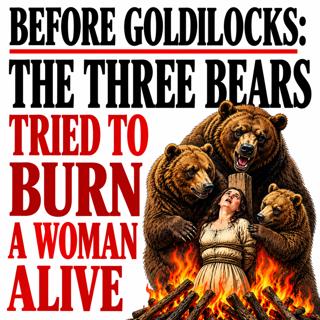

Before Goldilocks: The Three Bears Tried to Burn a Woman Alive

Before Goldilocks: The Three Bears Tried to Burn a Woman Alive

Goldilocks made the Three Bears cute. The original story was anything but.

Most people know Goldilocks and the Three Bears as a harmless children's fairy tale about a little girl who enters the home of three bears, eats their porridge, sits in their chairs and sleeps in their beds. But the original Three Bears story was not about Goldilocks at all.

The earliest recorded written version of The Three Bears dates to 1831, when Eleanor Mure handwritten and illustrated the story as a birthday present for her young nephew, Horace Broke. Her version featured an old woman, not Goldilocks. The bears were not Papa Bear, Mama Bear and Baby Bear, and the story did not end with a frightened little girl simply running away.

Eleanor Mure's Three Bears try to punish the old woman by throwing her onto a fire. When she will not burn, they put her into water. When she will not drown, they finally throw her onto St. Paul's churchyard steeple. Mure described the story as a "celebrated nursery tale," suggesting that the Three Bears story was already being told before she recorded it in 1831.

Six years later, Robert Southey published The Story of the Three Bears in 1837. Southey also used an old woman as the intruder. Over the following decades, however, the story changed dramatically. The old woman became a young girl, the bears became a family, and eventually the girl acquired the golden hair and name recognized around the world: Goldilocks.

This episode follows Goldilocks and the Three Bears backward, from the modern children's story to the strange and much harsher versions that came before it. Along the way, we look at Eleanor Mure's 1831 manuscript, Robert Southey's 1837 version, the transformation of the Three Bears into a family, and how Goldilocks herself was gradually inserted into the story.

But the larger question is about the bear. How did an animal historically feared, hunted, displayed, used in heraldry and represented as a symbol of power become one of childhood's most comforting characters?

From the Three Bears and Goldilocks to teddy bears, Winnie-the-Pooh, Paddington Bear, Yogi Bear, Gentle Ben, Baloo, the Care Bears and the Berenstain Bears, popular culture transformed the bear into a friend, protector and children's companion. Yet movies such as Grizzly, The Edge, Backcountry and The Revenant continue to present the other bear: powerful, unpredictable and dangerous.

The trail even leads to Theodore Roosevelt and Germany. In 1902, Roosevelt's refusal to shoot a captured bear inspired Clifford Berryman's famous political cartoon and helped produce the American "Teddy's Bear" phenomenon. At virtually the same moment, Richard Steiff was developing a movable stuffed bear in Germany, creating another major branch of the teddy bear story.

So this isn't simply the history of Goldilocks and the Three Bears. It is the history of how we changed the bear itself—from a feared and powerful wild animal into something children take to bed with them.

Before Goldilocks, the Three Bears tried to burn a woman. How did that become a bedtime story?

And that leads to an even larger question: Where did our ideas about childhood, education, obedience and discipline really come from?

After exploring Bern's disturbing Child-Eater Fountain, the armed bears marching beneath it and the strange history of the bear, this episode follows another trail: the history of frightening children's stories and the institutions created to educate children.

Many early fairy tales and nursery stories were far darker than the versions remembered today. Violence, abandonment, starvation, punishment and terrifying consequences appear repeatedly. Were these simply stories told for entertainment, or were fear and storytelling also used to teach children obedience, acceptable behavior and their place in society?

That question eventually takes us out of the nursery and into the school.

Critics of traditional American school architecture have compared schools to prisons: long institutional corridors, closed classrooms, bells controlling movement, restricted entrances and exits, surveillance, permission required to leave the room and relatively little time outdoors. Drills teach children to stop immediately, become quiet, follow instructions and move or remain in place according to commands from authority.

So who decided this was the way children should be educated?

When did governments, churches, educators, reformers and other powerful institutions begin taking a greater role in shaping children's minds and behavior? Why did obedience, discipline, punctuality, schedules and social order become intertwined with education? And why do some of the institutions built for children share physical and organizational characteristics with prisons, factories, hospitals, asylums and military barracks?

From Eleanor Mure's horrifying Three Bears and the eventual creation of Goldilocks to teddy bears, charity schools, compulsory education and the modern institutional classroom, this episode follows a much bigger trail.

Where did our system for shaping childhood come from, who shaped it, and what was it originally intended to accomplish?

The Dark original ending of the Three Bears Story #goldilocks #folklore #fairytales

Music: Smokey the Bear Song- Eddy Arnold (1952)

The Same People who Designed Prisons Also Designed Schools | ArchDaily

Why does school always feel like prison?

Panda Symbolism: 7 Powerful Meanings Behind These Beloved Black & White Bears

What is panda diplomacy, and why are the bears going back to China? | Wildlife News | Al Jazeera

Donald Trump Claims People Said He Looked Like Elvis Presley: 'You'll Say I'm Very Conceited… I'm Not' - Newsweek

Donald Trump posted a captionless AI-generated image with Elvis Presley: 'He's a fan of the King'

Melania: The Ultimate First Lady

How hormones work to flip sexes: Hormones

Do you have a psychopath in your life? The best way to find out is read my book. BOOK *FREE* Download – Psychopath In Your Life4

Support is Appreciated: Support the Show – Psychopath In Your Life

Download Pods here: TOP PODS – Psychopath In Your Life

My old discussion forum with last 10 years of victim stories, is back online. Psychopath Victim Support Community | Forums powered by UBB.threads™

Google Maps My HOME Address: 309 E. Klug Avenue, Norfolk, NE 68701 SMART Meters & Timelines – Psychopath In Your Life

THE STORY OF THE THREE BEARS The First Recorded Written Version — 1831

By Eleanor Mure

Written and illustrated as a birthday present for her four-year-old nephew, Horace Broke, September 26, 1831.

The tale of the THREE BEARS
Little Horbrook declares
He perfectly well can rehearse;
But Aunt Nella will tell,
Pretty nearly as well,
The very same Story in verse.

1

Many ages ago, it was common, I find,
For dumb creatures to talk just as well as mankind:
Birds and Beasts met together t'arrange their affairs;
Nay! the Frogs of the day, must needs give themselves airs,
And aping their betters, not pleas'd with their station,
Talked of having a King to rule over their nation.

2

In these curious days, it did raise no surprise,
(Though now 'twould make ev'ry one open their eyes)
That three Bears, very sick of their woods and their den,
Should fancy a home 'mongst the dwellings of men;
So not caring a fig for what any one said,
They bought a large house, already furnished.

3

An old woman liv'd near them, who to their house went,
As to make their acquaintance she was fully bent.
They refused to receive her; and at this rebuff,
The angry old woman went home in a huff:

"Adzooks!" she exclaim'd, "what impertinent Bears!
I would fain know their title to give themselves airs."

4

She, without more reflection, resolv'd not to let
The matter rest here; and worked into a pet.
She made up her mind to watch them safe out,
Then not at all thinking what she was about,
She determin'd, without the Bears' leave, to explore
Each part of the house; so popp'd in at the door.

5

She went to the parlour; and there she did see
Some bowls of good milk, by one, two, and three:
She tasted the first, and then spit it about;
She drank some of the second and threw it all out,
But when of the third, she had taken one sup,
Oh! greedy old woman! she drank it all up.

6

She went to the drawing-room, and she found there,
For each of the Bears a most ponderous chair;
She sat down in the first, but she found it too rough:
She sat down in the second, but that she found tough;
She sat down in the third, without much ado;
When, good lack-a-day! the bottom burst through.

7

She went to the bedroom, and there she did find
Three nice-looking beds, the best of their kind;
She lay down in the first; but she found little ease:
She lay down in the second, which still less did please;
She lay down in the third, without much ado,
When, good lack-a-day! the bottom burst through!

8

She look'd out of the window, and there she descried
The Bears coming home-wards, with dignified stride.

"Oh!" quoth she, "I am lost, if the Bears find me here."

So forthwith in a closet, all trembling with fear,
She hid herself; hoping she might get away,
Before the three Bears could find where she lay.

9

Meanwhile the poor Bears who had been out to roam,
Were coming as fast as they could to their home:
Tired, hungry, and longing for food and for rest,
Unsuspicious of harm, to the parlour they prest;
As they opened the door, a sight greeted their eyes,
Which fill'd their rough breasts both with fear and surprise.

10

The first Bear, roaring loud, exclaimed, "What do I see?
Who's been tasting my milk, without leave of me?"

The second more gently said, "I can't conceive
Who's been drinking my milk, without asking my leave?"

The little Bear scream'd, looking into his cup,
"Who's been drinking my milk, and drunk it all up?"

11

They went to the drawing-room; where the first Bear
Roar'd, "Who, without leave, has sat down in my chair?"

The second, astonish'd, more mildly did say,
"Who's been sitting in my chair, when I was away?"

The little Bear madly cried, "What shall I do?
Who has sat in my chair, and the bottom burst thro'?"

12

To the bedroom they went; and the first Bear then said,
"Who since I've been out, has lain down in my bed?"

The second Bear, quite aghast, fiercely did say,
"Who has had the presumption in my bed to lay?"

The little Bear scream'd out, "Oh! what shall I do?
Who in my bed has lain, and the bottom burst thro'?"

13

Indignant they run the delinquent to find;
Each corner they search, and each door look behind;
The closet they open, exclaiming, "She's here!"
And drag forth the dame, half expiring with fear;

Quite determin'd to punish her, long they debate
What, in justice, should be their old enemy's fate.

14

On the fire they throw her, but burn her they couldn't;
In the water they put her, but drown there she wouldn't;

They seize her before all the wondering people,
And chuck her aloft on St. Paul's church-yard steeple;

And if she's still there, when you earnestly look,
You will see her quite plainly—

my dear little Horbrook!

DEDICATION

The celebrated nursery tale
of the
THREE BEARS

put into verse
and embellished with drawings

for a
Birth-day Present

to
HORACE BROKE

Source: Eleanor Mure, The Story of the Three Bears, handwritten and illustrated manuscript, September 26, 1831.

Classic bear movies
  • The Bear — 1988
  • The Edge — 1997, Anthony Hopkins/Alec Baldwin, Kodiak bear
  • Grizzly — 1976
  • Prophecy — 1979, mutant bear
  • The Revenant — 2015, famous grizzly attack
  • Into the Grizzly Maze — 2015
  • Backcountry — 2014
  • The Great Outdoors — 1988, famous bear sequence
  • Legends of the Fall — 1994, bear imagery is important throughout
  • Brother Bear — 2003, animated
  • Brother Bear 2 — 2006
  • Open Season — 2006, animated
  • Cocaine Bear — 2023
  • Paddington — 2014
  • Paddington 2 — 2017
  • Paddington in Peru — 2024
  • Yogi Bear — 2010
  • The Country Bears — 2002
  • The Jungle Book — multiple versions, with Baloo
  • Brave — 2012; the bear is central to the story
  • The Fox and the Hound — 1981, major bear confrontation
  • Winnie the Pooh — numerous theatrical films
Bear television
  • Gentle Ben — 1967–1969
  • The Life and Times of Grizzly Adams — 1977–1978
  • BJ and the Bear — 1979–1981 — funny exception: "Bear" is actually the chimpanzee's name.
  • The Adventures of Paddington
  • Paddington — the classic 1970s stop-motion series
  • Paddington Bear — 1989 Hanna-Barbera series
  • The Adventures of Paddington Bear — 1997–2000
  • Bear in the Big Blue House
  • Little Bear
  • Masha and the Bear
  • We Bare Bears
  • We Baby Bears
  • Grizzy & the Lemmings
  • Rilakkuma and Kaoru
The enormous cartoon-bear world

This is where it gets particularly interesting.

Yogi Bear — debuted on The Huckleberry Hound Show and then got The Yogi Bear Show in 1961. He eventually spawned Yogi's Gang, Yogi's Space Race, Yogi's Treasure Hunt, The New Yogi Bear Show, Yo Yogi! and numerous movies and specials.

Boo-Boo Bear — Yogi's constant companion.

Winnie-the-Pooh — probably one of the most recognizable fictional bears ever created.

Paddington Bear — books, television, animation and feature films.

The Care Bears — began as greeting-card characters in 1982 before exploding into toys, television and movies.

The Berenstain Bears — another enormous children's bear franchise.

Baloo — The Jungle Book, and later a central character in TaleSpin.

Smokey Bear — not originally a cartoon entertainment character, but one of America's most recognizable anthropomorphic bears.

Fozzie Bear — The Muppet Show.

Rupert Bear — enormously important British children's character.

Little Bear

Corduroy

Pooh's friend Kanga isn't a bear, of course—but Pooh's world helped cement the teddy-bear character in children's entertainment.

Gummi Bears — Disney's Adventures of the Gummi Bears.

The Three Bears / Goldilocks — innumerable cartoons and adaptations.

We Bare Bears — Grizzly, Panda and Ice Bear.

Care Bears

Kissyfur

The Little Flying Bears

CB Bears

There were enough bear cartoons to constitute an entire television category: Yogi alone generated decades of series and specials, while later television added Care Bears, Berenstain Bears, Gummi Bears, Masha and the Bear, We Bare Bears and many others.

And there is a really interesting pattern for your research: the entertainment bear repeatedly falls into two almost opposite categories.

The terrifying bear: wild, murderous, uncontrollable, enormous — Grizzly, The Edge, The Revenant, Backcountry.

The humanized bear: friendly, funny, childlike, protective — Teddy, Pooh, Yogi, Paddington, Gentle Ben, Baloo, Care Bears, Berenstain Bears.

WHEN DID WE DECIDE THE BEAR WAS CUTE?

For thousands of years, the bear was not primarily a children's character.

It was a powerful wild animal. It could kill a human being. It was hunted, feared, worshipped, displayed on shields and flags, incorporated into legends and associated with gods and goddesses.

Yet today we put bears in children's bedrooms.

We have teddy bears, Winnie-the-Pooh, Paddington, Yogi Bear, Care Bears, Berenstain Bears, Baloo and hundreds of other friendly bears.

So when did the bear become cute?

The answer takes us through ancient religion, Bern, fairy tales, traveling performers, Theodore Roosevelt, Germany and one of the biggest toy crazes of the twentieth century.

THE ANCIENT BEAR

Long before the teddy bear, bears carried religious and symbolic importance.

One particularly important example comes from Switzerland.

At Muri bei Bern, just outside Bern, a bronze sculpture was discovered depicting a seated woman facing a large bear. The inscription identifies the deity as Dea Artio, generally interpreted as a Celtic or Gallo-Roman bear goddess.

The object dates to the Roman period, probably the second century AD.

That means the bear had symbolic importance around Bern roughly 1,700 years before Winnie-the-Pooh.

BEARS BECOME ENTERTAINMENT

There is another strand in the story, because for centuries Europeans weren't just afraid of bears, they were entertained by them. Bears were captured and trained, and dancing bears traveled from place to place with entertainers, while others were put on display in menageries for people to come and see.

And then there was the much uglier side of it. Bear-baiting became a popular blood sport, particularly in England, where a bear would be restrained and dogs would be turned loose on it while crowds stood around and watched.

So somewhere along the way, something had changed in the way people related to the bear. This was still a large, powerful and dangerous animal, but humans had figured out how to capture it, control it, put it on display and turn it into entertainment. And that change becomes important as we move forward in the story.

THE THREE BEARS

Then the bear enters one of the most famous children's stories in Western culture. In 1837, Robert Southey published The Story of the Three Bears, but the story most people know today is not the story Southey told. There was no Goldilocks. The person who entered the bears' house was an old woman, and the three bears were not yet the familiar father, mother and baby bear family. They were simply three bears, distinguished mainly by their different sizes.

Over the course of the nineteenth century, the story kept changing. The old woman eventually became a young girl, the three bears became a family, and ultimately the little girl acquired the name Goldilocks.

But look at what was happening to the bear while the story was changing. The bear was being moved out of the frightening wilderness and brought right into the human household. These bears lived in a house. They had chairs. They had beds. They ate porridge. They behaved like people.

The wild animal that Europeans had once feared, hunted, captured and forced to perform was now being transformed into a character that could sit at the breakfast table and eventually become part of a children's bedtime story.

THEN COMES GERMANY

This is where the conventional teddy-bear story becomes a little more complicated, because the teddy bear did not simply appear because Theodore Roosevelt went hunting. Something was already happening with the bear on the other side of the Atlantic, in Germany.

Margarete Steiff had established a German toy business during the nineteenth century, and in 1897 her nephew, Richard Steiff, joined the company. Richard became interested in bears and studied the real animals closely, including bears at the Nill zoological garden in Stuttgart. He was trying to figure out how a bear actually moved and how that could be translated into a toy.

In 1902, Richard designed what became known as the Steiff 55 PB bear. The name sounds complicated, but it was really a description of the toy: roughly 55 centimeters in size, made of plush, with movable limbs.

But the part I want you to remember is the year.

Because while Richard Steiff was turning the bear into a toy in Germany, something else involving a bear was happening in America that very same year.

THEODORE ROOSEVELT AND THE BEAR

Then, in November 1902, Theodore Roosevelt went on a bear hunt in Mississippi. Roosevelt had not managed to shoot a bear, so eventually a black bear was captured and restrained, giving the president the opportunity to kill it.

Roosevelt refused.

The story quickly became national news, and political cartoonist Clifford Berryman turned the incident into his famous cartoon, Drawing the Line in Mississippi. But Berryman didn't stop there. He continued using the bear in cartoons connected to Roosevelt, and if you follow those cartoons, something fascinating begins to happen.

The bear changes.

It becomes smaller. It becomes softer. It becomes cuter. It begins to look less like the dangerous animal Roosevelt encountered in Mississippi and more like a character people could become attached to.

Once again, we can watch the transformation happening right in front of us. The dangerous wild bear was gradually being turned into something friendly, appealing and increasingly human.

MORRIS AND ROSE MICHTOM

Meanwhile, in Brooklyn, Morris and Rose Michtom saw an opportunity. Rose reportedly made a stuffed bear, and the couple put it on display in their shop. Morris then sought Roosevelt's permission to use the president's nickname in connection with the toy.

And that gave us Teddy's Bear.

The response was enormous. Demand took off, and the Michtoms eventually became associated with what became the Ideal Novelty and Toy Company. America now had its teddy bear, complete with a president, a famous hunting story, a political cartoon and a catchy name.

Except there is a problem with the neat little story we have all been told.

Germany had a bear, too.

And Germany's bear had appeared at almost exactly the same time.

1903: THE TWO STORIES COLLIDE

In 1903, Richard Steiff took the company's bear to the Leipzig Toy Fair, where the initial reception was reportedly nothing remarkable. But then an American buyer entered the picture and placed an order for 3,000 Steiff bears to be shipped to the United States.

And this is where the two stories finally come together. Up until this point, we have a German toy company developing a stuffed bear at almost exactly the same time that Theodore Roosevelt's Mississippi bear hunt was creating a national sensation in America. Now thousands of those German bears were heading directly into the American market.

America had supplied something enormously valuable: the name "Teddy," a president, a dramatic bear story and national publicity. Germany had supplied a sophisticated manufactured bear that could be produced and sold on a large scale.

Put those two things together, and the bear was no longer simply a wild animal, a circus attraction or a character in a children's story. It had become a product.

And the market took care of the rest.

THE TEDDY-BEAR EXPLOSION

And the transformation happened extraordinarily quickly. According to Steiff, by 1907 its factory workers and network of home workers produced 973,999 teddy bears in a single year.

Just think about that for a minute. Only five years earlier, Theodore Roosevelt had refused to shoot a restrained bear in Mississippi. Now, Steiff alone was producing almost one million teddy bears in one year.

In a remarkably short period of time, the bear had gone from the wilderness, the hunt and the political cartoon into the toy shop and finally into the arms of children.

The bear had entered the nursery.

And once it got there, it never left.

WINNIE-THE-POOH

The next enormous transformation arrived in the 1920s.

A. A. Milne published Winnie-the-Pooh in 1926.

Pooh wasn't simply a bear that didn't attack people.

  • He had become essentially human.
  • He talked.
  • He worried.
  • He had friends.
  • He loved honey.
  • He lived in a recognizable social world.

The wild animal had become a child's companion.

PADDINGTON AND YOGI

Then came another remarkable coincidence.

1958 produced two enormously important fictional bears.

Michael Bond introduced Paddington Bear in A Bear Called Paddington.

That same year, Hanna-Barbera introduced Yogi Bear on The Huckleberry Hound Show.

Paddington wore a hat and eventually the famous duffle coat.

Yogi wore a tie and collar.

The bear wasn't merely humanized anymore.

We were dressing him.

THE 1960s AND 1970s

The friendly bear became firmly established in mass entertainment.

Disney's The Jungle Book arrived in 1967, giving generations of children the easygoing Baloo.

That same year, Gentle Ben became a television series.

The bear could now be a trusted companion.

But Hollywood hadn't forgotten what a real bear could do.

In 1976, Grizzly turned the animal back into a monster.

In 1977, television gave audiences The Life and Times of Grizzly Adams, featuring another sympathetic relationship between man and bear.

The two versions were now operating simultaneously.

THE 1980s: THE BEAR BECOMES PURE CUTE

The transformation reached another level with the Care Bears.

Originally created for greeting cards in the early 1980s, they expanded into toys, television and movies.

These weren't representations of wild bears anymore.

They were brightly colored personalities with symbols on their stomachs representing emotions and characteristics.

Disney introduced the Gummi Bears television series in 1985.

The Berenstain Bears expanded further into television.

Children were surrounded by bears.

THE MODERN BEAR

The pattern continues.

  • Brother Bear.
  • We Bare Bears.
  • Masha and the Bear.
  • Paddington.
  • Paddington 2.

And yet the original animal keeps breaking through.

  • The Edge.
  • Backcountry.
  • The Revenant.
  • Cocaine Bear.

Hollywood maintains two completely contradictory bears.

There is the bear you run from.

And there is the bear you hug.

THE STRANGE TRANSFORMATION

Put the entire sequence together and something remarkable becomes visible.

The ancient bear was associated with extraordinary power. Artio demonstrates that religious bear symbolism existed around what is now Bern during antiquity. Medieval and early-modern Bern turned the bear into part of its civic identity, and by the sixteenth century Bern was even depicting armed bears.

Elsewhere in Europe, people captured bears and made them perform. Then fairy tales began moving bears out of the wilderness and into houses. Eventually, Goldilocks gave us something even more familiar: a mother bear, a father bear and a baby bear living together as a family.

Then, around 1902–1903, something dramatic happened.

In Germany, Richard Steiff developed his movable stuffed bear. In the United States, Theodore Roosevelt refused to shoot a captured bear. Clifford Berryman transformed that incident into an unforgettable cartoon, and Morris and Rose Michtom produced Teddy's Bear.

At almost exactly the same moment, an American buyer ordered thousands of Steiff bears. Within only a few years, Steiff alone was producing nearly one million teddy bears annually.

And the transformation didn't stop there.

Then came Winnie-the-Pooh, Paddington, Yogi Bear, Baloo, Gentle Ben, the Care Bears, the Berenstain Bears and the Gummi Bears.

In a remarkably short period of history, the bear had traveled from the wilderness, religion and civic power into fairy tales, children's bedrooms, books, television and movies.

And generations of children went to sleep holding an imitation of an animal their ancestors had every

THE TIMELINE

Ancient period: Bear symbolism and worship, including Artio.

Roman era: Dea Artio bronze associated with Muri near Bern.

Middle Ages: Bern develops its famous civic bear identity.

1545–1546: Armed Bernese bears appear beneath the Child-Eater Fountain.

1837: Robert Southey publishes The Story of the Three Bears.

Late 1800s: The Three Bears evolves toward the Goldilocks story familiar today.

1897: Richard Steiff joins the Steiff company.

1902: Richard Steiff designs the 55 PB bear.

November 1902: Theodore Roosevelt refuses to shoot the captured Mississippi bear.

1902: Clifford Berryman publishes Drawing the Line in Mississippi.

1902–1903: Morris and Rose Michtom develop Teddy's Bear.

1903: Steiff exhibits its bear at Leipzig.

1903: An American buyer orders 3,000 Steiff bears.

1907: Steiff reports production of 973,999 teddy bears.

1926: Winnie-the-Pooh.

1958: A Bear Called Paddington.

1958: Yogi Bear debuts.

1967: Disney's The Jungle Book brings Baloo to movie audiences.

1967: Gentle Ben television series.

1976: Grizzly.

1977: The Life and Times of Grizzly Adams.

1980s: Care Bears.

1985: Disney's Adventures of the Gummi Bears.

1997: Bear in the Big Blue House.

2003: Brother Bear.

2014: Paddington.

2015: We Bare Bears.

2015: The Revenant reminds everybody what the other bear looks like.

2023: Cocaine Bear.

The question therefore isn't simply why humans like bears.

It's how we traveled from Artio and the armed bears of Bern to a teddy bear tucked underneath a child's arm.

And sitting almost exactly at the turning point are Germany and Theodore Roosevelt.

WINNIE-THE-POOH AND CHINA — HOW A CHILDREN'S BEAR BECAME POLITICALLY SENSITIVE

Winnie-the-Pooh occupies one of the strangest positions in the modern history of the bear.A. A. Milne introduced Winnie-the-Pooh to the world in 1926. Pooh was about as far removed from a threatening wild bear as imaginable. He was gentle, slow-moving, fond of honey, surrounded by friends, and primarily concerned with the small problems of life in the Hundred Acre Wood.Nearly ninety years later, that harmless children's bear became entangled with the president of China.

1926 — WINNIE-THE-POOH ARRIVES

A. A. Milne published Winnie-the-Pooh in 1926, with illustrations by E. H. Shepard.

The character was based on the teddy bear belonging to Milne's son, Christopher Robin Milne. That toy itself belonged to the much larger teddy-bear phenomenon that had exploded during the first decades of the twentieth century.

This represented an extraordinary transformation of the bear.

The animal that had once frightened and killed human beings had been miniaturized, stuffed with filling, placed in children's beds, and eventually given a personality.

Pooh was not merely domesticated.

He was humanized.

He talked. He worried. He visited friends. He made mistakes. He loved honey.

The bear had become safe.

DISNEY TAKES POOH AROUND THE WORLD

The next major transformation came through Disney.

Disney began developing its version of Winnie-the-Pooh during the 1960s, turning Pooh into one of the world's most recognizable children's characters.

The red shirt, yellow body and rounded shape became instantly identifiable.

That particular appearance would eventually become important in China.

Not because Pooh had anything to do with Chinese politics.

But because people on the internet decided he resembled China's leader.

2013 — XI JINPING AND BARACK OBAMA

The political Pooh phenomenon is generally traced to a photograph taken during Chinese President Xi Jinping's 2013 meeting with President Barack Obama in California.

Xi and Obama were photographed walking together.

Internet users circulated the photograph beside an image of Winnie-the-Pooh walking beside Tigger.

The comparison was simple.

Xi was Pooh.

Obama was the taller, thinner Tigger.

The images spread online and were reportedly circulated on Chinese social media before censorship began removing some versions of the joke.

It could easily have disappeared as another internet joke.

It didn't.

2014 — XI JINPING AND SHINZO ABE

The following year produced another photograph that kept the joke alive.

Xi Jinping met Japanese Prime Minister Shinzo Abe during the 2014 APEC summit in Beijing.

Their famously stiff handshake was subsequently compared online with an image of Winnie-the-Pooh meeting Eeyore.

Once again:

Xi = Pooh.

The association was becoming recognizable enough that Pooh could function as a substitute image for Xi.

That is where the joke became politically significant.

POOH BECOMES A WAY OF TALKING ABOUT XI

China maintains extensive controls over online political speech, particularly material involving senior Communist Party leadership.

Pooh created an unusual problem.

There was nothing inherently political about the character.

A picture of Winnie-the-Pooh was simply a picture of Winnie-the-Pooh.

But once enough people understood the visual joke, Pooh could communicate something without explicitly writing "Xi Jinping."

The children's character had acquired a second meaning.

In semiotics, this is remarkably simple: the symbol no longer needs to contain the thing it represents.

Pooh could mean Xi.

That made Pooh useful for satire.

And therefore useful to people attempting to circumvent censorship.

2015 — THE MEME KEEPS GROWING

Another widely circulated comparison appeared after Xi Jinping participated in a military parade.

An image of Xi standing through the roof of a parade vehicle was compared with a toy image of Winnie-the-Pooh riding in a little car.

The political Pooh meme was no longer dependent upon one photograph.

People were actively looking for photographs of Xi that could be paired with Pooh.

The comparison had become a recurring internet genre.

2017 — CHINESE CENSORSHIP ATTRACTS INTERNATIONAL ATTENTION

By July 2017, international news organizations were reporting that references and images involving Winnie-the-Pooh were being blocked or removed from some Chinese social-media platforms.

Searches and posts involving Pooh did not necessarily disappear universally or permanently. That distinction matters: Winnie-the-Pooh was not simply outlawed throughout China.

Rather, particular images, search terms, posts and politically suggestive uses of Pooh were subjected to China's changing censorship apparatus.

And the censorship produced the classic internet consequence.

It made the joke much bigger.

Outside China, people who had never heard of the Xi-Pooh comparison suddenly learned about it precisely because China was reportedly censoring it.

2018 — XI'S POLITICAL POSITION CHANGES

The controversy became even more politically charged in 2018.

China changed its constitution to remove the two-term limit on the presidency, allowing Xi Jinping to remain president beyond what previously would have been the constitutional limit.

Online criticism and satire surrounding Xi became especially sensitive.

And Winnie-the-Pooh was already established as one of the internet's most recognizable Xi symbols.

The bear now carried political baggage that A. A. Milne could never possibly have imagined.

2018 — CHRISTOPHER ROBIN DOESN'T GET A CHINESE RELEASE

Then came one of the most remarkable episodes.

Disney released Christopher Robin in 2018.

The live-action film featured Pooh prominently.

But the movie did not receive a theatrical release in mainland China.

International reporting immediately connected the decision with China's sensitivity toward the Winnie-the-Pooh/Xi Jinping meme. However, there is an important qualification: Chinese authorities did not publicly announce that the Xi comparison was the reason for denying the film a release.

China also limits the number of foreign films receiving theatrical releases, so the precise governmental reasoning was never publicly established.

Nevertheless, the Pooh controversy was sufficiently well known that the film's exclusion became international news.

WINNIE-THE-POOH WAS NOT COMPLETELY BANNED

This is where the story frequently becomes exaggerated.

It is often said that "Winnie-the-Pooh is banned in China."

That is too broad.

Pooh merchandise has continued to exist in China. Disney has operated in China. Winnie-the-Pooh has not simply been erased from every store, screen and official Disney property.

The more accurate statement is much more interesting:

Chinese censorship has repeatedly targeted Winnie-the-Pooh imagery and references when they are associated with Xi Jinping or used for political satire.

That is different from banning the fictional character outright.

2023 — THE PROBLEM SPREADS BEYOND MAINLAND CHINA

The political symbolism surrounding Pooh continued.

In 2023, screenings of the horror film Winnie the Pooh: Blood and Honey were abruptly cancelled in Hong Kong.

The distributor said cinemas had cancelled planned screenings, while Hong Kong authorities said the film had received the necessary approval and denied involvement in the cancellation.

Again, the circumstances demonstrated how politically loaded the Pooh image had become in the Chinese political environment, even when the precise reason for a particular decision could not be established publicly.

THE IRONY

This brings the bear story almost full circle.

  • The original bear was dangerous.
  • Humans feared it.
  • Fairy tales transformed it.
  • The teddy-bear industry domesticated it.
  • A. A. Milne gave it thoughts and feelings.

Disney transformed it into an international children's entertainment property.

Then the internet transformed it again.

This time, the bear became political satire.

And governments understand something that advertisers have understood for generations:

Images can communicate without words.

Once people learned that Pooh could mean Xi Jinping, the bear didn't have to say anything.

That is precisely what made the joke difficult to contain.

THE BEAR'S EXTRAORDINARY JOURNEY

In the nineteenth century, bears were still being hunted, displayed, feared and used in stories as potentially dangerous animals.

By the early twentieth century, Roosevelt's hunting incident helped launch the American teddy-bear phenomenon while Steiff industrialized the stuffed bear in Germany.

By 1926, Milne had turned the teddy bear into Winnie-the-Pooh.

Disney subsequently turned Pooh into a global entertainment property.

Then came the internet.

And in 2013, almost ninety years after Milne published Winnie-the-Pooh, somebody looked at a photograph of one of the world's most powerful political leaders walking beside the president of the United States and essentially said:

Wait a minute.

He looks like Winnie-the-Pooh.

And the joke became so politically sensitive that Chinese censors spent years trying to contain versions of it.

The bear had gone from the forest, to the hunt, to the toy factory, to the nursery, to Hollywood—

and finally into international politics.

References

Mure, Eleanor. The Story of the Three Bears. Manuscript written and illustrated as a birthday gift for Horace Broke, September 26, 1831.

Southey, Robert. "The Story of the Three Bears." In The Doctor, &c., vol. 4. London: Longman, Rees, Orme, Brown, Green, and Longman, 1837.

Opie, Iona, and Peter Opie. The Classic Fairy Tales. Oxford: Oxford University Press, 1974.

Briggs, Katharine M. A Dictionary of British Folk-Tales in the English Language. London: Routledge and Kegan Paul, 1970.

Toronto Public Library. "The Three Bears Before Goldilocks: The History of a Fairy Tale." Accessed September 13, 2026. Toronto Public Library article.

Smithsonian Institution. "Teddy Bear." National Museum of American History. Accessed September 13, 2026. Smithsonian teddy bear collection record.

Steiff. "The History of the Teddy Bear." Accessed September 13, 2026. Steiff teddy bear history.

Tämä jakso on lisätty Podme-palveluun avoimen RSS-syötteen kautta eikä se ole Podmen omaa tuotantoa. Siksi jakso saattaa sisältää mainontaa.

Jaksot(581)

CHILD-EATING STATUE in Bern, Switzerland -and a Bear with a RED PENIS. The Kindlifresserbrunnen.

CHILD-EATING STATUE in Bern, Switzerland -and a Bear with a RED PENIS. The Kindlifresserbrunnen.

"The mystery isn't only why Bern built a statue of a man eating children. The mystery is why Bern put its own armed bears beneath him." Why does Bern, Switzerland have a child-eating statue above an a...

13 Syys 1h 26min

The Gypsies, The Bohemians and The Habsburgs - A Connection Hidden in Plain Sight

The Gypsies, The Bohemians and The Habsburgs - A Connection Hidden in Plain Sight

"Before Bohemian meant artists hippies and boho it was a name attached to people traveling Europe under the protection of kings." The history of Jews, Gypsies, Roma, Bohemia and European royal familie...

5 Syys 1h 17min

NEPAL Flooding: Same Land. Same People. Since 2015, Disaster After Disaster - LAND THEFT on STEROIDS

NEPAL Flooding: Same Land. Same People. Since 2015, Disaster After Disaster - LAND THEFT on STEROIDS

When the people can no longer live on the land, the question becomes: who gets it? Nepal has endured a remarkable sequence of disasters involving earthquakes, floods, landslides, dams, hydropower proj...

31 Elo 50min
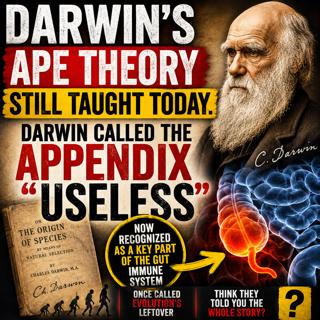
Who Designed the Human Body? A CREATOR -or an APE? Darwin Said Your Organs Were Useless. He Was Wrong.

Who Designed the Human Body? A CREATOR -or an APE? Darwin Said Your Organs Were Useless. He Was Wrong.

"Man is descended from a hairy, tailed quadruped, probably arboreal in its habits." — Charles Darwin, The Descent of Man   Darwin, Evolution, and the Human Body Did a Creator design the human body, or...

29 Elo 2h 3min

EBOLA in Congo: The Same Global-Health Network That Ran the Ivermectin Campaign Is Now Fighting Ebola. WTH

EBOLA in Congo: The Same Global-Health Network That Ran the Ivermectin Campaign Is Now Fighting Ebola. WTH

"Trust must be earned, it cannot be assumed. We have not always done things correctly." — WHO Director-General Tedros Adhanom Ghebreyesus, message to the people of the Democratic Republic of the Congo...

25 Elo 1h 28min

Eugenics and Silicon Valley: The Gates Family, Stanford University and William Shockley, Father of Silicon Valley, PROMOTED Eugenics.

Eugenics and Silicon Valley: The Gates Family, Stanford University and William Shockley, Father of Silicon Valley, PROMOTED Eugenics.

"Before you trust someone with the future, look at what they did with the power they already had." - Dianne Emerson   Eugenics and Silicon Valley: The Gates Family, Stanford University and William Sho...

22 Elo 1h 41min

Walter Rodney Exposed How America and Europe Looted Africa. Then He Was Murdered by a Car Bomb.

Walter Rodney Exposed How America and Europe Looted Africa. Then He Was Murdered by a Car Bomb.

"The question as to who and what is responsible for African underdevelopment can be answered at two levels. First, the operation of the imperialist system bears major responsibility for African econom...

13 Elo 35min

Suosittua kategoriassa Koulutus

rss-murhan-anatomia
aamukahvilla
psykopodiaa-podcast
adhd-podi
voi-hyvin-meditaatiot-2
rss-luonnollinen-synnytys-podcast
psykologia
koulu-podcast-2
rss-duodecim-lehti
rss-liian-kuuma-peruna
kesken
rss-uskonto-on-tylsaa
rss-arkea-ja-aurinkoa-podcast-espanjasta
rss-koira-haudattuna
rss-vapaudu-voimaasi
ihminen-tavattavissa-tommy-hellsten-instituutti
rss-niinku-asia-on
rss-rahamania
rss-spessu
ilona-rauhala