Attention Is the Gate—How Movement Becomes Lasting Learning with Dr. John Medina

Attention Is the Gate—How Movement Becomes Lasting Learning with Dr. John Medina

Episode 406 explains how movement prepares the brain but does not guarantee learning. It traces the full sequence—movement, RAS-driven readiness, salience and relevance, focused attention, encoding, retrieval and repetition, and recovery and sleep—that turns activation into lasting memory and performance.

The episode offers practical steps in a Move–Focus–Learn protocol: use brief movement to create readiness, clearly identify and remove distractions for one learning target, interact with material in meaningful ways, practice retrieval and spaced repetition, and protect recovery to support consolidation.

Listeners are encouraged to test these simple experiments for school, work, or personal learning to make experience more usable and improve attention, memory, and performance.

ON THIS EPISODE, YOU’LL LEARN:

✔ Why movement prepares the brain but does not guarantee learning

✔ How attention directs the capacity movement creates

✔ Why meaning and emotional relevance capture attention

✔ The difference between paying attention and actually learning

✔ How retrieval and repetition help new information stick

✔ How seeing, hearing, explaining, and applying an idea can help us remember it

✔ How restorative sleep supports memory and learning

✔ A practical Move–Focus–Learn Protocol for school, work, or your own personal learning

The central idea is simple:

Movement opens the window.

Attention determines what enters.

Repetition strengthens what remains.

And recovery helps the brain integrate what it has experienced.

Welcome back to the Neuroscience Meets Social and Emotional Learning Podcast, where we bridge neuroscience, social and emotional learning, and human performance so we can create measurable improvements in our well-being, achievement, leadership, productivity, and results.

I’m Andrea Samadi, and if you’ve been following along through Season 16, you’ll know that we have been building what I call The Brain’s Operating System for Human Performance—a neuroscience-based framework designed to help us understand how the different systems of the brain and body work together to influence how we learn, adapt, connect, lead, and ultimately, how we perform.

We are currently in Phase 3, focused on Movement, Learning, and Cognition.

As I prepared for this phase, I went back through more than 400 episodes of the podcast and organized them according to the five phases of this framework. I wanted to see whether any patterns would emerge.

And some did.

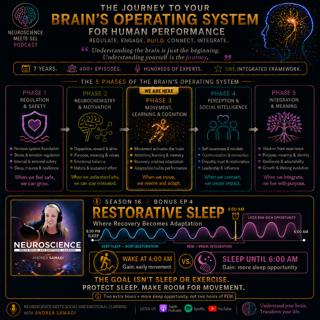
Phase 1, Regulation and Safety, includes 57 episodes.

Phase 2, Neurochemistry and Motivation, includes 41 episodes—the smallest category, possibly because this is the area I have explored the least with my learning.

Phase 3, Movement, Learning, and Cognition, includes 174 episodes—the largest category by far.

Phase 4, Perception and Social Intelligence, includes 68 episodes.

And Phase 5, Integration and Meaning, includes 71 episodes.

When I saw that 174 episodes—more than 40 percent of the entire podcast—fit into Movement, Learning, and Cognition, it immediately showed me where much of my curiosity has been directed over the years.

I have always been fascinated by learning:

How do we prepare the brain to learn?

What captures our attention?

Why do some ideas (or people) remain with us while others disappear?

How does knowledge become something we can retrieve, apply, and actually use to improve our lives?

And while I am spending most of my spare time hiking, or at the gym over the years, I wonder, how does this movement that I’m doing help to improve my attention, or memory, and finally, where does recovery fit into this process? The past few weeks, I’m finally connecting the dots with how important recovery is with this equation.

I’m also learning how to determine what’s important to me. John Medina’s Brain Rules book explains what holds our attention. He reminds us that “we don’t pay attention to boring things (or people).[i]

As we continue through these five phases of The Brain’s Operating System for Human Performance, I’m especially curious about how we will move beyond understanding these lessons, to begin implementing what we are learning, and connecting more ways to improve how we learn, adapt, connect, lead, and ultimately perform in our day to day lives.

That will become an important part of the upcoming workbook—which is a practical way for each of us to identify what we have already strengthened, where gaps may remain, and which specific actions can help us to improve our own learning, well-being, and performance.

Because the purpose of this 5 Phase Framework is not simply to collect more information about the brain.

It is to understand how the systems connect—and then use that understanding to create meaningful change.

“Attention Is the Gate—How Movement Becomes Learning.”

For today’s Episode 406, we’ll connect Dr. John Medina’s Brain Rules to the Movement Loop we have been building throughout Phase 3—and answer the next important question:

Once movement activates and prepares the brain, what determines whether that readiness becomes lasting learning?

You can review our full interview with John Medina from EP 42[ii] from February 2020. (find the link in the reference section of the show notes).

INTRODUCTION: THE MISSING STEP

We have spent this phase so far, examining how movement changes the brain.

Dr. Chuck Hillman and Paul Zientarski[iii] showed us that movement prepares the brain for learning.

Dr. John Ratey[iv] helped us understand how exercise influences neurochemistry, BDNF, and neuroplasticity.

Dr. Kristen Holmes[v] showed us that recovery helps determine whether strain becomes adaptation.

And our restorative-sleep episode explored where some of that recovery, adaptation, and integration may occur.

But one important question remains:

A brain can be activated, chemically prepared, and physiologically ready—but what determines what it actually learns?

The answer begins with attention.

Movement may create the readiness to learn, but readiness alone is not learning.

The brain must still select what matters, focus on it, interact with it, encode it, revisit it, and eventually integrate it.

That gives us the pathway we will explore today:

Movement creates readiness. But what is the filter in our brain that helps us to focus on the things that are most important to us. What gives us the ability to pay attention to something? The RAS- or The Reticular Activating System.

Before we continue, let’s remind ourselves what the RAS is.

The RAS—or reticular activating system—is a network of neurons extending through the brainstem that helps regulate wakefulness, alertness, and our readiness to respond to incoming information.

We explored this system previously in Episode 272, “Priming the Reticular Activating System to Achieve Our Goals.”

In that episode, we described the RAS as a type of filter that helps us notice information connected to what we have identified as important.

For example, once you decide that you are interested in a particular type of car, you may suddenly begin seeing that car everywhere. That’s the RAS filtering system in our brain. The cars were already there, but your attention now has a reason to prioritize them.

In Episode 272[vi], we applied this idea to goal-setting. When we clearly identify an intention, we may become more likely to notice relevant information, opportunities, and connections that were previously present but did not receive our attention.

That explanation gave us a useful starting point.

But here in Episode 406, we can add more precision.

The RAS is not a tiny gatekeeper sitting in the brain and personally deciding what we will learn. It is part of a broader network that helps maintain the level of arousal and alertness required for our attention.

It helps the brain become available to notice whatever it is that is important to us.

Then salience, relevance, emotion, intention, and our current goals help determine what receives priority.

Focused attention directs our limited cognitive resources toward the selected information.

Next, encoding and repetition help strengthen what we want to focus on.

And recovery and sleep help to further support its consolidation and integration.

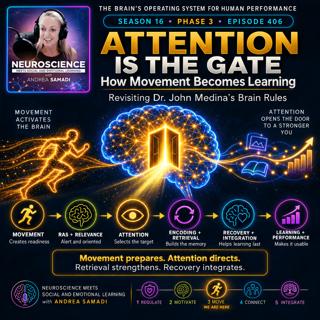
So our expanded Movement Loop now looks like this: you can see an image in the show notes to expand this understanding.

Movement supports brain activation.

RAS helps the brain become awake, alert, and ready to pay attention.

Salience and relevance (or what matters the most to us) helps to determine what receives priority.

Our focused attention selects what gets our priority.

Encoding and repetition further strengthens this pathway.

Recovery and sleep (that we’ve dove deep into) support consolidation and integration.

And together, these processes increase the likelihood that experience becomes learning—and that learning becomes available for future performance.

Whatever it is that we have put our attention on, is now made usable.

This shows us how our understanding has evolved since Episode 272, three years ago.

Then, we were asking:

How can our intention help us notice what matters with the attainment of our goals?

Now, years later, with more understanding, we are asking:

Once the brain is alert and something important has captured our attention, what sequence of events must occur for that information to become lasting learning?

We are no longer asking only what must remain top of mind so we can notice opportunities connected to our goals.

We are asking what happens next:

    How does something we notice become something we understand? How does something we understand become something we remember? And how does something we remember become knowledge or a skill we can retrieve, apply, and use to improve our performance?

This is where Dr. John Medina’s Brain Rules help us to connect the pieces.

Let’s begin with Lesson One:

Lesson 1: Movement Creates Readiness—Not Guaranteed Learning

Movement can increase alertness, circulation, and readiness for cognitive work.

But why might movement have such a powerful relationship with the brain?

Dr. John Medina explains this through an evolutionary lens. His point is that the human brain did not develop while we were sitting motionless at desks or staring at screens. It developed while human beings were moving through changing outdoor environments, solving immediate problems, and continually responding to the world around them.

Let’s listen to how he explains it.

CLIP 1 John Medina

“The human brain was designed to solve problems related to surviving in an outdoor setting, in unstable meteorological conditions—and to do so in constant motion.

The constant motion is where the exercise comes in. But the rest of that—the more a school, or any of us, can recreate the world of the Serengeti, the place where this brain actually grew up, the better things are.

And exercise, particularly outdoor exercise, is a terrific example of this idea.”

When Medina refers to the Serengeti, I don’t think he is suggesting that schools should literally recreate the dangers or conditions of an ancient environment.

He is giving us an evolutionary picture of the conditions under which the human brain developed:

We moved.

We navigated changing environments.

We encountered new sensory information.

We solved problems.

We adapted to uncertainty.

And we did these things together rather than remaining physically still for most of the day.

Outdoor movement may bring several of these conditions together. We are moving our bodies while also responding to changes in light, temperature, terrain, sound, distance, and direction.

This helps explain why movement belongs at the beginning of our Movement Loop.

But it also brings us to an important distinction:

Movement creates readiness. It does not guarantee learning.

A student can move before class and still become distracted.

A leader can exercise before work and still spend the morning reacting to notifications.

An athlete can warm up physically without becoming mentally focused on the strategy or skill required next.

Movement can help activate the system.

The RAS in the brain helps us become awake and alert.

But the brain must still determine what stands out, what is relevant, and what deserves focused attention.

Movement opens the window.

Attention determines what enters through it.

Our Key lesson:

Movement prepares the brain. Attention directs the preparation.

PUT THIS INTO ACTION

Before your next period of demanding cognitive work, use movement to create a window of readiness.

Take a five-to-ten-minute walk, complete a brief movement break, stretch, or choose another form of movement appropriate for your ability and environment.

But do not move without deciding what comes next.

Before you begin, identify the specific task you will return to:

“When this movement break ends, what will receive my attention?”

For a student, it might be the first problem on a math assignment.

For a leader, it might be the one decision that requires uninterrupted thinking.

For an athlete, it might be the cue, strategy, or skill that needs to remain at the center of practice.

Movement creates the opportunity. A clear intention helps direct what happens next.

Your experiment is:

Move briefly, choose one target that you want to complete with this intention, and begin that task immediately after the movement ends.

Lesson 2: Attention Is the Gate

In EP 395[vii], we examined what captures attention:

    Meaning Emotion Relevance Intention Reward Human connection

Now today’s episode shows how we move beyond why the brain notices something and explains what attention does after movement has prepared the system to learn.

Attention acts as a filter.

The brain encounters more information than it can consciously process, so it must select what receives priority.

This creates the bridge:

Brain activation creates capacity. Attention distributes that capacity.

Our Key lesson:

What the brain does not attend to has little opportunity to become lasting learning.

Andrea’s Application

This distinction between brain capacity and cognitive efficiency became personal for me when I reviewed the results of my 2020 brain scan. We covered this topic on EP 84[viii] and we will do a thorough review of what was learned with our brain scans at Dr. Daniel Amen’s CA Clinic.

The evaluation that I received after my scan was completed with Dr. Shane Creado, suggested that I had areas of strong capacity, but that my brain appeared to be working harder than necessary to complete certain tasks in the cognitive testing. A possible contributor we discussed was sleep deprivation.

I want to be careful here: a SPECT scan is not a direct measurement of attention or learning, and my results cannot tell us that insufficient sleep caused a specific attention pattern.

But the experience gave me a useful way to think about what we are learning today.

Having cognitive capacity does not necessarily mean that we are using that capacity efficiently.

I may be motivated, active, and ready to work—but if I am under-recovered, under-slept, distracted, or trying to process too many competing inputs, my brain may have to expend more energy to sustain focus.

This helped me understand the Movement Loop at a more personal level:

Movement can help activate my brain.

Attention gives that activation a target.

But recovery may influence how efficiently I can sustain that attention and use it for learning.

My scan did not define what my brain could do. It gave me another reason to examine the conditions under which my brain performs at its best.

PUT THIS INTO ACTION

Before asking yourself—or someone else—to focus, make the target of attention clear.

Start by completing this sentence:

“The most important thing to notice right now is…”

Then reduce the competition around it.

We all know to do this. Silence unnecessary notifications. Close unrelated tabs. Remove extra materials from view. Avoid asking the brain to switch repeatedly between tasks.

If you are teaching, make the relevance visible:

“Why does this matter?”

“What should students be listening or looking for?”

“How does this connect to something they already know?”

If you are working independently, write your one priority clearly where you can see it.

Remember, the goal is not to force the brain to attend to everything. The goal is to help it identify (with your RAS-that filter in your brain) what deserves your priority.

Your experiment is:

Choose one target, (something you want to accomplish) remove as many unnecessary sources of interference as possible, and create one meaningful reason to pay attention.

This also helps explain why keeping your desk clear, your closet organized, or your car tidy may make you feel calmer and more focused. How we do anything is how we do everything.

Every object, notification, unfinished task, or piece of visual clutter can become another potential signal competing for your attention. That does not mean everything must be perfectly organized before you can begin (while some of us would prefer to work this way), perfection can become its own form of interference. Just get started.

It simply means that when you reduce unnecessary visual and mental competition, you make it easier for the brain to recognize the priority in front of you.

Clear the space.

Name the target.

Create the relevance.

Then give the task your full attention.

Lesson 3: Attention Is Necessary—but It Is Not Enough

Paying attention to information once does not guarantee that it will be remembered.

This is where Dr. Medina’s memory rules enter:

Repeat to remember. Remember to repeat.

The first refers to giving new information more than one opportunity to be encoded.

The second points toward revisiting information over time.

This allows you to extend the Movement Loop:

Movement prepares the brain and body. Attention selects what to focus on. Retrieval and Repetition strengthens our focus. Recovery helps us to integrate what we are learning.

PUT THIS INTO ACTION

After learning something new, do not immediately reread it.

First, look away from the material and try to retrieve it.

Ask yourself:

“What were the three most important ideas?”

“How would I explain this without looking at my notes?”

“What can I remember on my own?”

Retrieval reveals the difference between recognizing information and actually being able to access it.

Then return to the material, check what you missed, and retrieve it again later—after an hour, the next day, or several days afterward.

For students, this could mean closing the textbook and explaining the lesson to a partner.

For professionals, it could mean summarizing a meeting before reviewing the notes.

For personal learning, it could mean recording a short voice memo explaining the idea from memory.

Your experiment is:

Learn it once, retrieve it without looking, and schedule a brief return to it later. See if you can remember it.

Attention begins the pathway. Retrieval and repetition help strengthen it.

Andrea’s Application

This lesson reminded me of one part of the cognitive testing that accompanied my brain scan at Amen Clinics: a Continuous Performance Test, or CPT.

In the version I completed, letters appeared on a computer screen. The instruction was to press a button whenever a letter appeared—except when the letter was X.

This type of task may sound simple, but it requires you to remain attentive over time, respond consistently, and inhibit your automatic response when the target letter appears.

My results indicated that this was an area in which I did not perform as strongly.

Looking back, I remember hearing the basic instruction: press the button for every letter except X. But I do not remember fully appreciating that the speed and consistency of my responses also mattered.

This gave me an important real-life lesson:

Hearing an instruction is not the same as accurately encoding everything the task requires.

Before beginning something important, pause and ask:

“What exactly am I being asked to do?”

“What details determine successful performance?”

“Can I explain the instructions back in my own words?”

And, when appropriate, write down the key steps before beginning.

This applies in a classroom, during a meeting, while completing an assessment, or whenever accuracy matters.

First, attend to the full instruction.

Then restate or retrieve it.

Clarify anything that is missing.

And only then begin the task.

My experience showed me that attention is not just about working harder or concentrating more intensely. It is also about identifying the correct target—and making sure we understand the complete task before directing our effort toward it.

Lesson 4: Learning Becomes Stronger When It Has More Than One Path

Dr. Medina’s Brain Rule #9 about sensory integration and vision(meaning our brains learn and remember best when multiple senses—like sight, sound, and touch—are engaged at the same time) give you the practical learning background to involve ALL of your senses.

While teaching and learning you can ask:

    Can I see it? Can I hear it? Can I explain it? Can I demonstrate it? Can I connect it to something I already know? Can I apply it physically or practically?

The goal is not sensory stimulation for its own sake. It is to provide clear, relevant pathways through which the learner can interact with the information.

Our Key lesson:

The more meaningfully we interact with information that we are learning, the more opportunities the brain has to encode and retrieve it.

PUT THIS INTO ACTION

Choose one idea you want to remember and interact with it in at least two meaningful ways.

You might:

See it in a diagram.

Hear it explained.

Say it in your own words.

Write or draw it.

Teach it to someone else.

Demonstrate it physically.

Connect it to a previous experience.

Or apply it to a real problem.

The goal is not to add noise or stimulation. More input is not automatically better.

Each interaction should make the idea clearer, more relevant, or easier to retrieve.

For example, instead of only reading about the Movement Loop, you could draw the sequence, explain it aloud, and identify where it appears in your own daily routine.

Your experiment is:

Take one important idea and represent it in two different, meaningful ways.

The more deeply we work with information, the more opportunities the brain has to encode and retrieve it.

Andrea’s Application

If you have been listening to this podcast for a while, I’m sure you have noticed that when I organize an idea into a framework—or represent it in a visual graphic—it begins to come to life. I can see how the pieces from past episodes connect, can explain the concept more clearly, and retrieve and apply it to my life more easily. It’s also difficult to forget something when there’s a visual image connected to it if you are the type of learner who needs to see something to make it stick in your memory.

LESSON 5: RECOVERY HELPS LEARNING CONTINUE AFTER ATTENTION ENDS

So far, we have followed learning through four important steps:

Movement prepares the brain and body.

RAS helps “turn on the lights,” allowing us to become awake, alert, and ready to respond.

Next, the brain begins identifying what might be important to us.

Salience refers to something that stands out—perhaps because it is new, unexpected, emotional, or connected to a possible reward or threat.

Relevance refers to how closely that information connects to our goals, needs, experiences, or interests.

In simple terms:

Salience asks, “What stands out?”

Relevance asks, “What matters to me?”

Attention through the RAS next directs the brain’s spotlight toward the information selected for deeper processing. Imagine a flashlight shining on whatever it is that you have picked to be important to learn.

Encoding creates the initial memory.

Retrieval and repetition strengthen it.

But learning does not necessarily end when we close the book, leave the classroom, finish the meeting, or stop practicing.

The brain still needs time to stabilize, organize, and connect what we learned.

This is where recovery and sleep enter the Movement Loop.

SLEEP IS AN IMPORTANT PART OF LEARNING

Sleep is not a period when the brain simply switches off.

While we sleep, the brain continues processing information from the day. Newly encoded memories may be reactivated, strengthened, reorganized, and connected with knowledge we already have.

This is called memory consolidation.

In simple terms, consolidation helps make a new memory more stable and easier to access later.

Deep non-REM sleep and REM sleep may support different but overlapping parts of this process.

Deep sleep is associated with physical restoration and the consolidation of certain facts and experiences.

REM sleep has been associated with emotional learning, procedural skills, creative connections, and integrating new experiences with older memories.

But we should not think of these as completely separate jobs. Deep sleep and REM are parts of a repeating sleep cycle, and both may contribute to learning.

This is why I use the phrases:

Deep sleep helps me recover from the hard work I did that day.

REM may help me integrate what I experienced and what it meant to me.

The word “may” matters because sleep is more complex than saying that deep sleep only restores the body and REM alone integrates learning.

The most important lesson is this:

What we focus on while we are awake gives the brain something to work with while we sleep.

Retrieval and repetition strengthen the information before sleep.

Then sleep provides conditions that can help stabilize, organize, and connect what we learned.

THE MOVEMENT LOOP IN SIMPLE TERMS

Let’s put the complete cognitive side of the Movement Loop into simple language.

MOVE—to prepare the brain and body.

BECOME READY—RAS- in the brain helps us become awake, alert, and available to respond.

NOTICE—salience helps something stand out because it is new, emotional, unexpected, rewarding, or potentially threatening.

RELEVANCE—relevance helps the brain recognize how that information relates to our goals, needs, interests, or previous experiences.

ATTENTION—directs our mental resources or a spotlight toward the selected information.

ENCODE—begins forming a memory of what we are focused on.

RETRIEVE AND REPEAT—strengthens the memory and makes it easier to access again.

RECOVERY and CONSOLIDATION—so the brain and body can restore, and sleep can support memory consolidation.

Leading us to--

INTEGRATION—to connect the new learning with what we already know.

APPLY—Making the learning available and ready to use when we need it.

So, in its expanded form, the Movement Loop looks like this:

Movement → RAS-Supports Readiness → Salience and Relevance (what’s important to us)→ Focused Attention → Encoding (forms the memory of what we are focused on)→ Retrieval and Repetition (to strengthen the neural pathway) → Recovery and Consolidation (important for the brain and body to be rested and recovered)→ Integration (connect new learning with what we already know)→ NEW Learning and Performance (ready and available for us whenever we need it).

Here is an even easier way to remember how we LEARN:

Move.

Wake or Get Ready.

Notice.

Focus.

Form a Memory.

Strengthen it.

Recover it.

Connect it.

Use it.

Movement prepares the system.

The RAS helps us become alert.

Salience and relevance identify possible priorities.

Attention selects the target.

Encoding begins the memory.

Retrieval and repetition strengthen it.

Recovery and sleep help stabilize it.

Integration connects it.

And application makes it useful.

These stages do not always occur in a perfectly straight line.

We may notice something before we are fully focused on it.

We may need several rounds of encoding and retrieval.

We may sleep on an idea and understand it differently the following day.

Or we may try to apply what we learned and discover that part of the pathway still needs strengthening.

That is why this is a loop rather than a one-way process.

Application produces feedback.

That feedback shows us what we understand, what we can retrieve and use, and what still requires attention, repetition, or recovery.

Then that feedback guides the next cycle of learning.

We move again.

We become ready.

We direct our attention toward what matters.

And with each cycle, we build learning that becomes more accessible, adaptable, and useful in our performance.

PUT THIS INTO ACTION

Before ending your next learning or work session, take one minute to ask:

“What is the most important thing I want to remember?”

Without looking at your notes, write down the central idea in your own words.

Then decide when you will retrieve it again—perhaps later that day or the following morning.

After that, give yourself permission to recover.

When your attention is fading, another exhausted hour may not be as valuable as a break or a full night of sleep.

The following day, try to retrieve the idea again before looking at your notes.

Notice what remained accessible and what needs another repetition.

Your experiment is simple:

Summarize it.

Sleep on it.

Retrieve it again.

Because learning begins while we are awake—but recovery and sleep help the brain continue the work.

The Move–Focus–Learn Protocol

BRINGING THE FIVE ACTIONS TOGETHER

Here is the full Move–Focus–Learn experiment:

Test this in school, work or personal learning:

    Use a brief walk or appropriate movement break before demanding cognitive work. This is what I told Dr. Medina 6 years ago is the only way I’m able to stay focused on writing difficult topics, like this one. Identify the one thing that deserves your attention next. Pick one priority you will focus on. Remove interference. Reduce unnecessary notifications, competing tasks and distractions. This can take a few minutes ahead of time, but keeps the learning slate clean so to speak. Create relevance. Ask, “Why does this matter to me—or to this learner?” Interact with the information you want to learn. Explain it, visualize it, discuss it, demonstrate it or apply it. Retrieve it. Close the book or screen and recall the important ideas without looking. Repeat it later. Return to the information after time has passed. Protect recovery. Allow sleep and recovery to support the next stage of learning.

REVIEW AND CONCLUSION

As we close out Episode 406, I want to return to the question we began with:

Once movement activates and prepares the brain, what determines whether that readiness becomes lasting learning?

The answer is not one single process.

Learning emerges through a sequence of connected conditions:

The brain and body must become ready.

Something must stand out and feel relevant.

Attention must select it.

The information must be encoded.

It must be retrieved and revisited.

And recovery and sleep must provide opportunities for consolidation and integration.

Dr. John Medina’s Brain Rules helped us follow this sequence through five key lessons.

LESSON 1: EXERCISE PREPARES THE BRAIN

Movement helps create biological conditions that support alertness, attention, and cognition.

The RAS contributes to this process by helping us become awake, alert, and ready to respond.

But movement creates an opportunity—not a guarantee.

A prepared brain still needs direction.

LESSON 2: ATTENTION SELECTS WHAT MATTERS

The brain encounters far more information than it can consciously process.

Salience helps us notice what stands out.

Relevance connects that information to our goals, needs, interests, or previous experiences.

Attention then directs the brain’s spotlight toward the selected target.

Movement may create greater readiness, but attention determines where that readiness goes.

LESSON 3: RETRIEVAL AND REPETITION STRENGTHEN WHAT ATTENTION BEGINS

Paying attention once may create familiarity, but familiarity is not the same as learning.

Encoding begins the memory.

Retrieval asks the brain to locate that information again.

Repetition gives us additional opportunities to strengthen our access to it.

This is why explaining an idea without looking at our notes can be more useful than simply rereading it.

Attention begins the pathway.

Retrieval and repetition help make it last.

LESSON 4: MEANINGFUL INTERACTION HELPS LEARNING STICK

We can strengthen encoding by interacting with an idea in more than one meaningful way.

We might see it, hear it, explain it, draw it, demonstrate it, or apply it.

The goal is not to add as much stimulation as possible.

The goal is to give the brain clear and relevant ways to understand, represent, and later retrieve the information.

This is something I have experienced while creating this podcast.

When I organize an idea into a framework or bring it to life in a visual graphic, I can see how the pieces connect. That helps me explain the idea more clearly, remember it more easily, and apply it more effectively.

LESSON 5: RECOVERY ALLOWS LEARNING TO CONTINUE

Learning does not necessarily end when we close the book, leave the classroom, finish the meeting, or stop practicing.

During sleep, newly encoded information may be reactivated, stabilized, reorganized, and connected with existing knowledge.

Deep non-REM sleep and REM sleep may contribute to this process in different but complementary ways.

This is why recovery is not separate from learning.

Recovery is part of the learning process.

PUTTING THE MOVEMENT LOOP TOGETHER

The complete cognitive side of the Movement Loop now looks like this:

Movement prepares the brain and body.

RAS-supported arousal helps us become awake and alert.

Salience and relevance help identify possible priorities.

Attention selects the target.

Encoding begins the memory.

Retrieval and repetition strengthen it.

Recovery and sleep support consolidation.

Integration connects the new learning with what we already know.

And application makes that learning available when we need it.

Or, in its simplest form:

Move.

Wake.

Notice.

Focus.

Form.

Strengthen.

Recover.

Connect.

Use.

Movement creates readiness.

Attention provides direction.

Encoding begins the memory.

Retrieval and repetition strengthen the pathway.

Recovery supports consolidation and integration.

And application turns what we have learned into improved performance.

Together, these processes help turn activity into lasting learning.

FINAL THOUGHT

This is not the first time we have explored Dr. John Medina’s work, but each return has allowed us to ask a different question.

In Episode 42[ix], we asked:

How should schools and workplaces change when we understand the brain?

In Episode 370[x], we asked:

How can neuroscience and emotional regulation improve learning environments?

In Episode 395[xi], we asked:

What captures attention and motivates behavior?

And here in Episode 406, we asked:

How does an activated and attentive brain convert an experience into learning?

That question has helped us add important detail to the Movement Loop.

Movement alone does not create learning.

Attention alone does not create lasting memory.

Repetition without meaning may not produce understanding.

And effort without recovery may not give the brain the conditions it needs to consolidate and integrate what happened.

Each part of the process matters.

Before we close, consider these questions:

    What are you preparing your brain to notice? Where is your attention going after you move? Are you interacting with important information deeply enough to encode it? Are you retrieving what you are learning—or merely rereading it? And are you protecting the recovery that allows learning to continue?

Because what we repeatedly attend to, retrieve, and apply begins to shape what we know, what we can do, and how we perform.

PREPARING FOR EPISODE 407

Movement can prepare the brain.

Attention can direct it.

Encoding can begin the memory.

Retrieval and repetition can strengthen it.

And recovery can help consolidate and integrate it.

But every part of this process requires energy.

The brain needs energy to direct attention, form memories, regulate behavior, and sustain performance.

The body needs energy to move, adapt, recover, and begin the cycle again.

So in Episode 407, we will revisit Jason Wittrock’s work through a more current and carefully defined lens.

We’ll examine his experience with nutrition and fasting as an applied practitioner and personal case study, while comparing those ideas with current evidence surrounding nutrition, blood-sugar stability, metabolic flexibility, recovery, and performance.

Because the brain and body cannot sustain performance without the energy required to power the system.

I’ll see you next time as we ask:

How does metabolic health influence our capacity to move, learn, recover, and perform?

RESOURCES

Clip 1 with Dr. John Medina https://www.youtube.com/shorts/zDItOHAc8qQ

Full Interview with Dr. John Medina https://www.youtube.com/watch?v=CFzg5nQnEMs

REFERENCE

[i] John Medina’s Brain Rule #4 https://brainrules.net/article/attention/

[ii] Neuroscience Meets Social and Emotional Learning Podcast EPISODE 42 with Dr. John Medina on “Implementing Brain Rules in Schools and Workplaces of the Future” https://andreasamadi.podbean.com/e/dr-john-medina-on-implementing-brain-rules-in-the-schools-and-workplaces-of-the-future/

[iii]Neuroscience Meets Social and Emotional Learning Podcast EPISODE 403 https://andreasamadi.podbean.com/e/movement-first-how-a-20%e2%80%91minute-walk-lights-up-the-brain/

[iv]Neuroscience Meets Social and Emotional Learning Podcast EPISODE 404 https://andreasamadi.podbean.com/e/movement-matters-how-every-move-rewires-the-brain/

[v] Neuroscience Meets Social and Emotional Learning Podcast EPISODE 405 https://andreasamadi.podbean.com/e/movement-isnt-enough-how-recovery-drives-real-adaptation/

[vi]Neuroscience Meets Social and Emotional Learning Podcast EPISODE 272 https://andreasamadi.podbean.com/e/brain-fact-friday-on-priming-the-reticular-activating-system-to-achieve-our-goals-in-2023/

[vii] Neuroscience Meets Social and Emotional Learning Podcast EPISODE 395 https://andreasamadi.podbean.com/e/theory-of-mind-the-missing-link-between-attention-reward-and-motivation/

[viii]Neuroscience Meets Social and Emotional Learning Podcast EPISODE 84 https://andreasamadi.podbean.com/e/how-a-spect-scan-can-change-your-life-part-3-with-andrea-samadi/

[ix] Neuroscience Meets Social and Emotional Learning Podcast EPISODE 42 with Dr. John Medina on “Implementing Brain Rules in Schools and Workplaces of the Future” https://andreasamadi.podbean.com/e/dr-john-medina-on-implementing-brain-rules-in-the-schools-and-workplaces-of-the-future/

[x]Neuroscience Meets Social and Emotional Learning Podcast EPISODE 370 https://andreasamadi.podbean.com/e/brain-rules-revisited-how-neuroscience-can-transform-classrooms/

[xi]Neuroscience Meets Social and Emotional Learning Podcast EPISODE 395 https://andreasamadi.podbean.com/e/theory-of-mind-the-missing-link-between-attention-reward-and-motivation/

Tämä jakso on lisätty Podme-palveluun avoimen RSS-syötteen kautta eikä se ole Podmen omaa tuotantoa. Siksi jakso saattaa sisältää mainontaa.

Jaksot(414)

The 4:00 AM Tradeoff: Movement, REM and Recovery (Bonus Episode)

The 4:00 AM Tradeoff: Movement, REM and Recovery (Bonus Episode)

In this episode Andrea Samadi explores how movement and sleep work together in a "brain operating system" for human performance, focusing on restorative sleep (deep + REM), personal WHOOP data, and th...

30 Elo 29min
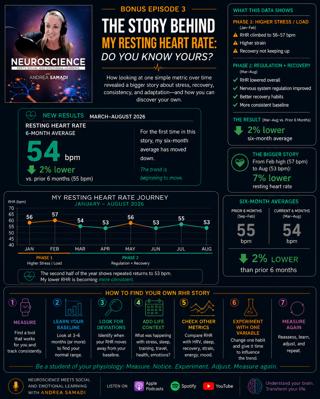
The Hidden Story Behind Your Resting Heart Rate: What Your RHR Can Reveal About Stress, Recovery & Adaptation

The Hidden Story Behind Your Resting Heart Rate: What Your RHR Can Reveal About Stress, Recovery & Adaptation

Andrea Samadi shares her personal resting heart rate data to show why measuring over time matters more than fixating on a single score. She explains how trends reveal stress, recovery, and adaptation,...

23 Elo 30min
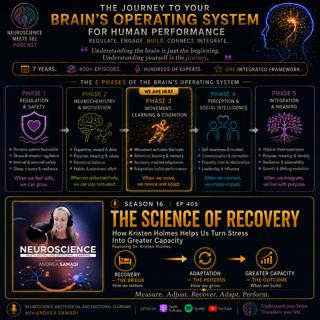
The Science of Recovery—How Dr. Kristen Holmes Helps Us Turn Stress Into Greater Capacity

The Science of Recovery—How Dr. Kristen Holmes Helps Us Turn Stress Into Greater Capacity

In this episode Andrea Samadi explores Phase 3 of the Brain's Operating System—movement, learning, and cognition—focusing on the recovery and adaptation side of the "movement loop." She revisits Dr. K...

16 Elo 45min
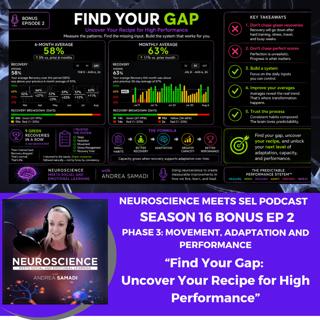
Find Your Gap: How Recovery Unlocks Predictable Performance (Bonus Episode)

Find Your Gap: How Recovery Unlocks Predictable Performance (Bonus Episode)

In this bonus episode Andrea Samadi introduces the Predictable Performance System, a practical roadmap from her Brain’s Operating System. She shows how measuring patterns—not chasing daily scores—plus...

9 Elo 30min
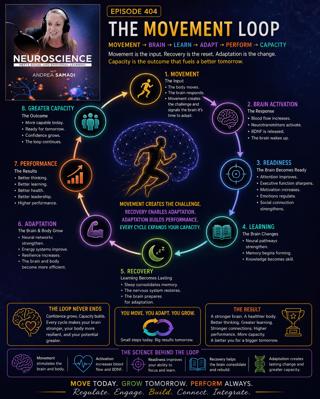
Dr. John Ratey and The Movement Loop: How Movement Becomes Human Performance

Dr. John Ratey and The Movement Loop: How Movement Becomes Human Performance

In this episode Andrea Samadi explores Phase Three of the Brain’s Operating System — how movement acts as the essential input that activates the brain, sharpens attention, boosts learning, and improve...

2 Elo 21min
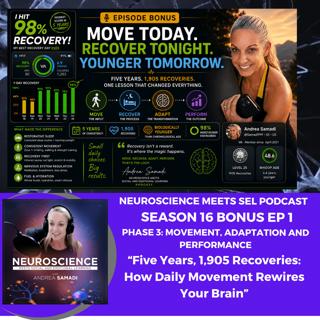
Five Years, 1,905 Recoveries: How Daily Movement Rewires Your Brain (Bonus Episode)

Five Years, 1,905 Recoveries: How Daily Movement Rewires Your Brain (Bonus Episode)

Andrea Samadi shares a five-year self-experiment using a WHOOP wearable to track sleep, recovery, movement, and biological age. She reveals how daily low-intensity movement and consistent recovery—not...

25 Heinä 16min
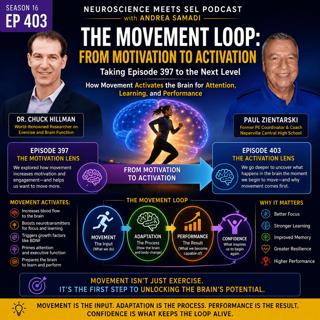
The Movement Loop: How Movement Activates the Brain for Learning, Adaptation & Performance

The Movement Loop: How Movement Activates the Brain for Learning, Adaptation & Performance

Welcome back to Season 16 of the Neuroscience Meets Social and Emotional Learning Podcast. I'm Andrea Samadi, and this is where we bridge neuroscience, social and emotional learning, and human perform...

19 Heinä 34min
Suosittua kategoriassa Koulutus

rss-murhan-anatomia
aamukahvilla
psykopodiaa-podcast
adhd-podi
voi-hyvin-meditaatiot-2
rss-koira-haudattuna
rss-rahamania
rss-niinku-asia-on
rss-vapaudu-voimaasi
rss-keskeneraiset-aidit
rss-liian-kuuma-peruna
rss-8-oppituntia-rohkeudesta
rss-arkea-ja-aurinkoa-podcast-espanjasta
jari-sarasvuo-podcast
kesken
koulu-podcast-2
salainen-paivakirja
rss-duodecim-lehti
rss-luonnollinen-synnytys-podcast
ihminen-tavattavissa-tommy-hellsten-instituutti