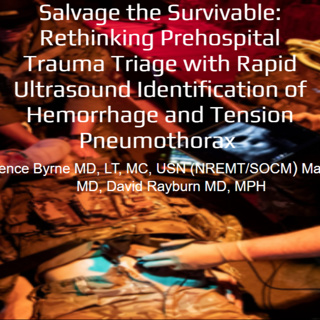
SOMA 26' - Ultrasound-Augmented Triage A Proposal To Refine Field Decision Making In Tactical Combat Casualty Care

SOMA 26' - Ultrasound-Augmented Triage A Proposal To Refine Field Decision Making In Tactical Combat Casualty Care

Recorded live at SOMA 26

In a near-peer MASCAL, one medic and one junior medic may face twenty penetrating torso casualties, one unit of blood, and no time to empirically needle or finger-decompress every chest. This SOMA presentation argues that formal triage algorithms are already giving way to intuitive, intervention-first decisions—and that point-of-care ultrasound can make that second pass objective. The proposed two-pass model keeps MARCH as a fast first pass (urgent vs non-urgent), then uses a three-view POCUS exam—parasternal or subxiphoid cardiac motion, pericardial effusion, and bilateral lung apices—completed in under 30 seconds to decide who gets blood, who needs targeted decompression, who needs a surgical airway to thoracotomy or pericardiocentesis, and who is unsurvivable cardiac standstill. Speakers review trauma-arrest survival data, needle-decompression overuse, SOF medic training at Henry Ford (RUSH exam and the abbreviated 30-second protocol), and civilian paramedic programs showing that short courses can produce usable scans that change management.

Sponsored by the Special Operations Medical Association.


Key Takeaways

  • Empiric bilateral chest decompression and “treat everybody” TCCC habits will not scale in large MASCALs when blood, time, and procedural capacity are scarce.
  • Formal algorithms are often unused in real events; medics already default to intuitive triage. The missing piece is an objective tool that separates salvageable from unsurvivable casualties.
  • Published decompression data show low response rates, high practice variation, and procedures performed on patients who did not meet criteria—driven by subjective breath sounds.
  • Cardiac motion on ultrasound is the strongest practical field marker of salvageability in pulseless trauma; standstill without tamponade is associated with essentially no survival and should conserve blood and procedures.
  • A three-view exam (cardiac motion, pericardial effusion, pneumothorax) can be completed in ~25–30 seconds. SOF medics approached expert performance after focused training; civilian paramedics have shown usable accuracy after 4–8 hour courses.
  • Positive findings should drive action: motion → consider blood; effusion + access to thoracotomy/pericardiocentesis → prioritize evacuation/intervention; no lung slide → targeted decompression rather than bilateral empiric procedures.


Chapters

00:00 – Introduction, disclosures, and the MASCAL problem01:00 – Case: 20 casualties, one unit of blood, empiric procedures02:40 – Intuitive triage vs formal algorithms03:20 – Why empiric needle/finger decompression falls short05:10 – Scarce blood and the need for a modified LSCO triage approach05:50 – Two-pass model: MARCH first, POCUS second07:20 – Three-view exam: motion, tamponade, pneumothorax08:00 – Pulseless trauma survival: civilian and military data11:00 – Cardiac views and what “salvageable” looks like15:20 – Field case: ultrasound guiding thoracotomy and blood use16:00 – Can medics do this? SOF RUSH pathway since 201717:30 – Abbreviated 30-second protocol: retrospective and prospective times19:30 – Civilian 4-hour training and New Orleans scan performance22:40 – Putting it together in MASCAL: salvage the survivable24:00 – Resource rules: motion vs standstill vs tamponade25:30 – Questions and close

Listen / follow: podcast → ⁠prolongedfieldcare.org⁠⁠@prolonged_field_care⁠

Tämä jakso on lisätty Podme-palveluun avoimen RSS-syötteen kautta eikä se ole Podmen omaa tuotantoa. Siksi jakso saattaa sisältää mainontaa.

Jaksot(627)

295- Logistics For LSCO: Why SOF Med Supplies Fail When The War Changes

295- Logistics For LSCO: Why SOF Med Supplies Fail When The War Changes

Medical logistics was an afterthought for a lot of us in GWOT. You submitted a request, something showed up, and everyone joked that the warehouse never read the order. That model does not survive lar...

7 Syys 35min
SOMA 26' - Role 1.5: Fighting Tourniquet Syndrome at the Forefront

SOMA 26' - Role 1.5: Fighting Tourniquet Syndrome at the Forefront

Ukrainian orthopedic and reconstructive surgeon describes what prolonged field care actually looks like when evacuation from the front line to Role 2 takes three to four days, and sometimes longer. Af...

3 Syys 21min

294 - Do Antibiotics Really Reduce Mortality in Trauma? Wound Care First in Prolonged Field Care

294 - Do Antibiotics Really Reduce Mortality in Trauma? Wound Care First in Prolonged Field Care

Antibiotics are not magic. In this episode of the PFC Podcast, Dennis sits down with Ryan to cut through the common myth that “I’ve given antibiotics, so the wound is protected.” They unpack why vigor...

31 Elo 36min
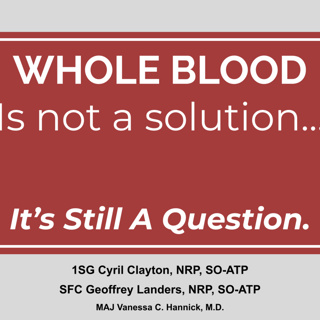
SOMA 26' - Fresh Whole Blood is Not The Answer: It's Still a Question

SOMA 26' - Fresh Whole Blood is Not The Answer: It's Still a Question

Whole Blood Is Not a Solution (Until Conventional Forces Can Deliver It)Recorded live at SOMA 26Dr. Vanessa Hanick (emergency physician, former active-duty Army, now National Guard) and 1SG Cy Clayton...

27 Elo 28min
293 - Dead Tissue Kills in Prolonged Field Care: 4 C’s, Early Debridement & Delayed Primary Closure Lessons from the Field

293 - Dead Tissue Kills in Prolonged Field Care: 4 C’s, Early Debridement & Delayed Primary Closure Lessons from the Field

In this episode of the PFC Podcast, Dennis sits down with missionary surgeon Jason to cut through the noise on real-world wound care in austere and unconventional warfare environments. From the bridge...

24 Elo 49min
SOMA 26' - European Medical Preparations for Major Engagements and Large-Scale Combat Operations

SOMA 26' - European Medical Preparations for Major Engagements and Large-Scale Combat Operations

Recorded live at SOMA 26Pierre Pasquier (France) and his German counterpart deliver a clear-eyed assessment of how European military medical systems are preparing for large-scale combat operations and...

20 Elo 31min
292-Building Mobile Surgical Capability in Denied Environments

292-Building Mobile Surgical Capability in Denied Environments

In this episode of the Prolonged Field Care Podcast, Dennis sits down with Mitch (U.S. family practice/ER physician) and Augustine (frontline surgeon with five years of experience) to unpack what it a...

17 Elo 41min

Suosittua kategoriassa Koulutus

rss-murhan-anatomia
aamukahvilla
psykopodiaa-podcast
voi-hyvin-meditaatiot-2
adhd-podi
rss-luonnollinen-synnytys-podcast
rss-liian-kuuma-peruna
ihminen-tavattavissa-tommy-hellsten-instituutti
rss-rahamania
aloita-meditaatio
kesken
rss-vapaudu-voimaasi
rss-8-oppituntia-rohkeudesta
koulu-podcast-2
rss-koira-haudattuna
rss-narsisti
ilona-rauhala
rss-valo-minussa-2
rss-arkea-ja-aurinkoa-podcast-espanjasta
rss-duodecim-lehti