
Prolonged Field Care Podcast 47: Andy Fisher And His Damage Control Resuscitation For PFC

Prolonged Field Care Podcast 47: Andy Fisher And His Damage Control Resuscitation For PFC

So what is different than what we already have in the THOR recommendations, the JTS DCR clinical Practice Guideline and the Ranger Regiment TDCR? No hextend?! Calcium with the 1st unit of blood?! TXA slow push?! What if the patient is not responding to resuscitation efforts? This is a guideline truly written for the Medic working despite lack of help or resources in an austere environment…

When reviewing and editing this evidence-based consensus guideline there were lengthy discussions about the realities of some of the issues mentioned above. One of the biggest questions came when discussing TCCC because there are slight differences with the CoTCCC guidelines which were written specifically for a medic treating a patient sequentially in the combat environment.

I will attempt to explain the thought process of the group of authors as I understood the conversations and email chains in order to help you make a better decision for your practice. That fact alone makes this guideline different. It is specifically written for an independent duty medic or corpsman who has the flexibility to make decisions about the care based on available evidence for the patient which may or may not yet exist in which case expert consensus was used.

Guidelines for medics must be written in a linear manner because they do not merely manage the care of a patient as part of a large team working together, they manage, prioritize, and physically complete each task one after another. Training other team members to complete certain tasks can greatly assist the medic. Gains in the quality of care and outcomes can come from optimizing a dedicated trauma system. When that system is a single person working problems in series, the variables must be looked at in a sequential manner because that is how they are performed. The administration of TXA comes to mind when talking about these minute changes.

TXA Slow Push: TXA is not the cornerstone of austere resuscitation, administration of blood is. Since the CRASH2 TXA trial results and per manufacturer recommendations, it has been recommended that TXA be given slowly over 10 minutes so as to not cause transient hypotension. The provider should absolutely be aware of this possibility no matter how small of a chance it may have of occurring. Once aware and taken into account, a decision can be made for the current situation. Do they have time to get out an IV bag, reconstitute the TXA, Inject it into the bag, start a new IV/IO site, hook up the line, count the drips, adjust the drip rate multiple times and then check on the drip rate multiple times so as to make sure that 10 minutes is vehemently adhered to? Does this bring the risk of transient hypotension to absolute zero or does it merely reduce an already small chance? This guideline gives the medic the same guidance and recommendations from conclusions of the original study with the caveat not to waste time they or the patient may not have due to the situation or environment. If that IV line is already the second line, it may be needed for other adjuncts including calcium, pain control, sedation, antibiotics, antiemetics, etc. 10 minutes is a long time when someone is writhing in pain, vomiting, mentally altered while bleeding out. If on the other hand, a patient arrives to your aid station with 2 IVs, blood hanging, with appropriate sedation and analgesia, there is likely time to adhere to the slow drip over 10 minute recommendation. Again, it is the prerogative of the independent duty medic or corpsman to weigh the risks versus gain.

Tämä jakso on lisätty Podme-palveluun avoimen RSS-syötteen kautta eikä se ole Podmen omaa tuotantoa. Siksi jakso saattaa sisältää mainontaa.

Jaksot(624)

294 - Do Antibiotics Really Reduce Mortality in Trauma? Wound Care First in Prolonged Field Care

294 - Do Antibiotics Really Reduce Mortality in Trauma? Wound Care First in Prolonged Field Care

Antibiotics are not magic. In this episode of the PFC Podcast, Dennis sits down with Ryan to cut through the common myth that “I’ve given antibiotics, so the wound is protected.” They unpack why vigor...

31 Elo 36min
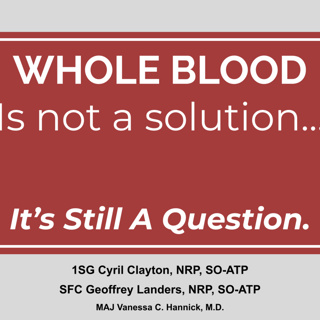
SOMA 26' - Fresh Whole Blood is Not The Answer: It's Still a Question

SOMA 26' - Fresh Whole Blood is Not The Answer: It's Still a Question

Whole Blood Is Not a Solution (Until Conventional Forces Can Deliver It)Recorded live at SOMA 26Dr. Vanessa Hanick (emergency physician, former active-duty Army, now National Guard) and 1SG Cy Clayton...

27 Elo 28min
293 - Dead Tissue Kills in Prolonged Field Care: 4 C’s, Early Debridement & Delayed Primary Closure Lessons from the Field

293 - Dead Tissue Kills in Prolonged Field Care: 4 C’s, Early Debridement & Delayed Primary Closure Lessons from the Field

In this episode of the PFC Podcast, Dennis sits down with missionary surgeon Jason to cut through the noise on real-world wound care in austere and unconventional warfare environments. From the bridge...

24 Elo 49min
SOMA 26' - European Medical Preparations for Major Engagements and Large-Scale Combat Operations

SOMA 26' - European Medical Preparations for Major Engagements and Large-Scale Combat Operations

Recorded live at SOMA 26Pierre Pasquier (France) and his German counterpart deliver a clear-eyed assessment of how European military medical systems are preparing for large-scale combat operations and...

20 Elo 31min
292-Building Mobile Surgical Capability in Denied Environments

292-Building Mobile Surgical Capability in Denied Environments

In this episode of the Prolonged Field Care Podcast, Dennis sits down with Mitch (U.S. family practice/ER physician) and Augustine (frontline surgeon with five years of experience) to unpack what it a...

17 Elo 41min
SOMA 26 - Optimizing the Efficacy of Commonly Used Tactical Medical Gear and Medications In The Arctic Extreme Cold Operational Environment

SOMA 26 - Optimizing the Efficacy of Commonly Used Tactical Medical Gear and Medications In The Arctic Extreme Cold Operational Environment

Recorded live at SOMA 26Dr. Emily Johnston (Cascadia Mountain Institute) and SFC Ezequiel Mendoza (Arctic Dustoff, Fairbanks) deliver a hard-hitting, field-validated look at how standard tactical medi...

13 Elo 29min
291 - Pediatric Burns In Prolonged Field Care Assessment, Resuscitation & Airway Management

291 - Pediatric Burns In Prolonged Field Care Assessment, Resuscitation & Airway Management

In this essential episode of the Prolonged Field Care Podcast, Dennis sits down with pediatric intensivist Dr. Sara Bibbens to tackle one of the most challenging and anxiety-inducing scenarios in aust...

10 Elo 30min
SOMA 26 - A History of Mobile Surgical Teams Role 1-3 and Horizon Scan

SOMA 26 - A History of Mobile Surgical Teams Role 1-3 and Horizon Scan

In this presentation, we take a deep dive into the 300-year history of mobile surgery supporting land campaigns — from Dominique Larrey’s ambulance volantes through the Letterman system, Arnhem, the F...

6 Elo 28min

Suosittua kategoriassa Koulutus

rss-murhan-anatomia
psykopodiaa-podcast
adhd-podi
voi-hyvin-meditaatiot-2
rss-vapaudu-voimaasi
ihminen-tavattavissa-tommy-hellsten-instituutti
rss-niinku-asia-on
rss-liian-kuuma-peruna
koulu-podcast-2
rss-uskonto-on-tylsaa
rss-arkea-ja-aurinkoa-podcast-espanjasta
rss-keskeneraiset-aidit
rahapuhetta
rss-koira-haudattuna
kesken
esa-saarinen-filosofia-ja-systeemiajattelu
rss-rahamania
rss-varapare
leveli
rss-arkijarki