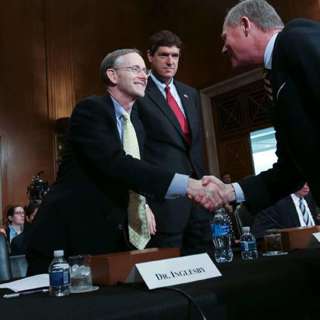
#27 - Dr Tom Inglesby on careers and policies that reduce global catastrophic biological risks

#27 - Dr Tom Inglesby on careers and policies that reduce global catastrophic biological risks

How about this for a movie idea: a main character has to prevent a new contagious strain of Ebola spreading around the world. She’s the best of the best. So good in fact, that her work on early detection systems contains the strain at its source. Ten minutes into the movie, we see the results of her work – nothing happens. Life goes on as usual. She continues to be amazingly competent, and nothing continues to go wrong. Fade to black. Roll credits.

If your job is to prevent catastrophes, success is when nobody has to pay attention to you. But without regular disasters to remind authorities why they hired you in the first place, they can’t tell if you’re actually achieving anything. And when budgets come under pressure you may find that success condemns you to the chopping block.

Dr Tom Inglesby, Director of the Center for Health Security at the Johns Hopkins Bloomberg School of Public Health, worries this may be about to happen to the scientists working on the ‘Global Health Security Agenda’.

In 2014 Ebola showed the world why we have to detect and contain new diseases before they spread, and that when it comes to contagious diseases the nations of the world sink or swim together. Fifty countries decided to work together to make sure all their health systems were up to the challenge. Back then Congress provided 5 years’ funding to help some of the world’s poorest countries build the basic health security infrastructure necessary to control pathogens before they could reach the US.

Links to learn more, job opportunities, and full transcript.

But with Ebola fading from public memory and no recent tragedies to terrify us, Congress may not renew that funding and the project could fall apart. (Learn more about how you can help: http://www.nti.org/analysis/articles/protect-us-investments-global-health-security/ )

But there are positive signs as well - the center Inglesby leads recently received a $16 million grant from the Open Philanthropy Project to further their work preventing global catastrophes. It also runs the [Emerging Leaders in Biosecurity Fellowship](http://www.centerforhealthsecurity.org/our-work/emergingbioleaders/) to train the next generation of biosecurity experts for the US government. And Inglesby regularly testifies to Congress on the threats we all face and how to address them.

In this in-depth interview we try to provide concrete guidance for listeners who want to to pursue a career in health security. Some of the topics we cover include:

* Should more people in medicine work on security?
* What are the top jobs for people who want to improve health security and how do they work towards getting them?
* What people can do to protect funding for the Global Health Security Agenda.
* Should we be more concerned about natural or human caused pandemics? Which is more neglected?
* Should we be allocating more attention and resources to global catastrophic risk scenarios?
* Why are senior figures reluctant to prioritize one project or area at the expense of another?
* What does Tom think about the idea that in the medium term, human-caused pandemics will pose a far greater risk than natural pandemics, and so we should focus on specific counter-measures?
* Are the main risks and solutions understood, and it’s just a matter of implementation? Or is the principal task to identify and understand them?
* How is the current US government performing in these areas?
* Which agencies are empowered to think about low probability high magnitude events?
And more...

Get this episode by subscribing: search for '80,000 Hours' in your podcasting app.

The 80,000 Hours Podcast is produced by Keiran Harris.

Jaksot(332)

#84 – Shruti Rajagopalan on what India did to stop COVID-19 and how well it worked

#84 – Shruti Rajagopalan on what India did to stop COVID-19 and how well it worked

When COVID-19 struck the US, everyone was told that hand sanitizer needed to be saved for healthcare professionals, so they should just wash their hands instead. But in India, many homes lack reliable...

13 Elo 20202h 58min
#83 - Jennifer Doleac on preventing crime without police and prisons

#83 - Jennifer Doleac on preventing crime without police and prisons

The killing of George Floyd has prompted a great deal of debate over whether the US should reduce the size of its police departments. The research literature suggests that the presence of police offic...

31 Heinä 20202h 23min
#82 – James Forman Jr on reducing the cruelty of the US criminal legal system

#82 – James Forman Jr on reducing the cruelty of the US criminal legal system

No democracy has ever incarcerated as many people as the United States. To get its incarceration rate down to the global average, the US would have to release 3 in 4 people in its prisons today.  The ...

27 Heinä 20201h 28min
#81 - Ben Garfinkel on scrutinising classic AI risk arguments

#81 - Ben Garfinkel on scrutinising classic AI risk arguments

80,000 Hours, along with many other members of the effective altruism movement, has argued that helping to positively shape the development of artificial intelligence may be one of the best ways to ha...

9 Heinä 20202h 38min

Advice on how to read our advice (Article)

Advice on how to read our advice (Article)

This is the fourth release in our new series of audio articles. If you want to read the original article or check out the links within it, you can find them here. "We’ve found that readers sometimes...

29 Kesä 202015min
#80 – Stuart Russell on why our approach to AI is broken and how to fix it

#80 – Stuart Russell on why our approach to AI is broken and how to fix it

Stuart Russell, Professor at UC Berkeley and co-author of the most popular AI textbook, thinks the way we approach machine learning today is fundamentally flawed. In his new book, Human Compatible, he...

22 Kesä 20202h 13min

What anonymous contributors think about important life and career questions (Article)

What anonymous contributors think about important life and career questions (Article)

Today we’re launching the final entry of our ‘anonymous answers' series on the website. It features answers to 23 different questions including “How have you seen talented people fail in their work?...

5 Kesä 202037min
#79 – A.J. Jacobs on radical honesty, following the whole Bible, and reframing global problems as puzzles

#79 – A.J. Jacobs on radical honesty, following the whole Bible, and reframing global problems as puzzles

Today’s guest, New York Times bestselling author A.J. Jacobs, always hated Judge Judy. But after he found out that she was his seventh cousin, he thought, "You know what? She's not so bad." Hijacking ...

1 Kesä 20202h 38min

Suosittua kategoriassa Koulutus

rss-murhan-anatomia
psykopodiaa-podcast
voi-hyvin-meditaatiot-2
adhd-podi
psykologia
rss-valo-minussa-2
rss-tietoinen-yhteys-podcast-2
rss-rahamania
rss-niinku-asia-on
kesken
rss-arkea-ja-aurinkoa-podcast-espanjasta
rahapuhetta
rss-liian-kuuma-peruna
rss-narsisti
dear-ladies
rss-eron-alkemiaa
rss-vapaudu-voimaasi
leikitaanko-laakaria
aamukahvilla
rss-uskonto-on-tylsaa