
#32 - Bryan Caplan on whether his Case Against Education holds up, totalitarianism, & open borders

#32 - Bryan Caplan on whether his Case Against Education holds up, totalitarianism, & open borders

Bryan Caplan’s claim in *The Case Against Education* is striking: education doesn’t teach people much, we use little of what we learn, and college is mostly about trying to seem smarter than other people - so the government should slash education funding.

It’s a dismaying - almost profane - idea, and one people are inclined to dismiss out of hand. But having read the book, I have to admit that Bryan can point to a surprising amount of evidence in his favour.

After all, imagine this dilemma: you can have either a Princeton education without a diploma, or a Princeton diploma without an education. Which is the bigger benefit of college - learning or convincing people you’re smart? It’s not so easy to say.

For this interview, I searched for the best counterarguments I could find and challenged Bryan on what seem like his weakest or most controversial claims.

Wouldn’t defunding education be especially bad for capable but low income students? If you reduced funding for education, wouldn’t that just lower prices, and not actually change the number of years people study? Is it really true that students who drop out in their final year of college earn about the same as people who never go to college at all?

What about studies that show that extra years of education boost IQ scores? And surely the early years of primary school, when you learn reading and arithmetic, *are* useful even if college isn’t.

I then get his advice on who should study, what they should study, and where they should study, if he’s right that college is mostly about separating yourself from the pack.

Full transcript, links to learn more, and summary of key points.

We then venture into some of Bryan’s other unorthodox views - like that immigration restrictions are a human rights violation, or that we should worry about the risk of global totalitarianism.

Bryan is a Professor of Economics at George Mason University, and a blogger at *EconLog*. He is also the author of *Selfish Reasons to Have More Kids: Why Being a Great Parent is Less Work and More Fun Than You Think*, and *The Myth of the Rational Voter: Why Democracies Choose Bad Policies*.

Get this episode by subscribing to our podcast on the world’s most pressing problems and how to solve them: type *80,000 Hours* into your podcasting app.

In this lengthy interview, Rob and Bryan cover:

* How worried should we be about China’s new citizen ranking system as a means of authoritarian rule?
* How will advances in surveillance technology impact a government’s ability to rule absolutely?
* Does more global coordination make us safer, or more at risk?
* Should the push for open borders be a major cause area for effective altruism?
* Are immigration restrictions a human rights violation?
* Why aren’t libertarian-minded people more focused on modern slavery?
* Should altruists work on criminal justice reform or reducing land use regulations?
* What’s the greatest art form: opera, or Nicki Minaj?
* What are the main implications of Bryan’s thesis for society?
* Is elementary school more valuable than university?
* What does Bryan think are the best arguments against his view?
* Do years of education affect political affiliation?
* How do people really improve themselves and their circumstances?
* Who should and who shouldn’t do a masters or PhD?
* The value of teaching foreign languages in school
* Are there some skills people can develop that have wide applicability?

Get this episode by subscribing: search for '80,000 Hours' in your podcasting app.

The 80,000 Hours Podcast is produced by Keiran Harris.

Tämä jakso on lisätty Podme-palveluun avoimen RSS-syötteen kautta eikä se ole Podmen omaa tuotantoa. Siksi jakso saattaa sisältää mainontaa.

Jaksot(346)

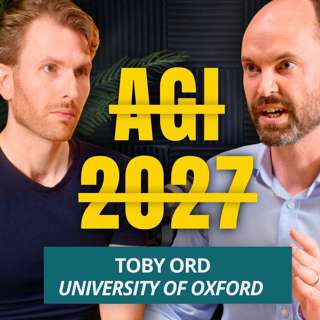
Where AGI timelines go wrong | Toby Ord, Oxford University

Where AGI timelines go wrong | Toby Ord, Oxford University

Both Silicon Valley and the public can’t get enough of ‘AGI timelines.’ But Toby Ord, senior researcher at Oxford’s AI Governance Initiative and author of The Precipice, believes we consistently make ...

6 Elo 2h 46min

What the hell happened with AGI timelines in 2026? – Rob Wiblin

What the hell happened with AGI timelines in 2026? – Rob Wiblin

Last October, famed coder Andrej Karpathy called AI agents “slop.” Two months later he completely reversed his view, describing them as “alien tools” that are “rocking the profession.”He was far from ...

4 Elo 49min

#249 – Spencer Greenberg on staying sane while trying to save the world

#249 – Spencer Greenberg on staying sane while trying to save the world

If you genuinely believe that humanity could be wiped out by AI or a pandemic, what is the appropriate amount of fear to feel?“As much as possible” can seem like the only reasonable answer. If the wor...

28 Heinä 2h 9min

#248 – Jasmine Sun on what the people building AI really believe

#248 – Jasmine Sun on what the people building AI really believe

Many AI researchers believe mass job displacement is coming — and some even think there’s a chance their technology will kill everyone. But they’re building it anyway. Writer and journalist Jasmine Su...

21 Heinä 1h 6min

#247 – Anton Leicht on how middle powers avoid losing everything in a post-AI world

#247 – Anton Leicht on how middle powers avoid losing everything in a post-AI world

In a post-AGI world, can a country without access to frontier AI even be considered sovereign anymore?Anton Leicht says once frontier AI becomes a core economic input, the countries that own it will p...

14 Heinä 1h 33min

#246 – Sneha Revanur on how a small team of activists helped pass America's landmark AI safety laws

#246 – Sneha Revanur on how a small team of activists helped pass America's landmark AI safety laws

Six years ago, aged just 15, Sneha Revanur founded the AI advocacy nonprofit Encode AI — back when AI felt like a niche issue. Now the world’s caught up with her, and she’s ready to share everything s...

8 Heinä 52min

We can guess what intergalactic war would look like. And strangely, it matters.

We can guess what intergalactic war would look like. And strangely, it matters.

Intergalactic war is probably billions of years away — yet physics can already tell us how it ends. And strangely that conclusion is relevant to decisions people have to make today.In this video, Rob ...

18 Kesä 15min

How AI could create the world’s biggest problems (article by Zershaaneh Qureshi)

How AI could create the world’s biggest problems (article by Zershaaneh Qureshi)

Imagine you’re living 15,000 years ago. Your people are hunter-gatherers and you sleep under the stars. If someone told you humans would one day build cities with millions of people, fly through the a...

11 Kesä 1h 29min

Suosittua kategoriassa Koulutus

rss-murhan-anatomia
psykopodiaa-podcast
voi-hyvin-meditaatiot-2
psykologia
adhd-podi
ilona-rauhala
kesken
rss-vapaudu-voimaasi
rss-hereilla
rss-arkea-ja-aurinkoa-podcast-espanjasta
rss-laadukasta-ensihoitoa
aamupore
rss-spessu
rss-liian-kuuma-peruna
rss-koira-haudattuna
rss-rahamania
rss-luonnollinen-synnytys-podcast
aloita-meditaatio
rss-rentotapaus
rss-xamk-podcast