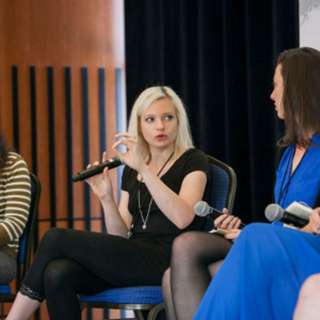

#42 - Amanda Askell on moral empathy, the value of information & the ethics of infinity

#42 - Amanda Askell on moral empathy, the value of information & the ethics of infinity

Consider two familiar moments at a family reunion.

Our host, Uncle Bill, takes pride in his barbecuing skills. But his niece Becky says that she now refuses to eat meat. A groan goes round the table; the family mostly think of this as an annoying picky preference. But if seriously considered as a moral position, as they might if instead Becky were avoiding meat on religious grounds, it would usually receive a very different reaction.

An hour later Bill expresses a strong objection to abortion. Again, a groan goes round the table; the family mostly think that he has no business in trying to foist his regressive preference on anyone. But if considered not as a matter of personal taste, but rather as a moral position - that Bill genuinely believes he’s opposing mass-murder - his comment might start a serious conversation.

Amanda Askell, who recently completed a PhD in philosophy at NYU focused on the ethics of infinity, thinks that we often betray a complete lack of moral empathy. All sides of the political spectrum struggle to get inside the mind of people we disagree with and see issues from their point of view.

Links to learn more, summary and full transcript.

This often happens because of confusion between preferences and moral positions.

Assuming good faith on the part of the person you disagree with, and actually engaging with the beliefs they claim to hold, is perhaps the best remedy for our inability to make progress on controversial issues.

One potential path for progress surrounds contraception; a lot of people who are anti-abortion are also anti-contraception. But they’ll usually think that abortion is much worse than contraception, so why can’t we compromise and agree to have much more contraception available?

According to Amanda, a charitable explanation for this is that people who are anti-abortion and anti-contraception engage in moral reasoning and advocacy based on what, in their minds, is the best of all possible worlds: one where people neither use contraception nor get abortions.

So instead of arguing about abortion and contraception, we could discuss the underlying principle that one should advocate for the best possible world, rather than the best probable world.

Successfully break down such ethical beliefs, absent political toxicity, and it might be possible to actually converge on a key point of agreement.

Today’s episode blends such everyday topics with in-depth philosophy, including:

* What is 'moral cluelessness' and how can we work around it?
* Amanda's biggest criticisms of social justice activists, and of critics of social justice activists
* Is there an ethical difference between prison and corporal punishment?
* How to resolve 'infinitarian paralysis' - the inability to make decisions when infinities are involved.
* What’s effective altruism doing wrong?
* How should we think about jargon? Are a lot of people who don’t communicate clearly just scamming us?
* How can people be more successful within the cocoon of school and university?
* How did Amanda find doing a philosophy PhD, and how will she decide what to do now?

Links:
* Career review: Congressional staffer
* Randomised experiment on quitting
* Psychology replication quiz
* Should you focus on your comparative advantage.

Get this episode by subscribing: type 80,000 Hours into your podcasting app.

The 80,000 Hours podcast is produced by Keiran Harris.

Jaksot(332)

#176 – Nathan Labenz on the final push for AGI, understanding OpenAI's leadership drama, and red-teaming frontier models

#176 – Nathan Labenz on the final push for AGI, understanding OpenAI's leadership drama, and red-teaming frontier models

OpenAI says its mission is to build AGI — an AI system that is better than human beings at everything. Should the world trust them to do that safely?That’s the central theme of today’s episode with Na...

22 Joulu 20233h 46min
#175 – Lucia Coulter on preventing lead poisoning for $1.66 per child

#175 – Lucia Coulter on preventing lead poisoning for $1.66 per child

Lead is one of the most poisonous things going. A single sugar sachet of lead, spread over a park the size of an American football field, is enough to give a child that regularly plays there lead pois...

14 Joulu 20232h 14min
#174 – Nita Farahany on the neurotechnology already being used to convict criminals and manipulate workers

#174 – Nita Farahany on the neurotechnology already being used to convict criminals and manipulate workers

"It will change everything: it will change our workplaces, it will change our interactions with the government, it will change our interactions with each other. It will make all of us unwitting neurom...

7 Joulu 20232h

#173 – Jeff Sebo on digital minds, and how to avoid sleepwalking into a major moral catastrophe

#173 – Jeff Sebo on digital minds, and how to avoid sleepwalking into a major moral catastrophe

"We do have a tendency to anthropomorphise nonhumans — which means attributing human characteristics to them, even when they lack those characteristics. But we also have a tendency towards anthropoden...

22 Marras 20232h 38min
#172 – Bryan Caplan on why you should stop reading the news

#172 – Bryan Caplan on why you should stop reading the news

Is following important political and international news a civic duty — or is it our civic duty to avoid it?It's common to think that 'staying informed' and checking the headlines every day is just wha...

17 Marras 20232h 23min
#171 – Alison Young on how top labs have jeopardised public health with repeated biosafety failures

#171 – Alison Young on how top labs have jeopardised public health with repeated biosafety failures

"Rare events can still cause catastrophic accidents. The concern that has been raised by experts going back over time, is that really, the more of these experiments, the more labs, the more opportunit...

9 Marras 20231h 46min
#170 – Santosh Harish on how air pollution is responsible for ~12% of global deaths — and how to get that number down

#170 – Santosh Harish on how air pollution is responsible for ~12% of global deaths — and how to get that number down

"One [outrageous example of air pollution] is municipal waste burning that happens in many cities in the Global South. Basically, this is waste that gets collected from people's homes, and instead of ...

1 Marras 20232h 57min
#169 – Paul Niehaus on whether cash transfers cause economic growth, and keeping theft to acceptable levels

#169 – Paul Niehaus on whether cash transfers cause economic growth, and keeping theft to acceptable levels

"One of our earliest supporters and a dear friend of mine, Mark Lampert, once said to me, “The way I think about it is, imagine that this money were already in the hands of people living in poverty. I...

26 Loka 20231h 47min

Suosittua kategoriassa Koulutus

rss-murhan-anatomia
psykopodiaa-podcast
voi-hyvin-meditaatiot-2
adhd-podi
rss-liian-kuuma-peruna
rss-tietoinen-yhteys-podcast-2
rss-niinku-asia-on
rss-valo-minussa-2
rss-rahamania
kesken
rss-arkea-ja-aurinkoa-podcast-espanjasta
rss-vapaudu-voimaasi
rahapuhetta
jari-sarasvuo-podcast
psykologia
rss-uskonto-on-tylsaa
ihminen-tavattavissa-tommy-hellsten-instituutti
rss-hereilla
kehossa
rss-narsisti