
#169 – Paul Niehaus on whether cash transfers cause economic growth, and keeping theft to acceptable levels

#169 – Paul Niehaus on whether cash transfers cause economic growth, and keeping theft to acceptable levels

"One of our earliest supporters and a dear friend of mine, Mark Lampert, once said to me, “The way I think about it is, imagine that this money were already in the hands of people living in poverty. If I could, would I want to tax it and then use it to finance other projects that I think would benefit them?”

I think that's an interesting thought experiment -- and a good one -- to say, “Are there cases in which I think that's justifiable?” — Paul Niehaus

In today’s episode, host Luisa Rodriguez interviews Paul Niehaus — co-founder of GiveDirectly — on the case for giving unconditional cash to the world's poorest households.

Links to learn more, summary and full transcript.

They cover:

  • The empirical evidence on whether giving cash directly can drive meaningful economic growth
  • How the impacts of GiveDirectly compare to USAID employment programmes
  • GiveDirectly vs GiveWell’s top-recommended charities
  • How long-term guaranteed income affects people's risk-taking and investments
  • Whether recipients prefer getting lump sums or monthly instalments
  • How GiveDirectly tackles cases of fraud and theft
  • The case for universal basic income, and GiveDirectly’s UBI studies in Kenya, Malawi, and Liberia
  • The political viability of UBI
  • Plenty more

Chapters:

  • Cold open (00:00:00)
  • Luisa’s intro (00:00:58)
  • The basic case for giving cash directly to the poor (00:03:28)
  • Comparing GiveDirectly to USAID programmes (00:15:42)
  • GiveDirectly vs GiveWell’s top-recommended charities (00:35:16)
  • Cash might be able to drive economic growth (00:41:59)
  • Fraud and theft of GiveDirectly funds (01:09:48)
  • Universal basic income studies (01:22:33)
  • Skyjo (01:44:43)


Producer and editor: Keiran Harris
Audio Engineering Lead: Ben Cordell
Technical editing: Dominic Armstrong and Milo McGuire
Additional content editing: Luisa Rodriguez and Katy Moore
Transcriptions: Katy Moore

Tämä jakso on lisätty Podme-palveluun avoimen RSS-syötteen kautta eikä se ole Podmen omaa tuotantoa. Siksi jakso saattaa sisältää mainontaa.

Jaksot(346)

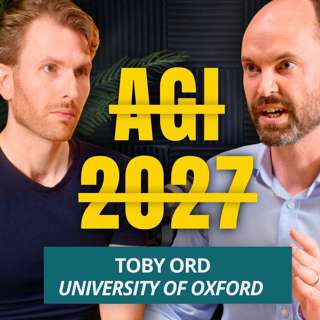
Where AGI timelines go wrong | Toby Ord, Oxford University

Where AGI timelines go wrong | Toby Ord, Oxford University

Both Silicon Valley and the public can’t get enough of ‘AGI timelines.’ But Toby Ord, senior researcher at Oxford’s AI Governance Initiative and author of The Precipice, believes we consistently make ...

6 Elo 2h 46min

What the hell happened with AGI timelines in 2026? – Rob Wiblin

What the hell happened with AGI timelines in 2026? – Rob Wiblin

Last October, famed coder Andrej Karpathy called AI agents “slop.” Two months later he completely reversed his view, describing them as “alien tools” that are “rocking the profession.”He was far from ...

4 Elo 49min

#249 – Spencer Greenberg on staying sane while trying to save the world

#249 – Spencer Greenberg on staying sane while trying to save the world

If you genuinely believe that humanity could be wiped out by AI or a pandemic, what is the appropriate amount of fear to feel?“As much as possible” can seem like the only reasonable answer. If the wor...

28 Heinä 2h 9min

#248 – Jasmine Sun on what the people building AI really believe

#248 – Jasmine Sun on what the people building AI really believe

Many AI researchers believe mass job displacement is coming — and some even think there’s a chance their technology will kill everyone. But they’re building it anyway. Writer and journalist Jasmine Su...

21 Heinä 1h 6min

#247 – Anton Leicht on how middle powers avoid losing everything in a post-AI world

#247 – Anton Leicht on how middle powers avoid losing everything in a post-AI world

In a post-AGI world, can a country without access to frontier AI even be considered sovereign anymore?Anton Leicht says once frontier AI becomes a core economic input, the countries that own it will p...

14 Heinä 1h 33min

#246 – Sneha Revanur on how a small team of activists helped pass America's landmark AI safety laws

#246 – Sneha Revanur on how a small team of activists helped pass America's landmark AI safety laws

Six years ago, aged just 15, Sneha Revanur founded the AI advocacy nonprofit Encode AI — back when AI felt like a niche issue. Now the world’s caught up with her, and she’s ready to share everything s...

8 Heinä 52min

We can guess what intergalactic war would look like. And strangely, it matters.

We can guess what intergalactic war would look like. And strangely, it matters.

Intergalactic war is probably billions of years away — yet physics can already tell us how it ends. And strangely that conclusion is relevant to decisions people have to make today.In this video, Rob ...

18 Kesä 15min

How AI could create the world’s biggest problems (article by Zershaaneh Qureshi)

How AI could create the world’s biggest problems (article by Zershaaneh Qureshi)

Imagine you’re living 15,000 years ago. Your people are hunter-gatherers and you sleep under the stars. If someone told you humans would one day build cities with millions of people, fly through the a...

11 Kesä 1h 29min

Suosittua kategoriassa Koulutus

rss-murhan-anatomia
psykopodiaa-podcast
voi-hyvin-meditaatiot-2
rss-vapaudu-voimaasi
rss-liian-kuuma-peruna
kesken
rss-luonnollinen-synnytys-podcast
psykologia
ilona-rauhala
rss-narsisti
rss-laadukasta-ensihoitoa
adhd-podi
jari-sarasvuo-podcast
rss-arkea-ja-aurinkoa-podcast-espanjasta
aamukahvilla
rss-niinku-asia-on
rss-spessu
rss-hereilla
aamupore
rss-rahamania