

#125 – Joan Rohlfing on how to avoid catastrophic nuclear blunders
80,000 Hours Podcast29 Maalis 2022

#125 – Joan Rohlfing on how to avoid catastrophic nuclear blunders

Since the Soviet Union split into different countries in 1991, the pervasive fear of catastrophe that people lived with for decades has gradually faded from memory, and nuclear warhead stockpiles have declined by 83%. Nuclear brinksmanship, proxy wars, and the game theory of mutually assured destruction (MAD) have come to feel like relics of another era.

Russia's invasion of Ukraine has changed all that.

According to Joan Rohlfing — President of the Nuclear Threat Initiative, a Washington, DC-based nonprofit focused on reducing threats from nuclear and biological weapons — the annual risk of a ‘global catastrophic nuclear event'’ never fell as low as people like to think, and for some time has been on its way back up.

Links to learn more, summary and full transcript.

At the same time, civil society funding for research and advocacy around nuclear risks is being cut in half over a period of years — despite the fact that at $60 million a year, it was already just a thousandth as much as the US spends maintaining its nuclear deterrent.

If new funding sources are not identified to replace donors that are withdrawing, the existing pool of talent will have to leave for greener pastures, and most of the next generation will see a career in the field as unviable.

While global poverty is on the decline and life expectancy increasing, the chance of a catastrophic nuclear event is probably trending in the wrong direction.

Ukraine gave up its nuclear weapons in 1994 in exchange for security guarantees that turned out not to be worth the paper they were written on. States that have nuclear weapons (such as North Korea), states that are pursuing them (such as Iran), and states that have pursued nuclear weapons but since abandoned them (such as Libya, Syria, and South Africa) may take this as a valuable lesson in the importance of military power over promises.

China has been expanding its arsenal and testing hypersonic glide missiles that can evade missile defences. Japan now toys with the idea of nuclear weapons as a way to ensure its security against its much larger neighbour. India and Pakistan both acquired nuclear weapons in the late 1980s and their relationship continues to oscillate from hostile to civil and back.

At the same time, the risk that nuclear weapons could be interfered with due to weaknesses in computer security is far higher than during the Cold War, when systems were simpler and less networked.

In the interview, Joan discusses several steps that can be taken in the immediate term, such as renewed efforts to extend and expand arms control treaties, changes to nuclear use policy, and the retirement of what they see as vulnerable delivery systems, such as land-based silos.

In the bigger picture, NTI seeks to keep hope alive that a better system than deterrence through mutually assured destruction remains possible. The threat of retaliation does indeed make nuclear wars unlikely, but it necessarily means the system fails in an incredibly destructive way: with the death of hundreds of millions if not billions.

In the long run, even a tiny 1 in 500 risk of a nuclear war each year adds up to around an 18% chance of catastrophe over the century.

In this conversation we cover all that, as well as:

• How arms control treaties have evolved over the last few decades
• Whether lobbying by arms manufacturers is an important factor shaping nuclear strategy
• The Biden Nuclear Posture Review
• How easily humanity might recover from a nuclear exchange
• Implications for the use of nuclear energy

Chapters:

  • Rob’s intro (00:00:00)
  • Joan’s EAG presentation (00:01:40)
  • The interview begins (00:27:06)
  • Nuclear security funding situation (00:31:09)
  • Policy solutions for addressing a one-person or one-state risk factor (00:36:46)
  • Key differences in the nuclear security field (00:40:44)
  • Scary scenarios (00:47:02)
  • Why the US shouldn’t expand its nuclear arsenal (00:52:56)
  • The evolution of nuclear risk over the last 10 years (01:03:41)
  • The interaction between nuclear weapons and cybersecurity (01:10:18)
  • The chances of humanity bouncing back after nuclear war (01:13:52)
  • What we should actually do (01:17:57)
  • Could sensors be a game-changer? (01:22:39)
  • Biden Nuclear Posture Review (01:27:50)
  • Influence of lobbying firms (01:33:58)
  • What NTI might do with an additional $20 million (01:36:38)
  • Nuclear energy tradeoffs (01:43:55)
  • Why we can’t rely on Stanislav Petrovs (01:49:49)
  • Preventing war vs. building resilience for recovery (01:52:15)
  • Places to donate other than NTI (01:54:25)
  • Career advice (02:00:15)
  • Why this problem is solvable (02:09:27)


Producer: Keiran Harris
Audio mastering: Ben Cordell
Transcriptions: Katy Moore

Jaksot(318)

Rebuilding after apocalypse: What 13 experts say about bouncing back

Rebuilding after apocalypse: What 13 experts say about bouncing back

What happens when civilisation faces its greatest tests?This compilation brings together insights from researchers, defence experts, philosophers, and policymakers on humanity’s ability to survive and...

15 Heinä 20254h 26min
#220 – Ryan Greenblatt on the 4 most likely ways for AI to take over, and the case for and against AGI in <8 years

#220 – Ryan Greenblatt on the 4 most likely ways for AI to take over, and the case for and against AGI in <8 years

Ryan Greenblatt — lead author on the explosive paper “Alignment faking in large language models” and chief scientist at Redwood Research — thinks there’s a 25% chance that within four years, AI will b...

8 Heinä 20252h 50min
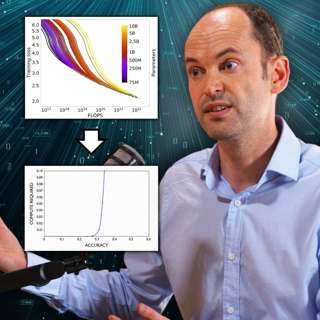
#219 – Toby Ord on graphs AI companies would prefer you didn't (fully) understand

#219 – Toby Ord on graphs AI companies would prefer you didn't (fully) understand

The era of making AI smarter just by making it bigger is ending. But that doesn’t mean progress is slowing down — far from it. AI models continue to get much more powerful, just using very different m...

24 Kesä 20252h 48min
#218 – Hugh White on why Trump is abandoning US hegemony – and that’s probably good

#218 – Hugh White on why Trump is abandoning US hegemony – and that’s probably good

For decades, US allies have slept soundly under the protection of America’s overwhelming military might. Donald Trump — with his threats to ditch NATO, seize Greenland, and abandon Taiwan — seems hell...

12 Kesä 20252h 48min

#217 – Beth Barnes on the most important graph in AI right now — and the 7-month rule that governs its progress

#217 – Beth Barnes on the most important graph in AI right now — and the 7-month rule that governs its progress

AI models today have a 50% chance of successfully completing a task that would take an expert human one hour. Seven months ago, that number was roughly 30 minutes — and seven months before that, 15 mi...

2 Kesä 20253h 47min

Beyond human minds: The bewildering frontier of consciousness in insects, AI, and more

Beyond human minds: The bewildering frontier of consciousness in insects, AI, and more

What if there’s something it’s like to be a shrimp — or a chatbot?For centuries, humans have debated the nature of consciousness, often placing ourselves at the very top. But what about the minds of o...

23 Touko 20253h 34min

Don’t believe OpenAI’s “nonprofit” spin (emergency pod with Tyler Whitmer)

Don’t believe OpenAI’s “nonprofit” spin (emergency pod with Tyler Whitmer)

OpenAI’s recent announcement that its nonprofit would “retain control” of its for-profit business sounds reassuring. But this seemingly major concession, celebrated by so many, is in itself largely me...

15 Touko 20251h 12min

The case for and against AGI by 2030 (article by Benjamin Todd)

The case for and against AGI by 2030 (article by Benjamin Todd)

More and more people have been saying that we might have AGI (artificial general intelligence) before 2030. Is that really plausible? This article by Benjamin Todd looks into the cases for and against...

12 Touko 20251h

Suosittua kategoriassa Koulutus

rss-murhan-anatomia
psykopodiaa-podcast
voi-hyvin-meditaatiot-2
rss-narsisti
adhd-podi
psykologia
rss-liian-kuuma-peruna
kesken
rss-niinku-asia-on
rss-duodecim-lehti
ihminen-tavattavissa-tommy-hellsten-instituutti
rahapuhetta
aamukahvilla
rss-honest-talk-with-laurrenna
rss-luonnollinen-synnytys-podcast
rss-tietoinen-yhteys-podcast-2
rss-opeklubi
rss-vapaudu-voimaasi
nakokulmia-rikollisuudesta-irrottautumiseen
rss-arkea-ja-aurinkoa-podcast-espanjasta