#139 – Alan Hájek on puzzles and paradoxes in probability and expected value

#139 – Alan Hájek on puzzles and paradoxes in probability and expected value

A casino offers you a game. A coin will be tossed. If it comes up heads on the first flip you win $2. If it comes up on the second flip you win $4. If it comes up on the third you win $8, the fourth you win $16, and so on. How much should you be willing to pay to play?

The standard way of analysing gambling problems, ‘expected value’ — in which you multiply probabilities by the value of each outcome and then sum them up — says your expected earnings are infinite. You have a 50% chance of winning $2, for '0.5 * $2 = $1' in expected earnings. A 25% chance of winning $4, for '0.25 * $4 = $1' in expected earnings, and on and on. A never-ending series of $1s added together comes to infinity. And that's despite the fact that you know with certainty you can only ever win a finite amount!

Today's guest — philosopher Alan Hájek of the Australian National University — thinks of much of philosophy as “the demolition of common sense followed by damage control” and is an expert on paradoxes related to probability and decision-making rules like “maximise expected value.”

Links to learn more, summary and full transcript.

The problem described above, known as the St. Petersburg paradox, has been a staple of the field since the 18th century, with many proposed solutions. In the interview, Alan explains how very natural attempts to resolve the paradox — such as factoring in the low likelihood that the casino can pay out very large sums, or the fact that money becomes less and less valuable the more of it you already have — fail to work as hoped.

We might reject the setup as a hypothetical that could never exist in the real world, and therefore of mere intellectual curiosity. But Alan doesn't find that objection persuasive. If expected value fails in extreme cases, that should make us worry that something could be rotten at the heart of the standard procedure we use to make decisions in government, business, and nonprofits.

These issues regularly show up in 80,000 Hours' efforts to try to find the best ways to improve the world, as the best approach will arguably involve long-shot attempts to do very large amounts of good.

Consider which is better: saving one life for sure, or three lives with 50% probability? Expected value says the second, which will probably strike you as reasonable enough. But what if we repeat this process and evaluate the chance to save nine lives with 25% probability, or 27 lives with 12.5% probability, or after 17 more iterations, 3,486,784,401 lives with a 0.00000009% chance. Expected value says this final offer is better than the others — 1,000 times better, in fact.

Ultimately Alan leans towards the view that our best choice is to “bite the bullet” and stick with expected value, even with its sometimes counterintuitive implications. Where we want to do damage control, we're better off looking for ways our probability estimates might be wrong.

In today's conversation, Alan and Rob explore these issues and many others:

• Simple rules of thumb for having philosophical insights
• A key flaw that hid in Pascal's wager from the very beginning
• Whether we have to simply ignore infinities because they mess everything up
• What fundamentally is 'probability'?
• Some of the many reasons 'frequentism' doesn't work as an account of probability
• Why the standard account of counterfactuals in philosophy is deeply flawed
• And why counterfactuals present a fatal problem for one sort of consequentialism

Chapters:

  • Rob’s intro (00:00:00)
  • The interview begins (00:01:48)
  • Philosophical methodology (00:02:54)
  • Theories of probability (00:37:17)
  • Everyday Bayesianism (00:46:01)
  • Frequentism (01:04:56)
  • Ranges of probabilities (01:16:23)
  • Implications for how to live (01:21:24)
  • Expected value (01:26:58)
  • The St. Petersburg paradox (01:31:40)
  • Pascal's wager (01:49:44)
  • Using expected value in everyday life (02:03:53)
  • Counterfactuals (02:16:38)
  • Most counterfactuals are false (02:52:25)
  • Relevance to objective consequentialism (03:09:47)
  • Marker 18 (03:10:21)
  • Alan’s best conference story (03:33:37)


Producer: Keiran Harris
Audio mastering: Ben Cordell and Ryan Kessler
Transcriptions: Katy Moore

Jaksot(325)

#35 - Tara Mac Aulay on the audacity to fix the world without asking permission

#35 - Tara Mac Aulay on the audacity to fix the world without asking permission

"You don't need permission. You don't need to be allowed to do something that's not in your job description. If you think that it's gonna make your company or your organization more successful and mor...

21 Kesä 20181h 22min
Rob Wiblin on the art/science of a high impact career

Rob Wiblin on the art/science of a high impact career

Today's episode is a cross-post of an interview I did with The Jolly Swagmen Podcast which came out this week. I recommend regular listeners skip to 24 minutes in to avoid hearing things they already ...

8 Kesä 20181h 31min
#34 - We use the worst voting system that exists. Here's how Aaron Hamlin is going to fix it.

#34 - We use the worst voting system that exists. Here's how Aaron Hamlin is going to fix it.

In 1991 Edwin Edwards won the Louisiana gubernatorial election. In 2001, he was found guilty of racketeering and received a 10 year invitation to Federal prison. The strange thing about that election?...

1 Kesä 20182h 18min
#33 - Anders Sandberg on what if we ended ageing, solar flares & the annual risk of nuclear war

#33 - Anders Sandberg on what if we ended ageing, solar flares & the annual risk of nuclear war

Joseph Stalin had a life-extension program dedicated to making himself immortal. What if he had succeeded?  According to our last guest, Bryan Caplan, there’s an 80% chance that Stalin would still be ...

29 Touko 20181h 24min
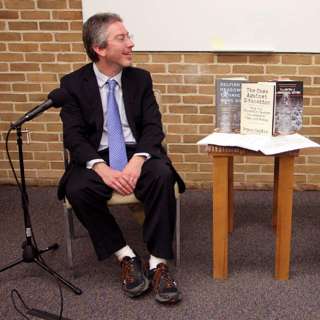
#32 - Bryan Caplan on whether his Case Against Education holds up, totalitarianism, & open borders

#32 - Bryan Caplan on whether his Case Against Education holds up, totalitarianism, & open borders

Bryan Caplan’s claim in *The Case Against Education* is striking: education doesn’t teach people much, we use little of what we learn, and college is mostly about trying to seem smarter than other peo...

22 Touko 20182h 25min
#31 - Allan Dafoe on defusing the political & economic risks posed by existing AI capabilities

#31 - Allan Dafoe on defusing the political & economic risks posed by existing AI capabilities

The debate around the impacts of artificial intelligence often centres on ‘superintelligence’ - a general intellect that is much smarter than the best humans, in practically every field. But according...

18 Touko 201848min
#30 - Eva Vivalt on how little social science findings generalize from one study to another

#30 - Eva Vivalt on how little social science findings generalize from one study to another

If we have a study on the impact of a social program in a particular place and time, how confident can we be that we’ll get a similar result if we study the same program again somewhere else? Dr Eva V...

15 Touko 20182h 1min
#29 - Anders Sandberg on 3 new resolutions for the Fermi paradox & how to colonise the universe

#29 - Anders Sandberg on 3 new resolutions for the Fermi paradox & how to colonise the universe

Part 2 out now: #33 - Dr Anders Sandberg on what if we ended ageing, solar flares & the annual risk of nuclear war The universe is so vast, yet we don’t see any alien civilizations. If they exist, whe...

8 Touko 20181h 21min

Suosittua kategoriassa Koulutus

rss-murhan-anatomia
voi-hyvin-meditaatiot-2
rss-narsisti
adhd-podi
psykopodiaa-podcast
rss-rahamania
rss-valo-minussa-2
rss-uskonto-on-tylsaa
rss-niinku-asia-on
mielipaivakirja
rss-vapaudu-voimaasi
rss-duodecim-lehti
rahapuhetta
ilona-rauhala
aamukahvilla
kesken
dear-ladies
rss-eron-alkemiaa
rss-arkea-ja-aurinkoa-podcast-espanjasta
rss-koira-haudattuna