Vijay Gokhale on China's India Policy and India-China Relations
Interpreting India15 Joulu 2022

Vijay Gokhale on China's India Policy and India-China Relations

2022 has been a year of geopolitical conflict and tensions. If we were expecting a quieter end to the year, then we were apparently mistaken. On December 9, Chinese and Indian troops had a face-off along the Line of Actual Control (LAC) in the Tawang sector of Arunachal Pradesh. While we don’t have many details yet, it appears that a few hundred soldiers were involved in a physical scuffle, and some thirty to forty, on both sides, sustained injuries. The Indian defence minister, Rajnath Singh, told the Parliament that the Chinese People’s Liberation Army troops had tried to transgress the LAC in this area and were prevented from doing so. Two days after this incident, the local commanders of the Indian Army and the People’s Liberation Army met to discuss the issue. Though it is unclear what, if anything, has been agreed upon to restore tranquility.

The relations between India and China have been in deep freeze since May 2020, when troops of the two sides had clashed along the LAC in Ladakh. Both sides have since enhanced their military deployment and upgraded their logistical infrastructure along the LAC. Arunachal Pradesh has several points where the two sides have different perceptions of where the LAC runs, and both sides patrol up to the line they claim. Apropos the recent standoff, the Indian Ministry of Defence has noted that this has been the case in the Tawang sector since 2006. How do we understand China’s posture and actions along the LAC in recent years? Is a purely bilateral framework adequate to grasp Beijing’s motivations, or are larger considerations at work? And, what are India’s options in dealing with Chinese activism along the LAC?

In an interesting coincidence, just as the news of the recent face-off hit the headlines a couple of days ago, Carnegie India published an important paper by Mr. Vijay Gokhale titled “A Historical Evolution of China’s India Policy: Lessons for India-China Relations”. While much has been written about India-China relations, most of it tends to be from the Indian perspective. We have few assessments of how Beijing has seen India and sought to deal with it. You can access Mr. Gokhale's excellent paper here, in which he traces and analyzes the arc of Chinese policy towards India from 1949 to the present day.

In this special episode of Interpreting India, Vijay Gokhale joins Srinath Raghavan to discuss Mr. Gokhale's paper and the increasingly fraught relationship between India and China, in light of the recent clash between Indian and Chinese troops along the Line of Actual Control in the Tawang sector of Arunachal Pradesh.

--

Episode Contributors

Vijay Gokhale is a nonresident senior fellow at Carnegie India. He retired from the Indian Foreign Service in January 2020 after a diplomatic career that spanned thirty-nine years. He has served as both the foreign secretary of India (from January 2018 to January 2020) and as India’s ambassador to China (from January 2016 to October 2017). He has worked extensively on matters relating to the Indo-Pacific region with a special emphasis on Chinese politics and diplomacy. Mr. Gokhale is the author of three books: Tiananmen Square: The Making of a Protest, The Long Game: How the Chinese Negotiate with India, and most recently After Tiananmen: The Rise of China.

Srinath Raghavan is a nonresident senior fellow at Carnegie India. He is also a professor of International Relations and History at Ashoka University. His primary research focus is on the contemporary and historical aspects of India’s foreign and security policies. He is the author of War and Peace in Modern India: A Strategic History of the Nehru Years (2010), and 1971: A Global History of the Creation of Bangladesh (2013), and co-authored Non-Alignment 2.0: A Foreign and Strategic Policy for India in the 21st Century (2013), India’s War: The Making of Modern South Asia, 1939 – 45 (2016), and, most recently, The Most Dangerous Place: A History of the United States in South Asia (2018).

--

🎙️ Check out our podcast, Interpreting India available now on YouTube, Spotify, and iTunes!

Home: https://interpreting-india.simplecast.com/

YouTube: https://www.youtube.com/playlist?list=PLeXQMWQXRkJXF71nDiX9LhlXiSkhR8JJT

Spotify: https://open.spotify.com/show/51yeOb8SimMIPe2KgIUQ8g

Apple Podcasts: https://podcasts.apple.com/in/podcast/interpreting-india/id1476357131

--

Carnegie India Socials:

Instagram: https://www.instagram.com/carnegieindia/ (@CarnegieIndia)

Twitter: https://twitter.com/CarnegieIndia

Website: https://carnegieindia.org

YouTube: https://www.youtube.com/c/CarnegieIndia/

Every two weeks, Interpreting India brings you diverse voices from India and around the world to explore the critical questions shaping the nation's future. We delve into how technology, the economy, and foreign policy intertwine to influence India's relationship with the global stage.

As a Carnegie India production, hosted by Carnegie scholars, Interpreting India, a Carnegie India production, provides insightful perspectives and cutting-edge by tackling the defining questions that chart India's course through the next decade.

Stay tuned for thought-provoking discussions, expert insights, and a deeper understanding of India's place in the world.

Don't forget to subscribe, share, and leave a review to join the conversation and be part of Interpreting India's journey.

Tämä jakso on lisätty Podme-palveluun avoimen RSS-syötteen kautta eikä se ole Podmen omaa tuotantoa. Siksi jakso saattaa sisältää mainontaa.

Jaksot(148)

AI Literacy and the Future of Work in India

AI Literacy and the Future of Work in India

Jaspreet's framing for the AI and work debate is worth staying with. He is not dismissive of disruption: he thinks AI will destroy certain jobs, create new ones, and the rupture will be real. But he p...

26 Touko 44min
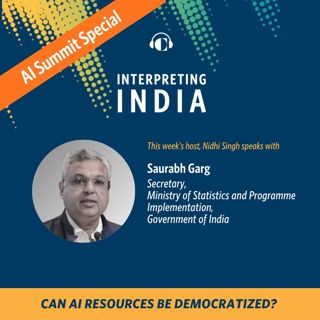
Can AI Resources Be Democratized? AI Summit Special

Can AI Resources Be Democratized? AI Summit Special

This episode is part of our special series on the India AI Impact Summit, examining the conversations, decisions, and debates that are shaping global AI governance. The working group was designed from...

15 Touko 28min

Space Security in the Age of AI

Space Security in the Age of AI

Almudena opens with a distinction that anchors the entire conversation: space security, unlike space safety, is about intentional harm. It concerns deliberate attempts to disrupt, deny, or destroy spa...

7 Touko 1h 7min

An African Perspective for Building AI for Global South | AI Summit Special

An African Perspective for Building AI for Global South | AI Summit Special

This episode is part of our special series on the India AI Impact Summit, examining the conversations, decisions, and debates that are shaping global AI governance. Raymond draws a distinction early i...

30 Huhti 48min

The India-EU Trade Deal: What It Delivers and What It Doesn't

The India-EU Trade Deal: What It Delivers and What It Doesn't

For most of the last decade, a trade deal between India and the EU seemed unlikely. The nudge came as the world changed around both. Nicolas points to three converging forces: the pressure of US tarif...

23 Huhti 51min

From Bletchley Park to Delhi and What Comes Next | AI Summit Special

From Bletchley Park to Delhi and What Comes Next | AI Summit Special

This episode is part of our special series on the India AI Impact Summit 2026, examining the conversations, perspectives, and debates that are shaping global AI discourse. Tino has been in the room a...

16 Huhti 54min

Data, AI, and the Laws Trying to Keep Up

Data, AI, and the Laws Trying to Keep Up

The conversation begins with a close look at India’s data protection regime, particularly the DPDP Act and its emphasis on consent. Nikhil challenges the perception that the law is overly consent-driv...

31 Maalis 42min

Inside the Iran Conflict: Power, Strategy, and India’s Balancing Act

Inside the Iran Conflict: Power, Strategy, and India’s Balancing Act

The conversation begins with a look at where the conflict stands today and how Iran has managed to absorb significant military pressure while still responding in a measured way. Dharmendra explains ho...

25 Maalis 1h 8min

Suosittua kategoriassa Politiikka ja uutiset

uutiscast
aikalisa
politiikan-puskaradio
ootsa-kuullut-tasta-2
rss-ootsa-kuullut-tasta
rss-podme-livebox
tervo-halme
otetaan-yhdet
rss-vaalirankkurit-podcast
et-sa-noin-voi-sanoo-esittaa
viisupodi
rss-asiastudio
rss-kaikki-uusiksi
rss-hyvaa-huomenta-bryssel
rss-girls-finish-f1rst
rss-ulkopoditiikkaa
linda-maria
the-ulkopolitist
rss-sinivalkoinen-islam
rss-pinnalla