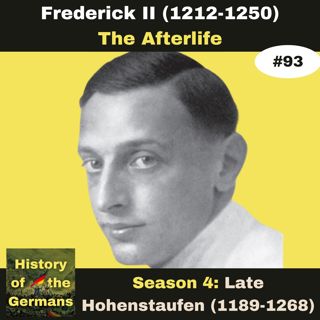
Ep. 93: Frederick II's Afterlife - from Fake Emperors to Ernst Kantorowics

Ep. 93: Frederick II's Afterlife - from Fake Emperors to Ernst Kantorowics

On July 7th, 1285, a sunny day in the city of Wetzlar, a day’s ride north of Frankfurt acrid smoke rises from a mighty pyre built up just outside its walls. The pyre was for an emperor, or at least a man who claimed to be the emperor Fredrick II. This man had shown up in the Rhineland, gathered followers, set up a court and sent letters to prince and cities across the realm. Envoys had come from Italy to find out whether the Stupor Mundi had indeed returned. King Rudolf of Habsburg had to turn up in person at the head of an army to sort things out. Just before the fires were lit the (fake) emperor called on to his followers to proceed to Frankfurt as planned where he would re-appear in three days’ time.

He did not reappear in Frankfurt but in Utrecht, where the imposter was hanged. The next sighting was in Lübeck in 1286, where he was killed again. In 1295 he was again captured and burned at the stake. The myth of the emperor who lives and does not live persisted over the centuries. Sometime in the 15th or 16the century the myth transfers from Frederick II to Barbarossa who now dwelt in the Khyffhaueser mountain waiting to be called.

Frederick II was relegated to a secondary role amongst the great medieval emperors until in 1927 a hitherto unknown writer, Ernst Kantorowics published his biography of Frederick II. This book became the most intensely discussed and most controversial biographies of a medieval ruler – full stop. Its view of the emperor was suffused with the right-wing ideology of the George Kreis. Hitler allegedly read it twice, it was on Goebbels’ bedside table, but at the same time Claus von Stauffenberg, the leader of the July plot to assassinate Hitler was a friend of Kantorowics and Admiral Canaris, another key conspirator asked for the book to read before his execution. Its Jewish author disliked the Nazis despite his extreme right-wing views. He fled Germany in 1938 and distanced himself from his most famous work. In the US he got caught in the nets of McCarthyism when he refused to swear an oath to fight communists. A rare case where the biographers biography is almost as fascinating as his subject, well worth exploring.

The music for the show is Flute Sonata in E-flat major, H.545 by Carl Phillip Emmanuel Bach (or some claim it as BWV 1031 Johann Sebastian Bach) performed and arranged by Michel Rondeau under Common Creative Licence 3.0.

As always:

Homepage with maps, photos, transcripts and blog: www.historyofthegermans.com

If you wish to support the show go to: Support • History of the Germans Podcast

For do it yourself merchandise go to: Merchandise • History of the Germans Podcast

Facebook: @HOTGPod

Threads: @history_of_the_germans_podcast

Bluesky: @hotgpod.bsky.social

Instagram: history_of_the_germans

Twitter: @germanshistory

To make it easier for you to share the podcast, I have created separate playlists for some of the seasons that are set up as individual podcasts. they have the exact same episodes as in the History of the Germans, but they may be a helpful device for those who want to concentrate on only one season.

So far I have:

The Ottonians

Salian Emperors and Investiture Controversy

Fredrick Barbarossa and Early Hohenstaufen

Frederick II Stupor Mundi

Saxony and Eastward Expansion

The Hanseatic League

The Teutonic Knights

The Holy Roman Empire 1250-1356

The Reformation before the Reformation

The Empire in the 15th century

The Fall and Rise of the Habsburgs

Jaksot(247)

Where To Go in Germany - Part 2

Where To Go in Germany - Part 2

One of the legacies of the Holy roman empire is that Germany does not have just one place where everything happens, where politicians, entrepreneurs, bankers, artists, and actors travel on the same un...

1 Tammi 37min
Where To Go in Germany - Part 1

Where To Go in Germany - Part 1

As you are still awaiting your presents, mine has already arrived, which is the chance to make this show. Despite all my occasional moaning and groaning about how much work it is, I have never enjoyed...

25 Joulu 202541min
Ep.219:  Maximilian I (1493-1519) – The Fall of Ghent

Ep.219: Maximilian I (1493-1519) – The Fall of Ghent

The words High and Late Middle Ages conjures up images of fog rising up over a field where knights in shining armor are trading blows with double handed swords, mighty bishops overseeing the construct...

18 Joulu 202539min
Ep. 218:  Maximilian I (1493-1519) – The Death of Mary of Burgundy

Ep. 218: Maximilian I (1493-1519) – The Death of Mary of Burgundy

By 1477 the rules of war that had been enshrined in the laws of chivalry are gone. The contest between the French and the Habsburgs over the inheritance of the Grand Dukes of the West gives us a foret...

11 Joulu 202540min
Ep. 217:  Maximilian I (1493-1519) – When Mary Met Maxi

Ep. 217: Maximilian I (1493-1519) – When Mary Met Maxi

How often have you heard this phrase “Let others wage war; you, happy Austria, marry". It goes back to a whole string of marriages, first Maximilian of Habsburg married the heiress of the duchy of Bur...

4 Joulu 202539min
Ep. 216:  Maximilian I (1493-1519) - The Youth of an Emperor

Ep. 216: Maximilian I (1493-1519) - The Youth of an Emperor

What is it like to grow up the son of the emperor? For most of the rulers of the Holy Roman Empire we have covered so far, no idea. There are scarce reports about the way the princes grew up, safe for...

27 Marras 202532min
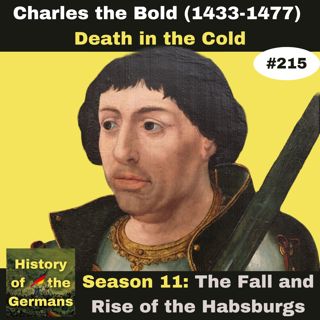
Ep. 215: Charles the Bold  (1433-1477) - Death in the Cold

Ep. 215: Charles the Bold (1433-1477) - Death in the Cold

The rise of the Habsburgs to world domination pivots on one crucial moment, the marriage of Maximilian of Habsburg to Mary of Burgundy, the daughter of Charles the Bold, last of the Grand Dukes of the...

20 Marras 202540min
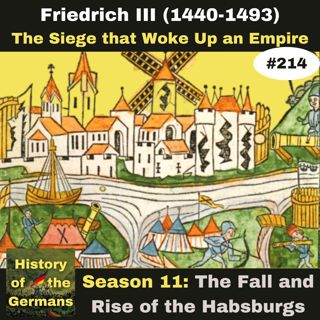
Ep. 214: Friedrich III (1440-1493) - The Siege that Woke up an Empire

Ep. 214: Friedrich III (1440-1493) - The Siege that Woke up an Empire

The venerable city of Neuss between Cologne and Düsseldorf was founded in 16 BC as a Roman army camp, making it one of the oldest in Germany. Its history is marked by the usual mix of feuds with its a...

13 Marras 202539min

Suosittua kategoriassa Koulutus

rss-murhan-anatomia
psykopodiaa-podcast
voi-hyvin-meditaatiot-2
psykologia
adhd-podi
rss-rahamania
rss-liian-kuuma-peruna
rss-valo-minussa-2
rss-tietoinen-yhteys-podcast-2
kesken
rss-arkea-ja-aurinkoa-podcast-espanjasta
rahapuhetta
rss-niinku-asia-on
rss-narsisti
dear-ladies
rss-duodecim-lehti
rss-eron-alkemiaa
rss-vapaudu-voimaasi
koodikahvit
leikitaanko-laakaria