Brain-Based Learning Author Eric Jensen on "Strategies for Reversing the Impact of Poverty and Stress on Student Learning"

Brain-Based Learning Author Eric Jensen on "Strategies for Reversing the Impact of Poverty and Stress on Student Learning"

Welcome back to the Neuroscience Meets Social and Emotional Learning podcast, episode #79 with Eric Jensen, a leading authority on the science and applications of brain research in education for more than 20 years. Watch the interview on YouTube here.

For those who are new here, my name is Andrea Samadi, I’m a former educator who created this podcast to bring the most current neuroscience and educational research, matched with social and emotional skills, with interviews from experts who have risen to the top of their field with specific strategies or ideas that you can implement immediately, to take your results to the next level.

Thank you so much Eric, for coming on this podcast today. Where have I reached you?

Just to give some background of Eric Jensen and his work:

Dr. Eric Jensen is a former teacher and Top 30 Global Guru. He co-founded an academic enrichment program, held in 16 countries with over 85,000 graduates. Jensen has authored over 30 books[i] including 3 bestsellers with his 2 most recent being Brain-Based Learning (in its 3rd edition)[ii] and Poor Students Rich Teaching[iii]. He is also member of the invitation-only Society for Neuroscience.[iv]

Eric, I know that your background has been focused around students and poverty, and how poverty impacts the brain and learning, specifically as it relates to trauma and stress. While our stress levels seem to keep jumping up to new levels each month as new stressors arise, we’ve got it handled here, as we have both parents working together with our children. I can’t help but think of those families who don’t have the resources or support that they need and would like to hear your thoughts of solutions that teachers and families could be looking at to better support students at this critical time in our world.

Q1: Can we start off with a brief overview of what stress does to the brain, specifically when we are trying to learn (if we are a student) or complete our work (if we are in the corporate space) as well as to think about the dangers of emotion contagion. What can we do these days to prevent stress from wreaking havoc on our lives, and improve our resiliency with a mind/body integration?

Q2: Right now, it’s such an odd time in the world with this global pandemic, but this podcast audience reaches into over 110 countries, and I know that the tips you have for us in the US, will be relevant to those around the world. Can we talk about the topic that I know you focused on with your doctoral dissertation, the fact that 1/5 children grow up in poverty? How does poverty impact a child’s brain?

Q3: I mentioned in the beginning, that many children are preparing to go back to school (at least virtually in my State) this week, and I did just interview authors Doug Fisher and Nancy Frey on their book about Distance Learning which provided some great suggestions for transitioning to 100% online learning. I still can’t help thinking of low-income families, and how they are coping. Our stress levels are high here as we are adapting to our new schedules, creating new workspaces, (suddenly we realized I need to buy 2 new desks with chairs) new routines, and expectations. What support or words of encouragement would you have for teachers serving low income students who might not have everything they need and their parents as we transition back to school virtually?

Q4: How does exposure to stressors in the home (that we’ve heard of from children with ACES—Adverse Childhood Experiences) influence a child’s working memory? What strategies do you have to teach students with poverty in mind to help students with impulse regulation, visual/spatial skills, language skills, cognitive skills, social and emotional skills and conflict resolution?

Q5: I heard you say that “our DNA is not our destiny” and I just loved hearing this because we don’t choose our parents. Next week I’m speaking with the Founder of the 16 Strong Project, created out of Harvard’s Grad School of Education to show other young people that ACES can be mitigated. In your 20 years of working with schools, and students, with a focus on low income students, what success stories have you seen where students were able to change their brains for the better? How do you think they did this?

Q6: What are your final thoughts, or advice to teachers who are looking for new strategies to engage students in effective teaching this fall and upcoming year?

Thank you so much Eric, for taking the time to speak with me. If anyone wants to learn more about your books, and programs/workshops for schools, they can go to https://www.jensenlearning.com/ or find you @EricJensenBrain on Twitter. Thanks so much.

RESOURCES:

Eric’s Books

His books include, Teaching with Poverty in Mind[v], Tools for Engagement,[vi] Engaging Students with Poverty in Mind[vii], Turnaround Tools for the Teenage Brain[viii], Poor Students, Rich Teaching[ix] and Different Brains, Different Learners.[x]

REFERENCES:

Kaiser Permanente ACE Study https://www.cdc.gov/violenceprevention/acestudy/about.html

Dr. Lionel Allen, Urban Prep Academy in Chicago, IL https://www.sesp.northwestern.edu/news-center/inquiry/2011-fall/where-are-they-now.html

Dr. Terrence Sejnowski https://www.salk.edu/scientist/terrence-sejnowski/

Learning How to Learn by Barbara Oakley, Terrence Sejnowski and Alistair McConville (August 2018) https://www.amazon.com/dp/B077CRLW9Q/ref=dp-kindle-redirect?_encoding=UTF8&btkr=1

[i] https://www.jensenlearning.com/about-eric-jensen/

[ii] Brain-Based Learning by Eric Jensen https://www.jensenlearning.com/what-is-brain-based-research/

[iii] Poor Students, Rich Teaching by Eric Jensen https://www.amazon.com/Poor-Students-Rich-Teaching-Mindsets-ebook/dp/B01BGAK7ZK

[iv] Society for Neuroscience https://www.sfn.org/

[v] Teaching with Poverty in Mind by Eric Jensen http://www.ascd.org/publications/books/109074.aspx

[vi] Tools for Engagement by Eric Jensen http://www.toolsforengagement.com/

[vii] Engaging Students with Poverty in Mind http://www.ascd.org/Publications/Books/Overview/Engaging-Students-with-Poverty-in-Mind.aspx

[viii] Turnaround Tools for the Teenage Brain by Eric Jensen https://www.jensenlearning.com/turnaround-tools-for-the-teenage-brain/

[ix] Poor Students, Rich Teaching by Eric Jensen https://www.amazon.com/Poor-Students-Rich-Teaching-Mindsets-ebook/dp/B01BGAK7ZK

[x] Different Brains, Different Learners by Eric Jensen https://us.corwin.com/en-us/nam/different-brains-different-learners/book232340

Tämä jakso on lisätty Podme-palveluun avoimen RSS-syötteen kautta eikä se ole Podmen omaa tuotantoa. Siksi jakso saattaa sisältää mainontaa.

Jaksot(406)

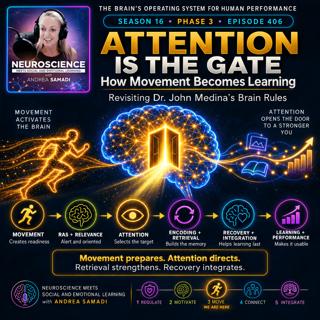
How Movement Builds the Brain, the Body & Human Performance (Phase 3 Introduction)

How Movement Builds the Brain, the Body & Human Performance (Phase 3 Introduction)

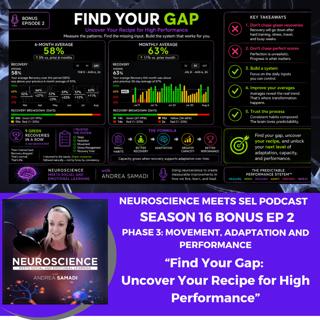
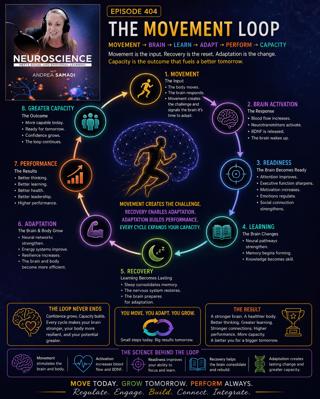
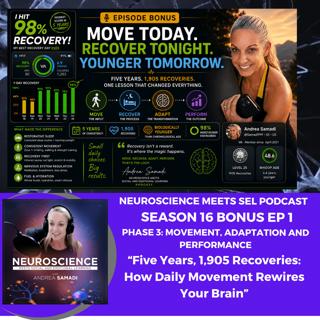
Season 16, Episode 402 explores the Brain's Operating System for Human Performance, focusing on Phase 3: movement, adaptation, and performance. Andrea Samadi explains how movement triggers neurochemic...

12 Heinä 25min

Trust as the Foundation with Greg Hill: How Great Leaders Create the Conditions for Learning, Growth and Performance

Trust as the Foundation with Greg Hill: How Great Leaders Create the Conditions for Learning, Growth and Performance

In episode 401 Andrea Samadi welcomes Greg Hill to explore why trust is the essential foundation for learning, growth, and high performance. They discuss how trust creates psychological safety, encour...

27 Kesä 37min

Episode 400: Sales Leadership Under Pressure with Majid Samadi: 7 Lessons Learned from 7 Years of Neuroscience

Episode 400: Sales Leadership Under Pressure with Majid Samadi: 7 Lessons Learned from 7 Years of Neuroscience

In this milestone episode (400), Andrea Samadi celebrates seven years of the Neuroscience Meets SEL Podcast with her husband Majid Samadi. They reflect on the journey of translating neuroscience into ...

20 Kesä 47min

Phase 2 Review: The Motivation Loop: How to Keep Effort Worthwhile

Phase 2 Review: The Motivation Loop: How to Keep Effort Worthwhile

Episode 399 reviews Phase 2 of Season 15 and introduces the Motivation Loop — the sequence of meaning, belief, attention, action, reward, and recovery that drives sustained effort. The episode explain...

14 Kesä 28min

Fun, Fear, Focus: Closing the Motivation Loop with Friederike Fabritius

Fun, Fear, Focus: Closing the Motivation Loop with Friederike Fabritius

Episode 398 revisits neuroscientist Friederike Fabritius (from November 2022) to explain how three ingredients — fun (dopamine), fear (productive challenge), and focus — create the neurochemical condi...

9 Kesä 23min

Move to Learn: How Movement Activates the Brain and Fuels Motivation (with Dr. Chuck Hillman and Paul Zientarski)

Move to Learn: How Movement Activates the Brain and Fuels Motivation (with Dr. Chuck Hillman and Paul Zientarski)

Season 15, Episode 397 revisits research and real-world practice showing movement is more than fitness: it activates the brain, boosts attention, enhances learning, and sustains motivation. Dr. Chuck ...

31 Touko 35min

Dopamine, Motivation and Why the Brain Repeats Behavior with Dr. Anna Lembke

Dopamine, Motivation and Why the Brain Repeats Behavior with Dr. Anna Lembke

Host Andrea Samadi welcomes Dr. Anna Lembke to explain how pleasure and pain share the same neural circuitry and how dopamine governs motivation. The episode explores why overconsumption of easy rewar...

24 Touko 23min

Theory of Mind: The Missing Link Between Attention, Reward, and Motivation with John Medina

Theory of Mind: The Missing Link Between Attention, Reward, and Motivation with John Medina

Episode 395 explores how theory of mind — our ability to understand others' intentions — drives attention, emotional relevance, and reward, shaping motivation and behavior. Dr. John Medina explains wh...

17 Touko 37min

Suosittua kategoriassa Koulutus

rss-murhan-anatomia
psykopodiaa-podcast
voi-hyvin-meditaatiot-2
adhd-podi
rss-arkea-ja-aurinkoa-podcast-espanjasta
kesken
rss-liian-kuuma-peruna
rss-niinku-asia-on
rss-tietoinen-yhteys-podcast-2
rss-koira-haudattuna
rss-narsisti
rss-rahamania
ihminen-tavattavissa-tommy-hellsten-instituutti
rss-perho-rajoilla
rss-luonnollinen-synnytys-podcast
aloita-meditaatio
rss-keskeneraiset-aidit
rss-psykalab
rss-rahataito-podcast
rss-suomen-aa-podcast