Brain Fact Friday on "Transforming the Mind Using Athletics and Neuroscience"

Brain Fact Friday on "Transforming the Mind Using Athletics and Neuroscience"

Welcome back to the Neuroscience Meets Social and Emotional Learning Podcast, for Brain Fact Friday and episode #122.

This week we interviewed Paul Zientarski,[i] the former PE teacher from Naperville Central High School, who reinvented physical education using the understanding of simple neuroscience. Then last week’s interview with Dr. John Ratey,[ii] and his book Spark, cemented the idea of the profound impact that exercise has on our cognitive abilities and mental health.

Paul Zientarski said many things that caught my attention in the interview and took me by surprise especially with the whole idea of their Zero Hour PE creating such noticeable results with students in the classroom, and even going on to inspire some student to become PE teachers in the future. I thought what their research uncovered at Naperville was important enough to reinforce and take a closer look at why those students at Naperville scored so high on their tests after they took this NEW Physical Education class that blended aerobic activity with an understanding of neuroscience. If you haven’t listened to Dr. Ratey’s episode #116, or Paul Zientarski on #121, be sure to go back and listen after this brain fact.

BRAIN FACT: Aerobic activity can transform not only the body, but also the mind.

Dr. Ratey said it clearly in his book Spark when he said that “aerobic activity has a dramatic effect on adaptation, regulating systems that might be out of balance and optimizing those that are not—it’s an indispensable tool for anyone who wants to reach his or her full potential.” (Spark, Page 10).

By now we all know that exercise increases brain activity, and that the benefits of exercise “come directly from its ability to reduce insulin resistance, reduce inflammation, and stimulate the release of growth factors—chemicals in the brain that affect the health of brain cells, the growth of new blood vessels in the brain, and even the abundance and survival of new brain cells.”[iii]

Dr. Chuck Hillman[iv], from the University of IL (now at Northeastern University) conducted a series of brain scans on students and showed what their brain activity looked like after sitting quietly (not much color if you look at the images in the show notes) vs how vibrant the brain looks after even a 20-minute walk.

Without knowing anything about fMRI scans, one look at how the brain lights up after exercise, and we all can come to the same conclusion. “Exercise primes the brain, putting it in the right environment for learning.”

Hillman took his research a bit further, and divided students (aged 9/10) into 2 groups. Higher fit (if they could run 0.25 miles without stopping) and lower fit if they had to stop in this 0.25 mile run.

The students were asked to take a test similar to what you would find on Lumosity.com and the brains of the higher fit students lit up during the easy test, showing more red color (more brain activity) than the lower fit students. The most noticeable difference was during the difficult test, the brains of the higher fit students lit up bright red, showing the increase of brain activity they had access to, and the lower fit students just didn’t have enough brain power during the difficult test.

This study clearly shows how the power of exercise and being physically impacts our brain and cognition.

Hillman went another step further with his research and created a 9-month intervention PE program, taught by future PE teachers.

Half of the students had an hour of PE prior to their school day, and half didn’t attend the PE program. They went straight to school (they called them the wait list group).

The brain scans of the one-hour PE group showed a significant increase of brain activity compared to the students who did not take this extra hour of PE each day.

If you are listening to this podcast, I am sure that this will get you as excited as Paul Zientarski was when he first saw these results, and what made Dr. John Ratey jump on an airplane when Naperville scored so high on those tests, using this strategy.

“Many studies have suggested that the parts of the brain that control thinking and memory (the prefrontal cortex and medial temporal cortex) have greater volume in people who exercise versus people who don’t.”[v]

How Can You Implement This Brain Fact in Your Life?

Whether you are an educator working in the classroom, or an employee working in the corporate world, this concept can be easily implemented to get you into a state of heightened awareness before learning, or before you need to sit and work for long periods of time at your desk.

    START WITH WALKING: If you have something important you need to work on, go for a walk ahead of time, to activate and prime your brain for the focused attention it will need. Hillman’s study showed it only took 20 minutes of walking to light up the brain. How much physical activity would you need to do to impact your memory? Standard recommendations advise “half an hour of moderate physical activity most days of the week, or at least 150 minutes a week.”[vi] START YOUR OWN MOVEMENT: If you want to take advantage of this concept and work in a school, share Paul Zeintarski’s[vii] podcast with your site administrator, and see how you can spearhead a movement of neuroscience in your school. Watch episode #3 with Ron Hall, from Valley Day School on “Launching a Neuroeducational Program in Your School.”[viii] LEARN FROM OTHERS WHO HAVE PAVED THE WAY: If starting an exercise program seems too much, start doing some research to see how other people began theirs. I loved seeing the story of the Dallas Stars Executive, Tom Holy, who lost almost 100 pounds from starting a walking routine every night.[ix] What started for Holy with just 3 mile walks a day, at the beginning of COVID turned into walking 26.2 miles in a day, and over 100 miles in a week. He began inspiring his neighbors to do the same, and health really is infectious. Everyone wants to help or motivate each other. MEASURE YOUR HEART RATE: It was adding the heart rate monitors into the game that really made the difference for Naperville students. To experience the best results with their Zero Hour PE, Paul Zientarsky explained that they had to measure the student’s heart rates during exercise and they needed to get their heart rate into the Peak Heart Zone Range of over 150 beats per minute, for at least 20 minutes. Of course, after I heard this, I looked at my workouts the past few months and noticed that although I exercise a lot, I’m very rarely in that Peak Heart Zone Range, unless I’m running. If we want to experience the benefits to our brain, we must put in the effort for this to occur.

I hope you have enjoyed diving a bit deeper into what exactly exercise does to the brain. As brain scan technology improves and advances, I know we will have more questions answered, and more strategies to implement for our brain health and well-being. Until then, I hope you have found something that lights a “Spark” for you to take some new action towards exercise, to improve your brain health.

See you next week.

RESOURCES:

Exercise Appears to Improve Brain Function Among Younger People Dec. 18, 2006 by Melissa Mitchell https://news.illinois.edu/view/6367/206773

REFERENCES:

[i] Neuroscience Meets Social and Emotional Learning Podcast EPISODE #121 with Paul Zientarski on “Transforming Students Using Physical Education and Neuroscience” https://andreasamadi.podbean.com/e/naperville-central-high-schools-paul-zeintarski-on-transforming-students-using-physical-education-and-neuroscience/

[ii] Neuroscience Meets Social and Emotional Learning Podcast EPISODE #116 with John J. Ratey, MD on “The Revolutionary New Science of Exercise and the Brain” https://andreasamadi.podbean.com/e/best-selling-author-john-j-ratey-md-on-the-revolutionary-new-science-of-exercise-and-the-brain/

[iii] Regular Exercise Changes the Brain to Improve Memory and Thinking Skills April 9, 2014 by April Godman https://www.health.harvard.edu/blog/regular-exercise-changes-brain-improve-memory-thinking-skills-201404097110

[iv] Dr. Chuck Hillman https://cos.northeastern.edu/people/charles-hillman/

[v] Regular Exercise Changes the Brain to Improve Memory and Thinking Skills April 9, 2014 by April Godman https://www.health.harvard.edu/blog/regular-exercise-changes-brain-improve-memory-thinking-skills-201404097110

[vi] IBID

[vii] Neuroscience Meets Social and Emotional Learning Podcast EPISODE #121 with Paul Zientarski on “Transforming Students Using Physical Education and Neuroscience” https://andreasamadi.podbean.com/e/naperville-central-high-schools-paul-zeintarski-on-transforming-students-using-physical-education-and-neuroscience/

[viii] Neuroscience Meets Social and Emotional Learning Podcast EPISODE #3 https://andreasamadi.podbean.com/e/interview-with-ron-hall-valley-day-school-on-launching-your-neuroeducational-program/

[ix] How Dallas Stars Executive. Tom Holy, used COVID-19 to Lose 100 pounds.https://www.star-telegram.com/sports/spt-columns-blogs/mac-engel/article245434890.html

Tämä jakso on lisätty Podme-palveluun avoimen RSS-syötteen kautta eikä se ole Podmen omaa tuotantoa. Siksi jakso saattaa sisältää mainontaa.

Jaksot(407)

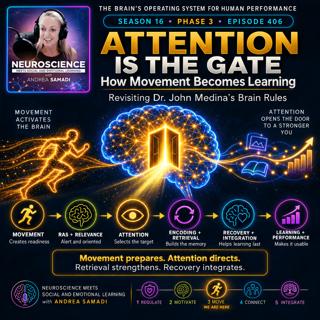
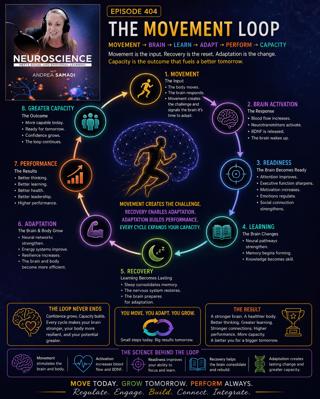
The Movement Loop: How Movement Activates the Brain for Learning, Adaptation & Performance

The Movement Loop: How Movement Activates the Brain for Learning, Adaptation & Performance

Welcome back to Season 16 of the Neuroscience Meets Social and Emotional Learning Podcast. I'm Andrea Samadi, and this is where we bridge neuroscience, social and emotional learning, and human perform...

19 Heinä 34min

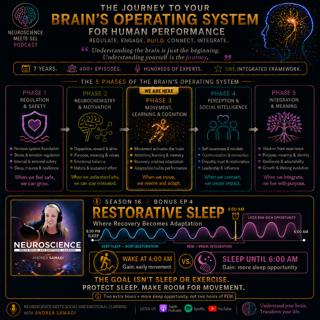
How Movement Builds the Brain, the Body & Human Performance (Phase 3 Introduction)

How Movement Builds the Brain, the Body & Human Performance (Phase 3 Introduction)

Season 16, Episode 402 explores the Brain's Operating System for Human Performance, focusing on Phase 3: movement, adaptation, and performance. Andrea Samadi explains how movement triggers neurochemic...

12 Heinä 25min

Trust as the Foundation with Greg Hill: How Great Leaders Create the Conditions for Learning, Growth and Performance

Trust as the Foundation with Greg Hill: How Great Leaders Create the Conditions for Learning, Growth and Performance

In episode 401 Andrea Samadi welcomes Greg Hill to explore why trust is the essential foundation for learning, growth, and high performance. They discuss how trust creates psychological safety, encour...

27 Kesä 37min

Episode 400: Sales Leadership Under Pressure with Majid Samadi: 7 Lessons Learned from 7 Years of Neuroscience

Episode 400: Sales Leadership Under Pressure with Majid Samadi: 7 Lessons Learned from 7 Years of Neuroscience

In this milestone episode (400), Andrea Samadi celebrates seven years of the Neuroscience Meets SEL Podcast with her husband Majid Samadi. They reflect on the journey of translating neuroscience into ...

20 Kesä 47min

Phase 2 Review: The Motivation Loop: How to Keep Effort Worthwhile

Phase 2 Review: The Motivation Loop: How to Keep Effort Worthwhile

Episode 399 reviews Phase 2 of Season 15 and introduces the Motivation Loop — the sequence of meaning, belief, attention, action, reward, and recovery that drives sustained effort. The episode explain...

14 Kesä 28min

Fun, Fear, Focus: Closing the Motivation Loop with Friederike Fabritius

Fun, Fear, Focus: Closing the Motivation Loop with Friederike Fabritius

Episode 398 revisits neuroscientist Friederike Fabritius (from November 2022) to explain how three ingredients — fun (dopamine), fear (productive challenge), and focus — create the neurochemical condi...

9 Kesä 23min

Move to Learn: How Movement Activates the Brain and Fuels Motivation (with Dr. Chuck Hillman and Paul Zientarski)

Move to Learn: How Movement Activates the Brain and Fuels Motivation (with Dr. Chuck Hillman and Paul Zientarski)

Season 15, Episode 397 revisits research and real-world practice showing movement is more than fitness: it activates the brain, boosts attention, enhances learning, and sustains motivation. Dr. Chuck ...

31 Touko 35min

Dopamine, Motivation and Why the Brain Repeats Behavior with Dr. Anna Lembke

Dopamine, Motivation and Why the Brain Repeats Behavior with Dr. Anna Lembke

Host Andrea Samadi welcomes Dr. Anna Lembke to explain how pleasure and pain share the same neural circuitry and how dopamine governs motivation. The episode explores why overconsumption of easy rewar...

24 Touko 23min

Suosittua kategoriassa Koulutus

rss-murhan-anatomia
psykopodiaa-podcast
voi-hyvin-meditaatiot-2
rss-niinku-asia-on
adhd-podi
kesken
ihminen-tavattavissa-tommy-hellsten-instituutti
rss-liian-kuuma-peruna
rss-arkea-ja-aurinkoa-podcast-espanjasta
rahapuhetta
rss-perho-rajoilla
rss-koira-haudattuna
rss-narsisti
rss-rahataito-podcast
rss-ai-mita-siskopodcast
rss-tietoinen-yhteys-podcast-2
rss-hereilla
salainen-paivakirja
rss-valo-minussa-2
rss-ihana-elamani