Jeff Kleck on ”Using Neuroscience to Inspire Thinkers: In Schools, Sport and the Workplace”

Jeff Kleck on ”Using Neuroscience to Inspire Thinkers: In Schools, Sport and the Workplace”

“Like Martin Luther King, I have a dream. I dream that someday all teachers will teach students how to think rather than make them think. I dream that all students will understand how their brains work and use the knowledge to be successful and excel in whatever endeavor they choose.” Arizona School Administrator, Jeff Kleck

Watch this interview on YouTube here https://youtu.be/2pDRrOOcX5s

On this episode we will learn:

✔ About the educator who inspired Andrea to move in the direction of neuroscience in 2014.

✔ How he became interested in neuroscience, introducing Andrea to Carol Dweck and David A. Sousa.

✔ The moment of truth when Jeff met Andrea and gave her feedback that changed the direction of her work.

✔ How to handle criticism, and move forward even when it's difficult to hear.

✔ After 40 years in education, Jeff Kleck shares brain-based strategies he's used with students, athletes and his own children.

Welcome back to The Neuroscience Meets Social and Emotional Learning Podcast, where we cover the science-based evidence behind social and emotional learning (for schools) and emotional intelligence training (in the workplace) with tools, ideas and strategies that we can all use for immediate results, with our brain in mind.

I’m Andrea Samadi, an author, and educator with a passion for learning specifically on the topics of health, wellbeing and productivity, and launched this podcast to share how important an understanding of our brain is for our everyday life and results using the most current brain research to inform our decisions.

Our guest today is someone I’ve mentioned often on this podcast, but one day, I realized that I know very little about the person who encouraged me to pivot in the direction of neuroscience, back in 2014. Every interview I’ve ever done, someone always asks me “How did you end up doing a podcast on the topic of neuroscience?” and I tell the same story about how an educator urged me to go in this direction many years ago. I’m very intentional about the people I ask to come on the podcast. They are usually someone who is making an impact in the field of health, wellness, and education in some way, or has had an impact on my direction, and the work I’ve been doing over the years and while creating the questions for Dr. Ginger Campbell, who’s well known for her podcast Brain Science[i], I stopped to think for a moment about how on the earth I ended up where I am today and I thought about our next guest. I never ignore those flashes of insight that interrupt me while working, as the connections I’ve made over the years are the only reason I am here today, working in this field of educational neuroscience, and so very passionate about it, with the incredible opportunity to think, learn and create every day.

And I wouldn’t have had the courage to move in the direction of Neuroscience, without the guidance of our next guest, Jeff Kleck,[ii] who is now the principal at Valley Christian School in Phoenix. I look forward to talking neuroscience with Jeff, someone I’ve not seen since he helped me to create my second book, Level Up: A Brain-Based Strategy.

On today’s episode #246, we’ll be speaking with Jeff Kleck, and see if I can fill in the blanks of where his passion for neuroscience began, what he’s doing now to help educators understand how their brain impacts learning, and what he thinks of the future of educational neuroscience in our schools, sports and workplace environments. Let’s welcome my mentor to this field of educational neuroscience, Jeff Kleck.

Intro: Welcome Jeff! It’s incredible to see you again. Was it 2014 when we met last? Maybe 2015? Somewhere back then…

Jeff, I reached out to you, as I mention in the back story that I never ignore those flashes of insight that come while working, and I was writing Dr. Ginger Campbell’s interview questions, and for a moment, I was stumped. How on the earth did I get here, asking the host of the top neuroscience podcast questions for an upcoming interview. For a minute, I was just blown away, because you’ll remember that day we met in your office, and you were handing me all these books off your bookshelf for me to read, I knew absolutely nothing about this topic. First off, I want to let you know how grateful I am that you presented me with this opportunity to learn more about the brain.

Q1: Can we begin with where YOUR interest in neuroscience began?

Why did you have all those books on your book shelf, and I know you gave me a ton of your hand-written notes and research to get started. Where did this interest begin for you?

Q1B: I’ll never forget you telling me to research Carol Dweck[iii]. I wrote her name on the back on a piece of paper, and her Mindset book took off in our schools after you had mentioned her work. I’m curious, who you are you studying now?

Q2: If you think back to that day where we met in your office, and you gave me all of those books (I still have them all, one set is behind me) I know that you were really trying to help me, or I know you wouldn’t have given me so much content to give me a running start. What do you remember about having to provide feedback about the direction I was going, that no one wants to say, but your feedback ended up being a huge turning point for me?

Q3: One of the books you gave me was David A. Sousa’s How the Brain Learns Series by Corwin Press. I can’t even tell you how much this series impacted the work I’ve been doing since we met. I’ve interviewed Dr. Sousa (twice), have met many other Corwin Press authors, worked on projects with other companies with these authors and have used what I learned from Dr. Sousa to help my youngest daughter who needed new strategies to help her with reading comprehension. A huge thank you for that but I remember opening that book, and seeing all these charts about the brain, and memory, I almost thought that learning neuroscience was going to be too difficult for me. How are you approaching this topic with your teachers now, and do you receive any pushback on the topic at all? (does anyone talk about the reading wars—science vs whole language point of view)?

Q4: I know you’ve been wearing the hat of an educator for most of your years (working in the admin side) but I wonder, when you took off this hat, and switch to being a student, what is something that you have learned over the years about the brain that has helped you?

4B: Did you use what you know about the brain with your children when you were raising them?

4C: What strategies did you use for athletes as a football coach?

Q5: What’s your vision for educational neuroscience in the future? What do you think will help our students in the classroom, athletics and even when they move into College and their future careers?

Q6: Is there anything important that I have missed?

Jeff, I want to thank from the bottom of my heart for coming on this podcast today to share your passion and vision for neuroscience in our classrooms of the future. I know I would not be doing what I’m doing today without your influence, and I’ll be forever grateful for that.

I do hope that you publish something someday to document everything you’ve learned on this topic over the years and if you do, please do come back on the podcast to share it.

FOLLOW ANDREA SAMADI:

YouTube Channel: https://www.youtube.com/c/AndreaSamadi

Website https://www.achieveit360.com/

LinkedIn: https://www.linkedin.com/in/samadi/

Facebook: https://www.facebook.com/Achieveit360com

Neuroscience Meets SEL Facebook Group https://www.facebook.com/groups/2975814899101697

Twitter: https://twitter.com/andreasamadi

Instagram: https://www.instagram.com/andreasamadi/

RESOURCES:

How the Brain Influences Behavior by David A. Sousa https://us.corwin.com/sites/default/files/upm-assets/26266_book_item_26266.pdf

REFERENCES:

[i] https://brainsciencepodcast.com/

[ii] https://valleychristianaz.org/team/jeff-kleck/

[iii] Mindset: The New Psychology of Success by Carol Dweck Published Feb. 28, 2006 https://www.amazon.com/Mindset-Psychology-Carol-S-Dweck-ebook/dp/B000FCKPHG/ref=tmm_kin_swatch_0?_encoding=UTF8&qid=1662756061&sr=8-1

Tämä jakso on lisätty Podme-palveluun avoimen RSS-syötteen kautta eikä se ole Podmen omaa tuotantoa. Siksi jakso saattaa sisältää mainontaa.

Jaksot(407)

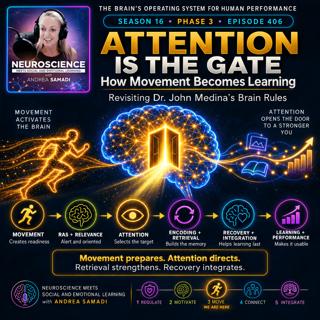
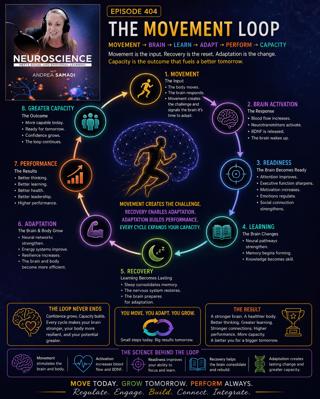
The Movement Loop: How Movement Activates the Brain for Learning, Adaptation & Performance

The Movement Loop: How Movement Activates the Brain for Learning, Adaptation & Performance

Welcome back to Season 16 of the Neuroscience Meets Social and Emotional Learning Podcast. I'm Andrea Samadi, and this is where we bridge neuroscience, social and emotional learning, and human perform...

19 Heinä 34min

How Movement Builds the Brain, the Body & Human Performance (Phase 3 Introduction)

How Movement Builds the Brain, the Body & Human Performance (Phase 3 Introduction)

Season 16, Episode 402 explores the Brain's Operating System for Human Performance, focusing on Phase 3: movement, adaptation, and performance. Andrea Samadi explains how movement triggers neurochemic...

12 Heinä 25min

Trust as the Foundation with Greg Hill: How Great Leaders Create the Conditions for Learning, Growth and Performance

Trust as the Foundation with Greg Hill: How Great Leaders Create the Conditions for Learning, Growth and Performance

In episode 401 Andrea Samadi welcomes Greg Hill to explore why trust is the essential foundation for learning, growth, and high performance. They discuss how trust creates psychological safety, encour...

27 Kesä 37min

Episode 400: Sales Leadership Under Pressure with Majid Samadi: 7 Lessons Learned from 7 Years of Neuroscience

Episode 400: Sales Leadership Under Pressure with Majid Samadi: 7 Lessons Learned from 7 Years of Neuroscience

In this milestone episode (400), Andrea Samadi celebrates seven years of the Neuroscience Meets SEL Podcast with her husband Majid Samadi. They reflect on the journey of translating neuroscience into ...

20 Kesä 47min

Phase 2 Review: The Motivation Loop: How to Keep Effort Worthwhile

Phase 2 Review: The Motivation Loop: How to Keep Effort Worthwhile

Episode 399 reviews Phase 2 of Season 15 and introduces the Motivation Loop — the sequence of meaning, belief, attention, action, reward, and recovery that drives sustained effort. The episode explain...

14 Kesä 28min

Fun, Fear, Focus: Closing the Motivation Loop with Friederike Fabritius

Fun, Fear, Focus: Closing the Motivation Loop with Friederike Fabritius

Episode 398 revisits neuroscientist Friederike Fabritius (from November 2022) to explain how three ingredients — fun (dopamine), fear (productive challenge), and focus — create the neurochemical condi...

9 Kesä 23min

Move to Learn: How Movement Activates the Brain and Fuels Motivation (with Dr. Chuck Hillman and Paul Zientarski)

Move to Learn: How Movement Activates the Brain and Fuels Motivation (with Dr. Chuck Hillman and Paul Zientarski)

Season 15, Episode 397 revisits research and real-world practice showing movement is more than fitness: it activates the brain, boosts attention, enhances learning, and sustains motivation. Dr. Chuck ...

31 Touko 35min

Dopamine, Motivation and Why the Brain Repeats Behavior with Dr. Anna Lembke

Dopamine, Motivation and Why the Brain Repeats Behavior with Dr. Anna Lembke

Host Andrea Samadi welcomes Dr. Anna Lembke to explain how pleasure and pain share the same neural circuitry and how dopamine governs motivation. The episode explores why overconsumption of easy rewar...

24 Touko 23min

Suosittua kategoriassa Koulutus

rss-murhan-anatomia
psykopodiaa-podcast
voi-hyvin-meditaatiot-2
rss-arkea-ja-aurinkoa-podcast-espanjasta
aamukahvilla
kesken
rss-luonnollinen-synnytys-podcast
rss-koira-haudattuna
rss-narsisti
rss-rahataito-podcast
ihminen-tavattavissa-tommy-hellsten-instituutti
rss-hereilla
rahapuhetta
solu-ja-molekyylibiologian-perusteet
mielipaivakirja
rss-liian-kuuma-peruna
rss-perho-rajoilla
ilona-rauhala
rss-niinku-asia-on
rss-suomen-aa-podcast