Reflecting on 2022: Learning from Success and Challenges

Reflecting on 2022: Learning from Success and Challenges

This week on the podcast, I'm reflecting on 2022 using a framework that I hope you will replicate.

Review your goals from tactical/physical practices and from how you managed your mindset.

The key is to be transparent with yourself, be willing to look at the whole story. If you look for successes, you can find them. The lessons are there too, and with both I just want you to observe them.

With regards to the tactical/physical practices:

Ask yourself:

  1. Are you consistently making doable plans?
  2. Are you tracking your drinks? Do you measure your pours and account for ABV?
  3. Are you reflecting and recovering when you have off-plan drinking?
  4. Are you staying hydrated? Are you drinking enough water (or water-based drinks like tea or coffee) each day?
  5. Are you committed to good sleep hygiene and prioritize it in your daily life?

For each of those questions, identify a success that you experienced for each of those tactics. If you’re not always making plans, do you make plans half of the time? Did you make a plan for a specific event when you were concerned about the possibility of overdrinking? Have you planned in alcohol-free days when you used to have none?

With the successful experience identified, ask yourself…what did you like about that decision? What did you have to think in order to make that decision? Why are you grateful for making that decision?

On the flip side, there are lessons to be learned too. Again, this isn’t an opportunity to beat yourself down. The fact that you are here, listening to this podcast and committing to a reflection exercise, means that you are ready to find the lesson and use it moving forward.

What lessons did you learn when it comes to the tactical practices of creating a peaceful relationship with alcohol?

The second part of this reflection will be for you to look at your growth in using the Behavior Map-Results Cycle. If your year is anything like mine, it was a combination of highs and lows. There were disruptive life events and hopefully some great moments too. There were small wins and possibly big losses… and in each of them there was a whole story, a narrative available to you that can help you feel better. I want you to get neutral with the circumstance, write it down without any subjective thinking. Just the facts…then choose any thought you can find about that event. Write it down. When you think that thought, what feeling does it create for you? Write it down. Now…find a different thought. Do the same thing. Write it down and find the feeling that thought creates for you.

Just being willing to separate the circumstances of your life from your own thinking is something that we aren’t taught to do. This is a skill set that you will continually build on and that is nothing but great news. Learning this tool and applying it to your life, is how you build emotional resilience.

Interested in Step One?

Buy Breaking the Bottle Legacy: How to Change Your Drinking Habits and Create A Peaceful Relationship with Alcohol on Amazon or most online retailers. Thi

US Kindle

US Paperback

UK Kindle

UK Paperback

Apple Books

Barnes & Noble

Kobo

Join my private FB group Alcohol Minimalists here: https://www.facebook.com/groups/changeyouralcoholhabit

Has this podcast helped you? Please leave a review wherever you listen to podcasts!

Follow me on Instagram: @AlcoholMinimalist

Have you grabbed your free e-book, "Alcohol Truths: How Much is Safe?" Get it here.

Low risk drinking guidelines from the NIAAA:

Healthy men under 65:

No more than 4 drinks in one day and no more than 14 drinks per week.

Healthy women (all ages) and healthy men 65 and older: No more than 3 drinks in one day and no more than 7 drinks per week.

One drink is defined as 12 ounces of beer, 5 ounces of wine, or 1.5 ounces of 80-proof liquor. So remember that a mixed drink or full glass of wine are probably more than one drink.

Abstinence from alcohol Abstinence from alcohol is the best choice for people who take medication(s) that interact with alcohol, have health conditions that could be exacerbated by alcohol (e.g. liver disease), are pregnant or may become pregnant or have had a problem with alcohol or another substance in the past.

Benefits of “low-risk” drinking Following these guidelines reduces the risk of health problems such as cancer, liver disease, reduced immunity, ulcers, sleep problems, complications of existing conditions, and more. It also reduces the risk of depression, social problems, and difficulties at school or work.

If you' are unsure about whether or not you have alcohol use disorder, please visit the NIAAA for more information.

★ Support this podcast ★

Tämä jakso on lisätty Podme-palveluun avoimen RSS-syötteen kautta eikä se ole Podmen omaa tuotantoa. Siksi jakso saattaa sisältää mainontaa.

Jaksot(375)

Less Alcohol...But Are We More Resilient?

Less Alcohol...But Are We More Resilient?

Alcohol consumption in the United States is declining. Gallup reports that only 54% of Americans now drink — the lowest level recorded in decades — and nearly half of Americans say they are actively t...

23 Helmi 19min
Think Thursday: The Brain's Need for Coherence

Think Thursday: The Brain's Need for Coherence

In this week’s Think Thursday, Molly builds on last week’s conversation about overwhelm and takes it one level deeper—into uncertainty and the brain’s fundamental need for coherence.Many people say, “...

19 Helmi 15min
Are You Giving Alcohol Too Much Power?

Are You Giving Alcohol Too Much Power?

On this episode of The Alcohol Minimalist Podcast, Molly reflects on what would have been her mother’s 95th birthday and the years lost not only at the end of her life, but throughout decades spent in...

16 Helmi 19min
Think Thursday: When the Brain Stops Organizing and Starts Alarming

Think Thursday: When the Brain Stops Organizing and Starts Alarming

Many people are saying the same thing lately: “I’m overwhelmed by everything.”In this Think Thursday episode, Molly explores what overwhelm actually is from a neuroscience perspective. Is it just busy...

12 Helmi 12min
Alcohol & Cancer: Understanding the Risk

Alcohol & Cancer: Understanding the Risk

Last week marked World Cancer Day, and in this episode, Molly revisits an important—and often misunderstood—topic: the relationship between alcohol and cancer.This is not a new conversation, and it’s ...

9 Helmi 15min
Think Thursday: Intentional Discomfort & Hedonic Reset

Think Thursday: Intentional Discomfort & Hedonic Reset

In this Think Thursday episode, we explore how the human brain evolved to use discomfort as information—and what happens when modern life removes nearly all friction, effort, and delay.Our brains were...

5 Helmi 12min
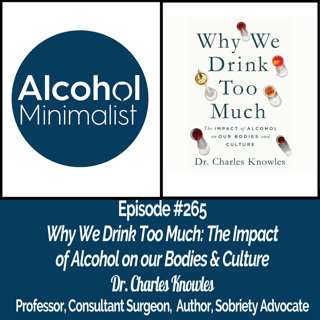
Why We Drink Too Much: The Impact  of Alcohol on our Bodies & Culture with Dr. Charles Knowles

Why We Drink Too Much: The Impact of Alcohol on our Bodies & Culture with Dr. Charles Knowles

In this episode of the Alcohol Minimalist Podcast, Molly sits down with Dr. Charles Knowles, professor of surgery at Queen Mary University of London and author of Why We Drink Too Much.This is a deep,...

2 Helmi 52min
Think Thursday: When Progress is Invisible-The Psychology of Change You Can't See

Think Thursday: When Progress is Invisible-The Psychology of Change You Can't See

In this final Think Thursday of Mostly Dry January, Molly delivers an empowering message for anyone questioning whether their efforts this month "counted." If you’ve found yourself wondering why chang...

29 Tammi 6min

Suosittua kategoriassa Koulutus

rss-murhan-anatomia
psykopodiaa-podcast
voi-hyvin-meditaatiot-2
adhd-podi
rss-rahamania
rss-valo-minussa-2
rss-luonnollinen-synnytys-podcast
rss-liian-kuuma-peruna
rss-narsisti
rahapuhetta
kesken
ihminen-tavattavissa-tommy-hellsten-instituutti
rss-tietoinen-yhteys-podcast-2
rss-arkea-ja-aurinkoa-podcast-espanjasta
rss-niinku-asia-on
aamukahvilla
dear-ladies
filocast-filosofian-perusteet
rss-vapaudu-voimaasi
rss-ammattipuhuja