Think Thursday:  The Connection Economy-How Relationships Reshape Our Brains

Think Thursday: The Connection Economy-How Relationships Reshape Our Brains

In today’s Think Thursday episode, we’re diving into one of the most powerful, yet often overlooked, tools for behavior change: human connection. We’re not just talking about any connections, but deep, meaningful relationships—the kind that profoundly shape our brain, our well-being, and even our relationship with alcohol.

We’ll explore what I call the “Connection Economy”, where investing in quality relationships provides neurological, emotional, and physical benefits. Unlike the Attention Economy, which constantly pulls us into distraction and stress, the Connection Economy is where we all profit—gaining better mental health, stronger habits, and a more fulfilling life.

What You’ll Learn in This Episode:

✔️ How deep relationships reshape the brain and impact behavior change
✔️ Why the Harvard Study of Adult Development proves that quality relationships are the key to long-term health and happiness
✔️ The brain chemistry of connection—how oxytocin, dopamine, and serotonin create lasting well-being
✔️ The dangers of our current connection crisis and why loneliness increases our reliance on alcohol
✔️ 5 science-backed strategies to strengthen connections and support lasting behavior change

Key Takeaways:

🧠 Neuroscience of Connection – Our brains thrive on relationships. Deep conversations and in-person interactions activate reward pathways, making us more resilient to stress.
💡 The Power of Social Bonds – Strong relationships regulate stress, rewire reward circuits, and protect against cognitive decline.
⚠️ The Connection Crisis – Despite digital connectivity, we are more isolated than ever. Substituting social media for real-life connection can actually increase stress levels.
🔑 Connection as a Behavior Change Tool – Meaningful relationships help us drink less and worry less by providing natural sources of comfort and stress relief.

Try This!

Here are five research-backed strategies you can start using today to harness the power of connection for behavior change:
1️⃣ Prioritize depth over breadth – Invest in a few meaningful relationships rather than many surface-level ones.
2️⃣ Make time for face-to-face interaction – Even short in-person conversations boost oxytocin and improve mood.
3️⃣ Practice active listening – Strengthening your listening skills deepens connections and makes others feel seen.
4️⃣ Engage in shared experiences – Group activities, meals, or hobbies enhance social bonds.
5️⃣ Reach out instead of reaching for a drink – Next time you feel the urge to drink for stress relief, try calling a friend or meeting up in person instead.

★ Support this podcast ★

Tämä jakso on lisätty Podme-palveluun avoimen RSS-syötteen kautta eikä se ole Podmen omaa tuotantoa. Siksi jakso saattaa sisältää mainontaa.

Jaksot(375)

Less Alcohol...But Are We More Resilient?

Less Alcohol...But Are We More Resilient?

Alcohol consumption in the United States is declining. Gallup reports that only 54% of Americans now drink — the lowest level recorded in decades — and nearly half of Americans say they are actively t...

23 Helmi 19min
Think Thursday: The Brain's Need for Coherence

Think Thursday: The Brain's Need for Coherence

In this week’s Think Thursday, Molly builds on last week’s conversation about overwhelm and takes it one level deeper—into uncertainty and the brain’s fundamental need for coherence.Many people say, “...

19 Helmi 15min
Are You Giving Alcohol Too Much Power?

Are You Giving Alcohol Too Much Power?

On this episode of The Alcohol Minimalist Podcast, Molly reflects on what would have been her mother’s 95th birthday and the years lost not only at the end of her life, but throughout decades spent in...

16 Helmi 19min
Think Thursday: When the Brain Stops Organizing and Starts Alarming

Think Thursday: When the Brain Stops Organizing and Starts Alarming

Many people are saying the same thing lately: “I’m overwhelmed by everything.”In this Think Thursday episode, Molly explores what overwhelm actually is from a neuroscience perspective. Is it just busy...

12 Helmi 12min

Alcohol & Cancer: Understanding the Risk

Alcohol & Cancer: Understanding the Risk

Last week marked World Cancer Day, and in this episode, Molly revisits an important—and often misunderstood—topic: the relationship between alcohol and cancer.This is not a new conversation, and it’s ...

9 Helmi 15min
Think Thursday: Intentional Discomfort & Hedonic Reset

Think Thursday: Intentional Discomfort & Hedonic Reset

In this Think Thursday episode, we explore how the human brain evolved to use discomfort as information—and what happens when modern life removes nearly all friction, effort, and delay.Our brains were...

5 Helmi 12min
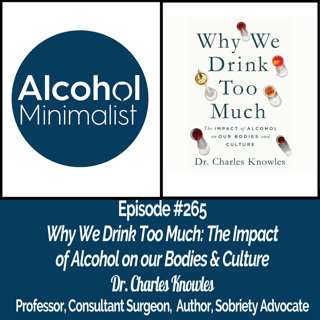
Why We Drink Too Much: The Impact  of Alcohol on our Bodies & Culture with Dr. Charles Knowles

Why We Drink Too Much: The Impact of Alcohol on our Bodies & Culture with Dr. Charles Knowles

In this episode of the Alcohol Minimalist Podcast, Molly sits down with Dr. Charles Knowles, professor of surgery at Queen Mary University of London and author of Why We Drink Too Much.This is a deep,...

2 Helmi 52min
Think Thursday: When Progress is Invisible-The Psychology of Change You Can't See

Think Thursday: When Progress is Invisible-The Psychology of Change You Can't See

In this final Think Thursday of Mostly Dry January, Molly delivers an empowering message for anyone questioning whether their efforts this month "counted." If you’ve found yourself wondering why chang...

29 Tammi 6min

Suosittua kategoriassa Koulutus

rss-murhan-anatomia
psykopodiaa-podcast
voi-hyvin-meditaatiot-2
adhd-podi
rss-rahamania
rss-valo-minussa-2
rss-luonnollinen-synnytys-podcast
rss-liian-kuuma-peruna
rss-narsisti
rahapuhetta
kesken
ihminen-tavattavissa-tommy-hellsten-instituutti
rss-tietoinen-yhteys-podcast-2
rss-arkea-ja-aurinkoa-podcast-espanjasta
rss-niinku-asia-on
aamukahvilla
dear-ladies
filocast-filosofian-perusteet
rss-vapaudu-voimaasi
rss-ammattipuhuja