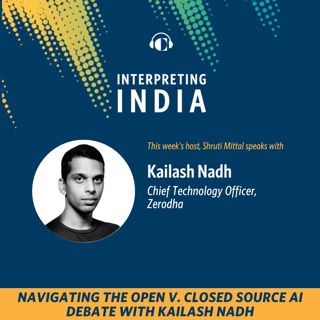
Navigating the Open v. Closed Source AI Debate with Kailash Nadh
Interpreting India26 Kesä 2025

Navigating the Open v. Closed Source AI Debate with Kailash Nadh

The episode opens with an in-depth discussion about the value of open source as a model of development and how the definitional contours of open-source AI differ from those of traditional open-source software. The discussion also explores the characteristics and challenges that distinguish open-source AI models from conventional software development approaches.

The discussion goes on to address recent strategic shifts in the AI industry towards more open development, sparked by developments like DeepSeek's open-source R1 model and leaked internal assessments suggesting that open-source communities may be outpacing tech giants.

The discussion also explores the complex trade-offs between open and closed AI development. While open-source models offer transparency, democratization, and innovation benefits, they also present cybersecurity vulnerabilities and potential national security risks. Nadh addresses concerns about jailbreaking vulnerabilities in open models, using DeepSeek's recent security lapses as an example, while also examining the limitations and risks of closed proprietary systems.

Nadh also provides his perspective on India-specific considerations, including the government's IndiaAI Mission and the decision to develop a homegrown large language model, and discuss the strategic implications of India's approach, which is not expected to be open-source at first, and the potential for India to make meaningful progress in driving open-source AI development as a matter of policy.

Episode Contributors

Kailash Nadh is the chief technology officer of Zerodha, India’s leading stock brokerage platform, where he has led its technology and product stack development since 2013. He is also the co-founder and director of FOSS United, a non-profit foundation based in Bangalore, that aims to provide grassroot support to free and open-source software projects and communities in India. In addition to being a full-stack software developer with more than two decades of technical experience, Nath holds a PhD in artificial intelligence and computational linguistics. His most recent writings also provide a compelling analysis of open-source software developments and AI breakthroughs, including in the Indian context.

Shruti Mittal is a research analyst at Carnegie India. Her current research interests include artificial intelligence, semiconductors, compute, and data governance. She is also interested in studying the potential socio-economic value that open development and diffusion of technologies can create in the Global South.

Every two weeks, Interpreting India brings you diverse voices from India and around the world to explore the critical questions shaping the nation's future. We delve into how technology, the economy, and foreign policy intertwine to influence India's relationship with the global stage.

As a Carnegie India production, hosted by Carnegie scholars, Interpreting India, a Carnegie India production, provides insightful perspectives and cutting-edge by tackling the defining questions that chart India's course through the next decade.

Stay tuned for thought-provoking discussions, expert insights, and a deeper understanding of India's place in the world.

Don't forget to subscribe, share, and leave a review to join the conversation and be part of Interpreting India's journey.

Tämä jakso on lisätty Podme-palveluun avoimen RSS-syötteen kautta eikä se ole Podmen omaa tuotantoa. Siksi jakso saattaa sisältää mainontaa.

Jaksot(148)

AI Literacy and the Future of Work in India

AI Literacy and the Future of Work in India

Jaspreet's framing for the AI and work debate is worth staying with. He is not dismissive of disruption: he thinks AI will destroy certain jobs, create new ones, and the rupture will be real. But he p...

26 Touko 44min
Can AI Resources Be Democratized? AI Summit Special

Can AI Resources Be Democratized? AI Summit Special

This episode is part of our special series on the India AI Impact Summit, examining the conversations, decisions, and debates that are shaping global AI governance. The working group was designed from...

15 Touko 28min

Space Security in the Age of AI

Space Security in the Age of AI

Almudena opens with a distinction that anchors the entire conversation: space security, unlike space safety, is about intentional harm. It concerns deliberate attempts to disrupt, deny, or destroy spa...

7 Touko 1h 7min

An African Perspective for Building AI for Global South | AI Summit Special

An African Perspective for Building AI for Global South | AI Summit Special

This episode is part of our special series on the India AI Impact Summit, examining the conversations, decisions, and debates that are shaping global AI governance. Raymond draws a distinction early i...

30 Huhti 48min

The India-EU Trade Deal: What It Delivers and What It Doesn't

The India-EU Trade Deal: What It Delivers and What It Doesn't

For most of the last decade, a trade deal between India and the EU seemed unlikely. The nudge came as the world changed around both. Nicolas points to three converging forces: the pressure of US tarif...

23 Huhti 51min

From Bletchley Park to Delhi and What Comes Next | AI Summit Special

From Bletchley Park to Delhi and What Comes Next | AI Summit Special

This episode is part of our special series on the India AI Impact Summit 2026, examining the conversations, perspectives, and debates that are shaping global AI discourse. Tino has been in the room a...

16 Huhti 54min

Data, AI, and the Laws Trying to Keep Up

Data, AI, and the Laws Trying to Keep Up

The conversation begins with a close look at India’s data protection regime, particularly the DPDP Act and its emphasis on consent. Nikhil challenges the perception that the law is overly consent-driv...

31 Maalis 42min

Inside the Iran Conflict: Power, Strategy, and India’s Balancing Act

Inside the Iran Conflict: Power, Strategy, and India’s Balancing Act

The conversation begins with a look at where the conflict stands today and how Iran has managed to absorb significant military pressure while still responding in a measured way. Dharmendra explains ho...

25 Maalis 1h 8min

Suosittua kategoriassa Politiikka ja uutiset

uutiscast
aikalisa
politiikan-puskaradio
rss-ootsa-kuullut-tasta
ootsa-kuullut-tasta-2
rss-podme-livebox
tervo-halme
otetaan-yhdet
rss-vaalirankkurit-podcast
et-sa-noin-voi-sanoo-esittaa
viisupodi
rss-asiastudio
linda-maria
rss-girls-finish-f1rst
rss-pinnalla
the-ulkopolitist
helsingin-sanomat-dev
rss-kaikki-paskaksi-ystavat
rss-hyvaa-huomenta-bryssel
rss-ulkopoditiikkaa