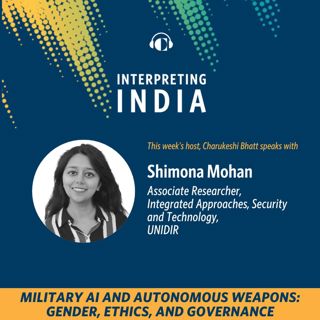
Military AI and Autonomous Weapons: Gender, Ethics, and Governance

Military AI and Autonomous Weapons: Gender, Ethics, and Governance

The episode opens with Bhatt framing the global stakes: from drones on the battlefield to AI-powered early warning systems, militaries worldwide are racing to integrate AI, often citing strategic necessity in volatile security environments. Mohan underscores that AI in conflict cannot be characterized in a single way, applications range from decision-support systems and logistics to disinformation campaigns and border security.

The conversation explores two categories of AI-related risks:

  • Inherent risks: design flaws, bias in datasets, adversarial attacks, and human–machine trust calibration.
  • Applied risks: escalation through miscalculation, misuse in targeting, and AI’s role as a force multiplier for nuclear and cyber threats.

On governance, Mohan explains the fragmentation of current disarmament processes, where AI intersects with multiple regimes, nuclear, cyber, conventional arms, yet lacks a unified framework. She highlights ongoing debates at the UN’s Group of Governmental Experts (GGE) on LAWS, where consensus has been stalled over definitions, human-machine interaction, and whether regulation should be voluntary or treaty-based.

International humanitarian law (IHL) remains central, with discussions focusing on how principles like distinction, proportionality, and precaution can apply to autonomous systems. Mohan also emphasizes a “life-cycle approach” to weapon assessment, extending legal and ethical oversight from design to deployment and decommissioning.

A significant portion of the conversation turns to gender and bias, an area Mohan has advanced through her research at UNIDIR. She draws attention to how gendered and racial biases encoded in AI systems can manifest in conflict, stressing the importance of diversifying participation in both technology design and disarmament diplomacy.

Looking forward, Mohan cites UN Secretary-General António Guterres’s call for a legally binding instrument on autonomous weapons by 2026. She argues that progress will depend on multi-stakeholder engagement, national strategies on AI, and confidence-building measures between states. The episode closes with a reflection on the future of warfare as inseparable from governance innovation—shifting from arms reduction to resilience, capacity-building, and responsible innovation.

Episode Contributors

Shimona Mohan is an associate researcher on Gender & Disarmament and Security & Technology at UNIDIR in Geneva, Switzerland. She was named among Women in AI Ethics’ “100 Brilliant Women in AI Ethics for 2024.” Her areas of focus include the multifarious intersections of security, emerging technologies (in particular AI and cybersecurity), gender, and disarmament.

Charukeshi Bhatt is a research analyst at Carnegie India, where her work focuses on the intersection of emerging technologies and international security. Her current research explores how advancements in technologies such as AI are shaping global disarmament frameworks and security norms.

Readings

Gender and Lethal Autonomous Weapons Systems, UNIDIR Factsheet

Political Declaration on Responsible Military Use of AI and Autonomy, US Department of State

AI in the Military Domain: A Briefing Note for States by Giacomo Persi Paoli and Yasmin Afina

Understanding the Global Debate on Lethal Autonomous Weapons Systems: An Indian Perspective by Charukeshi Bhatt and Tejas Bharadwaj

Every two weeks, Interpreting India brings you diverse voices from India and around the world to explore the critical questions shaping the nation's future. We delve into how technology, the economy, and foreign policy intertwine to influence India's relationship with the global stage.

As a Carnegie India production, hosted by Carnegie scholars, Interpreting India, a Carnegie India production, provides insightful perspectives and cutting-edge by tackling the defining questions that chart India's course through the next decade.

Stay tuned for thought-provoking discussions, expert insights, and a deeper understanding of India's place in the world.

Don't forget to subscribe, share, and leave a review to join the conversation and be part of Interpreting India's journey.

Tämä jakso on lisätty Podme-palveluun avoimen RSS-syötteen kautta eikä se ole Podmen omaa tuotantoa. Siksi jakso saattaa sisältää mainontaa.

Jaksot(153)

India, Australia, and the Critical Minerals Opportunity

India, Australia, and the Critical Minerals Opportunity

The conversation opens with a useful baseline on both countries. Australia has world-class mining equipment, technology, and services capabilities, and its mining sector contributes roughly 10 to 15 p...

13 Elo 49min
Chokepoints, Economic Warfare and India's Strategic Options

Chokepoints, Economic Warfare and India's Strategic Options

Edward lays out three criteria for what makes something a genuine choke point: dominant market share, difficulty to substitute, and the ability to weaponize it with asymmetric impact, hurting the adve...

10 Heinä 33min
India's AI Ambitions and the Road to Viksit Bharat | AI Summit Special

India's AI Ambitions and the Road to Viksit Bharat | AI Summit Special

This is the final episode of our special series on the India AI Impact Summit, examining the conversations, decisions, and debates that are shaping global AI governance. This episode explores: India...

2 Heinä 33min
Did India's AI Summit Get Safety Right? AI Summit Special

Did India's AI Summit Get Safety Right? AI Summit Special

This episode is part of our special series on the India AI Impact Summit, examining the conversations, decisions, and debates that are shaping global AI governance. Professor Ravindran addresses early...

19 Kesä 40min
Subsea Cables, Trusted Networks, and India's Strategic Opportunity

Subsea Cables, Trusted Networks, and India's Strategic Opportunity

Pooja opens with a mismatch that frames the entire conversation. India consumes around 20% of global internet traffic but accounts for just 2% of global subsea cable infrastructure. Even with the expa...

4 Kesä 46min
AI Literacy and the Future of Work in India

AI Literacy and the Future of Work in India

Jaspreet's framing for the AI and work debate is worth staying with. He is not dismissive of disruption: he thinks AI will destroy certain jobs, create new ones, and the rupture will be real. But he p...

26 Touko 44min
Can AI Resources Be Democratized? AI Summit Special

Can AI Resources Be Democratized? AI Summit Special

This episode is part of our special series on the India AI Impact Summit, examining the conversations, decisions, and debates that are shaping global AI governance. The working group was designed from...

15 Touko 28min

Space Security in the Age of AI

Space Security in the Age of AI

Almudena opens with a distinction that anchors the entire conversation: space security, unlike space safety, is about intentional harm. It concerns deliberate attempts to disrupt, deny, or destroy spa...

7 Touko 1h 7min

Suosittua kategoriassa Politiikka ja uutiset

uutiscast
aikalisa
politiikan-puskaradio
ootsa-kuullut-tasta-2
rss-ootsa-kuullut-tasta
otetaan-yhdet
rss-seksicast
tervo-halme
rss-podme-livebox
et-sa-noin-voi-sanoo-esittaa
rss-asiastudio
rss-kaikki-uusiksi
rss-vaalirankkurit-podcast
rss-tyolinjalla-pekka-sauri
rss-raha-talous-ja-politiikka
linda-maria
rss-voi-venaja
eevan-politiikkapodi-totuuksia-suomesta
rss-diet-woke