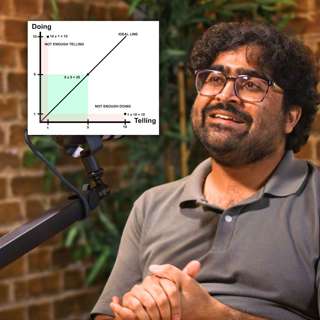
#223 – Neel Nanda on leading a Google DeepMind team at 26 – and advice if you want to work at an AI company (part 2)

#223 – Neel Nanda on leading a Google DeepMind team at 26 – and advice if you want to work at an AI company (part 2)

At 26, Neel Nanda leads an AI safety team at Google DeepMind, has published dozens of influential papers, and mentored 50 junior researchers — seven of whom now work at major AI companies. His secret? “It’s mostly luck,” he says, but “another part is what I think of as maximising my luck surface area.”

Video, full transcript, and links to learn more: https://80k.info/nn2

This means creating as many opportunities as possible for surprisingly good things to happen:

  • Write publicly.
  • Reach out to researchers whose work you admire.
  • Say yes to unusual projects that seem a little scary.

Nanda’s own path illustrates this perfectly. He started a challenge to write one blog post per day for a month to overcome perfectionist paralysis. Those posts helped seed the field of mechanistic interpretability and, incidentally, led to meeting his partner of four years.

His YouTube channel features unedited three-hour videos of him reading through famous papers and sharing thoughts. One has 30,000 views. “People were into it,” he shrugs.

Most remarkably, he ended up running DeepMind’s mechanistic interpretability team. He’d joined expecting to be an individual contributor, but when the team lead stepped down, he stepped up despite having no management experience. “I did not know if I was going to be good at this. I think it’s gone reasonably well.”

His core lesson: “You can just do things.” This sounds trite but is a useful reminder all the same. Doing things is a skill that improves with practice. Most people overestimate the risks and underestimate their ability to recover from failures. And as Neel explains, junior researchers today have a superpower previous generations lacked: large language models that can dramatically accelerate learning and research.

In this extended conversation, Neel and host Rob Wiblin discuss all that and some other hot takes from Neel's four years at Google DeepMind. (And be sure to check out part one of Rob and Neel’s conversation!)


What did you think of the episode? https://forms.gle/6binZivKmjjiHU6dA

Chapters:

  • Cold open (00:00:00)
  • Who’s Neel Nanda? (00:01:12)
  • Luck surface area and making the right opportunities (00:01:46)
  • Writing cold emails that aren't insta-deleted (00:03:50)
  • How Neel uses LLMs to get much more done (00:09:08)
  • “If your safety work doesn't advance capabilities, it's probably bad safety work” (00:23:22)
  • Why Neel refuses to share his p(doom) (00:27:22)
  • How Neel went from the couch to an alignment rocketship (00:31:24)
  • Navigating towards impact at a frontier AI company (00:39:24)
  • How does impact differ inside and outside frontier companies? (00:49:56)
  • Is a special skill set needed to guide large companies? (00:56:06)
  • The benefit of risk frameworks: early preparation (01:00:05)
  • Should people work at the safest or most reckless company? (01:05:21)
  • Advice for getting hired by a frontier AI company (01:08:40)
  • What makes for a good ML researcher? (01:12:57)
  • Three stages of the research process (01:19:40)
  • How do supervisors actually add value? (01:31:53)
  • An AI PhD – with these timelines?! (01:34:11)
  • Is career advice generalisable, or does everyone get the advice they don't need? (01:40:52)
  • Remember: You can just do things (01:43:51)

This episode was recorded on July 21.

Video editing: Simon Monsour and Luke Monsour
Audio engineering: Ben Cordell, Milo McGuire, Simon Monsour, and Dominic Armstrong
Music: Ben Cordell
Camera operator: Jeremy Chevillotte
Coordination, transcriptions, and web: Katy Moore

Jaksot(317)

#28 - Owen Cotton-Barratt on why scientists should need insurance, PhD strategy & fast AI progresses

#28 - Owen Cotton-Barratt on why scientists should need insurance, PhD strategy & fast AI progresses

A researcher is working on creating a new virus – one more dangerous than any that exist naturally. They believe they’re being as careful as possible. After all, if things go wrong, their own life and...

27 Huhti 20181h 3min
#27 - Dr Tom Inglesby on careers and policies that reduce global catastrophic biological risks

#27 - Dr Tom Inglesby on careers and policies that reduce global catastrophic biological risks

How about this for a movie idea: a main character has to prevent a new contagious strain of Ebola spreading around the world. She’s the best of the best. So good in fact, that her work on early detect...

18 Huhti 20182h 16min
#26 - Marie Gibbons on how exactly clean meat is made & what's needed to get it in every supermarket

#26 - Marie Gibbons on how exactly clean meat is made & what's needed to get it in every supermarket

First, decide on the type of animal. Next, pick the cell type. Then take a small, painless biopsy, and put the cells in a solution that makes them feel like they’re still in the body. Once the cells a...

10 Huhti 20181h 44min
#25 - Robin Hanson on why we have to lie to ourselves about why we do what we do

#25 - Robin Hanson on why we have to lie to ourselves about why we do what we do

On February 2, 1685, England’s King Charles II was struck by a sudden illness. Fortunately his physicians were the best of the best. To reassure the public they kept them abreast of the King’s treatme...

28 Maalis 20182h 39min
#24 - Stefan Schubert on why it’s a bad idea to break the rules, even if it’s for a good cause

#24 - Stefan Schubert on why it’s a bad idea to break the rules, even if it’s for a good cause

How honest should we be? How helpful? How friendly? If our society claims to value honesty, for instance, but in reality accepts an awful lot of lying – should we go along with those lax standards? Or...

20 Maalis 201855min
#23 - How to actually become an AI alignment researcher, according to Dr Jan Leike

#23 - How to actually become an AI alignment researcher, according to Dr Jan Leike

Want to help steer the 21st century’s most transformative technology? First complete an undergrad degree in computer science and mathematics. Prioritize harder courses over easier ones. Publish at lea...

16 Maalis 201845min
#22 - Leah Utyasheva on the non-profit that figured out how to massively cut suicide rates

#22 - Leah Utyasheva on the non-profit that figured out how to massively cut suicide rates

How people kill themselves varies enormously depending on which means are most easily available. In the United States, suicide by firearm stands out. In Hong Kong, where most people live in high rise ...

7 Maalis 20181h 8min
#21 - Holden Karnofsky on times philanthropy transformed the world & Open Phil’s plan to do the same

#21 - Holden Karnofsky on times philanthropy transformed the world & Open Phil’s plan to do the same

The Green Revolution averted mass famine during the 20th century. The contraceptive pill gave women unprecedented freedom in planning their own lives. Both are widely recognised as scientific breakthr...

27 Helmi 20182h 35min

Suosittua kategoriassa Koulutus

rss-murhan-anatomia
psykopodiaa-podcast
voi-hyvin-meditaatiot-2
rss-valo-minussa-2
rss-narsisti
adhd-podi
rss-niinku-asia-on
aamukahvilla
rss-duodecim-lehti
kesken
rahapuhetta
aloita-meditaatio
salainen-paivakirja
rss-elamankoulu
psykologia
rss-uskonto-on-tylsaa
rss-psykalab
rss-selvat-savelet
rss-koira-haudattuna
rss-hereilla