#223 – Neel Nanda on leading a Google DeepMind team at 26 – and advice if you want to work at an AI company (part 2)

#223 – Neel Nanda on leading a Google DeepMind team at 26 – and advice if you want to work at an AI company (part 2)

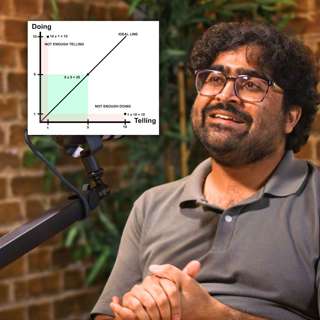
At 26, Neel Nanda leads an AI safety team at Google DeepMind, has published dozens of influential papers, and mentored 50 junior researchers — seven of whom now work at major AI companies. His secret? “It’s mostly luck,” he says, but “another part is what I think of as maximising my luck surface area.”

Video, full transcript, and links to learn more: https://80k.info/nn2

This means creating as many opportunities as possible for surprisingly good things to happen:

  • Write publicly.
  • Reach out to researchers whose work you admire.
  • Say yes to unusual projects that seem a little scary.

Nanda’s own path illustrates this perfectly. He started a challenge to write one blog post per day for a month to overcome perfectionist paralysis. Those posts helped seed the field of mechanistic interpretability and, incidentally, led to meeting his partner of four years.

His YouTube channel features unedited three-hour videos of him reading through famous papers and sharing thoughts. One has 30,000 views. “People were into it,” he shrugs.

Most remarkably, he ended up running DeepMind’s mechanistic interpretability team. He’d joined expecting to be an individual contributor, but when the team lead stepped down, he stepped up despite having no management experience. “I did not know if I was going to be good at this. I think it’s gone reasonably well.”

His core lesson: “You can just do things.” This sounds trite but is a useful reminder all the same. Doing things is a skill that improves with practice. Most people overestimate the risks and underestimate their ability to recover from failures. And as Neel explains, junior researchers today have a superpower previous generations lacked: large language models that can dramatically accelerate learning and research.

In this extended conversation, Neel and host Rob Wiblin discuss all that and some other hot takes from Neel's four years at Google DeepMind. (And be sure to check out part one of Rob and Neel’s conversation!)


What did you think of the episode? https://forms.gle/6binZivKmjjiHU6dA

Chapters:

  • Cold open (00:00:00)
  • Who’s Neel Nanda? (00:01:12)
  • Luck surface area and making the right opportunities (00:01:46)
  • Writing cold emails that aren't insta-deleted (00:03:50)
  • How Neel uses LLMs to get much more done (00:09:08)
  • “If your safety work doesn't advance capabilities, it's probably bad safety work” (00:23:22)
  • Why Neel refuses to share his p(doom) (00:27:22)
  • How Neel went from the couch to an alignment rocketship (00:31:24)
  • Navigating towards impact at a frontier AI company (00:39:24)
  • How does impact differ inside and outside frontier companies? (00:49:56)
  • Is a special skill set needed to guide large companies? (00:56:06)
  • The benefit of risk frameworks: early preparation (01:00:05)
  • Should people work at the safest or most reckless company? (01:05:21)
  • Advice for getting hired by a frontier AI company (01:08:40)
  • What makes for a good ML researcher? (01:12:57)
  • Three stages of the research process (01:19:40)
  • How do supervisors actually add value? (01:31:53)
  • An AI PhD – with these timelines?! (01:34:11)
  • Is career advice generalisable, or does everyone get the advice they don't need? (01:40:52)
  • Remember: You can just do things (01:43:51)

This episode was recorded on July 21.

Video editing: Simon Monsour and Luke Monsour
Audio engineering: Ben Cordell, Milo McGuire, Simon Monsour, and Dominic Armstrong
Music: Ben Cordell
Camera operator: Jeremy Chevillotte
Coordination, transcriptions, and web: Katy Moore

Jaksot(318)

#36 - Tanya Singh on ending the operations management bottleneck in effective altruism

#36 - Tanya Singh on ending the operations management bottleneck in effective altruism

Almost nobody is able to do groundbreaking physics research themselves, and by the time his brilliance was appreciated, Einstein was hardly limited by funding. But what if you could find a way to unlo...

11 Heinä 20182h 4min
#35 - Tara Mac Aulay on the audacity to fix the world without asking permission

#35 - Tara Mac Aulay on the audacity to fix the world without asking permission

"You don't need permission. You don't need to be allowed to do something that's not in your job description. If you think that it's gonna make your company or your organization more successful and mor...

21 Kesä 20181h 22min
Rob Wiblin on the art/science of a high impact career

Rob Wiblin on the art/science of a high impact career

Today's episode is a cross-post of an interview I did with The Jolly Swagmen Podcast which came out this week. I recommend regular listeners skip to 24 minutes in to avoid hearing things they already ...

8 Kesä 20181h 31min
#34 - We use the worst voting system that exists. Here's how Aaron Hamlin is going to fix it.

#34 - We use the worst voting system that exists. Here's how Aaron Hamlin is going to fix it.

In 1991 Edwin Edwards won the Louisiana gubernatorial election. In 2001, he was found guilty of racketeering and received a 10 year invitation to Federal prison. The strange thing about that election?...

1 Kesä 20182h 18min
#33 - Anders Sandberg on what if we ended ageing, solar flares & the annual risk of nuclear war

#33 - Anders Sandberg on what if we ended ageing, solar flares & the annual risk of nuclear war

Joseph Stalin had a life-extension program dedicated to making himself immortal. What if he had succeeded?  According to our last guest, Bryan Caplan, there’s an 80% chance that Stalin would still be ...

29 Touko 20181h 24min
#32 - Bryan Caplan on whether his Case Against Education holds up, totalitarianism, & open borders

#32 - Bryan Caplan on whether his Case Against Education holds up, totalitarianism, & open borders

Bryan Caplan’s claim in *The Case Against Education* is striking: education doesn’t teach people much, we use little of what we learn, and college is mostly about trying to seem smarter than other peo...

22 Touko 20182h 25min
#31 - Allan Dafoe on defusing the political & economic risks posed by existing AI capabilities

#31 - Allan Dafoe on defusing the political & economic risks posed by existing AI capabilities

The debate around the impacts of artificial intelligence often centres on ‘superintelligence’ - a general intellect that is much smarter than the best humans, in practically every field. But according...

18 Touko 201848min
#30 - Eva Vivalt on how little social science findings generalize from one study to another

#30 - Eva Vivalt on how little social science findings generalize from one study to another

If we have a study on the impact of a social program in a particular place and time, how confident can we be that we’ll get a similar result if we study the same program again somewhere else? Dr Eva V...

15 Touko 20182h 1min

Suosittua kategoriassa Koulutus

rss-murhan-anatomia
psykopodiaa-podcast
voi-hyvin-meditaatiot-2
rss-niinku-asia-on
kesken
rss-liian-kuuma-peruna
rss-narsisti
adhd-podi
ihminen-tavattavissa-tommy-hellsten-instituutti
rss-duodecim-lehti
rss-psykalab
aamukahvilla
aloita-meditaatio
psykologia
rahapuhetta
rss-elamankoulu
rss-valo-minussa-2
rss-arkijarki
rss-honest-talk-with-laurrenna
rss-mental-race