Jim van Os - Rethinking Biological Psychiatry

Jim van Os - Rethinking Biological Psychiatry

This week, we interview Professor Jim van Os.

Professor van Os is Chairman of the Department of Psychiatry and Psychology at Maastricht University Medical Centre, Maastricht, The Netherlands, and Visiting Professor of Psychiatric Epidemiology at King's College, Institute of Psychiatry, London.

He trained in Psychiatry in Casablanca, Bordeaux and the Institute of Psychiatry and the Maudsley Royal Hospital in London.

In 2011, he was elected member of the Royal Netherlands Academy of Arts and Sciences (KNAW); he appears on the 2014 Thomson-Reuter Web of Science list of the world's most influential scientific minds of our time.

He is Director of Psychiatric Services at Maastricht University Medical Centre and runs a service for treatment-resistant depression and first episode psychosis.

I was keen to ask professor van Os about his views on biological psychiatry, why we should sometimes challenge schizophrenia, psychosis and other diagnostic terminology and how he sees the future of mental healthcare.

In this episode, we discuss:

How Jim became interested in Psychology and Psychiatry, partly because of the experiences of family members

That Jim felt that training in many parts of the world allowed him to see variations in psychiatric models and this led to him questioning the biological model

That Jim also saw how dominant the prescribing of medication but noticed the wide variation in practices

How Jim observed in France a willingness by the treating doctors to accept that they didn't know what the root cause of a mental health difficulty

That some of the diagnoses that psychiatrists rely on are actually cultural agreements between professionals and that if a patient accepts the idea that they have a diseased brain, it can be limiting for that patient

That we should be able to admit that we don't know causes but we can still help and support people who struggle with their mental health

That there is a 25% yearly prevalence of mental disorders, but many nations have a capacity for only 4% to 6% of the general population

That selection criteria to get help and support with their mental health just don't work because we cannot precept outcomes for people

That there are interesting developments in eCommunities where people can participate in online communities to share experiences, for example 'Proud to be Me' in the Netherlands.

That diagnoses are starting to function as an economic measurement of mental illness and treatment and some cannot access treatment without a diagnosis, which perpetuate the diagnostic paradigm

That there were attempts in the most recent Diagnostic and Statistical Manual (DSM V) discussions to adopt ranges or dimensions of disorders, but the proposal was shot down

That it would have been historic if dimensions were adopted in the DSM because then the discussion between the clinician and the patient would have had to change

That there is some dimensionality in DSM V, represented as 'spectrum disorders' which are the first step towards acknowledging the variations inherent in human experiences

That Jim saw in his own family that the initial 'relief' of receiving a diagnosis was undone when more and more diagnoses were added

That a label of Schizophrenia can mean that other people do not know what to expect and find it difficult to relate psychologically to that person and their experiences

That the Maastricht User Research Centre has been discussing the language used in psychiatry, in particular the terms psychosis and schizophrenia and trying to find more helpful terms, for example hyper-meaning

That sometimes terms such as 'susceptibility' and 'syndrome' are far more helpful than giving someone the message that they have a brain disease

That biological psychiatry has been trying to reverse engineer and validate the concept of schizophrenia by investigating case control differences

That there is more awareness developing about the critical appraisal of diagnostic terminology

That the mental health sector should not be viewed as a separate entity, but should reinvent itself as an inclusive local community that is there to connect with people and their range of experiences

That patients often indicate that what got them better was community and connection and meaning and empowerment

That the User Research Centre, led by Dr. Peter Groot, have developed a solution to help patients withdraw slowly and gradually from their psychiatric medications

That when prescribing medication, we should encourage people to monitor their experiences to allow a better discussion about treatment continuing or stopping based on evidence

That if we suppress difficulties with medication, it can make it more difficult for the person to build up coping mechanisms

To listen on Mad in America: https://goo.gl/tyyLmt

Podcast show notes: https://goo.gl/h1CHc5

To get in touch with us email: podcasts@madinamerica.com

© Mad in America 2017

Jaksot(290)

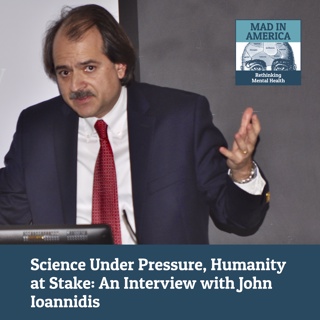
Science Under Pressure, Humanity at Stake: An Interview with John Ioannidis

Science Under Pressure, Humanity at Stake: An Interview with John Ioannidis

John Ioannidis is a Stanford professor, a physician, and one of the most eminent scholars in the world in the field of evidence-based medicine. Ioannidis has spent his career exposing the weak foundat...

10 Syys 202551min
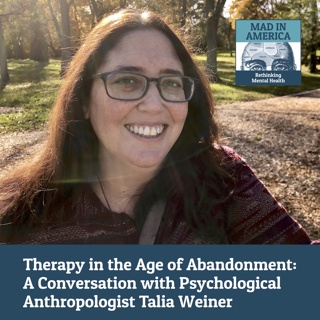
Therapy in the Age of Abandonment: A Conversation with Psychological Anthropologist Talia Weiner

Therapy in the Age of Abandonment: A Conversation with Psychological Anthropologist Talia Weiner

Talia Weiner is a psychological anthropologist, licensed professional counselor, and assistant professor of psychology at the University of West Georgia. As a medical and psychological anthropologist,...

3 Syys 202537min
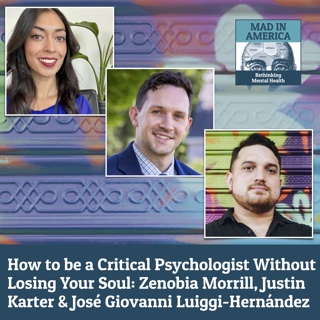
How to be a Critical Psychologist Without Losing Your Soul: A Conversation With Zenobia Morrill, José Giovanni Luiggi-Hernández and Justin Karter

How to be a Critical Psychologist Without Losing Your Soul: A Conversation With Zenobia Morrill, José Giovanni Luiggi-Hernández and Justin Karter

On the Mad in America podcast this week, we explore the importance of raising awareness of psychological approaches that challenge mainstream perspectives. Joining us today are three people who are pr...

13 Elo 202545min
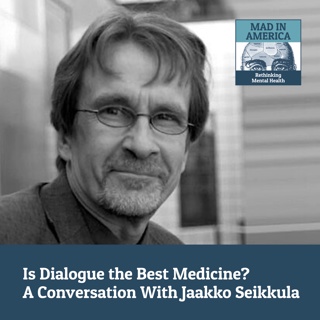
Is Dialogue the Best Medicine? A Conversation With Jaakko Seikkula

Is Dialogue the Best Medicine? A Conversation With Jaakko Seikkula

Welcome to MIA Radio. Today, we are pleased to have as our guest Jaakko Seikkula. Jaakko is a psychologist who helped develop the Open Dialogue practice at Keropudas Hospital in Tornio, Finland, in th...

30 Heinä 202545min
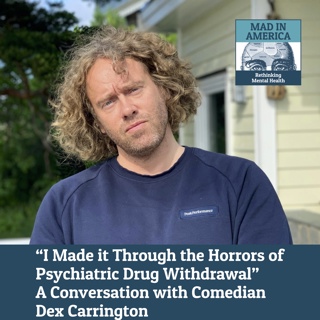
"I Made it Through the Horrors of Psychiatric Drug Withdrawal" A Conversation with Comedian Dex Carrington

"I Made it Through the Horrors of Psychiatric Drug Withdrawal" A Conversation with Comedian Dex Carrington

Jørgen Kjønø, whose stage name is Dex Carrington, is a Norwegian-American stand-up comedian based in Oslo, Norway. He is also an actor, host of the Truth Train podcast, and former travel show host who...

9 Heinä 202542min
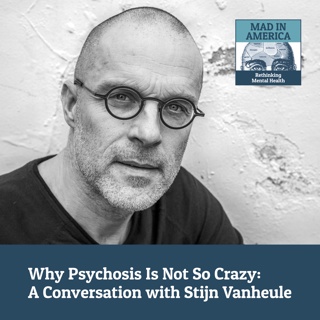
Why Psychosis Is Not So Crazy: A Conversation with Stijn Vanheule

Why Psychosis Is Not So Crazy: A Conversation with Stijn Vanheule

Stijn Vanheule is a clinical psychologist, psychoanalyst, and professor of psychology at Ghent University. Trained in the Lacanian tradition, he has written widely on the structure of psychosis, the l...

25 Kesä 202544min
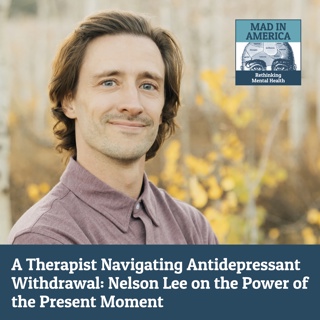
A Therapist Navigating Antidepressant Withdrawal: Nelson Lee on the Power of the Present Moment

A Therapist Navigating Antidepressant Withdrawal: Nelson Lee on the Power of the Present Moment

Nelson Lee is a therapist and mental skills coach with a master's degree in clinical mental health counseling and an MBA. In 2024, he attempted to get off antidepressants that he'd been on for 15 year...

11 Kesä 202546min
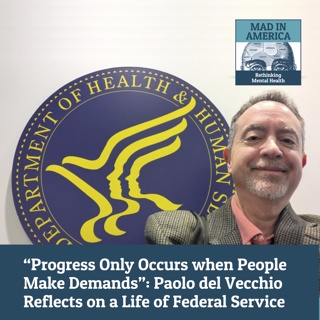
"Progress Only Occurs when People Make Demands" Paolo del Vecchio Reflects on a Life of Federal Service

"Progress Only Occurs when People Make Demands" Paolo del Vecchio Reflects on a Life of Federal Service

Paulo del Vecchio is a person in long-term recovery from mental health and addictions, who has been a leader in the peer recovery movement for 40 years. He recently completed a 30-year career at the U...

4 Kesä 202539min

Suosittua kategoriassa Terveys ja hyvinvointi

unicast
tiedenaiset-podcast
psykopodiaa-podcast
voi-hyvin-meditaatiot-2
rss-pitaisko-erota
vakeva-elama-viisaampi-mieli-vahvempi-keho
meditaatiot-suomeksi
junnut-pelissa
rss-mighty-finland-podcast
puhu-muru
rss-narsisti
terapiassa
paritellen
aamukahvilla
mielen-puolikkaat
rss-uplevel-by-sonja-hannus
rss-pt-paahtio
rss-vapaudu-voimaasi
rss-adama-mindful-hetki
rss-nautinto