Jim van Os - Rethinking Biological Psychiatry

Jim van Os - Rethinking Biological Psychiatry

This week, we interview Professor Jim van Os.

Professor van Os is Chairman of the Department of Psychiatry and Psychology at Maastricht University Medical Centre, Maastricht, The Netherlands, and Visiting Professor of Psychiatric Epidemiology at King's College, Institute of Psychiatry, London.

He trained in Psychiatry in Casablanca, Bordeaux and the Institute of Psychiatry and the Maudsley Royal Hospital in London.

In 2011, he was elected member of the Royal Netherlands Academy of Arts and Sciences (KNAW); he appears on the 2014 Thomson-Reuter Web of Science list of the world's most influential scientific minds of our time.

He is Director of Psychiatric Services at Maastricht University Medical Centre and runs a service for treatment-resistant depression and first episode psychosis.

I was keen to ask professor van Os about his views on biological psychiatry, why we should sometimes challenge schizophrenia, psychosis and other diagnostic terminology and how he sees the future of mental healthcare.

In this episode, we discuss:

How Jim became interested in Psychology and Psychiatry, partly because of the experiences of family members

That Jim felt that training in many parts of the world allowed him to see variations in psychiatric models and this led to him questioning the biological model

That Jim also saw how dominant the prescribing of medication but noticed the wide variation in practices

How Jim observed in France a willingness by the treating doctors to accept that they didn't know what the root cause of a mental health difficulty

That some of the diagnoses that psychiatrists rely on are actually cultural agreements between professionals and that if a patient accepts the idea that they have a diseased brain, it can be limiting for that patient

That we should be able to admit that we don't know causes but we can still help and support people who struggle with their mental health

That there is a 25% yearly prevalence of mental disorders, but many nations have a capacity for only 4% to 6% of the general population

That selection criteria to get help and support with their mental health just don't work because we cannot precept outcomes for people

That there are interesting developments in eCommunities where people can participate in online communities to share experiences, for example 'Proud to be Me' in the Netherlands.

That diagnoses are starting to function as an economic measurement of mental illness and treatment and some cannot access treatment without a diagnosis, which perpetuate the diagnostic paradigm

That there were attempts in the most recent Diagnostic and Statistical Manual (DSM V) discussions to adopt ranges or dimensions of disorders, but the proposal was shot down

That it would have been historic if dimensions were adopted in the DSM because then the discussion between the clinician and the patient would have had to change

That there is some dimensionality in DSM V, represented as 'spectrum disorders' which are the first step towards acknowledging the variations inherent in human experiences

That Jim saw in his own family that the initial 'relief' of receiving a diagnosis was undone when more and more diagnoses were added

That a label of Schizophrenia can mean that other people do not know what to expect and find it difficult to relate psychologically to that person and their experiences

That the Maastricht User Research Centre has been discussing the language used in psychiatry, in particular the terms psychosis and schizophrenia and trying to find more helpful terms, for example hyper-meaning

That sometimes terms such as 'susceptibility' and 'syndrome' are far more helpful than giving someone the message that they have a brain disease

That biological psychiatry has been trying to reverse engineer and validate the concept of schizophrenia by investigating case control differences

That there is more awareness developing about the critical appraisal of diagnostic terminology

That the mental health sector should not be viewed as a separate entity, but should reinvent itself as an inclusive local community that is there to connect with people and their range of experiences

That patients often indicate that what got them better was community and connection and meaning and empowerment

That the User Research Centre, led by Dr. Peter Groot, have developed a solution to help patients withdraw slowly and gradually from their psychiatric medications

That when prescribing medication, we should encourage people to monitor their experiences to allow a better discussion about treatment continuing or stopping based on evidence

That if we suppress difficulties with medication, it can make it more difficult for the person to build up coping mechanisms

To listen on Mad in America: https://goo.gl/tyyLmt

Podcast show notes: https://goo.gl/h1CHc5

To get in touch with us email: podcasts@madinamerica.com

© Mad in America 2017

Jaksot(290)

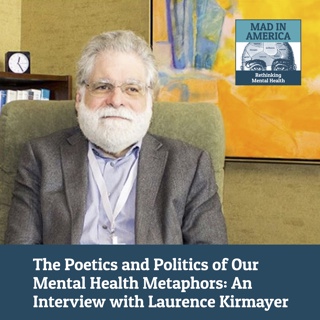
The Poetics and Politics of Our Mental Health Metaphors: An Interview with Laurence Kirmayer

The Poetics and Politics of Our Mental Health Metaphors: An Interview with Laurence Kirmayer

Laurence Kirmayer is one of the most influential figures in cultural psychiatry today. A psychiatrist, researcher, and theorist, he serves as James McGill Professor and Director of the Division of Soc...

21 Touko 202537min

Kermit Cole: Dialogical Therapy and Quantum Theory Walk Into a Bar…

Kermit Cole: Dialogical Therapy and Quantum Theory Walk Into a Bar…

Hello, my name is Bob Whitaker, and today I have the pleasure of speaking with Kermit Cole. We'll be speaking about a philosophical enterprise that Kermit is now deeply engaged in. That is, broadly sp...

7 Touko 202536min
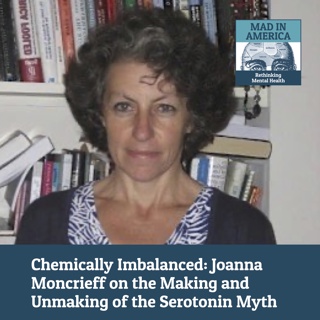
Chemically Imbalanced: Joanna Moncrieff on the Making and Unmaking of the Serotonin Myth

Chemically Imbalanced: Joanna Moncrieff on the Making and Unmaking of the Serotonin Myth

Welcome to this Mad in America podcast. My name is Robert Whitaker, and I'm happy today to have the pleasure of speaking with Joanna Moncrieff. Dr. Moncrieff is a psychiatrist who works in the Nationa...

30 Huhti 202549min
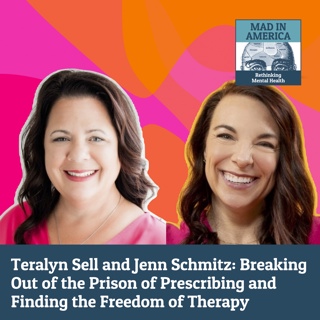
Teralyn Sell and Jenn Schmitz: Breaking Out of the Prison of Prescribing and Finding the Freedom of Therapy

Teralyn Sell and Jenn Schmitz: Breaking Out of the Prison of Prescribing and Finding the Freedom of Therapy

On the Mad in America podcast this week, Brooke Siem, author of May Cause Side Effects, talks with Teralyn Sell and Jenn Schmitz about their journey from working in the prison system to challenging co...

16 Huhti 202548min
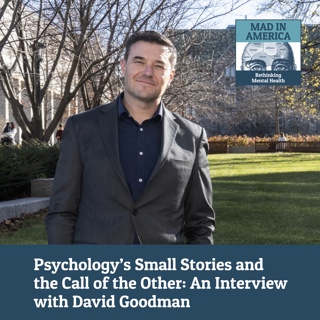
Psychology's Small Stories and the Call of the Other: An Interview with David Goodman

Psychology's Small Stories and the Call of the Other: An Interview with David Goodman

David Goodman is the Director of the Center for Psychological Humanities and Ethics and the Dean of the Woods College of Advancing Studies at Boston College, where he also teaches in the Department ...

9 Huhti 202543min
Psychotherapy and Psychosomatics: End of an Era for Independent Journals? An Interview With Giovanni Fava

Psychotherapy and Psychosomatics: End of an Era for Independent Journals? An Interview With Giovanni Fava

Welcome to Mad In America Radio. My name is Bob Whitaker, and today my guest is Italian psychiatrist, Giovanni Fava. From 1992 to 2022, Dr. Fava edited the journal Psychotherapy and Psychosomatics. We...

26 Maalis 202540min
Psychology, Personhood, and the Crisis of Neoliberalism: Jeff Sugarman on Theoretical and Critical Psychology

Psychology, Personhood, and the Crisis of Neoliberalism: Jeff Sugarman on Theoretical and Critical Psychology

Jeff Sugarman is a distinguished scholar in theoretical and philosophical psychology, known for his work examining the psychology of selfhood, human agency, and the sociopolitical underpinnings of psy...

19 Maalis 202553min
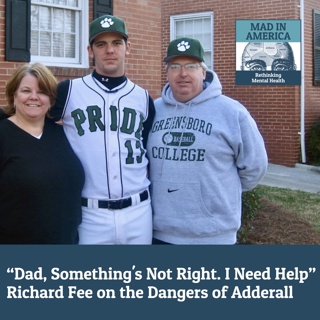
"Dad, Something's Not Right. I Need Help"- Richard Fee on the Dangers of Adderall

"Dad, Something's Not Right. I Need Help"- Richard Fee on the Dangers of Adderall

Welcome to the Mad in America podcast. My name is Brooke Siem, and I'm the author of May Cause Side Effects. Today, I'm here with Rick Fee, president of the Richard Fee Foundation. Rick joins us to ta...

5 Maalis 202547min

Suosittua kategoriassa Terveys ja hyvinvointi

unicast
tiedenaiset-podcast
psykopodiaa-podcast
voi-hyvin-meditaatiot-2
rss-pitaisko-erota
vakeva-elama-viisaampi-mieli-vahvempi-keho
meditaatiot-suomeksi
junnut-pelissa
rss-mighty-finland-podcast
puhu-muru
rss-narsisti
terapiassa
paritellen
aamukahvilla
mielen-puolikkaat
rss-uplevel-by-sonja-hannus
rss-pt-paahtio
rss-vapaudu-voimaasi
rss-adama-mindful-hetki
rss-nautinto