Bonnie Burstow and Nick Walker - An Introduction to Cognitive Liberty

Bonnie Burstow and Nick Walker - An Introduction to Cognitive Liberty

This week, Mad in America editor Emily Sheera Cutler presents the first in a series of interviews that examine the many important issues around forced treatment and cognitive liberty. The series will examine philosophical, theological, and sociological perspectives on coercive treatment.

In this first part, Emily interviews two well known and very respected academics and activists Bonnie Burstow and Nick Walker. Central to both Bonnie and Nick's work is the concept of cognitive liberty or freedom and integrity of the mind. Early proponents of cognitive liberty have defined it as the right to control one's own consciousness and be free from mind-altering drugs and technologies, as well as the right to use mind-enhancing drugs and technologies without facing legal consequences. Contemporary proponents of cognitive liberty have expanded the definition to include the right to experience and express each and every thought, feeling, state of mind, and belief as long as it does not harm anyone else. Both Bonnie and Nick describe cognitive liberty as the right to express oneself authentically. In this first episode, they get to the core of why so many human rights activists oppose forced treatment – it can interfere with people's rights to be themselves.

In this episode we discuss:

  • How Bonnie became an antipsychiatry activist and scholar, and why she sees the institution of psychiatry as a human rights violation
  • How Nick became a neurodiversity scholar through his involvement with the Autistic rights movement
  • The difference between the neurodiversity paradigm, which views neurological, mental, and cognitive differences on the natural spectrum of human diversity, and the pathology paradigm, which assumes there is a right way or healthy way of being and to differ from it is unhealthy
  • What it means for each person to have cognitive liberty and be able to express their own unique way of being and processing the world without repercussions
  • How psychiatry curtails our cognitive liberty and freedom of mind by pathologizing difference to justify forceful and coercive measures
  • The social model of disability, which states that people are disabled by lack of access and discrimination, not by medical conditions or internal deficits
  • How the social model of disability intersects with neurodiversity and antipsychiatry but also falls short
  • That Applied Behavior Analysis (ABA) constitutes a human rights abuse against Autistic children, forcing and coercing them to act more normal and less different
  • That other behaviour therapies and even humanistic therapies can be coercive as well
  • That the autism industry profits off of the pathology paradigm, convincing parents there is something wrong with their Autistic children and that it is not okay to be Autistic, and their children need to be subjected to ABA and other "treatments"
  • How antipsychiatry and neurodiversity intersect with feminism and queer studies
  • Why it is necessary for educators to teach students "mad literacy" from an early age
  • The importance of writing and publishing literature with accurate, positive representations of neurodivergent and Mad people
  • How we can build communities in which people support one another through emotional distress without violating anyone's autonomy or restricting anyone's freedom
  • Why the conventional notion of "suicide prevention" is problematic and can serve to take away people's coping skills
  • How the ideas of somatic therapy can help us support people in distress

Relevant Links

Bonnie Burstow

Nick Walker

Bonnie Burstow's articles for Mad in America

The Bonnie Burstow Scholarship in Antipsychiatry

Autonomous Press

Throw Away the Master's Tools: Liberating Ourselves from the Pathology Paradigm by Nick Walker

Neuroqueer: An Introduction by Nick Walker

The social model of disability vs. the medical model of disability

To get in touch with us email: podcasts@madinamerica.com

© Mad in America 2017

Tämä jakso on lisätty Podme-palveluun avoimen RSS-syötteen kautta eikä se ole Podmen omaa tuotantoa. Siksi jakso saattaa sisältää mainontaa.

Jaksot(308)

When Stopping Prescription Drugs Isn't Simple: Alicia Martin and the TaperMate Story

When Stopping Prescription Drugs Isn't Simple: Alicia Martin and the TaperMate Story

Alicia Martin is an Australian community pharmacist, a member of the Not Broken Project and founder of TaperMate. Through her work in pharmacy, Alicia saw patients struggling with unusual and severe s...

16 Syys 34min
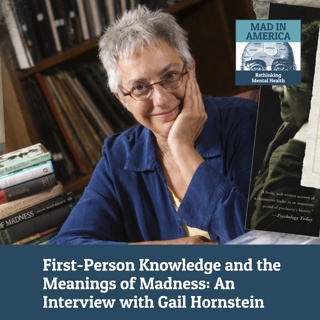
First-Person Knowledge and the Meanings of Madness: An Interview with Gail Hornstein

First-Person Knowledge and the Meanings of Madness: An Interview with Gail Hornstein

Gail Hornstein is Professor Emerita of Psychology at Mount Holyoke College. Across a long and influential career, her work has moved between psychology, psychoanalysis, history, qualitative research, ...

2 Syys 1h 8min
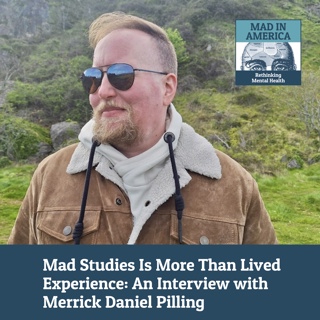
Mad Studies Is More Than Lived Experience: An Interview with Merrick Daniel Pilling

Mad Studies Is More Than Lived Experience: An Interview with Merrick Daniel Pilling

Merrick Daniel Pilling is an Associate Professor and Interim Co-Director of the School of Disability Studies at Toronto Metropolitan University. He is the author of Queer and Trans Madness: Struggles ...

19 Elo 49min
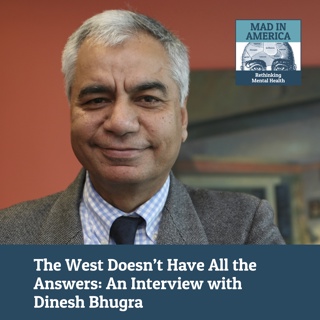
The West Doesn't Have All the Answers: An Interview with Dinesh Bhugra

The West Doesn't Have All the Answers: An Interview with Dinesh Bhugra

Dinesh Bhugra is a leading voice in social and cultural psychiatry. He is Emeritus Professor of Mental Health and Cultural Diversity at King's College London and has served as president of the Royal ...

12 Elo 36min
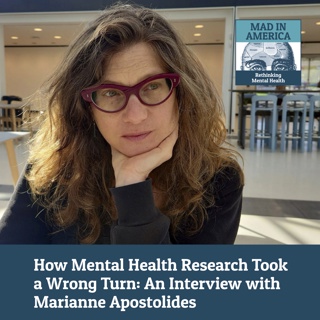
Go/No Go - How Mental Health Research Took a Wrong Turn: An Interview with Marianne Apostolides

Go/No Go - How Mental Health Research Took a Wrong Turn: An Interview with Marianne Apostolides

Marianne Apostolides is the award-winning author of eight books, four of which have been translated and published internationally. She is a two-time recipient of the Chalmers Arts Fellowship and winne...

29 Heinä 48min
Unlearn Your Pain: Harnessing the Power of Neuroplasticity – A Conversation With Howard Schubiner

Unlearn Your Pain: Harnessing the Power of Neuroplasticity – A Conversation With Howard Schubiner

Welcome to the Mad in America podcast. My name is Brooke Siem, and I am the author of the award-winning memoir on antidepressant withdrawal, May Cause Side Effects. Today, I'm excited to have Dr. Howa...

15 Heinä 41min
The Empire of Madness: Why Psychiatry Must Rethink Human Suffering - An Interview with Khameer Kidia

The Empire of Madness: Why Psychiatry Must Rethink Human Suffering - An Interview with Khameer Kidia

Khameer Kidia is a physician and an anthropologist, works at Harvard Medical School and the University of Zimbabwe, and spends his life between Washington DC and Harare. Kidia has many accolades to hi...

8 Heinä 48min
A Mother's Journey Through Psychiatric Drug Harm and Healing

A Mother's Journey Through Psychiatric Drug Harm and Healing

Chelsea McVeigh began her journey with psychiatric medications at 16, never imagining where it would lead. At 31, during a new pregnancy, she suffered a severe adverse reaction that turned her world u...

1 Heinä 24min

Suosittua kategoriassa Terveys ja hyvinvointi

unicast
aamukahvilla
tiedenaiset-podcast
vakeva-elama-viisaampi-mieli-vahvempi-keho
meditaatiot-suomeksi
psykopodiaa-podcast
terapiassa
rss-pitaisko-erota
katilon-kahvitunti
rss-kuumilla-aalloilla
voi-hyvin-meditaatiot-2
rss-pt-paahtio
rss-sanelunpurku-podcast
rss-duodecim-lehti
fitnesskuplassa
paritellen
rss-uplevel-by-sonja-hannus
rss-kehtaanko-kysya-podcast-aideille
selviytyjat-tarinoita-elamasta
fitnessvastaanotto