World Benzodiazepine Awareness Day 2018 - Part 2 - Robert Whitaker

World Benzodiazepine Awareness Day 2018 - Part 2 - Robert Whitaker

This week on MIA Radio, we present a special episode of the podcast to join in the many events being held for World Benzodiazepine Awareness Day, July 11, 2018.

In part 2 of the podcast, we interview Mad in America founder, Robert Whitaker. For many of us, Robert needs no introduction as he is well known for his award-winning book, Anatomy of an Epidemic: Magic Bullets, Psychiatric Drugs, and the Astonishing Rise of Mental Illness in America, which was released in 2010.

Robert has been a medical writer at the Albany Times Union newspaper, A journalism fellow at the Massachusetts Institute of Technology and Director of publications at the Harvard Medical School. Besides many papers, journals and articles, Robert has written five books which include Mad In America: Bad Science, Bad Medicine, and The Enduring Mistreatment of the Mentally Ill in 2001, Anatomy of an Epidemic in 2010 and Psychiatry Under The Influence: Institutional Corruption, Social Injury, and Prescriptions for Reform published in 2015.

We discuss:
  • What took Bob from writing as an industry insider covering clinical trials to founding Mad in America.
  • How writing a story about the botched introduction of laparoscopic surgery led to an interest in how commerce was corrupting healthcare.
  • How Freedom of Information requests led to an understanding of the corruption in the clinical trials of antipsychotic drugs.
  • What led to writing the book Mad in America: Bad Science, Bad Medicine, and The Enduring Mistreatment of the Mentally Ill in 2001.
  • That, when you look at the science, you see an enduring theme in psychiatry of treatments that are full of promise, but ultimately can lead to harm.
  • That Bob came to these issues as a journalist who felt a sense of public duty to be an honest reporter of the facts and the science.
  • The extraordinary history behind the revival of the market for benzodiazepines.
  • How Valium became the western world's most prescribed psychiatric drug during the late 1960s.
  • How, in the 1970s, it became apparent that people were struggling to get off the drugs.
  • That women's magazines started to write about the experiences of women addicted to Valium, and it was recognised as a bigger issue than heroin addiction.
  • That the reaction by the pharmaceutical manufacturers was to reconceptualize anxiety-related distress as depressive distress and move patients on to SSRIs.
  • How in 1980, in the third version of the Diagnostic and Statistical Manual, a new disorder is named: Panic Disorder, leading the maker of Alprazolam, Upjohn, to get it approved specifically for the treatment of panic disorder.
  • How the study published showed that the reduction in panic attacks in the medicated group over four weeks was greater than the unmedicated group, but the study actually ran for eight weeks, by which time there was no difference between the medicated and unmedicated groups.
  • That in the six-week withdrawal phase of the study, 44% were not able to stop the drugs.
  • How newspapers reported that Xanax (Alprazolam) was an efficacious, safe and non-addictive treatment for panic disorder.
  • That what you see in the heart of the Xanax story is a betrayal of the public.
  • The reasons why doctors often don't review the papers that would lead them to conclude that benzodiazepines are highly problematic drugs.
  • A paper from a new International Task Force on Benzodiazepines which seems to be a statement of intent to increase benzodiazepine prescribing.
  • That people should keep on telling their stories of withdrawal and iatrogenic harm.
  • The attempt in Massachusetts to pass a bill requiring informed consent.
  • The problems inherent in using the language of withdrawal when the symptoms are protracted and that it would be more appropriate to describe this as a neurological injury.
  • That the benzodiazepine community is doing an incredible service by alerting the public to what should be seen as a public health crisis.
Relevant links:

Revival of the market for Benzodiazepines

Malcolm Lader: It is more difficult to withdraw people from benzodiazepines than it is from heroin

International Task Force on Benzodiazepines

Jaksot(290)

Mitochondria and Energetic Failures - A New Understanding of Antidepressant Withdrawal? An Interview with Chris Masterjohn

Mitochondria and Energetic Failures - A New Understanding of Antidepressant Withdrawal? An Interview with Chris Masterjohn

This week, we are joined by Chris Masterjohn, PhD. Chris is a nutritional scientist, a former professor, and the founder of Mitome. With a PhD in nutritional science and years of research in mitochond...

21 Tammi 43min

Why Critical Mental Health Knowledge Is Essential for Ethical Practice: An Interview with Jan DeFehr

Why Critical Mental Health Knowledge Is Essential for Ethical Practice: An Interview with Jan DeFehr

Jan N. DeFehr is an associate professor in the Faculty of Education at the University of Winnipeg and an associate of The Taos Institute and a member of the Faculty for Palestine, Manitoba. She is als...

14 Tammi 47min
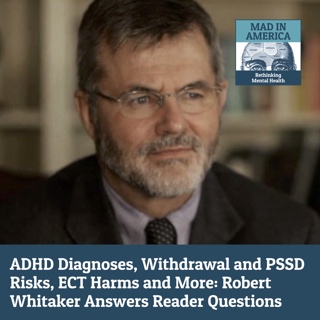
ADHD Diagnoses, Examining the Psyche, Withdrawal and PSSD Risks, ECT Harms and More: Robert Whitaker Answers Reader Questions

ADHD Diagnoses, Examining the Psyche, Withdrawal and PSSD Risks, ECT Harms and More: Robert Whitaker Answers Reader Questions

In our first podcast of 2026, Robert Whitaker joins us to answer questions submitted by Mad in America readers and listeners. We discuss the validity of ADHD diagnoses, withdrawal and sexual dysfuncti...

7 Tammi 48min

Learning to Soar: A Conversation With Artist Kev G Mor

Learning to Soar: A Conversation With Artist Kev G Mor

Musician and artist Kev G Mor joins us to discuss his experience of psychosis, his daily support strategies, and the pros and cons of having a hundred-pound pit bull terrier for emotional support. Kev...

17 Joulu 202543min
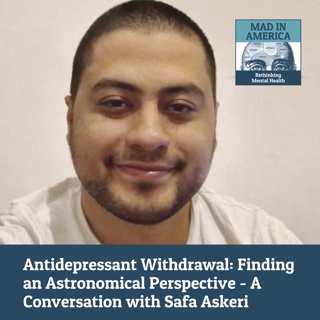
Antidepressant Withdrawal: Finding an Astronomical Perspective - A Conversation with Safa Askeri

Antidepressant Withdrawal: Finding an Astronomical Perspective - A Conversation with Safa Askeri

Safa Askeri joins us to discuss his experience of antidepressant withdrawal and the gaslighting he was subjected to as he raised concerns with his doctors. "After this happened to me, I know that I ca...

19 Marras 202537min
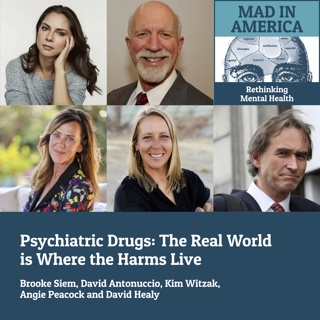
Psychiatric Drugs: The Real World is Where the Harms Live

Psychiatric Drugs: The Real World is Where the Harms Live

Joining us for a roundtable discussion are Brooke Siem, David Antonuccio, Kim Witzak, Angie Peacock and David Healy. They discuss the challenges of openly discussing psychiatric drug withdrawal, the t...

29 Loka 202545min
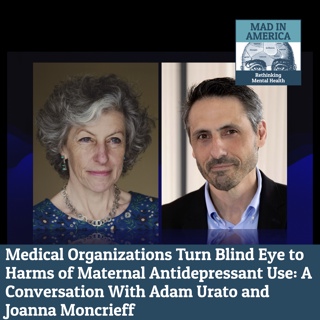
Medical Organizations Turn Blind Eye to Harms of Maternal Antidepressant Use: A Conversation With Adam Urato and Joanna Moncrieff

Medical Organizations Turn Blind Eye to Harms of Maternal Antidepressant Use: A Conversation With Adam Urato and Joanna Moncrieff

On July 21st 2025, the FDA convened a hearing on maternal use of antidepressants during pregnancy and the impact this use has on fetal development. Around 400,000 children in the United States are bor...

8 Loka 202548min
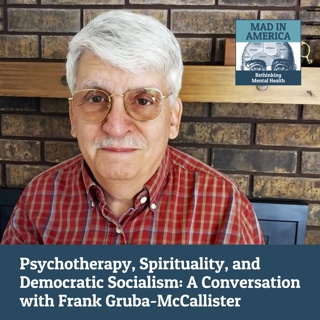
Psychotherapy, Spirituality, and Democratic Socialism: A Conversation with Frank Gruba-McCallister

Psychotherapy, Spirituality, and Democratic Socialism: A Conversation with Frank Gruba-McCallister

Frank Gruba-McCallister is a clinical psychologist, educator, and scholar whose career spans more than three decades of teaching and academic leadership. He served as Vice President of Academic Affai...

24 Syys 202544min

Suosittua kategoriassa Terveys ja hyvinvointi

unicast
tiedenaiset-podcast
psykopodiaa-podcast
voi-hyvin-meditaatiot-2
rss-pitaisko-erota
vakeva-elama-viisaampi-mieli-vahvempi-keho
meditaatiot-suomeksi
junnut-pelissa
rss-mighty-finland-podcast
puhu-muru
rss-narsisti
terapiassa
paritellen
aamukahvilla
mielen-puolikkaat
rss-uplevel-by-sonja-hannus
rss-pt-paahtio
rss-vapaudu-voimaasi
rss-adama-mindful-hetki
rss-nautinto