Unbundling AI Openness: Beyond the Binary
Interpreting India16 Loka 2025

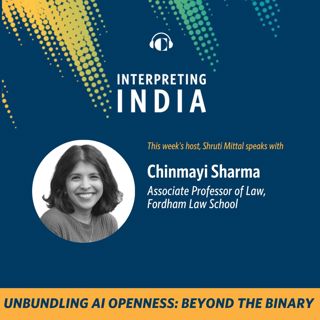
Unbundling AI Openness: Beyond the Binary

The episode challenges the familiar “open versus closed” framing of AI systems. Sharma argues that openness is not inherently good or bad—it is an instrumental choice that should align with specific policy goals. She introduces a seven-part taxonomy of AI—compute, data, source code, model weights, system prompts, operational records and controls, and labor—to show how each component interacts differently with innovation, safety, and governance. Her central idea, differential openness, suggests that each component can exist along a spectrum rather than being entirely open or closed. For instance, a company might keep its training data private while making its system prompts partially accessible, allowing transparency without compromising competitive or national interests. Using the example of companion bots, Sharma highlights how tailored openness across components can enhance safety and oversight while protecting user privacy. She urges policymakers to adopt this nuanced approach, applying varying levels of openness based on context—whether in public services, healthcare, or defense. The episode concludes by emphasizing that understanding these layers is vital for shaping balanced AI governance that safeguards public interest while supporting innovation.

How can regulators determine optimal openness levels for different components of AI systems? Can greater transparency coexist with innovation and competitive advantage? What governance structures can ensure that openness strengthens democratic accountability without undermining safety or national security?

Episode Contributors

Chinmayi Sharma is an associate professor of law at Fordham Law School in New York. She is a nonresident fellow at the Stoss Center, the Center for Democracy and Technology, and the Atlantic Council. She serves on Microsoft’s Responsible AI Committee and the program committees for the ACM Symposium on Computer Science and Law and the ACM Conference on Fairness, Accountability, and Transparency.

Shruti Mittal is a research analyst at Carnegie India. Her current research interests include artificial intelligence, semiconductors, compute, and data governance. She is also interested in studying the potential socio-economic value that open development and diffusion of technologies can create in the Global South.

Suggested Readings

Unbundling AI Openness by Parth Nobel, Alan Z. Rozenshtein, and Chinmayi Sharma.

Tragedy of the Digital Commons by Chinmayi Sharma.

India’s AI Strategy: Balancing Risk and Opportunity by Amlan Mohanty and Shatakratu Sahu.

Every two weeks, Interpreting India brings you diverse voices from India and around the world to explore the critical questions shaping the nation's future. We delve into how technology, the economy, and foreign policy intertwine to influence India's relationship with the global stage.

As a Carnegie India production, hosted by Carnegie scholars, Interpreting India, a Carnegie India production, provides insightful perspectives and cutting-edge by tackling the defining questions that chart India's course through the next decade.

Stay tuned for thought-provoking discussions, expert insights, and a deeper understanding of India's place in the world.

Don't forget to subscribe, share, and leave a review to join the conversation and be part of Interpreting India's journey.

Tämä jakso on lisätty Podme-palveluun avoimen RSS-syötteen kautta eikä se ole Podmen omaa tuotantoa. Siksi jakso saattaa sisältää mainontaa.

Jaksot(148)

AI Literacy and the Future of Work in India

AI Literacy and the Future of Work in India

Jaspreet's framing for the AI and work debate is worth staying with. He is not dismissive of disruption: he thinks AI will destroy certain jobs, create new ones, and the rupture will be real. But he p...

26 Touko 44min
Can AI Resources Be Democratized? AI Summit Special

Can AI Resources Be Democratized? AI Summit Special

This episode is part of our special series on the India AI Impact Summit, examining the conversations, decisions, and debates that are shaping global AI governance. The working group was designed from...

15 Touko 28min

Space Security in the Age of AI

Space Security in the Age of AI

Almudena opens with a distinction that anchors the entire conversation: space security, unlike space safety, is about intentional harm. It concerns deliberate attempts to disrupt, deny, or destroy spa...

7 Touko 1h 7min

An African Perspective for Building AI for Global South | AI Summit Special

An African Perspective for Building AI for Global South | AI Summit Special

This episode is part of our special series on the India AI Impact Summit, examining the conversations, decisions, and debates that are shaping global AI governance. Raymond draws a distinction early i...

30 Huhti 48min

The India-EU Trade Deal: What It Delivers and What It Doesn't

The India-EU Trade Deal: What It Delivers and What It Doesn't

For most of the last decade, a trade deal between India and the EU seemed unlikely. The nudge came as the world changed around both. Nicolas points to three converging forces: the pressure of US tarif...

23 Huhti 51min

From Bletchley Park to Delhi and What Comes Next | AI Summit Special

From Bletchley Park to Delhi and What Comes Next | AI Summit Special

This episode is part of our special series on the India AI Impact Summit 2026, examining the conversations, perspectives, and debates that are shaping global AI discourse. Tino has been in the room a...

16 Huhti 54min

Data, AI, and the Laws Trying to Keep Up

Data, AI, and the Laws Trying to Keep Up

The conversation begins with a close look at India’s data protection regime, particularly the DPDP Act and its emphasis on consent. Nikhil challenges the perception that the law is overly consent-driv...

31 Maalis 42min

Inside the Iran Conflict: Power, Strategy, and India’s Balancing Act

Inside the Iran Conflict: Power, Strategy, and India’s Balancing Act

The conversation begins with a look at where the conflict stands today and how Iran has managed to absorb significant military pressure while still responding in a measured way. Dharmendra explains ho...

25 Maalis 1h 8min

Suosittua kategoriassa Politiikka ja uutiset

uutiscast
aikalisa
politiikan-puskaradio
rss-ootsa-kuullut-tasta
ootsa-kuullut-tasta-2
rss-podme-livebox
tervo-halme
otetaan-yhdet
rss-vaalirankkurit-podcast
et-sa-noin-voi-sanoo-esittaa
viisupodi
rss-asiastudio
linda-maria
rss-girls-finish-f1rst
rss-pinnalla
the-ulkopolitist
helsingin-sanomat-dev
rss-kaikki-paskaksi-ystavat
rss-hyvaa-huomenta-bryssel
rss-ulkopoditiikkaa