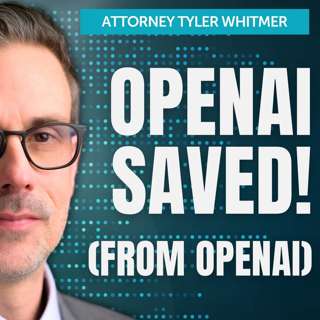
OpenAI: The nonprofit refuses to be killed (with Tyler Whitmer)
80,000 Hours Podcast11 Marras 2025

OpenAI: The nonprofit refuses to be killed (with Tyler Whitmer)

Last December, the OpenAI business put forward a plan to completely sideline its nonprofit board. But two state attorneys general have now blocked that effort and kept that board very much alive and kicking.

The for-profit’s trouble was that the entire operation was founded on the premise of — and legally pledged to — the purpose of ensuring that “artificial general intelligence benefits all of humanity.” So to get its restructure past regulators, the business entity has had to agree to 20 serious requirements designed to ensure it continues to serve that goal.

Attorney Tyler Whitmer, as part of his work with Legal Advocates for Safe Science and Technology, has been a vocal critic of OpenAI’s original restructure plan. In today’s conversation, he lays out all the changes and whether they will ultimately matter.

Full transcript, video, and links to learn more: https://80k.info/tw2

After months of public pressure and scrutiny from the attorneys general (AGs) of California and Delaware, the December proposal itself was sidelined — and what replaced it is far more complex and goes a fair way towards protecting the original mission:

  • The nonprofit’s charitable purpose — “ensure that artificial general intelligence benefits all of humanity” — now legally controls all safety and security decisions at the company. The four people appointed to the new Safety and Security Committee can block model releases worth tens of billions.
  • The AGs retain ongoing oversight, meeting quarterly with staff and requiring advance notice of any changes that might undermine their authority.
  • OpenAI’s original charter, including the remarkable “stop and assist” commitment, remains binding.

But significant concessions were made. The nonprofit lost exclusive control of AGI once developed — Microsoft can commercialise it through 2032. And transforming from complete control to this hybrid model represents, as Tyler puts it, “a bad deal compared to what OpenAI should have been.”

The real question now: will the Safety and Security Committee use its powers? It currently has four part-time volunteer members and no permanent staff, yet they’re expected to oversee a company racing to build AGI while managing commercial pressures in the hundreds of billions.

Tyler calls on OpenAI to prove they’re serious about following the agreement:

  • Hire management for the SSC.
  • Add more independent directors with AI safety expertise.
  • Maximise transparency about mission compliance.

"There’s a real opportunity for this to go well. A lot … depends on the boards, so I really hope that they … step into this role … and do a great job. … I will hope for the best and prepare for the worst, and stay vigilant throughout."

Chapters:

  • We’re hiring (00:00:00)
  • Cold open (00:00:40)
  • Tyler Whitmer is back to explain the latest OpenAI developments (00:01:46)
  • The original radical plan (00:02:39)
  • What the AGs forced on the for-profit (00:05:47)
  • Scrappy resistance probably worked (00:37:24)
  • The Safety and Security Committee has teeth — will it use them? (00:41:48)
  • Overall, is this a good deal or a bad deal? (00:52:06)
  • The nonprofit and PBC boards are almost the same. Is that good or bad or what? (01:13:29)
  • Board members’ “independence” (01:19:40)
  • Could the deal still be challenged? (01:25:32)
  • Will the deal satisfy OpenAI investors? (01:31:41)
  • The SSC and philanthropy need serious staff (01:33:13)
  • Outside advocacy on this issue, and the impact of LASST (01:38:09)
  • What to track to tell if it's working out (01:44:28)


This episode was recorded on November 4, 2025.

Video editing: Milo McGuire, Dominic Armstrong, and Simon Monsour
Audio engineering: Milo McGuire, Simon Monsour, and Dominic Armstrong
Music: CORBIT
Coordination, transcriptions, and web: Katy Moore

Jaksot(320)

#116 – Luisa Rodriguez on why global catastrophes seem unlikely to kill us all

#116 – Luisa Rodriguez on why global catastrophes seem unlikely to kill us all

If modern human civilisation collapsed — as a result of nuclear war, severe climate change, or a much worse pandemic than COVID-19 — billions of people might die.That's terrible enough to contemplate....

19 Marras 20213h 45min
#115 – David Wallace on the many-worlds theory of quantum mechanics and its implications

#115 – David Wallace on the many-worlds theory of quantum mechanics and its implications

Quantum mechanics — our best theory of atoms, molecules, and the subatomic particles that make them up — underpins most of modern physics. But there are varying interpretations of what it means, all o...

12 Marras 20213h 9min
#114 – Maha Rehman on working with governments to rapidly deliver masks to millions of people

#114 – Maha Rehman on working with governments to rapidly deliver masks to millions of people

It’s hard to believe, but until recently there had never been a large field trial that addressed these simple and obvious questions:1. When ordinary people wear face masks, does it actually reduce the...

22 Loka 20211h 42min
We just put up a new compilation of ten core episodes of the show

We just put up a new compilation of ten core episodes of the show

We recently launched a new podcast feed that might be useful to you and people you know. It's called Effective Altruism: Ten Global Problems, and it's a collection of ten top episodes of this show, se...

20 Loka 20213min
#113 – Varsha Venugopal on using gossip to help vaccinate every child in India

#113 – Varsha Venugopal on using gossip to help vaccinate every child in India

Our failure to make sure all kids globally get all of their basic vaccinations leads to 1.5 million child deaths every year.According to today’s guest, Varsha Venugopal, for the great majority this ha...

18 Loka 20212h 5min
#112 – Carl Shulman on the common-sense case for existential risk work and its practical implications

#112 – Carl Shulman on the common-sense case for existential risk work and its practical implications

Preventing the apocalypse may sound like an idiosyncratic activity, and it sometimes is justified on exotic grounds, such as the potential for humanity to become a galaxy-spanning civilisation.But the...

5 Loka 20213h 48min
#111 – Mushtaq Khan on using institutional economics to predict effective government reforms

#111 – Mushtaq Khan on using institutional economics to predict effective government reforms

If you’re living in the Niger Delta in Nigeria, your best bet at a high-paying career is probably ‘artisanal refining’ — or, in plain language, stealing oil from pipelines. The resulting oil spills da...

10 Syys 20213h 20min
#110 – Holden Karnofsky on building aptitudes and kicking ass

#110 – Holden Karnofsky on building aptitudes and kicking ass

Holden Karnofsky helped create two of the most influential organisations in the effective philanthropy world. So when he outlines a different perspective on career advice than the one we present at 80...

26 Elo 20212h 46min

Suosittua kategoriassa Koulutus

rss-murhan-anatomia
psykopodiaa-podcast
rss-narsisti
voi-hyvin-meditaatiot-2
aamukahvilla
rss-vapaudu-voimaasi
rss-niinku-asia-on
psykologia
rss-liian-kuuma-peruna
adhd-podi
kesken
dear-ladies
leveli
rss-duodecim-lehti
rss-koira-haudattuna
rss-luonnollinen-synnytys-podcast
rahapuhetta
aloita-meditaatio
ihminen-tavattavissa-tommy-hellsten-instituutti
rss-ai-mita-siskopodcast