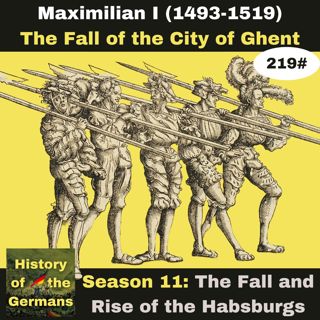
Ep.219:  Maximilian I (1493-1519) – The Fall of Ghent

Ep.219: Maximilian I (1493-1519) – The Fall of Ghent

The words High and Late Middle Ages conjures up images of fog rising up over a field where knights in shining armor are trading blows with double handed swords, mighty bishops overseeing the construction of monumental cathedrals and peasants toiling on the land as serfs.

The reason we see it that way goes back to the chivalric literature that celebrated the aristocratic lifestyle where tournaments and poetry mattered more than the humdrum world of business.

But let’s just take a look back at the High Middle Ages, the time of Richard the Lionheart, Saint Louis and Frederick Barbarossa. Who controlled access to the great endeavor of the time, the conquest of the Holy Land? Who re-opened up the connections to the wider world, from Novgorod to India and China? Who were the most ferocious fighters who neither expected norgranted any quarter? Who had all the money?

These were the great cities of Italy, of Flanders, of Picardie and Provence and of the Holy Roman Empire. Verona under the Della Scala in the 14th century generated tax revenues twice as high as those of England, Venice capacity was sixty percent of what France could generate. And these cities fielded armies that, as we know, defeated the Holy Roman Emperors, even the most capable ones like Barbarossa and Frederick II time and time again. Their absolute dedication to fight to the end was evidenced by their extremely heavy and slow war carts, the Carroccios and by the bravery of the Flemish Militia at the Battle of the Golden Spurs. And the first European since Roman times to make to India and China wasn’t a Knight errant, but a Venetian merchant, nor were the vast lands on the Eastern side of the continent linked up by military force. The crusades, the grand project of the age was as much a venetian mercantile adventure as a religious pilgrimage, culminating in the sack of Constantinople in 1204.

What happened? Where did all these city states go? And why?

That is what we are going to discuss today, when we look at the showdown between Maximilian of Habsburg, widower of the last duchess of Burgundy and father of Philip, the universally recognised heir of the Low Countries and the Flemish cities, and specifically its largest, the city of Ghent.

The music for the show is Flute Sonata in E-flat major, H.545 by Carl Phillip Emmanuel Bach (or some claim it as BWV 1031 Johann Sebastian Bach) performed and arranged by Michel Rondeau under Common Creative Licence 3.0.

As always:

Homepage with maps, photos, transcripts and blog: www.historyofthegermans.com

If you wish to support the show go to: Support • History of the Germans Podcast

For do it yourself merchandise go to: Merchandise • History of the Germans Podcast

Facebook: @HOTGPod

Threads: @history_of_the_germans_podcast

Bluesky: @hotgpod.bsky.social

Instagram: history_of_the_germans

Twitter: @germanshistory

To make it easier for you to share the podcast, I have created separate playlists for some of the seasons that are set up as individual podcasts. they have the exact same episodes as in the History of the Germans, but they may be a helpful device for those who want to concentrate on only one season.

So far I have:

The Ottonians

Salian Emperors and Investiture Controversy

Fredrick Barbarossa and Early Hohenstaufen

Frederick II Stupor Mundi

Saxony and Eastward Expansion

The Hanseatic League

The Teutonic Knights

The Holy Roman Empire 1250-1356

The Reformation before the Reformation

The Empire in the 15th century

The Fall and Rise of the Habsburgs

Episoder(247)

Ep. 205: Habsburg Dukes (1308-1437) – Sempach, Birth of a Nation

Ep. 205: Habsburg Dukes (1308-1437) – Sempach, Birth of a Nation

On July 9th, 1386 in a field near the Sempach lake., the armies of archduke Leopold of Austria line up against the forces of the city of Lucerne and the men of Uri, Schwyz and NidwaldenMuch of what ha...

4 Sep 202538min
Ep. 204: Habsburg Dukes (1308-1437) – Rudolf IV, Founder and Forger

Ep. 204: Habsburg Dukes (1308-1437) – Rudolf IV, Founder and Forger

Rudolf IV of Habsburg (1339–1365), son of Albrecht “the Wise,” reigned as Duke of Austria for just seven years but left a lasting mark. Born when the dynasty seemed close to extinction, Rudolf secured...

28 Aug 202532min
Ep. 203: Early Habsburgs – From Rudolf I to Albrecht the Wise

Ep. 203: Early Habsburgs – From Rudolf I to Albrecht the Wise

The Habsburg dynasty, originating from Radobot’s castle in 11th-century Switzerland, rose from obscurity to European prominence. In 1273 Rudolf of Habsburg was elected King of the Romans. Far from the...

21 Aug 202525min
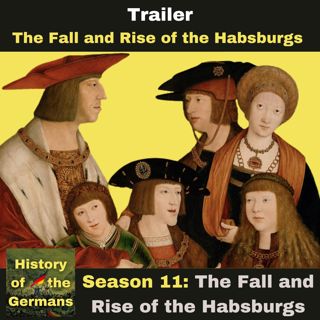
The Fall and Rise of the House of Habsburg - Trailer

The Fall and Rise of the House of Habsburg - Trailer

"Let others wage war: you, happy Austria, marry’. Is that really it? Did this family acquire an empire where the sun never sets through just luck and longevity?That is what we will try to find out in ...

14 Aug 20256min

Ep. 202 - Arms and Armour

Ep. 202 - Arms and Armour

In 1550 Spanish court records show that the Augsburg armorer Kolman Helmschmied was paid an advance of 2,000 ducats for a full armour for king Philipp II. The final price for this piece was 3,000 duca...

24 Jul 202535min

Ep. 201 – Mapping the World, or how Germans invented America

Ep. 201 – Mapping the World, or how Germans invented America

When you enter the great hall of the Thomas Jefferson building at the Library of Congress in Washington, the first exhibit you will be facing is their Gutenberg Bible. And it is one of the finest Gute...

17 Jul 202548min
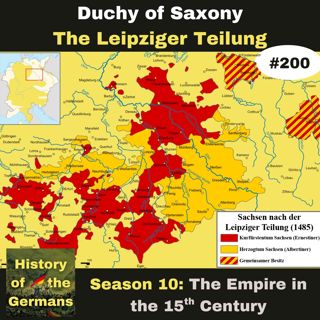
Ep. 200 – Divide and Lose, the Leipziger Teilung

Ep. 200 – Divide and Lose, the Leipziger Teilung

When two brothers, Ernst and Albrecht of Saxony divided up their enormous inheritance that comprised Thuringia, Meissen and the electorate of Sachsen-Wittenberg, they not only undermined their power b...

3 Jul 202528min
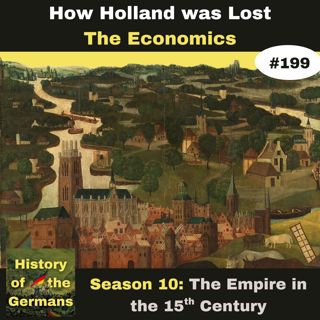
Ep. 199 – How Holland was Lost to the Holy Roman Empire (Part 2 - the Economy)

Ep. 199 – How Holland was Lost to the Holy Roman Empire (Part 2 - the Economy)

So, why did Holland really leave the empire? Was it because the valiant and tragic countess Jacqueline was “hunted down from one land to the other, all of them mine”. Was it a story of misogyny, betra...

26 Jun 202535min

Populært innen Fakta

fastlegen
dine-penger-pengeradet
relasjonspodden-med-dora-thorhallsdottir-kjersti-idem
mikkels-paskenotter
foreldreradet
rss-strid-de-norske-borgerkrigene
treningspodden
rss-bisarr-historie
jakt-og-fiskepodden
rss-sunn-okonomi
sinnsyn
takk-og-lov-med-anine-kierulf
ukast
hverdagspsyken
rss-bak-luftfarten
gravid-uke-for-uke
lederskap-nhhs-podkast-om-ledelse
fryktlos
level-up-med-anniken-binz
tomprat-med-gunnar-tjomlid