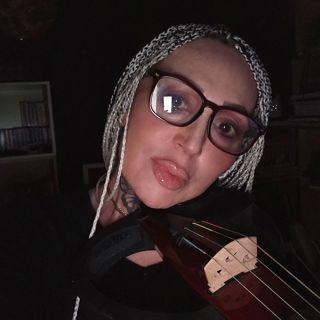

đŸŽ» The Viola: Naming the Structure Understanding the Space | iServalan | Continuum Approach

đŸŽ» The Viola: Naming the Structure Understanding the Space | iServalan | Continuum Approach

This essay accompanies an audio episode from iServalan and forms part of a wider approach to learning music through listening, movement, and attention.

đŸŽ» The Viola: Naming the Structure, Standing in the Middle Voice

Before we talk about comparison,
before we talk about being “overlooked,”
before we talk about whether the viola is harder or easier — we meet it properly. Because the viola is not a compromise.
It is a place. And to stand in that place,
we need shared language. Not memorised.
Not defended.
Simply understood. So when I name something,
you know where we are. The Body of the Viola Let’s begin at the top. At the very top is the scroll,
similar in shape to the violin’s,
but carried by a larger body below. Beneath it sit the tuning pegs,
resting in the pegbox,
guiding the strings down into the neck
and onto the fingerboard. The fingerboard is longer than the violin’s,
wider beneath the hand,
asking for more reach,
more patience. This is an instrument that does not rush. Where the fingerboard meets the neck is the nut,
a small but precise piece of wood
cut to guide the strings cleanly and evenly. Below this point, the instrument opens into its body. The front is the top plate,
arched to move air slowly and richly.
The f-holes are wider set,
releasing sound that does not shout
but spreads. The bridge stands beneath the strings,
balanced — not fixed —
holding tension through placement alone. The strings pass down to the tailpiece,
secured by the tailgut,
and finally to the end button,
which anchors the instrument to the player’s body. Inside, unseen but vital,
the bass bar supports resonance,
and the soundpost transfers vibration,
linking front and back. You do not need to picture all of this clearly. You only need to feel
that this is a larger, slower-speaking system. The Bow The viola bow is heavier than the violin bow,
with a broader ribbon of hair. There is a stick.
There is bow hair.
There is the frog —
the weighted, adjustable meeting point
where the hand transfers arm weight into sound. The opposite end is the tip. These words matter
because teachers will use them,
and they refer not to judgement,
but to location. The bow is not about pressure.
It is about staying long enough for sound to bloom. Holding the Viola The viola rests on the body
much like the violin,
but it asks for more space. The instrument sits slightly lower.
The left arm opens more.
The right arm travels further. If you try to treat it like a violin,
it resists. If you give it time,
it responds. This is not an instrument for urgency.You tuck the instrument between your shoulder and your chin.You can optionally use a shoulder rest. This is entirely a matter of choice. We will look further into this in a future episode. Taking Up Space: The Inner Orb Where the violin projects outward,
the viola settles inward. Imagine an orb around your torso —
not small,
but contained. Your breath lives here.
Your ribs.
Your shoulders. The bow moves through this space.
The sound grows from it. Nothing should feel pinched.
Nothing should feel apologetic. The viola does not reward forcing yourself forward.
It rewards depth. If you hurry,
the sound thins. So you allow yourself to stay. Calmly.
Steadily.
With trust. What Comes Next Now — and only now —
do we have what we need. Not repertoire.
Not comparison. But ground. A named structure.
A body allowed to open.
Time for sound to form. Now we can make a noise. A middle voice.
A necessary voice. And once that sound exists,
it holds everything together.It belongs to you.

iServalanℱ
Music, listening, and the Continuum Approach: Exploring sound across genres, eras, and performance cultures — from Baroque to punk, hip-hop to minimalism — without hierarchy or haste.

🎧 Podcast & essays: đŸŽ» Music School
https://iservalan.gumroad.com/l/concervatoire?
https://iservalan.gumroad.com📚 Books & long-form work by Sarnia de la MarĂ© FRSA:
https://www.amazon.co.uk/stores/author/B0CWGX2DJ6🎹 Professional profile:
https://www.a-n.co.uk/person/sarnia-de-la-mare-frsa-2/

#iServalan #ContinuumApproach #MusicPodcast #RadicalListening #MusicAcrossGenres
#PerformanceCulture #SarniaDeLaMaré

Episoder(252)

Music as Mental and Physical Occupation in Recovery | iServalan | Continuum Approach

Music as Mental and Physical Occupation in Recovery | iServalan | Continuum Approach

Music as Occupation(Why disciplined attention leaves little room for self-destruction)Music does not make people virtuous.It makes them busy in a particular way.Learning an instrument occupies the bra...

22 Des 20257min

What Would Chopin Have Done If Johnny Rotten Asked Him to Stand In One Night? | iServalan | Continuum

What Would Chopin Have Done If Johnny Rotten Asked Him to Stand In One Night? | iServalan | Continuum

What Would Chopin Have Done If Johnny Rotten Asked Him to Stand In One Night?(Public Image Ltd., not the Sex Pistols, this is my fantasy, and it was PIL who put the art into punk like no other).  If y...

22 Des 20253min

What Would Mozart Have Done If He’d Been Dropped Into a Grime Night? | iServalan | Continuum Approach

What Would Mozart Have Done If He’d Been Dropped Into a Grime Night? | iServalan | Continuum Approach

What Would Mozart Have Done If He’d Been Dropped Into a Grime Night? People underestimate Wolfgang Amadeus Mozart because they confuse charm with lightness. Mozart is funny, yes.He’s elegant, yes. A f...

22 Des 20253min

Beethoven by Robert S. Carr Live Public Domain Reading | iServalan | Continuum Approach

Beethoven by Robert S. Carr Live Public Domain Reading | iServalan | Continuum Approach

Robert S. Carr wrote a poem titled "Beethoven," published in Weird Tales magazine in August 1927, and it's available as an audio recording on LibriVox as part of a poetry collection, showcasing the Am...

22 Des 20251min

Who Would Win X Factor: Bach, Mozart, Chopin, Liszt or Rachmaninov? | iServalan | Continuum Approach

Who Would Win X Factor: Bach, Mozart, Chopin, Liszt or Rachmaninov? | iServalan | Continuum Approach

Who Would Win X Factor: Bach, Mozart, Chopin, Liszt or Rachmaninov?It sounds like a parlour game.But like most good parlour games, it reveals something uncomfortable about how we judge art.If the five...

21 Des 20255min

The Shepherd William Blake Public Domain Live Recording | iServalan | Continuum Approach

The Shepherd William Blake Public Domain Live Recording | iServalan | Continuum Approach

Beutiful #spokenwordiServalanℱMusic, listening, and the Continuum Approach: Exploring sound across genres, eras, and performance cultures — from Baroque to punk, hip-hop to minimalism — without hierar...

21 Des 202550s

Using the Body in Music | iServalan | Continuum Approach

Using the Body in Music | iServalan | Continuum Approach

Using the Body in Music(Why rhythm is learned before it is explained)Before music is something you do, it is something you coordinate.Long before a child understands beat, bar, or tempo, they already ...

21 Des 20255min

Teaching Tempo as Sensation, Not BPM | iServalan | Continuum Method

Teaching Tempo as Sensation, Not BPM | iServalan | Continuum Method

Teaching Tempo as Sensation, Not BPM(Why time must be felt before it can be counted)Tempo is usually introduced as a number.60 BPM.80 BPM.120 BPM.Neat. Measurable. Reassuring.And completely insufficie...

21 Des 20255min

PopulĂŠrt innen Fakta

fastlegen
dine-penger-pengeradet
relasjonspodden-med-dora-thorhallsdottir-kjersti-idem
mikkels-paskenotter
foreldreradet
treningspodden
rss-strid-de-norske-borgerkrigene
jakt-og-fiskepodden
sinnsyn
rss-bisarr-historie
takk-og-lov-med-anine-kierulf
rss-kull
rss-sunn-okonomi
fryktlos
hverdagspsyken
tomprat-med-gunnar-tjomlid
level-up-med-anniken-binz
hagespiren-podcast
gravid-uke-for-uke
rss-kunsten-a-leve