Why Visual Music Scores Might Be a Good Fit For Autistic Music Students | Continuum Approach

Why Visual Music Scores Might Be a Good Fit For Autistic Music Students | Continuum Approach

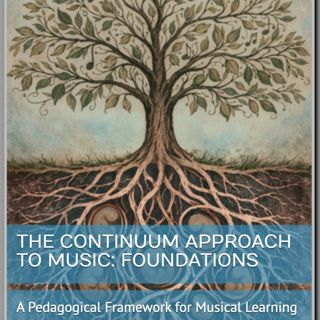
From the new Book The Continuum Approach to Music: Building: A Pedagogical Framework for Musical Learning (The Continuum Music Framework™ Part 2) Playing the Line, without reading note.

When we remove notes, bars, and instructions, something unexpected happens: musicians begin to listen again and to simultaneously express themselves musically without prior knowlege of music score reading. This is extremely liberating, great fun, and by default highly creative.

A line score, or image score, does not tell a performer what to play. It offers a direction of movement and asks the body to decide how sound should travel. The eye follows the line, the body and the impulse lead. Time becomes flexible. Pitch becomes relative, irrelevant even. Sound becomes an active flurry of instinct as the subcouncious impulses are allowed to run free.

For many players — dislexic, autistic, neurodivergent, or non score reading musicians — traditional notation can feel visually loud. White pages, dense symbols, and competing instructions demand constant decoding. A line on a dark field does the opposite. It reduces visual noise and allows motion to be perceived before meaning. The line is not read; it is traced with the eye and focused in the mind with a freer committment and an honest result.

This shift matters. When music is approached as motion rather than correctness, anxiety falls away. There are no wrong notes because there are no prescribed notes. There is only continuity, interruption, weight, and release. The performer listens not for accuracy, but for coherence.

Line or directional scores are particularly powerful in groups. When several performers follow the same direction — or co-existing lines of possibility— the music becomes collective without being uniform. Players move together in time and space (not necessarily at a regulated tempo) while remaining independent in sound. This produces music that is often deeply human, irregular, and emotionally aligned, even when the performers have not rehearsed together.Working with a teacher/conducter can add a level of organisation that acts as a cohesive energy, perhaps blowing a whistle or ringing a bell at the start of actionable symbols or intstructions.

At the piano, a line score can be followed by one hand or two. Each hand may trace a different line, or the same line in a different register. For percussion, the line becomes gesture and density. For voice, it becomes breath and contour. The image does not dictate the result; it invites it. There is no correct way to perform the piece and every performance will be different. Recording the productions leads to confident, experimental, and alternative works of pride for all participents offering an intrigueing look into a musician's personality and style.©2026 Sarnia de la Mare

iServalan™
Music, listening, and the Continuum Approach: Exploring sound across genres, eras, and performance cultures — from Baroque to punk, hip-hop to minimalism — without hierarchy or haste.

🎧 Podcast & essays: 🎻 Music School
https://iservalan.gumroad.com/l/concervatoire?
https://iservalan.gumroad.com📚 Books & long-form work by Sarnia de la Maré FRSA:
https://www.amazon.co.uk/stores/author/B0CWGX2DJ6🎨 Professional profile:
https://www.a-n.co.uk/person/sarnia-de-la-mare-frsa-2/

#iServalan #ContinuumApproach #MusicPodcast #RadicalListening #MusicAcrossGenres
#PerformanceCulture #SarniaDeLaMaré

Denne episoden er hentet fra en åpen RSS-feed og er ikke publisert av Podme. Den kan derfor inneholde annonser.

Episoder(255)

Mastering “He’s a Pirate” from Pirates of the Caribbean: A Complete Guide to ABRSM Cello Grade 3.

Mastering “He’s a Pirate” from Pirates of the Caribbean: A Complete Guide to ABRSM Cello Grade 3.

This is an InfoPod for Continuum School of Music.Mastering “He’s a Pirate” from Pirates of the Caribbean: A Complete Guide to ABRSM Cello Grade 3.Choosing repertoire for an ABRSM exam is never just ab...

29 Jun 8min

ABRSM vs Suzuki Methods for Instrumentalists New Learners Advice with Sylibi Explained #continuum

ABRSM vs Suzuki Methods for Instrumentalists New Learners Advice with Sylibi Explained #continuum

Book lessons at iServalan.comiServalan™Music, listening, and the Continuum Approach: Exploring sound across genres, eras, and performance cultures — from Baroque to punk, hip-hop to minimalism — witho...

21 Jun 8min

ABRSM Grade 1 Cello Exam Pieces with Descriptions and Information on Required Techniques #cellists

ABRSM Grade 1 Cello Exam Pieces with Descriptions and Information on Required Techniques #cellists

Join me on Patreon to book lessons. iServalan™Music, listening, and the Continuum Approach: Exploring sound across genres, eras, and performance cultures — from Baroque to punk, hip-hop to minimalism ...

19 Jun 1min

The Pattern Paradox: Why Artists Break What the World Repeats: Continuum Pedagogy

The Pattern Paradox: Why Artists Break What the World Repeats: Continuum Pedagogy

Essays from the Continuum Approach by Sarnia de la MAré FRSAiServalan™Music, listening, and the Continuum Approach: Exploring sound across genres, eras, and performance cultures — from Baroque to punk...

15 Mar 7min

Free Vocal Linguistics Voice as Language Before Words | Continuum Pedagogy

Free Vocal Linguistics Voice as Language Before Words | Continuum Pedagogy

Free Vocal Linguistics: Voice as Language Before Words In much formal musical training, the voice is introduced in a restricted and highly structured way. It is treated primarily as a vehicle for lyri...

8 Mar 7min

 How Scales and Sympathetic Strings Teach the Ear to Play | The Continuum Approach to Music

 How Scales and Sympathetic Strings Teach the Ear to Play | The Continuum Approach to Music

How Scales and Sympathetic Strings Teach the Ear to Play. Before we talk about scales, we should talk about listening. Most people are introduced to scales as ladders — up, down, repeat — something to...

7 Mar 5min

Interlude Lyrics Songs Live Readings in the Public Domain | Continuum Approach

Interlude Lyrics Songs Live Readings in the Public Domain | Continuum Approach

The Continuum Framework™ — A ManifestoThe Continuum Framework™ is a non-linear approach to musical learning that understands sound not as a series of achievements to be climbed, but as a field to be e...

7 Mar 1min

The Continuum Framework™ — A Manifesto by Sarnia de la Maré FRSA #pedagogy

The Continuum Framework™ — A Manifesto by Sarnia de la Maré FRSA #pedagogy

The Continuum Framework™ — A Manifesto. The Continuum Framework™ is a non-linear approach to musical learning that understands sound not as a series of achievements to be climbed, but as a field to be...

7 Mar 1min

Populært innen Fakta

fastlegen
dine-penger-pengeradet
relasjonspodden-med-dora-thorhallsdottir-kjersti-idem
foreldreradet
treningspodden
rss-kunsten-a-leve
mikkels-paskenotter
sinnsyn
rss-strid-de-norske-borgerkrigene
gravid-uke-for-uke
hverdagspsyken
tomprat-med-gunnar-tjomlid
rss-var-forste-kaffe
jakt-og-fiskepodden
rss-impressions-2
fryktlos
dopet
tid-for-historie
rss-sarbar-med-lotte-erik
hagespiren-podcast