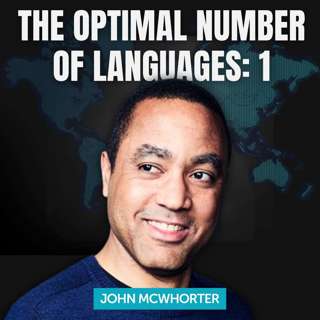
#142 Classic episode – John McWhorter on why the optimal number of languages might be one, and other provocative claims about language

#142 Classic episode – John McWhorter on why the optimal number of languages might be one, and other provocative claims about language

John McWhorter is a linguistics professor at Columbia University specialising in research on creole languages. He's also a content-producing machine, never afraid to give his frank opinion on anything and everything. On top of his academic work, he's written 22 books, produced five online university courses, hosts one and a half podcasts, and now writes a regular New York Times op-ed column.

Rebroadcast: this episode was originally released in December 2022.

YouTube video version: https://youtu.be/MEd7TT_nMJE

Links to learn more, video, and full transcript: https://80k.link/JM

We ask him what we think are the most important things everyone ought to know about linguistics, including:

  • Can you communicate faster in some languages than others, or is there some constraint that prevents that?
  • Does learning a second or third language make you smarter or not?
  • Can a language decay and get worse at communicating what people want to say?
  • If children aren't taught a language, how many generations does it take them to invent a fully fledged one of their own?
  • Did Shakespeare write in a foreign language, and if so, should we translate his plays?
  • How much does language really shape the way we think?
  • Are creoles the best languages in the world — languages that ideally we would all speak?
  • What would be the optimal number of languages globally?
  • Does trying to save dying languages do their speakers a favour, or is it more of an imposition?
  • Should we bother to teach foreign languages in UK and US schools?
  • Is it possible to save the important cultural aspects embedded in a dying language without saving the language itself?
  • Will AI models speak a language of their own in the future, one that humans can't understand but which better serves the tradeoffs AI models need to make?

We’ve also added John’s talk “Why the World Looks the Same in Any Language” to the end of this episode. So stick around after the credits!

Chapters:

  • Rob's intro (00:00:00)
  • Who's John McWhorter? (00:05:02)
  • Does learning another language make you smarter? (00:05:54)
  • Updating Shakespeare (00:07:52)
  • Should we bother teaching foreign languages in school? (00:12:09)
  • Language loss (00:16:05)
  • The optimal number of languages for humanity (00:27:57)
  • Do we reason about the world using language and words? (00:31:22)
  • Can we communicate meaningful information more quickly in some languages? (00:35:04)
  • Creole languages (00:38:48)
  • AI and the future of language (00:50:45)
  • Should we keep ums and ahs in The 80,000 Hours Podcast? (00:59:10)
  • Why the World Looks the Same in Any Language (01:02:07)

Producer: Keiran Harris
Audio mastering: Ben Cordell and Simon Monsour
Video editing: Ryan Kessler and Simon Monsour
Transcriptions: Katy Moore

Episoder(325)

#220 – Ryan Greenblatt on the 4 most likely ways for AI to take over, and the case for and against AGI in <8 years

#220 – Ryan Greenblatt on the 4 most likely ways for AI to take over, and the case for and against AGI in <8 years

Ryan Greenblatt — lead author on the explosive paper “Alignment faking in large language models” and chief scientist at Redwood Research — thinks there’s a 25% chance that within four years, AI will b...

8 Jul 20252h 50min

#219 – Toby Ord on graphs AI companies would prefer you didn't (fully) understand

#219 – Toby Ord on graphs AI companies would prefer you didn't (fully) understand

The era of making AI smarter just by making it bigger is ending. But that doesn’t mean progress is slowing down — far from it. AI models continue to get much more powerful, just using very different m...

24 Jun 20252h 48min
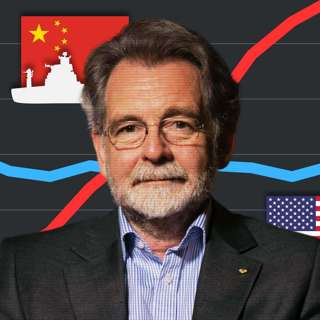
#218 – Hugh White on why Trump is abandoning US hegemony – and that’s probably good

#218 – Hugh White on why Trump is abandoning US hegemony – and that’s probably good

For decades, US allies have slept soundly under the protection of America’s overwhelming military might. Donald Trump — with his threats to ditch NATO, seize Greenland, and abandon Taiwan — seems hell...

12 Jun 20252h 48min

#217 – Beth Barnes on the most important graph in AI right now — and the 7-month rule that governs its progress

#217 – Beth Barnes on the most important graph in AI right now — and the 7-month rule that governs its progress

AI models today have a 50% chance of successfully completing a task that would take an expert human one hour. Seven months ago, that number was roughly 30 minutes — and seven months before that, 15 mi...

2 Jun 20253h 47min

Beyond human minds: The bewildering frontier of consciousness in insects, AI, and more

Beyond human minds: The bewildering frontier of consciousness in insects, AI, and more

What if there’s something it’s like to be a shrimp — or a chatbot?For centuries, humans have debated the nature of consciousness, often placing ourselves at the very top. But what about the minds of o...

23 Mai 20253h 34min

Don’t believe OpenAI’s “nonprofit” spin (emergency pod with Tyler Whitmer)

Don’t believe OpenAI’s “nonprofit” spin (emergency pod with Tyler Whitmer)

OpenAI’s recent announcement that its nonprofit would “retain control” of its for-profit business sounds reassuring. But this seemingly major concession, celebrated by so many, is in itself largely me...

15 Mai 20251h 12min

The case for and against AGI by 2030 (article by Benjamin Todd)

The case for and against AGI by 2030 (article by Benjamin Todd)

More and more people have been saying that we might have AGI (artificial general intelligence) before 2030. Is that really plausible? This article by Benjamin Todd looks into the cases for and against...

12 Mai 20251h

Emergency pod: Did OpenAI give up, or is this just a new trap? (with Rose Chan Loui)

Emergency pod: Did OpenAI give up, or is this just a new trap? (with Rose Chan Loui)

When attorneys general intervene in corporate affairs, it usually means something has gone seriously wrong. In OpenAI’s case, it appears to have forced a dramatic reversal of the company’s plans to si...

8 Mai 20251h 2min

Populært innen Fakta

fastlegen
dine-penger-pengeradet
relasjonspodden-med-dora-thorhallsdottir-kjersti-idem
treningspodden
foreldreradet
rss-strid-de-norske-borgerkrigene
jakt-og-fiskepodden
rss-sunn-okonomi
takk-og-lov-med-anine-kierulf
merry-quizmas
sinnsyn
rss-kunsten-a-leve
lederskap-nhhs-podkast-om-ledelse
gravid-uke-for-uke
smart-forklart
hverdagspsyken
level-up-med-anniken-binz
hagespiren-podcast
fryktlos
rss-kull