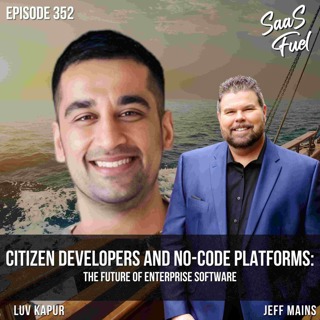
Citizen Developers and No-Code Platforms: The Future of Enterprise Software | Luv Kapur | 352

Citizen Developers and No-Code Platforms: The Future of Enterprise Software | Luv Kapur | 352

In this episode, Jeff Mains sits down with Luv Kapur, a technology leader at Bit who's reshaping how enterprises build software. Luv shares his journey from leading platform engineering at one of Canada's largest pension funds to joining a startup on a mission to help organizations scale development through composability and AI-powered tools.

The conversation explores how AI is fundamentally changing software development—not by writing more code, but by enabling teams to compose better solutions with less custom code. Luv challenges the hype around code generation, arguing that the real bottleneck isn't writing code but translating business requirements into sound architecture and reusing battle-tested components.

Luv also offers a grounded perspective on AI's impact on jobs, the importance of discoverability in component libraries, and practical advice for CTOs building composable organizations.

Key Takeaways

[0:00] - Episode introduction: AI-powered, cloud-native enterprise development tools

[1:00] - The hidden cost of poor discoverability in internal libraries and how it silently slows high-performing teams

[4:26] - Luv's background: From leading platform engineering at Healthcare of Ontario Pension Plan to joining Bit

[4:47] - The spark for the leap: Believing in the mission of helping enterprises scale development globally

[5:19] - The consistency problem: When products span multiple teams but feel disjointed to users

[6:37] - Building a platform team whose customers are developers themselves

[7:23] - Discoverability as the key problem: Developers couldn't find what already existed

[9:24] - Why inner source software transforms development artifacts into invaluable organizational assets

[11:37] - Viewing your org chart as a dependency graph, not a hierarchy

[15:51] - The AI hype is justified, but code generation isn't the real bottleneck

[17:01] - The bottleneck is translating business requirements into software architecture, not writing code

[18:41] - AI should help us do less work, not more work

[19:27] - Why developers won't lose jobs: There's infinite work, not finite work

[20:19] - Reusing battle-tested components increases quality and reduces surface area for errors

[21:59] - Reducing AI context to dependency graphs and APIs prevents hallucinations

[23:05] - Private enterprise data is the gold mine for AI value

[24:35] - The rise of citizen developers: Non-technical people building with natural language

[26:40] - Empowering citizen developers with internal component marketplaces

[27:19] - How AI changes the build vs. buy equation through faster prototyping

[30:09] - Internal tools will be hit hardest by AI disruption

[34:41] - SaaS companies must align with core business value to stay sticky

[36:19] - The biggest mistake: Equating vibe-engineered solutions with production-ready software

[39:01] - Building AI muscle: Start with clear scoped goals, not vague initiatives

[40:45] - The future: Higher skill ceiling, elimination of junior developer roles, but more opportunities overall

[43:45] - Junior developers must contribute to open source and build visible impact

[44:31] - The one capability every software leader needs: Willingness to adopt AI and keep learning

Tweetable Quotes"For an internal team, if it doesn't get adopted, it's useless. Adoption is key." - Luv Kapur"Don't look at your organizational chart as a hierarchical chart. Look at it as a dependency graph." - Luv Kapur"The bottleneck isn't the amount of code we write. The bottleneck is how quickly I can translate a business requirement into a software architecture." - Luv Kapur"We want AI to help us do less work, not more work. I don't want to write a large amount of code. I want to write less code and deliver the same." - Luv Kapur"We do not have a finite amount of work. We have an infinite amount of work. AI will only uplift the best technical talent to focus on larger problems." - Luv Kapur"Knowledge is now a commodity for everyone. It depends on what you do with it." - Luv Kapur"The more context AI has, the more it hallucinates. Reduce the amount of context but give it relevant context." - Luv Kapur"Delivering production-grade software is more than just writing code and watching it work." - Luv KapurSaaS Leadership Lessons1. Treat Your Org Chart as a Dependency Graph

Stop viewing your organization hierarchically and start seeing it as a network of dependencies. Each team either depends on something or is depended upon. This shift in perspective reveals how capabilities compose together to deliver stakeholder value and helps you identify where to standardize and build reusable components from the bottom up.

2. Discoverability Drives Adoption

Building great internal tools or component libraries means nothing if developers can't find them. Without discoverability and analytics, adoption suffers, and developers will find workarounds. Invest in platforms that make it easy to discover, understand usage, and contribute back to shared resources.

3. AI's Real Value Isn't Code Generation—It's Architectural Intelligence

The bottleneck in software development isn't typing speed or lines of code written. It's translating business requirements into sound software architecture and composing solutions from existing, battle-tested components. Focus AI efforts on helping teams make smarter architectural decisions, not just generating more code.

4. Reduce AI Context to Prevent Hallucinations

Don't dump massive codebases into AI context. Instead, give AI a dependency graph view and API-first understanding of your systems. This reduces hallucinations while providing relevant context for intelligent decision-making across your codebase.

5. Build vs. Buy Gets Redefined by Fast Prototyping

AI enables rapid prototyping that changes the build vs. buy calculation. You can now quickly validate whether you can build 60-80% of what you need internally before writing a check. This leads to more educated decisions and often reveals that building and augmenting is more feasible than previously thought.

6. Production-Ready Means More Than "It Works"

Vibe-engineered solutions that work in a demo are not production-ready. Production software requires compliance, security verification, analytics, maintainability, dependency management, and error handling. Leaders must ensure teams understand what it truly takes to ship enterprise-grade software before adopting AI coding tools.

Guest Resources

luv@bit.dev

https://bit.dev/

https://www.linkedin.com/in/luvkapur/

Episode Sponsor

The Captain's Keys

Small Fish, Big Pond – https://smallfishbigpond.com/ Use the promo code ‘SaaSFuel’

Champion Leadership Group – https://championleadership.com/

SaaS Fuel Resources

Website - https://championleadership.com/

Jeff Mains on LinkedIn - https://www.linkedin.com/in/jeffkmains/

Twitter - https://twitter.com/jeffkmains

Facebook - https://www.facebook.com/thesaasguy/

Instagram - https://instagram.com/jeffkmains

Denne episoden er hentet fra en åpen RSS-feed og er ikke publisert av Podme. Den kan derfor inneholde annonser.

Episoder(433)

432 | How Cross-Functional Alignment Prevents Costly Project Failures | Deborah Kaminetzky

432 | How Cross-Functional Alignment Prevents Costly Project Failures | Deborah Kaminetzky

A software implementation can be delivered on time and on budget, then fail the moment people refuse to use it.In this episode, Jeff Mains talks with Deborah Kaminetzky, founder of De Facto Project Ma...

15 Okt 47min

431 | The Hidden Work Behind Cross-Border Supply Chains | Daman Grewal

431 | The Hidden Work Behind Cross-Border Supply Chains | Daman Grewal

Daman Grewal grew a logistics company from $1 million to $24 million in four years, working across dispatch, safety, accounts receivable, and sales before he fully recognized the skills he was buildin...

13 Okt 53min
430 | Revenue Per Employee, Capital Efficiency, and the Future of Startup Growth | Lindsey Mignano

430 | Revenue Per Employee, Capital Efficiency, and the Future of Startup Growth | Lindsey Mignano

Are you raising venture capital because your business needs it—or because getting funded feels like proof you’ve made it?In this episode of Futureproof Founder, Jeff Mains sits down with Lindsey Migna...

8 Okt 54min

429 | AI, Education, and the Decline of Independent Thinking | Jonathan Schaeffer

429 | AI, Education, and the Decline of Independent Thinking | Jonathan Schaeffer

Are you using AI to make better decisions—or letting a confident answer do your thinking for you?In this episode of Futureproof Founder, Jeff Mains sits down with AI researcher and entrepreneur Jonath...

6 Okt 57min

428 | Intellectual Property for Founders: Trademarks, Patents, Copyright, and Trade Secrets | James Gourley

428 | Intellectual Property for Founders: Trademarks, Patents, Copyright, and Trade Secrets | James Gourley

Jeff Mains sits down with James Gourley, a patent attorney and IP litigator who has spent 20 years on both sides of intellectual property disputes — from filing patents and trademarks to defending com...

1 Okt 42min
427 | Customer Outcomes, AI Adoption, and the New Software Economy | Carl Lenocker

427 | Customer Outcomes, AI Adoption, and the New Software Economy | Carl Lenocker

Jeff Mains sits down with Carl Lenocker, a 30-year enterprise software veteran who started in Silicon Valley in the '80s, survived the dot-com bust, and now consults founders on what actually creates ...

29 Sep 45min
426 | How Founders Can Turn AI Whiplash Into Strategic Focus | David Fung

426 | How Founders Can Turn AI Whiplash Into Strategic Focus | David Fung

David Fung spent 15 years at Salesforce as a Senior Director before walking away from unvested RSUs to launch Coachful Coaching. He now coaches CTOs and tech leaders on the pattern he calls "AI whipla...

24 Sep 46min

425 | Product-Market Fit Starts with Understanding the User | Erin Rollenhagen

425 | Product-Market Fit Starts with Understanding the User | Erin Rollenhagen

Erin Rollenhagen learned the most expensive lesson in product development the hard way: she spent years building software without ever talking to a single end user—and people took early retirement to ...

22 Sep 46min

Populært innen Business og økonomi

stopp-verden
dine-penger-pengeradet
e24-podden
rss-penger-polser-og-politikk
rss-borsmorgen-okonominyhetene
rss-skravla-gar
rss-pa-konto
livet-pa-veien-med-jan-erik-larssen
pengepodden-2
tid-er-penger-en-podcast-med-peter-warren
utbytte
lederpodden
finansredaksjonen
stormkast-med-valebrokk-stordalen
rss-markedspuls-2
morgenkaffen-med-finansavisen
pengesnakk
rss-orjasater
okonomiamatorene
rss-fa-makro