Space Security in the Age of AI

Space Security in the Age of AI

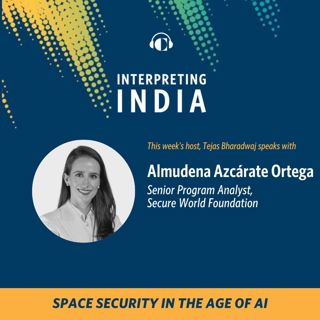
Almudena opens with a distinction that anchors the entire conversation: space security, unlike space safety, is about intentional harm. It concerns deliberate attempts to disrupt, deny, or destroy space systems and the services they provide, and it is discussed not in Vienna at COPUOS but in forums like the Conference on Disarmament and the UN General Assembly's First Committee in Geneva. AI, she argues, is not new to space systems, having been slowly integrated since the late 1990s for data processing and autonomous operations, but its implications for security are only beginning to surface in multilateral discussions.

On the opportunities AI presents, Almudena is clear: faster data processing for space situational awareness, smarter collision avoidance, more efficient Earth observation, and greater autonomy for robotic explorers in deep space. But she is equally clear about the risks. The black box nature of AI systems adds a layer of opacity to operations that are already difficult to attribute, and in a geopolitically tense environment, opacity contributes to escalation. She walks through a scenario that captures the danger precisely: an adversary feeding incorrect data to an AI system managing satellite manoeuvres, causing it to collide rather than avoid. The AI has not been weaponized in the traditional sense, but the satellite has, and liability under existing frameworks is far from straightforward.

On governance, Almudena resists the temptation to call for an entirely new treaty architecture. The Outer Space Treaty, she argues, was always a treaty of principles, functioning more like a constitution than a rulebook, and its core provisions on non-discrimination, responsibility, and due regard remain relevant in the age of AI. What is needed is not a replacement but a layered approach: applying existing principles thoughtfully, developing non-legally binding norms where binding agreements are politically out of reach, and remaining flexible enough to adapt as the technology evolves. She also flags cyber as the technology deserving the most urgent attention in the near term, given how deeply software-dependent space systems have become and how difficult cyber-attacks are to attribute and deter.

Episode Contributors

Tejas Bharadwaj is a senior research analyst with the Technology and Society Program at Carnegie India. He works on space law and policies, tracking India’s space sector developments as well as issues pertaining to space security and sustainability globally. He also works on AI in military domain, including Lethal Autonomous Weapon Systems (LAWS), defense tech partnerships and cybersecurity policies.

Almudena Azcárate Ortega is the lead researcher at UNIDIR's Space Security Programme. She is an experienced space lawyer and policy scholar and has briefed UN member states on the topic of space security law policy and has presented her research in multiple forums.

Every two weeks, Interpreting India brings you diverse voices from India and around the world to explore the critical questions shaping the nation's future. We delve into how technology, the economy, and foreign policy intertwine to influence India's relationship with the global stage.

As a Carnegie India production, hosted by Carnegie scholars, Interpreting India, a Carnegie India production, provides insightful perspectives and cutting-edge by tackling the defining questions that chart India's course through the next decade.

Stay tuned for thought-provoking discussions, expert insights, and a deeper understanding of India's place in the world.

Don't forget to subscribe, share, and leave a review to join the conversation and be part of Interpreting India's journey.

Denne episoden er hentet fra en åpen RSS-feed og er ikke publisert av Podme. Den kan derfor inneholde annonser.

Episoder(148)

AI Literacy and the Future of Work in India

AI Literacy and the Future of Work in India

Jaspreet's framing for the AI and work debate is worth staying with. He is not dismissive of disruption: he thinks AI will destroy certain jobs, create new ones, and the rupture will be real. But he p...

26 Mai 44min
Can AI Resources Be Democratized? AI Summit Special

Can AI Resources Be Democratized? AI Summit Special

This episode is part of our special series on the India AI Impact Summit, examining the conversations, decisions, and debates that are shaping global AI governance. The working group was designed from...

15 Mai 28min

An African Perspective for Building AI for Global South | AI Summit Special

An African Perspective for Building AI for Global South | AI Summit Special

This episode is part of our special series on the India AI Impact Summit, examining the conversations, decisions, and debates that are shaping global AI governance. Raymond draws a distinction early i...

30 Apr 48min

The India-EU Trade Deal: What It Delivers and What It Doesn't

The India-EU Trade Deal: What It Delivers and What It Doesn't

For most of the last decade, a trade deal between India and the EU seemed unlikely. The nudge came as the world changed around both. Nicolas points to three converging forces: the pressure of US tarif...

23 Apr 51min

From Bletchley Park to Delhi and What Comes Next | AI Summit Special

From Bletchley Park to Delhi and What Comes Next | AI Summit Special

This episode is part of our special series on the India AI Impact Summit 2026, examining the conversations, perspectives, and debates that are shaping global AI discourse. Tino has been in the room a...

16 Apr 54min

Data, AI, and the Laws Trying to Keep Up

Data, AI, and the Laws Trying to Keep Up

The conversation begins with a close look at India’s data protection regime, particularly the DPDP Act and its emphasis on consent. Nikhil challenges the perception that the law is overly consent-driv...

31 Mar 42min

Inside the Iran Conflict: Power, Strategy, and India’s Balancing Act

Inside the Iran Conflict: Power, Strategy, and India’s Balancing Act

The conversation begins with a look at where the conflict stands today and how Iran has managed to absorb significant military pressure while still responding in a measured way. Dharmendra explains ho...

25 Mar 1h 8min

Populært innen Politikk og nyheter

giver-og-gjengen-vg
aftenpodden
aftenpodden-usa
forklart
stopp-verden
popradet
fotballpodden-2
nokon-ma-ga
rss-gukild-johaug
det-store-bildet
rss-espen-lee-usensurert
hanna-de-heldige
dine-penger-pengeradet
rss-ness
lydartikler-fra-aftenposten
e24-podden
chit-chat-med-helle
aftenbla-bla
rss-utenrikskomiteen-med-bogen-og-grasvik
frokostshowet-pa-p5