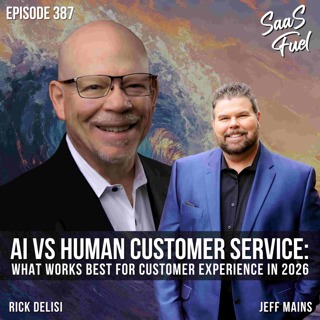
AI vs Human Customer Service: What Works Best for Customer Experience in 2026 | Rick DeLisi | 387

AI vs Human Customer Service: What Works Best for Customer Experience in 2026 | Rick DeLisi | 387

Most SaaS leaders are asking the wrong question. They obsess over NPS and CSAT scores, celebrate high satisfaction ratings, and then watch customers quietly disappear. In this episode, Jeff Mains sits down with Rick DeLisi — co-founder of The Effortless Experience, creator of the Customer Effort Score (CES), and Chief Evangelist at Glia — to challenge one of the most dangerous myths in customer experience: that satisfaction equals loyalty.

Rick reveals why the real driver of customer retention isn't how happy customers feel — it's how hard they had to work to get what they needed. He introduces the concept of "insidious disloyalty," explains why product failures are actually service failures in disguise, and lays out how AI can dramatically reduce customer effort when deployed correctly. For SaaS founders focused on retention, this episode is a fundamental shift in how to think about keeping customers.

Key Takeaways

4:22 — **The wrong question** — Rick explains why CSAT and NPS are company-centric metrics that don't predict future loyalty. The right question: "How much effort was required for you to get what you needed?"

6:35 — **Insidious disloyalty** — Customers who leave without saying a word are more dangerous than those who complain. Silent churn gives you no opportunity to recover the relationship or learn from the failure.

10:04 — **Customers want to stay** — Customers don't want to switch vendors. The goal isn't to build loyalty — it's to stop destroying it with high-effort experiences.

11:23 — **Mitigate disloyalty, don't try to promote loyalty** — Promoting loyalty is less fruitful than eliminating the friction that causes customers to start looking elsewhere.

14:37 — **There's no such thing as a product failure** — Every product failure immediately becomes a service issue. Future loyalty is shaped by how the service team responds, not by the failure itself.

29:15 — **The biggest misconception about customer service** — Not every interaction is a relationship-building moment. Forcing fake friendliness on transactional interactions feels disrespectful, not warm.

31:41 — **Neither extreme works** — Full automation fails just as surely as requiring humans for everything. The winning approach is intelligently routing issues to AI or live agents based on complexity.

41:59 — **Surveys are just the entry point** — Quantitative survey scores tell you almost nothing. The real insight comes from qualitative follow-up conversations, and you need far fewer than you think.

45:35 — **What customers are actually loyal to** — Customers aren't loyal to your company. They're loyal to their own decision to become your customer. Probe how your product makes them feel about themselves.

45:58 — **The reframe** — Stop asking what customers think of you. Start asking how customers feel about themselves as a result of choosing you.

Tweetable Quotes"The single question you can ask right after a service interaction to predict future loyalty: How much effort was required for you to get what you needed?" — Rick DeLisi"Insidious disloyalty is the customer who quietly disappears in the night. No explanation. No opportunity to recover. You didn't even learn anything." — Rick DeLisi"Trying to promote loyalty is far less fruitful than mitigating disloyalty." — Rick DeLisi"There's no such thing as a product failure. The moment something breaks, it becomes a service issue — and your customer's future loyalty depends on how you handle it." — Rick DeLisi"Customers aren't loyal to your company. They're loyal to their own decision to become your customer." — Rick DeLisi"Stop asking what customers think of you. Ask how customers feel about themselves as a result of being your customer." — Rick DeLisi"Your success in marketing is getting a customer to think about you 1% more. Your success in service is the moment they forget it was ever a problem." — Rick DeLisi"AI should be a part of every interaction — making things easier for customers, easier for your frontline, and more efficient for your company." — Rick DeLisiSaaS Leadership Lessons

1. The metric you're measuring may be the reason you're losing customers. CSAT and NPS are lagging, company-centric indicators. They make you feel good but don't predict churn. Customer Effort Score — how hard someone had to work to get what they needed — is the far more accurate signal. Build your CX measurement strategy around effort, not satisfaction.

2. Silent churn is the most expensive kind. Customers who leave without complaining are more costly than angry ones. Vocal detractors give you a chance to save the relationship and learn from it. The quiet exits give you nothing. Map your customer journey specifically to identify where insidious disloyalty can take root — low engagement, repeated friction, unanswered needs — before customers start shopping elsewhere.

3. Your job isn't to create loyalty. It's to stop destroying it. Customers who sign up with you are already loyal — they just made the decision to trust you. Your real job is to protect that trust by removing friction at every touchpoint. Every high-effort support interaction is a crack in the foundation of a relationship that took real sales effort to build.

4. Every product bug is a customer service test. When something breaks, customers don't remember the bug — they remember how you handled it. A fast, effortless resolution can actually strengthen loyalty. A slow, frustrating one will cost you the relationship even if you technically solved the problem. Invest in your service response capability as seriously as you invest in product quality.

5. AI reduces effort — but only when it knows its lane. Generic AI frustrates customers. Vertical, context-aware AI resolves routine issues instantly and hands off complex ones to live agents with full context already loaded. The bar for good AI in service is simple: does it make the customer's experience easier or harder? If a customer has to fight through your automation, you've made the problem worse.

6. In B2B SaaS, your champion's ego is part of the product. The person who bought your software has personal equity in that decision. When your product makes them look smart, delivers real ROI, and gives them a competitive edge internally, they become your best retention tool. When it doesn't, they quietly stop defending you. Probe how your product makes your champions feel about themselves — not just how it performs on paper.

Guest Resources

rick.delisi@glia.com

www.glia.com

https://www.linkedin.com/in/rick-delisi-1122257/

Episode Sponsor

The Futureproof Series - https://www.youtube.com/playlist?list=PLfkXKUPZ5xuOqMPR7_gzGybncTtavyR1N

The Captain's Keys

Small Fish, Big Pond – https://smallfishbigpond.com/ Use the promo code ‘SaaSFuel’

Champion Leadership Group – https://championleadership.com/

SaaS Fuel Resources

Website - https://championleadership.com/

Jeff Mains on LinkedIn - https://www.linkedin.com/in/jeffkmains/

Twitter - https://twitter.com/jeffkmains

Facebook - https://www.facebook.com/thesaasguy/

Instagram - https://instagram.com/jeffkmains

Denne episoden er hentet fra en åpen RSS-feed og er ikke publisert av Podme. Den kan derfor inneholde annonser.

Episoder(433)

432 | How Cross-Functional Alignment Prevents Costly Project Failures | Deborah Kaminetzky

432 | How Cross-Functional Alignment Prevents Costly Project Failures | Deborah Kaminetzky

A software implementation can be delivered on time and on budget, then fail the moment people refuse to use it.In this episode, Jeff Mains talks with Deborah Kaminetzky, founder of De Facto Project Ma...

15 Okt 47min
431 | The Hidden Work Behind Cross-Border Supply Chains | Daman Grewal

431 | The Hidden Work Behind Cross-Border Supply Chains | Daman Grewal

Daman Grewal grew a logistics company from $1 million to $24 million in four years, working across dispatch, safety, accounts receivable, and sales before he fully recognized the skills he was buildin...

13 Okt 53min
430 | Revenue Per Employee, Capital Efficiency, and the Future of Startup Growth | Lindsey Mignano

430 | Revenue Per Employee, Capital Efficiency, and the Future of Startup Growth | Lindsey Mignano

Are you raising venture capital because your business needs it—or because getting funded feels like proof you’ve made it?In this episode of Futureproof Founder, Jeff Mains sits down with Lindsey Migna...

8 Okt 54min
429 | AI, Education, and the Decline of Independent Thinking | Jonathan Schaeffer

429 | AI, Education, and the Decline of Independent Thinking | Jonathan Schaeffer

Are you using AI to make better decisions—or letting a confident answer do your thinking for you?In this episode of Futureproof Founder, Jeff Mains sits down with AI researcher and entrepreneur Jonath...

6 Okt 57min

428 | Intellectual Property for Founders: Trademarks, Patents, Copyright, and Trade Secrets | James Gourley

428 | Intellectual Property for Founders: Trademarks, Patents, Copyright, and Trade Secrets | James Gourley

Jeff Mains sits down with James Gourley, a patent attorney and IP litigator who has spent 20 years on both sides of intellectual property disputes — from filing patents and trademarks to defending com...

1 Okt 42min
427 | Customer Outcomes, AI Adoption, and the New Software Economy | Carl Lenocker

427 | Customer Outcomes, AI Adoption, and the New Software Economy | Carl Lenocker

Jeff Mains sits down with Carl Lenocker, a 30-year enterprise software veteran who started in Silicon Valley in the '80s, survived the dot-com bust, and now consults founders on what actually creates ...

29 Sep 45min
426 | How Founders Can Turn AI Whiplash Into Strategic Focus | David Fung

426 | How Founders Can Turn AI Whiplash Into Strategic Focus | David Fung

David Fung spent 15 years at Salesforce as a Senior Director before walking away from unvested RSUs to launch Coachful Coaching. He now coaches CTOs and tech leaders on the pattern he calls "AI whipla...

24 Sep 46min
425 | Product-Market Fit Starts with Understanding the User | Erin Rollenhagen

425 | Product-Market Fit Starts with Understanding the User | Erin Rollenhagen

Erin Rollenhagen learned the most expensive lesson in product development the hard way: she spent years building software without ever talking to a single end user—and people took early retirement to ...

22 Sep 46min

Populært innen Business og økonomi

stopp-verden
dine-penger-pengeradet
e24-podden
rss-penger-polser-og-politikk
rss-borsmorgen-okonominyhetene
rss-skravla-gar
rss-pa-konto
pengepodden-2
livet-pa-veien-med-jan-erik-larssen
tid-er-penger-en-podcast-med-peter-warren
utbytte
lederpodden
finansredaksjonen
stormkast-med-valebrokk-stordalen
rss-markedspuls-2
morgenkaffen-med-finansavisen
pengesnakk
rss-orjasater
okonomiamatorene
liberal-halvtime